



Estate planning in California comes with its own set of hurdles. Property values across San Diego County and the greater San Diego area regularly push estates past the probate threshold. Community property rules, Proposition 19, and shifting tax laws add layers of complexity. A plan that works in Texas or Florida may fall short under California law.
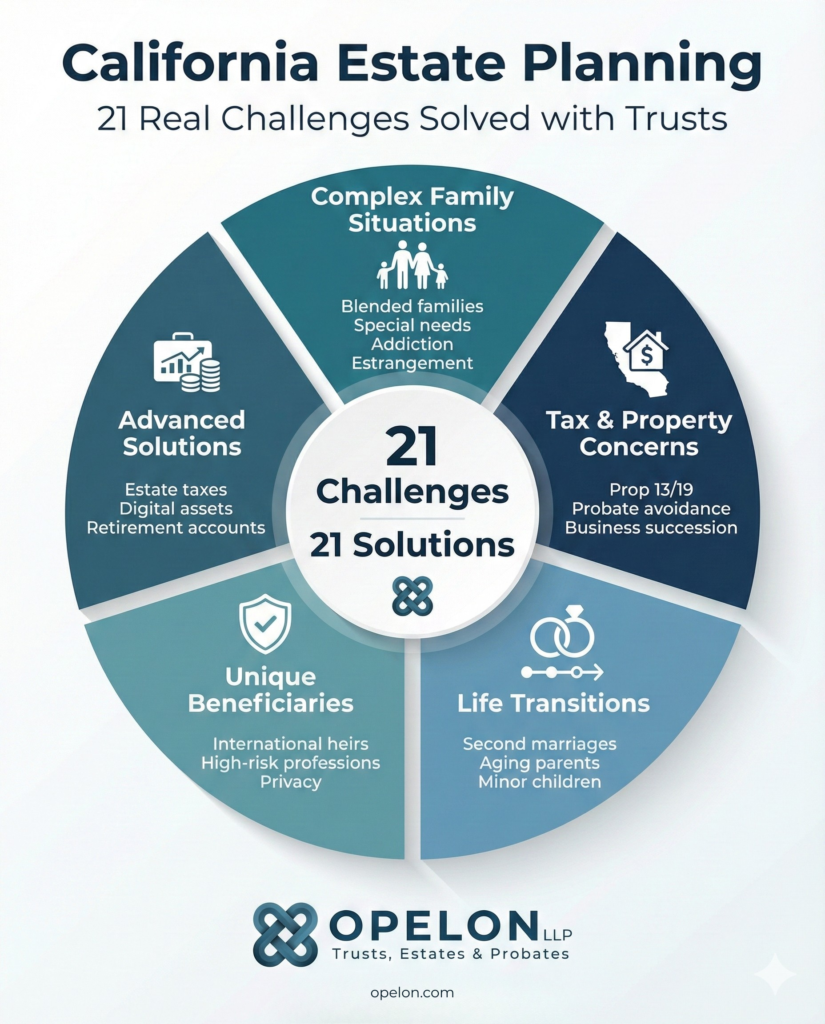
That is why a cookie-cutter approach rarely works here. Whether you are part of a blended family in Carlsbad, caring for aging parents in North County, or protecting a child with special needs, your estate plan should reflect your life. This California estate planning case study walks through 21 scenarios and the trust-based solutions that California families actually use.
Key Takeaways • Blended families, special needs dependents, and high-value real estate all require trust structures tailored to California law. • Revocable living trusts remain the most effective way to avoid California probate and its statutory fees (based on gross estate value under Probate Code §10810). • Proposition 19 changed property tax rules for inherited real estate, making advance planning more important than ever. • Advanced tools like ILITs, GRATs, and charitable remainder trusts can significantly reduce federal estate tax exposure, especially before the current exemption sunsets. • Every scenario below is based on common situations California families face. An experienced estate planning attorney can customize solutions to fit your goals. |
Table of Contents
Trusts for Complex Family Situations in California
California families with blended households, dependents with disabilities, or strained relationships face estate planning challenges that a basic will cannot solve. Trusts offer the flexibility to protect every family member while keeping your wishes legally enforceable.
Case 1: Protecting a Blended Family’s Inheritance
The Challenge: Blended families are increasingly common in California. One of the biggest hurdles is making sure children from a prior relationship receive their inheritance while still providing for a surviving spouse.
The Solution: A Qualified Terminable Interest Property (QTIP) trust allows the surviving spouse to benefit from the estate during their lifetime. After the spouse passes, the remaining assets transfer to children from the prior marriage. This structure reduces family tension and provides a clear, legally enforceable roadmap.
Case 2: Providing for a Child with Special Needs
The Challenge: A direct inheritance can disqualify a child with disabilities from critical programs like SSI or Medi-Cal.
The Solution: A Special Needs Trust (SNT) lets families set aside assets to improve the child’s quality of life without jeopardizing public benefits eligibility. The trust can pay for education, recreation, and services that government programs do not cover.
Case 3: Shielding a Beneficiary Struggling with Addiction
The Challenge: Leaving a lump sum to someone dealing with substance abuse can cause more harm than good.
The Solution: A discretionary (or “dole-out”) trust gives the trustee full control over distributions. Some families also include incentive provisions tied to treatment milestones. This protects the inheritance and supports the beneficiary’s recovery.
Case 4: Disinheriting or Limiting a Child’s Share
The Challenge: Intentionally leaving someone out of an estate plan can lead to legal challenges, especially in California.
The Solution: A trust that specifically names the child and explains the decision is far stronger than simply omitting them. Including a no-contest clause (in terrorem clause) can discourage challenges by conditioning other beneficiaries’ shares on their acceptance of the trust terms. Work with a California estate planning attorney to draft this language carefully.
California Property Tax and Probate Avoidance Strategies
High property values and California-specific tax rules like Proposition 19 make real estate one of the most important (and most misunderstood) parts of estate planning.
Case 5: Keeping Property Taxes Low After Inheriting Real Estate
The Challenge: Under Proposition 19 (effective February 16, 2021), children who inherit property may face a reassessment to current market value unless specific conditions are met.
The Solution: Families can plan transfers while the parent is still alive, using a combination of trust structures and (in some cases) entity arrangements, to preserve the Proposition 13 tax base where allowed. Timing and strategy are critical, and the rules have narrow exceptions. This is one area where professional guidance is especially valuable.
California Note Proposition 19 replaced the broad parent-child exclusion that existed under Propositions 58 and 193. Now, the exclusion applies only to a primary residence transferred to a child who uses it as their own primary residence, and only up to a $1 million reassessment cushion above the existing base year value. Investment and rental properties no longer qualify for the exclusion. |
Case 6: Avoiding Probate on High-Value Real Estate
The Challenge: California’s probate threshold is $208,850 (effective April 1, 2025, and adjusted periodically under Probate Code §13100). With median home prices well above that amount in most of San Diego County, even modest estates can be pulled into probate.
The Solution: A revocable living trust is the most effective way to avoid probate in California. When the trust is properly funded (meaning your assets are titled in the trust’s name), real estate and other property transfer directly to your beneficiaries without court oversight. This saves time, reduces legal costs, and keeps your family’s financial details private.
What Probate Actually Costs in California
Statutory attorney and executor fees under Probate Code §10810 are based on the gross value of the estate (mortgage balances are not subtracted):
Gross Estate Value | Attorney Fee | Executor Fee | Total Statutory Fees |
$500,000 | $13,000 | $13,000 | $26,000 |
$750,000 | $18,000 | $18,000 | $36,000 |
$1,000,000 | $23,000 | $23,000 | $46,000 |
$1,500,000 | $28,000 | $28,000 | $56,000 |
$2,000,000 | $33,000 | $33,000 | $66,000 |
Note: These are statutory minimums. Additional “extraordinary fees” may apply for selling real property, tax issues, or complex accounting. A revocable living trust can help your family avoid these costs entirely.
Case 7: Equalizing Inheritances When One Child Takes Over the Business
The Challenge: When one child wants to continue the family business and the others do not, dividing the estate fairly becomes complicated.
The Solution: A combination of buy-sell agreements and trust allocations can provide balance. For example, the business can pass to the interested child, while other heirs receive life insurance proceeds or non-business assets of equal value. A California estate planning attorney can structure these arrangements for both tax efficiency and family harmony.
Estate Planning for Major Life Changes
Marriage, aging parents, and growing families all create moments when an estate plan needs to adapt. These scenarios show how trusts handle common life transitions under California law.
Case 8: Second Marriages and Protecting Both Sides
The Challenge: In a second marriage, a surviving spouse’s legal rights can conflict with what the children from a prior marriage expect to receive.
The Solution: Coordinating a prenuptial agreement with a trust ensures both the new spouse and the children are protected. A trust can clearly define what each party receives, reducing the risk of disputes. This is especially important in California, where community property rules apply automatically to married couples.
Case 9: Protecting Assets While Caring for Aging Parents
The Challenge: Long-term care costs can drain a family’s estate quickly, especially if a parent needs to qualify for Medi-Cal.
The Solution: Irrevocable trusts, when properly structured and timed, can move assets out of a parent’s name while potentially helping them qualify for Medi-Cal benefits. These trusts must comply with Medi-Cal’s look-back and transfer penalty rules. Early planning is essential because transfers made within the look-back period may result in a period of ineligibility.
Case 10: Inheritance Planning for Minor Children
The Challenge: Children under 18 cannot legally inherit or manage property in California. Without a plan, a court-supervised guardianship may be required.
The Solution: A minor’s trust within a revocable living trust names a trustee to manage assets until the child reaches a designated age. Many parents choose staggered distribution ages (for example, portions at 25, 30, and 35) to encourage financial maturity.
Trusts for Unique Beneficiary Situations
Not every beneficiary fits a standard mold. International heirs, professionals in high-liability fields, and families who value privacy all benefit from specialized trust structures.
Case 11: International Beneficiaries
The Challenge: When heirs live in another country, cross-border estate transfers can trigger IRS reporting requirements and foreign tax complications.
The Solution: Trusts designed with international tax compliance in mind, including careful trustee selection and language addressing currency exchange and residency rules, can help minimize complications. Families in this situation should work with an attorney experienced in both California estate law and international tax planning.
Case 12: Protecting Heirs in High-Risk Professions
The Challenge: Beneficiaries who are doctors, business owners, or landlords face a higher risk of lawsuits. An outright inheritance could be exposed to creditors.
The Solution: Spendthrift provisions and irrevocable trust structures can help shield inherited wealth from creditors and legal judgments in California. These protections keep the inheritance in the trust, out of the beneficiary’s personal estate.
Case 13: Keeping Estate Transfers Private
The Challenge: Probate is a public process in California. Court filings become part of the public record, meaning anyone can look up your family’s assets and beneficiaries.
The Solution: A trust avoids probate entirely, which means your estate details stay private. Unlike a will, a trust does not need to be filed with the court. This is especially important for high-net-worth families and those with complex estates in San Diego County and across California.
Advanced Estate Planning Strategies for California Families
For larger estates or families with specific tax concerns, advanced trust strategies can preserve significantly more wealth for the next generation.
Case 14: Reducing Federal Estate Tax Exposure
The Challenge: The current federal estate tax exemption is $13.99 million per individual (2025), but this amount is scheduled to sunset after 2025, potentially dropping to roughly half. Large estates in California face significant exposure.
The Solution: Irrevocable Life Insurance Trusts (ILITs), Grantor Retained Annuity Trusts (GRATs), and Charitable Remainder Trusts (CRTs) can reduce estate tax burdens while preserving family wealth. These tools require precise drafting but can save families hundreds of thousands, or even millions, in taxes over time.
Important The federal estate tax exemption is set to decrease significantly after 2025 unless Congress acts. Families with estates approaching the current exemption should consider acting sooner rather than later. |
Case 15: Planning for Digital Assets
The Challenge: Without proper planning, families may struggle to access email accounts, social media profiles, cloud storage, and cryptocurrency after a loved one passes.
The Solution: Modern trusts should include digital asset provisions that authorize a fiduciary to access and manage online accounts. Creating a digital asset inventory and storing credentials securely (using encrypted platforms) helps ensure nothing is lost.
Case 16: Coordinating Trusts with Retirement Accounts
The Challenge: Incorrectly naming beneficiaries on IRAs, 401(k)s, or annuities can trigger immediate taxation and reduce the long-term value of these accounts.
The Solution: A Standalone Retirement Trust (SRT) can help pass retirement accounts in a tax-efficient manner. These trusts may extend the distribution timeline, protect heirs from poor financial decisions, and shield retirement assets from creditors. Under the SECURE Act, most non-spouse beneficiaries must withdraw inherited IRA funds within 10 years, making trust coordination even more important.
Emerging Estate Planning Needs in a Changing California
California’s housing market, family dynamics, and natural disaster risks create estate planning needs that did not exist a generation ago. These newer scenarios are becoming more common every year.
Case 17: Helping Adult Children with Housing
The Challenge: In high-cost areas like San Diego, Los Angeles, and San Francisco, adult children often struggle to afford housing. Parents may gift or co-own property without considering the long-term consequences.
The Solution: A Qualified Personal Residence Trust (QPRT) or a limited partnership structure can let parents help with housing while protecting the equity and maintaining control. These tools also help reduce estate tax exposure and clarify ownership if family circumstances change.
Case 18: Protecting Inheritances from Divorce
The Challenge: Inherited assets can become mixed with marital property during a marriage, making them vulnerable in a divorce.
The Solution: A separate property trust keeps inherited assets clearly separated from community property. California is a community property state, so intentional title management and trust structure are critical to preserving family wealth for the intended beneficiary.
Case 19: Pet Care Planning
The Challenge: Pet owners, especially seniors and individuals without children, worry about who will care for their animals after death or incapacity.
The Solution: A pet trust (authorized under California Probate Code §15212) designates a caregiver and sets aside funds for the pet’s care. The trust can include specific instructions about food, veterinary care, and living arrangements.
Case 20: Charitable Giving Through Your Estate Plan
The Challenge: Many Californians want to support charitable causes but are unsure how to do it in a way that also benefits their estate.
The Solution: Charitable remainder trusts (CRTs), donor-advised funds (DAFs), and family foundations allow you to leave a meaningful legacy while potentially reducing estate and income taxes. These tools work especially well for individuals with highly appreciated assets like real estate or stock.
Case 21: Emergency Access to Estate Documents
The Challenge: In areas prone to wildfires, earthquakes, and other natural disasters (common across Southern California), quick access to estate documents can be critical.
The Solution: Include emergency planning in your trust strategy. Digital backups, cloud-based storage, and a portable estate summary binder ensure that trustees and family members can access key documents during evacuations or power outages. Review and update these materials annually.
Which Type of Trust Fits Your Situation?
This comparison table summarizes the trust types covered in this California estate planning case study and the situations where each one applies.
Trust Type | Best For | See Case(s) |
Revocable Living Trust | Avoiding probate, privacy, incapacity planning | Cases 6, 10, 13 |
QTIP Trust | Blended families, protecting children from prior marriage | Case 1 |
Special Needs Trust | Preserving public benefits eligibility | Case 2 |
Discretionary Trust | Beneficiaries with addiction or financial issues | Case 3 |
Irrevocable Trust | Medi-Cal planning, asset protection, tax reduction | Cases 9, 12, 14 |
ILIT | Removing life insurance from taxable estate | Case 14 |
GRAT | Transferring appreciating assets at reduced gift tax cost | Case 14 |
QPRT | Transferring residence at reduced tax value | Case 17 |
CRT / DAF | Charitable giving with tax benefits | Case 20 |
Pet Trust | Ensuring care for companion animals | Case 19 |
Standalone Retirement Trust | Tax-efficient transfer of IRAs and 401(k)s | Case 16 |
Frequently Asked Questions About California Estate Planning
A California estate planning case study is a real-world example showing how a family used trusts and other legal tools to solve a specific estate planning challenge under California law. These scenarios help readers understand how different strategies apply to common situations.
Statutory probate fees in California are set by Probate Code §10810 and are based on the gross value of the estate. For a $1 million estate, combined attorney and executor fees total $46,000. Mortgage balances are not subtracted from the gross value when calculating fees.
As of April 1, 2025, estates with California assets exceeding $208,850 in gross value generally require formal probate. This threshold adjusts periodically based on the Consumer Price Index under Probate Code §13100.
Yes. A properly funded revocable living trust allows assets to transfer directly to beneficiaries without court involvement. This is the most common reason California families create trusts, especially families with real estate.
Proposition 19, effective February 16, 2021, significantly limited the parent-child property tax exclusion. Now, only a primary residence transferred to a child who uses it as their own primary residence qualifies for the exclusion, and only up to a $1 million cushion above the existing base year value.
Even smaller estates may benefit from a trust. A trust provides incapacity planning, privacy, and the ability to control how and when assets pass to beneficiaries. It also avoids the delays and costs associated with court-supervised transfers.
Under the SECURE Act, most non-spouse beneficiaries must withdraw inherited IRA and 401(k) funds within 10 years. This accelerated timeline can create a significant tax burden. A Standalone Retirement Trust can help manage distributions and protect assets.
A Special Needs Trust (SNT) holds assets for a beneficiary with disabilities without affecting their eligibility for government programs like SSI or Medi-Cal. It is needed whenever a family wants to supplement (not replace) public benefits for a loved one with special needs.
About the Author
Matt Odgers, Esq. is a Founding Partner and Director of Marketing and Operations at Opelon LLP, a trust, estate, and probate law firm based in Carlsbad, California. A San Diego County native who grew up in Ramona, Matt earned his J.D. from Thomas Jefferson School of Law in San Diego and holds a B.A. in Political Science from Purdue University.
Matt’s commitment to client service and legal excellence has earned him numerous accolades, including Best Lawyers: Ones to Watch in America (2026), the Carlsbad Chamber of Commerce 40 Under 40 (2023), and recognition as a Super Lawyers Rising Star (2017, 2018, 2019). He received the Wiley W. Manuel Award for Pro Bono Legal Services from the State Bar of California (2016) and maintains a 10.0 Superb rating on Avvo in both Business Law and Estate Planning.
Matt is admitted to the State Bar of California (Bar #290722) and is committed to providing compassionate, effective legal guidance to families navigating estate planning and probate matters throughout San Diego County.
Legal Disclaimer This article provides general information about California estate planning law and is for educational purposes only. It does not constitute legal advice and does not create an attorney-client relationship. Estate planning laws are complex and change frequently. The information in this article was accurate as of March 2026. For advice about your specific situation, please consult with a qualified California estate planning attorney. The information on this website applies to California law only. Estate planning laws vary significantly by state. If you own property in multiple states or live outside California, consult an attorney licensed in those jurisdictions. Threshold amounts referenced in this article are current as of the dates noted and adjust periodically. Verify current amounts before making decisions based on these figures. |