Serving as an executor in California can feel overwhelming. You may be grieving while trying to make sound decisions for your family. Someone trusted you to carry out their final wishes. The legal process behind that role may be entirely new to you.
This guide explains what an executor does in practical terms. It shows how California probate works in San Diego County. It walks through the fiduciary duties you must follow. It also flags common mistakes and areas of potential executor liability.
You may be serving as an executor right now. You may have been named in a will. You may be choosing an executor for your own estate plan. Either way, understanding this role helps you move forward with confidence. The OJ Simpson estate planning lessons are a public reminder of how much rides on choosing the right person.
Key Takeaways for California Executors
Here are the core facts before you read on. These points summarize the main executor duties in California.
An executor is the person named in a valid will to manage a deceased person’s estate. If no will exists, the court appoints an administrator with the same core duties.
Executors are fiduciaries under California law. They must act with loyalty, care, and impartiality toward every beneficiary at all times.
California probate usually takes 9 to 18 months in San Diego County. The Inventory and Appraisal is due within four months after Letters are issued.
Executor fees follow a statutory schedule under Probate Code section 10800. The fee is based on the gross value of the estate, not the net equity after debts.
Most California executors benefit from working with a local probate attorney. That is especially true when real estate, creditor disputes, or tax issues arise.
What Is an Executor in California?
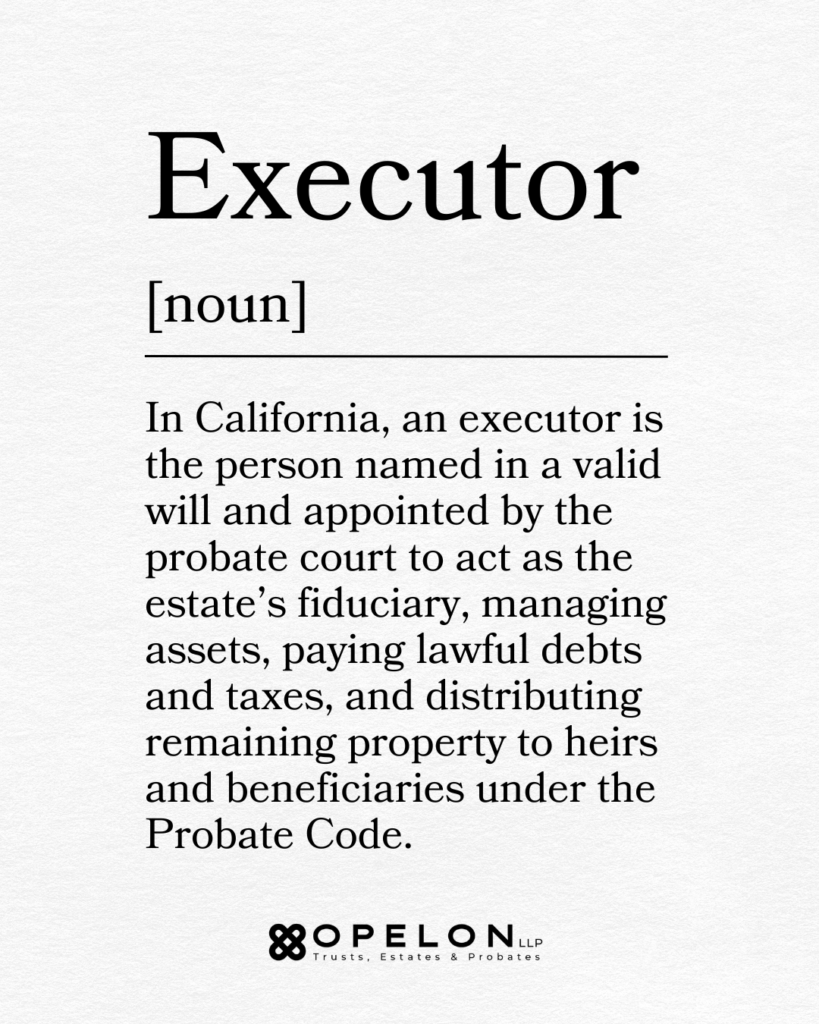
An executor is the person named in a valid California will to carry out the deceased person’s wishes and manage the estate through probate. If there is no will, the court appoints an administrator to perform the same duties.
Under the California Probate Code, an executor is a personal representative and a fiduciary. That legal status carries real weight. You must act with honesty, care, and loyalty toward the estate and its beneficiaries. This duty applies at every stage of administration.
In practical terms, the executor handles three main jobs. First, you gather and protect the estate’s assets. Then you handle debts and taxes. Finally, you distribute what remains to the beneficiaries. Courts often supervise this work when probate is required.
Who Can Serve as Executor in California?
Executors are most often family members: a surviving spouse, an adult child, or a sibling. Some people choose a close friend, a professional fiduciary, or, for larger estates, a bank or trust company.
In most California probate cases, the court will appoint the person named in the will if that person meets the following general requirements:
Requirement
Details
Age
Must be at least 18 years old
Competency
Must be of sound mind (not subject to a conservatorship of the person)
Residency
Non-residents may serve but may need to post a bond.A non-U.S. resident may not serve as an administrator (Prob. Code § 8402(a)(4)); this restriction does not apply to a person named as executor in a valid will.
Criminal history
California law does not disqualify a proposed executor based on a criminal conviction alone. Disqualification instead turns on being a minor, incapacity, or conduct that would support removal for cause, such as fraud or a conflict of interest (Prob. Code § 8402).
Willingness
Must be willing to accept the appointment and take the required oath
If the named executor is unwilling, unable, or legally disqualified, the court looks to any alternate named in the will. If no alternate is named, the court follows Probate Code priority rules to appoint an administrator.
Executor vs. Administrator: What Is the Difference?
California uses different titles depending on whether a valid will exists, but the core responsibilities are nearly identical:
This is the classic executor vs administrator California comparison.
Factor
Executor
Administrator
Appointment source
Named in the decedent’s valid will
Appointed by the court when no will exists or named executor cannot serve
Court document issued
Letters Testamentary (Form DE-150)
Letters of Administration (Form DE-150)
Distribution rules
Follows the terms of the will
Follows California intestacy law (Prob. Code secs. 6400-6414)
Bond requirement
May be waived by the will
Often required unless waived by all heirs
Core duties
Same: inventory assets, pay debts, distribute
Same: inventory assets, pay debts, distribute
Who Can Serve as Executor in California?
Executors are most often family members. A surviving spouse, an adult child, or a sibling commonly serves. Some people choose a close friend or a professional fiduciary. For larger estates, a bank or trust company may serve.
In most California probate cases, the court appoints the person named in the will. That person must meet a few general requirements.
Requirement
Details
Age
Must be at least 18 years old.
Competency
Must be of sound mind and not under a conservatorship of the estate.
Residency
Non-residents may serve but may need to post a bond. A non-U.S. resident may not serve as an administrator (Prob. Code § 8402(a)(4)). This limit does not apply to a person named as executor in a valid will.
Criminal history
A criminal conviction alone does not disqualify a proposed executor. Disqualification turns on being a minor, incapacity, or conduct that supports removal for cause, such as fraud or a conflict of interest (Prob. Code § 8402).
Willingness
Must accept the appointment and take the required oath.
Sometimes the named executor cannot or will not serve. The court then looks to any alternate named in the will. If no alternate is named, the court follows Probate Code priority rules to appoint an administrator.
Executor vs. Administrator: What Is the Difference?
California uses different titles based on whether a valid will exists. The core responsibilities stay nearly identical. This is the classic executor versus administrator comparison in California.
Factor
Executor
Administrator
Appointment source
Named in the decedent’s valid will
Appointed by the court when no will exists or the named executor cannot serve
Court document issued
Letters Testamentary (Form DE-150)
Letters of Administration (Form DE-150)
Distribution rules
Follows the terms of the will
Follows California intestacy law (Prob. Code §§ 6400-6414)
Bond requirement
May be waived by the will
Often required unless waived by all heirs
Core duties
Inventory assets, pay debts, distribute
Inventory assets, pay debts, distribute
Core Fiduciary Duties of a California Executor
Serving as an executor is a legal responsibility, not just a family role. California law imposes four primary fiduciary duties on every personal representative. A violation can lead to personal liability, removal, or both.
Duty of Loyalty
You must put the interests of the estate and its beneficiaries ahead of your own. Self-dealing means profiting personally from estate transactions. Secret profits and hidden conflicts of interest are also prohibited.
Either problem can lead to removal or a surcharge order. This duty applies even when you are also a beneficiary. That situation is common in family estates.
Duty of Care and Prudence
You must manage estate assets with reasonable care throughout the administration. Keep estate money in a clearly labeled, separate estate account. Never mix estate funds with personal accounts.
Confirm that real estate and other property carry adequate insurance. This matters most when a home sits vacant. Obtain professional appraisals when needed to value assets accurately. Consult qualified legal or tax advisors for complex issues.
Duty of Impartiality
With multiple beneficiaries, you must treat all of them fairly. Follow the will’s instructions, or the intestacy rules, without favoring one heir. This duty holds even when you feel closer to one beneficiary.
Duty to Account and Disclose
You must keep clear, complete records of every estate transaction. You must also provide required notices and financial reports to the court and beneficiaries. Transparency is one of the best ways to prevent disputes. Beneficiaries who feel informed are less likely to challenge the administration.
The California Probate Code sets specific notice and accounting requirements. Missing them can cause delays, court orders, or personal liability.
The 6 Phases of California Executor Administration
Every estate is different, but most California probate cases follow a similar sequence. The phases below describe the common path for estates in San Diego County. Exact timing depends on the court’s schedule and the estate’s complexity.
Order several certified copies of the death certificate. You will need more than you expect.
Secure the home and other property. Check locks, manage mail, keep utilities paid, and confirm insurance.
Make an initial list of major assets and known debts.
These first steps focus on protection and preservation, not legal filings.
Phase 2: Opening the Probate Case
File a Petition for Probate (Form DE-111) with the San Diego County Superior Court, Probate Division. Attach the original will and a certified death certificate.
Give required written notice of the hearing to all heirs and named beneficiaries.
Attend a short hearing where the judge validates the will and confirms your appointment.
Obtain Letters Testamentary (Form DE-150). This is your official proof of authority for banks, title companies, and third parties.
Phase 3: Inventory and Appraisal
Identify, list, and value all probate assets.
File the Inventory and Appraisal (Forms DE-160 and DE-161). Under Probate Code section 8800, it is generally due within four months after Letters are issued.
A court-appointed Probate Referee values non-cash assets. These include real estate, investment accounts, and business interests.
Start with a room-by-room list of personal property. Add bank and brokerage statements plus any San Diego real property or business interests.
Phase 4: Creditor Claims and Debts
Send required written notices to all known or reasonably discoverable creditors.
Review each claim for validity. The creditor claim period generally runs four months from the date Letters are first issued (Probate Code section 9100). Late notice to a known creditor can extend that deadline in some cases.
Pay approved claims from estate funds in the required order of priority under California law.
Reject improper or late claims in writing. A probate attorney can help with this step.
Phase 5: Taxes and Ongoing Management
Coordinate the deceased person’s final federal and California income tax returns.
File estate income tax returns if the estate earns significant income during administration.
Keep managing estate assets. Pay ongoing expenses such as insurance, utilities, and maintenance.
Keep detailed records of every financial transaction in this phase.
Phase 6: Final Accounting and Distribution
Prepare a detailed accounting of all estate income, expenses, and transactions. A simplified report may work where beneficiaries waive the accounting.
File a Petition for Final Distribution. This asks the court to approve the accounting and authorize distributions.
Once the court approves, transfer assets to beneficiaries and obtain signed receipts.
File a petition for final discharge. This closes the estate and ends your authority for future actions. It does not erase liability for actions taken before discharge, under Probate Code sections 12250 and 11753.
Executor Task and Timeline Overview
The table below connects common executor tasks with the relevant court forms and typical deadlines in a California probate.
Task
Court Form(s)
Typical Deadline / Outcome
File Petition for Probate
DE-111
File as soon as possible after death; sets the hearing date
Obtain Letters Testamentary
DE-150
Issued at or shortly after the initial hearing
File Inventory and Appraisal
DE-160 / DE-161
Within 4 months of Letters being issued (Prob. Code § 8800)
Notify creditors
Published notice plus written notice
Creditor claim period: generally 4 months from Letters (Prob. Code § 9100)
File final and estate income tax returns
IRS / FTB forms
Varies; consult a CPA or tax advisor
File Petition for Final Distribution
Attorney-drafted petition; proposed Order for Final Distribution submitted with it
After debts, taxes, and expenses are resolved
Obtain court order and distribute
Court order
Upon court approval of the final distribution petition
File for discharge and close estate
Ex Parte Petition for Final Discharge and Order (DE-295)
After distributions complete and receipts obtained
SAN DIEGO NOTE
San Diego County probate matters are heard through the Probate Division of the San Diego County Superior Court. In most straightforward, uncontested estates, the full process takes about 9 to 18 months from filing to final discharge. Estates with real property sales, creditor disputes, or tax issues can take longer.
Managing Estate Assets: Practical Steps for California Executors
Good asset management takes detailed, ongoing work throughout the administration. Common practical steps include the following.
Protect real property. Change locks promptly, arrange regular property checks, and confirm adequate insurance, especially for a vacant home.
Secure valuable personal property. Store jewelry, collectibles, and important documents in a safe place as soon as practical.
Contact banks and financial institutions with certified copies of the Letters. This confirms account balances and prevents unauthorized activity.
Maintain a running inventory of all discovered assets. Update it as new information arrives, and attach receipts and appraisal reports.
Keep both a digital and a physical copy of the inventory. This supports later accountings and protects against claims of mismanagement.
Communicating with Beneficiaries
One of the most overlooked parts of the executor’s role is keeping beneficiaries informed. Clear, consistent communication prevents misunderstandings. It also lowers the chance of disputes.
Share key documents when California law requires it. These include inventories, notices of court filings, and approved financial reports.
Explain the general timeline and next steps in plain language. Assume beneficiaries have no legal background.
Respond to reasonable questions about timing and distribution. A pending matter is still a fair answer.
Keep copies of all emails, letters, and written communications in the estate file.
You do not have to share every detail in real time. Still, a regular flow of information builds trust. It also helps the estate move toward timely distribution.
What an Executor Cannot Do: Common Pitfalls to Avoid
Even well-meaning executors make costly mistakes. The actions below are either prohibited or require advance court approval. Get legal guidance before proceeding.
Prohibited or Restricted Action
Legal Principle
Correct Approach
Using estate funds for personal expenses
Breach of fiduciary duty and duty of loyalty
Keep a separate estate account; document every disbursement
Selling property to yourself or family at a reduced price
Self-dealing and conflict of interest
Get full disclosure, a fair market appraisal, and court approval
Distributing to beneficiaries before debts are resolved
Creditors are paid before beneficiaries
Confirm all debts, taxes, and expenses are paid or set aside first
Failing to give required notices to creditors or beneficiaries
Probate Code notice requirements
Follow statutory deadlines; consult a probate attorney if unsure
Mixing estate funds with personal accounts
Duty of care and commingling ban
Open a clearly labeled estate account right away
Taking major actions without court approval
Court supervision requirements
Petition the court for instructions before proceeding
IMPORTANT
Not sure whether an action is allowed? The safest course is to ask the probate court for instructions or consult a San Diego probate attorney first. Personal liability for improper executor actions can be significant and hard to reverse.
The estate’s attorney earns the same statutory fee under Probate Code section 10810. For most California estates, the combined statutory fees are effectively doubled.
Common Estate Examples (Combined Statutory Fees)
Gross Estate Value
Executor Fee
Attorney Fee
Combined Total
$300,000
$9,000
$9,000
$18,000
$500,000
$13,000
$13,000
$26,000
$750,000
$18,000
$18,000
$36,000
$1,000,000
$23,000
$23,000
$46,000
$1,500,000
$28,000
$28,000
$56,000
GROSS VALUE NOTE
Fees are calculated on the gross appraised value of the estate, not the net equity. Say a home is worth $1,000,000 but carries a $600,000 mortgage. The fee is still based on the full $1,000,000. This often surprises San Diego County families whose main asset is real property with significant debt.
A few more points apply to executor compensation.
You may request extra “extraordinary” compensation for unusual services. Examples include running a business, handling litigation, or complex tax work. The court must approve any extraordinary fee.
Family members who are also beneficiaries sometimes waive the executor fee. They are not required to do so.
Document any nonstandard fee arrangement clearly. Where disputes are possible, submit it to the court for approval.
How to Reduce Personal Liability as a California Executor
Serving as an executor always carries some risk. Disciplined record-keeping and procedural compliance manage most of it. These habits also limit executor liability during probate.
Follow Probate Code procedures and deadlines. The Inventory and Appraisal deadline and the creditor claim period matter most. Missing them can create personal exposure.
Keep estate funds completely separate. Open a clearly labeled estate account right away. Never deposit estate receipts into a personal account.
Document all decisions, payments, and communications. A well-kept estate file is your main defense against later claims.
Seek court approval for major or disputed transactions. When in doubt, petition the court for instructions.
Work with a local probate attorney. In San Diego County, good guidance helps you avoid costly technical mistakes.
In most estates, consulting a probate attorney early costs far less than fixing a dispute. It also helps you avoid a surcharge order. A surcharge order is a court directive requiring an executor to repay funds to the estate from personal assets.
Most routine California probate cases take 9 to 18 months from the initial filing to final discharge. Busy court calendars, real estate sales, unresolved creditor claims, and tax issues can extend that timeline. San Diego County matters are heard through the Probate Division of the Superior Court.
Yes. Beneficiaries, co-executors, or other interested parties can petition the court to remove an executor for cause. Common grounds include failure to perform duties, mismanagement, self-dealing, or refusal to provide financial reports. The court reviews the evidence. It then decides whether removal is needed to protect the estate.
A named executor can decline by filing a written declination with the probate court. The court then looks to any alternate named in the will. If no alternate exists, it appoints an administrator under Probate Code priority rules. Declining promptly is better than accepting and later abandoning the role.
The executor usually coordinates the deceased person’s final federal and California income tax returns. The estate may also owe income tax if it earns significant income during administration. For estates with large assets, retirement accounts, or business interests, involve a CPA experienced in estate and trust taxation.
No. Many estates avoid formal probate through several tools. These include revocable living trusts, beneficiary designations, small-estate affidavits, joint ownership with right of survivorship, and transfer-on-death deeds. Probate is usually required when significant assets are held solely in the deceased person’s name without a trust or named beneficiary.
How Opelon LLP Helps Executors and California Families
Opelon LLP is a trust, estate, and probate law firm based in Carlsbad, serving families throughout San Diego County. The firm helps executors and administrators through California’s probate process step by step. That support runs from the initial petition through final distribution and discharge.
Review your situation and explain the right path. Options include full probate, a simplified procedure, or a trust-based approach.
Guide executors and administrators through each phase of the San Diego County probate process.
Prepare and file the Petition for Probate, Inventory and Appraisal, creditor notices, accountings, and final distribution paperwork.
Coordinate with your CPA, financial advisor, and real estate agent on tax issues and property sales.
Help design or update your estate plan so your chosen executor has a clear roadmap.
Maybe you were named executor. Maybe you are already serving as a personal representative. Maybe you want to choose the right executor in your estate plan. Contact Opelon LLP at (760) 278-1116 or visit opelon.com to schedule a consultation at our Carlsbad office.
T. Owen Rassman, Esq., LL.M. is the founding partner of Opelon LLP and a California-licensed estate planning, trust, and probate attorney based in Carlsbad. Admitted to the California Bar in 2005 (State Bar No. 236974), Owen has drafted 700+ California trusts and shepherded 250+ San Diego County estates through probate. He earned his LL.M. in Taxation at the University of San Diego School of Law, his J.D. at Pepperdine University School of Law, his M.B.A. at the Pepperdine Graziadio Business School, and his B.A. in English Literature at UCLA. Owen has been selected to Super Lawyers every year from 2023 through 2026 (4 consecutive years) and is an active member of the California State Bar Trusts and Estates Section, the San Diego County Bar Association (Taxation and Business & Corporate Law Sections), and the North County Bar Association. Opelon offers flat-fee estate planning and a free 15-minute phone consultation. Reach Owen directly at owen@opelon.com.
The information provided on this website does not, and is not intended to, constitute legal, tax, or financial advice; instead, all content available on opelon.com is for general informational purposes only and may not reflect the most current legal developments. Opelon LLP is a California law firm based in Carlsbad, California, and its attorneys are licensed to practice in California only. The firm limits its practice to non-contested estate planning, probate administration, and trust administration. This website may contain links to third-party websites, which are provided solely for the convenience of the reader; Opelon LLP and its attorneys do not endorse the contents of any third-party site.
Readers should contact a California-licensed attorney to obtain advice on any particular legal matter and should not act or refrain from acting based on information found on this site without first seeking advice from counsel. Use of this website, submission of a contact form, or transmission of an email does not create an attorney-client relationship with Opelon LLP, its attorneys, or its staff. Past results, testimonials, awards, and recognitions do not guarantee or predict a similar outcome in any future matter. For the firm's full website disclaimer, please visit https://opelon.com/website-disclaimer/.
Found this useful? Add Opelon LLP as a preferred source in Google to see more of our California estate planning and probate guides in your results.
Have a question about your own situation? Book a free 15-minute phone consultation. We will tell you whether this is something we handle and what it would cost. It is a needs evaluation, not legal advice, and we do not review documents on the call.