


What Is Virtual Representation Under California AB 565?
Virtual representation allows one person to receive notice, give consent, and bind another person in trust matters when the represented person cannot act for themselves. The rule applies under California Probate Code Section 15804, effective January 1, 2026.
Virtual representation is not a new idea. Before AB 565, 47 other states already had some form of this rule. California was one of only three states without one.
The old version of Section 15804 dealt only with notice to successor interest holders. Many California practitioners found it confusing and hard to apply.
The new statute replaces the old language in full. It creates a modern framework that lets a competent adult represent and bind trust beneficiaries who lack capacity to act for themselves. The law also aligns California with the Uniform Trust Code. This change makes California estate planning trusts more attractive to families who might otherwise set up trusts in other states.
Who Can a Virtual Representative Stand In For? Understanding MIUUs
Virtual representation applies to individuals who cannot represent themselves in trust matters. These are called MIUUs:
- Minors (children under age 18)
- Incapacitated persons (adults without legal capacity)
- Unborn persons (future beneficiaries not yet born)
- Unknown individuals (persons whose identity or location cannot reasonably be found)
Before AB 565, trustees had limited options when a beneficiary fell into one of these categories. They often needed to petition the court for a guardian ad litem. This added delay, legal fees, and complexity to routine administrative actions.
A Common San Diego County Example
A grandparent creates a California revocable living trust for their children and grandchildren. When the trust needs administration, there may be:
- Minor grandchildren
- Grandchildren not yet born
- Beneficiaries whose addresses the trustee cannot locate
Under the old rules, the trustee had to arrange separate notice procedures for each category. AB 565 streamlines this process.
Who Qualifies as a Virtual Representative Under California Probate Code Section 15804?
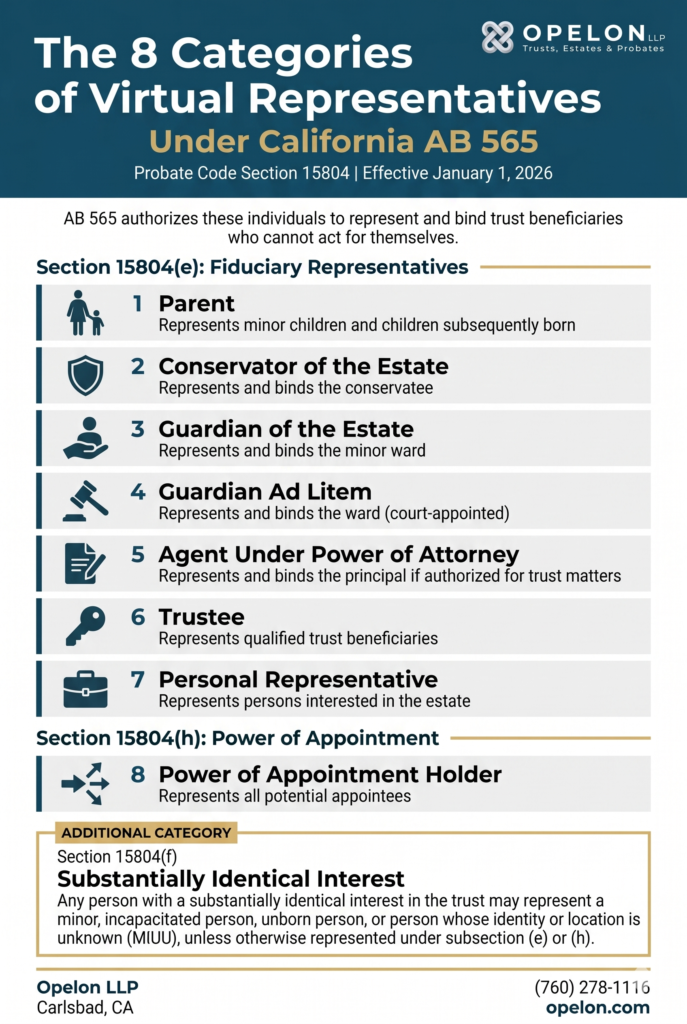
California Probate Code Section 15804 authorizes eight categories of persons who may serve as virtual representatives.
Section 15804(e) establishes seven fiduciary categories:
- Parents, for their minor and later-born children
- Conservators of the estate, for conservatees
- Guardians of the estate, for wards
- Guardians ad litem, for the persons they represent
- Agents under a power of attorney, for their principals
- Trustees, for qualified trust beneficiaries
- Personal representatives, for persons interested in an estate
Section 15804(h) separately authorizes holders of a power of appointment to represent potential appointees. That is the eighth category.
The statute also allows a person with a substantially identical interest in the trust to represent any MIUU. This applies unless the MIUU is already represented by a fiduciary from the list above or by a power of appointment holder.
Example: Two siblings share equal interests in a trust. One is a competent adult. The other is incapacitated. The competent sibling may represent and bind the incapacitated sibling for notice and consent.
California Trust Notice Requirements: Before and After AB 565
Scenario | Before AB 565 | After AB 565 (January 1, 2026) |
Trust has minor beneficiaries | Court petition for guardian ad litem generally required | Parent can represent and bind minor children without court appointment |
Beneficiary whose location is unknown | Complex statutory notice procedures or court involvement required | Another beneficiary with substantially identical interest can represent the unknown person |
Unborn future beneficiaries | Court appointment of guardian ad litem generally required | Parent or current beneficiary with identical interest represents future beneficiaries |
Trust with power of appointment | Trustee had to notify every potential appointee individually | Holder of the power of appointment can represent all potential appointees |
Incapacitated beneficiary | Conservator appointment generally required if none existed | Conservator of the estate represents conservatee, or another beneficiary with identical interest may represent |
Persons interested in an estate | No specific virtual representation mechanism | Personal representative can represent and bind persons interested in the estate |
What Safeguards Does AB 565 Include to Protect Beneficiaries?
AB 565 includes four main safeguards against misuse:
- A prohibition on representation when a conflict of interest exists
- A prohibition on settlors representing beneficiaries for trust changes
- A written consent requirement
- Limited liability protection for trustees who act in good faith
Conflict of Interest Prohibition
Under Section 15804(b)(1), no person may serve as a virtual representative if they have a conflict of interest with the represented person. The conflict must relate to the specific matter at issue.
This is the statute’s most important safeguard. It prevents anyone from using virtual representation to benefit themselves at the expense of a beneficiary who cannot speak for themselves.
If there is any question about whether a conflict exists, the trustee should seek court guidance or ask for a guardian ad litem.
Settlor Cannot Represent Beneficiaries for Trust Changes
Under Section 15804(b)(2), a settlor may not represent and bind a beneficiary on trust modification or termination of an irrevocable trust. This rule prevents a trust creator from using virtual representation to undo protections they built into the trust.
Written Consent Requirement
When someone consents on behalf of another person under this statute, the consent must be in writing. This requirement is in Section 15804(c)(1).
The written consent binds the represented person. However, the represented person may object to the representation before the consent becomes effective under Section 15804(c)(2).
This creates a clear paper trail. It also gives represented persons a chance to object if they later gain capacity or become known.
Trustee Liability Protection
Trustees who rely in good faith on a virtual representation are protected under Section 15804(c)(3). A trustee will not be liable for a loss unless the trustee:
- Acted intentionally to breach trust
- Acted with gross negligence
- Acted in bad faith
- Acted with reckless indifference to beneficiary interests
This protection gives trustees in Carlsbad, San Diego County, and throughout California confidence to use virtual representation for routine trust administration matters.
How Does AB 565 Affect California Trust Administration in Practice?
AB 565 reduces the cost and burden of trust administration in California. Trustees can now satisfy notice requirements through virtual representation instead of notifying every beneficiary individually.
For many San Diego County families, the impact is simple. Routine trust actions that once required court involvement or guardian ad litem appointments can now move faster. These actions include:
- Trustee accountings
- Trust modifications
- Changes in trustee
- Notices of proposed action under Probate Code Sections 16500 through 16504
Real Cost Savings
Multi-generational trusts often have dozens of beneficiaries. The group may include minor children, future grandchildren, and relatives whose addresses change.
Before AB 565, notice procedures for a routine trustee accounting on a trust with 30 or more beneficiaries could cost thousands of dollars. Virtual representation can reduce those notice expenses substantially. That means more trust assets reach beneficiaries instead of paying administrative costs.
California Note: AB 565 also allows power of appointment holders to virtually represent all potential appointees. This is useful for trusts that use powers of appointment as flexible planning tools. Trustees now give one notice to the power holder instead of notifying 30 or more potential appointees individually.
When Should a California Trustee Still Provide Full Notice?
Experienced California trust administration attorneys recommend full notice in three situations:
- When the trust action is potentially divisive
- When beneficiary interests may not be truly identical
- When any uncertainty exists about conflicts of interest
AB 565 is a strong tool for routine matters. But the cost of full notice is often small compared to the risk of future litigation over inadequate notice. A beneficiary who was virtually represented could later challenge the action if a hidden conflict existed at the time.
Our estate planning attorneys in Carlsbad, California advise trustees to evaluate each situation individually. Virtual representation is best when:
- All beneficiary interests clearly align
- The action is straightforward
- No conflicts exist among beneficiaries
For actions that could affect beneficiaries differently, full notice is the safer choice. An example is a trust modification that changes distribution percentages.
Warning: Virtual representation is not right for every trust action. If there is any chance of a conflict of interest, the trustee should provide full notice or seek court guidance. An undisclosed conflict could expose the trustee and the trust to costly litigation. When in doubt, consult a California trust administration attorney before relying on virtual representation.
Why Did California Enact AB 565? Competing with Other Trust Jurisdictions
California enacted AB 565 to reduce friction in trust proceedings and compete with other trust-friendly states. The law aligns California Probate Code with the Uniform Trust Code.
For years, California families with significant assets have looked to other states for trust establishment. States like Nevada, Delaware, Wyoming, and South Dakota offer:
- Streamlined trust administration rules
- Favorable tax treatment
- Robust asset protection statutes
California’s lack of a virtual representation statute was one more reason families looked elsewhere.
About the Bill
AB 565 was authored by Assemblywoman Diane Dixon (R-Newport Beach). It was sponsored by the California Lawyers Association Trusts and Estates Section Executive Committee (TEXCOM) and co-sponsored by the California Bankers Association.
The bill passed unanimously in both chambers:
- Assembly: 74 to 0
- Senate: 37 to 0
This reflects broad bipartisan support for the reform.
How Does AB 565 Interact with Existing California Trust Notice Requirements?
AB 565 supplements, but does not replace, existing California trust notice requirements. These include:
- The 60-day beneficiary notification requirement under Probate Code Section 16061.7
- Notice of proposed action requirements under Probate Code Sections 16500 through 16504
The statute clarifies that virtual representation does not affect notice requirements for:
- A person who has requested special notice
- A person who has filed a notice of appearance
- A particular person or entity required by statute to receive notice
AB 565 also does not limit the availability of a guardian ad litem under Probate Code Section 1003. Trustees and their attorneys can still seek court appointment of a guardian ad litem when circumstances warrant.
AB 565 gives trustees an additional tool. It is not a replacement for careful trust administration. Trustees must still comply with all other notice requirements under California law. Virtual representation simply provides a more efficient way to satisfy those requirements when the statute’s conditions are met.
What Steps Should California Trustees Take Now That AB 565 Is in Effect?
California trustees should take five steps to prepare for virtual representation:
- Review trust documents. Examine the trust instrument to identify all classes of beneficiaries. Look for contingent and future beneficiaries. Note any powers of appointment.
- Identify MIUU beneficiaries. List any beneficiaries who are minors, incapacitated, unborn, or whose identity or location is unknown. These are the individuals for whom virtual representation is most useful.
- Evaluate potential conflicts. Before using virtual representation, assess whether a conflict of interest exists between the proposed representative and the represented beneficiary. Document your analysis.
- Obtain written consent when required. If the representative will provide consent on behalf of the represented person, get that consent in writing as required by Section 15804(c)(1).
- Consult with a California trust administration attorney. AB 565 is new law. Courts have not yet interpreted many of its provisions. An experienced attorney can help you decide when virtual representation is appropriate.