

What Is a Will in California?
Under California Probate Code 6110, a will is a written, signed, and witnessed document that directs how a testator’s property passes at death. |
The will names an executor to administer the estate and identifies the beneficiaries who receive property. For parents of minor children, it also nominates a guardian. California Probate Code Division 6 (Sections 6100 to 6580) governs wills.
Three actors appear in every will:
- The testator. The person making the will. Must be 18 or older and of sound mind.
- The executor. The person who administers the estate after death. Sometimes called the personal representative.
- The beneficiaries. The people, charities, or trusts that receive property under the will.
A common question we hear from San Diego County families: “If I have a trust, do I still need a will?” In most cases, yes. A pour-over will can catch property you did not fund into your trust. It is also typically the document used to nominate guardians for minor children; a revocable living trust generally is not used for that purpose.
A will alone generally does NOT avoid probate for assets that require a court administration. Probate Code 10800 and 10810 apply identical sliding scales to the personal representative and the attorney.
On a $1 million California probate estate, combined statutory compensation can run roughly $46,000. That figure does not include court costs, probate referee fees, or the timeline, which commonly ranges around 9 to 18 months but can be shorter or longer depending on the estate and the court.
This is why most California families pair a will with a California revocable living trust.
For broader trust planning context, see our California trusts complete guide and our breakdown of the difference between a will and a trust. For a basic overview, the California Courts self-help wills page is a useful starting point.
How Wills Work in California
A California will takes effect at the moment of death and operates through the probate court. Until death, the testator can change or revoke the will at any time. After death, the executor named in the will petitions the Superior Court to begin probate.
Execution. Under Probate Code 6110, a will generally must be in writing, signed by the testator (or by another person at the testator’s direction and in the testator’s presence), and witnessed. In most cases, the witnesses should be present at the same time and understand they are witnessing the testator’s signing or acknowledgment of the will, and they should then sign as witnesses.
Capacity. Probate Code 6100 requires the testator to be 18 or older. Probate Code 6100.5 requires the testator to be of sound mind at the moment of execution. Sound mind is a low bar but a contestable one. The testator must understand the nature of the act, the property being disposed of, and the natural objects of the testator’s bounty.
Witness rules. Probate Code 6112 governs witnesses. The interested-witness rule matters here. If a witness is also a beneficiary, the gift to that witness creates a presumption that the gift was procured by duress, menace, fraud, or undue influence. The witness can still serve, but the gift may be void unless the presumption is rebutted.
Custodian’s duty. Probate Code 8200 sets a 30-day clock. In general, whoever has custody of the original will when the testator dies must lodge it with the Superior Court within 30 days after having knowledge of the testator’s death. Failing to do this can expose the custodian to potential liability in appropriate circumstances.
Filing the Petition for Probate. The executor named in the will then files a Petition for Probate (Form DE-111) under Probate Code 8000 et seq. to be confirmed and to begin administering the estate.
Why a copy of a will is often not enough. Probate Code 6124 establishes a presumption that can be outcome-determinative in some cases. If the original will was last in the testator’s possession and cannot be found at death, the law generally presumes the testator destroyed it with intent to revoke. Producing only a photocopy can require additional evidence and may lead to litigation to overcome that presumption.
In our experience working with San Diego County families, the most common reason a California will fails at probate is missing witnesses. The second most common is an interested witness who is also a beneficiary. Both are preventable with proper drafting and storage.
For more on what happens after a will is filed, see our California probate guide and the Carlsbad probate lawyer page for local court-specific issues.
Major Will Categories
Before diving into individual types, it helps to understand three basic distinctions that cut across the will universe in California.
Witnessed (Formal) Wills vs. Holographic Wills
The first split is execution method. A witnessed (formal) will follows Probate Code 6110: in writing, signed by the testator, signed by two witnesses present at the same time. A holographic will follows Probate Code 6111: the material provisions and signature must be in the testator’s handwriting, with no witnesses required.
Feature | Witnessed (Formal) Will | Holographic Will |
Probate Code section | 6110 | 6111 |
Witnesses required | 2 | 0 |
Format | Typed or handwritten | Material provisions and signature handwritten |
Self-proving affidavit | Common (Prob. Code 8220) | Not available |
Evidentiary strength | Strong | Weaker; harder to authenticate |
Common use | Standard attorney-drafted wills | Emergency last-minute changes |
Likelihood of contest | Lower | Higher |
The honest framing matters here. Holographic wills are valid in California. They are also harder to admit at probate because there are no witnesses to confirm execution, and they are more often subject to ambiguity and contest. We mention them here because they exist, not because we recommend them as a planning tool.
Self-Proving Wills vs. Standard Witnessed Wills
A self-proving will is a witnessed will with one extra feature: a witness affidavit signed in front of a notary at the time of execution. Probate Code 8220 governs use of a witness affidavit for proof of execution at probate.
The benefit can show up years later, at probate. In some cases, a standard witnessed will may require additional proof of execution (which can include locating witnesses or using other evidence). A witness affidavit can streamline proof in many cases, but it does not eliminate all probate requirements in every situation. California permits witness affidavits and does not require them. Many attorney-drafted wills include them as a matter of practice.
In our experience, the difference between a witness affidavit and a standard witnessed will often shows up years later. By then the witnesses may have moved out of state, died, or cannot be located. The affidavit can be one efficient way to help prove execution, although other admissible evidence may also be available depending on the circumstances.
Stand-Alone Wills vs. Pour-Over Wills
The third split is structural. A stand-alone will distributes property directly to named beneficiaries. The will is the only operative document.
A pour-over will is the will that goes WITH a revocable living trust. Its job is narrow. It catches any property the testator failed to fund into the trust during life. At death, it “pours” that residual property into the trust.
Pour-over wills are a common companion document to a California revocable living trust and appear in many trust-based plans.
6 Types of California Wills
California recognizes several distinct will types, each with its own use case, requirements, and trade-offs. The summary table below gives you a quick map. Each subsection that follows goes deeper.
Will Type | Best For | Witness Requirement |
Witnessed (formal) will | Most California adults, especially with minor children or real estate | 2 witnesses |
Holographic will | Emergencies; remote settings; not recommended as a primary plan | 0 witnesses |
Statutory will (Prob. Code 6240) | Very simple estates with no minor children | 2 witnesses |
Pour-over will | Anyone with a revocable living trust | 2 witnesses |
Joint or mutual wills | Almost no one in modern California practice | 2 witnesses |
“Living will” (advance health care directive) | Every California adult, alongside a regular will | Notary or 2 witnesses |
1. California Witnessed (Formal) Will
The witnessed will is the most common format for attorney-drafted estate plans. It is typically easier to prove at probate than a holographic will and, as a general matter, can reduce contest risk when properly executed and documented, though no will is contest-proof.
Execution requirements come from Probate Code 6110. The will must be in writing. The testator must sign it (or direct another person to sign in the testator’s presence). Two witnesses must be present at the same time, must understand they are witnessing a will, and must sign themselves.
The interested-witness rule under Probate Code 6112 is a common drafting trap. If a witness is also a beneficiary, the gift to that witness can trigger a presumption that the gift was procured by duress, menace, fraud, or undue influence. The witness can still serve, but the gift to the witness may be invalid unless the presumption is rebutted or an exception applies. We use disinterested witnesses as a best practice.
A witness affidavit under Probate Code 8220 (commonly called a self-proving affidavit) is strongly recommended. The witnesses sign a sworn statement in front of a notary at the time of execution. The court can then admit the will at probate without locating the witnesses.
Opelon LLP drafts witnessed wills as part of every estate plan we produce in Carlsbad and across San Diego County. For more on what to look for in a drafting attorney, see our page on the best Carlsbad estate planning attorney.
2. California Holographic Will
A holographic will is a handwritten will, signed by the testator, with no witnesses. Probate Code 6111 sets the rules: the material provisions and signature must be in the testator’s handwriting. Many holographic wills are dated, and dating can matter in some scenarios (for example, when multiple writings are at issue). Probate Code 6111.5 allows extrinsic evidence to determine whether the document is a will and to clarify the testator’s intent.
Common situations where holographic wills appear include emergency last-minute changes and testators in remote settings without access to witnesses. They also appear when testators never got around to formalizing a will. They have legal force. They are also harder to authenticate at probate because there are no witnesses to confirm the testator’s signature or capacity.
A handwritten “note” or “list” of wishes is NOT automatically a holographic will. The document must show clear testamentary intent. That means an intent that this specific document operate as a will at death. A letter to family explaining wishes does not qualify unless it shows that intent.
Opelon LLP does NOT recommend holographic wills as a primary planning instrument. We explain them here so you understand when they are valid. A witnessed will (or a will and trust package) is almost always the better choice when time and circumstances allow.
3. California Statutory Will (Probate Code 6240)
The statutory will is a fill-in-the-blank form authorized by California statute. Probate Code 6240 contains the official form text. The State Bar of California has historically published a fillable version of the form.
Witnesses are still required. Two of them, signing under Probate Code 6110.
The form’s strength is also its weakness. In general, the statutory will is intended to be used largely as written, and changes outside the provided blanks can create validity or interpretation problems. Depending on what is changed, a court may treat altered language as ineffective while leaving the remainder operative, but the result can be fact-specific. There is no built-in trust funding language, no asset-protection planning, and limited flexibility for blended families or complex distribution wishes.
The statutory will is best suited for very simple estates. Examples: a single adult with no minor children, modest assets, and a clear distribution to one or two named beneficiaries. For most San Diego County families we work with, the form’s limitations rarely fit. Opelon LLP does NOT typically draft statutory wills, but they are mentioned here for completeness.
4. California Pour-Over Will (Companion to a Revocable Living Trust)
A pour-over will is the will you sign WITH your revocable living trust. The two documents work together. The trust holds the assets you funded into it during life. The will catches anything you missed.
The will’s job is narrow. It pours residual property (a forgotten brokerage account, a vehicle title still in your name, a stock certificate in a drawer) into the trust at death. Without a pour-over will, those assets would pass under California intestate succession (Probate Code 6400 et seq.). That often means going to people you would not have chosen.
Probate Code 6300 authorizes pour-over gifts to existing trusts. A pour-over will may still require a probate proceeding (or a probate-like court process) to clear title to assets that remain in the decedent’s name at death, though in some estates those assets can be transferred using non-probate procedures. The dollar value passing through probate is often smaller when the trust was funded properly during life, but this depends on what was left outside the trust.
Opelon LLP drafts pour-over wills in every trust-based estate plan. We pair them with a California revocable living trust and a coordinated set of ancillary documents. Those include a durable power of attorney, an advance health care directive, and a HIPAA authorization.
5. California Joint Will and Mutual Wills (Informational)
A joint will is a single document executed by two testators, typically a married couple. A mutual will is a pair of separate but reciprocal wills with corresponding terms, often executed under a contract not to revoke.
California recognizes both. They are RARELY used in modern California practice for one reason: rigidity. A joint will (or a mutual will under a contract not to revoke) can lock the surviving spouse out of changes after the first death. New marriages, new children, blended-family dynamics, and changing tax law all argue for flexibility.
The modern alternative is a revocable living trust with QTIP provisions or A-B trust planning for blended families. The trust gives the same protection (preserving the first spouse’s distribution wishes) without the lock-in.
Opelon LLP does NOT typically draft joint or mutual wills. We include them here so you can recognize them in older estate plans. If you are named as executor or successor trustee on an older plan with a joint will, you may need help interpreting it.
6. Living Will (Common Confusion: This Is NOT a Will)
This is a common source of confusion. A “living will” in California is generally not a will at all; most people mean an advance health care directive, which can control medical decisions during your life if you cannot speak for yourself.
The Health Care Decisions Law (Probate Code 4600 et seq.), and specifically the advance health care directive provisions at Probate Code 4670 to 4736, governs advance health care directives. The will statute (Probate Code 6100 et seq.) does not.
A California advance health care directive does three main things. It names an agent to make medical decisions if you cannot. It states your preferences for end-of-life care, life-sustaining treatment, and pain management. It can also include organ donation wishes.
Opelon LLP drafts advance health care directives as part of every estate plan. Every California adult should have one alongside a regular will, regardless of age or health.
Note: Nuncupative (Oral) Wills Are NOT Valid in California
Some states permit nuncupative (oral) wills under narrow circumstances, usually for soldiers in active service or sailors at sea. As a general rule, California does not recognize oral wills as valid wills.
A purely oral declaration of intent at a deathbed generally has no testamentary effect under California law. To have legal force as a will, the disposition typically must be in a written instrument that satisfies the requirements for a formal will (Probate Code 6110) or a holographic will (Probate Code 6111). We mention this here to head off a common search query and correct the misconception.
Legal Requirements for a Valid California Will
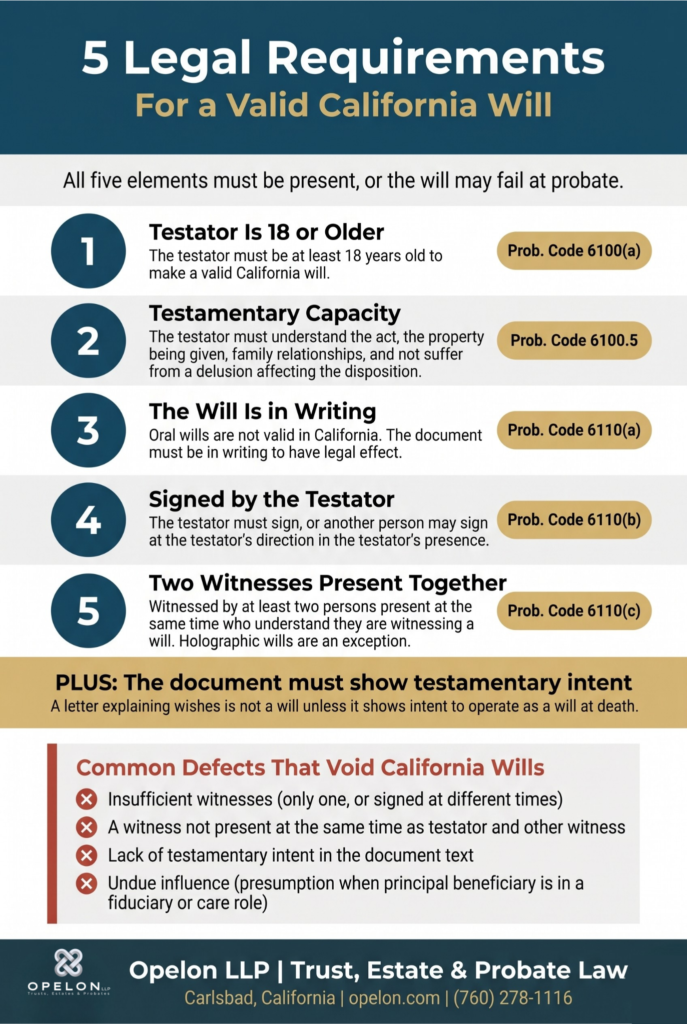
For a California will to be admitted to probate, five elements must line up. Each one is a potential point of attack at probate, so each one matters.
- Testator is 18 or older. Probate Code 6100(a). Minors cannot make a will in California.
- Testator has testamentary capacity at the time of execution. Probate Code 6100.5. The testator must understand the nature of the act and the nature and situation of the property. The testator must also understand his or her relations to family members who would naturally be beneficiaries. The testator must also not suffer from a delusion that affects the disposition.
- The will is in writing. Probate Code 6110(a). Oral wills are not valid in California.
- The will is signed by the testator (or by another person at the testator’s direction in the testator’s presence). Probate Code 6110(b).
- The will is witnessed by at least two persons present at the same time who understand they are witnessing a will (Probate Code 6110(c)). The holographic exception under Probate Code 6111 substitutes a fully handwritten document for the witness requirement. Probate Code 6110(c)(2) also permits a court, in some cases, to admit a witness-defective will if the proponent establishes by clear and convincing evidence that the testator intended the document to be the testator’s will
Beyond these five elements, the document must show testamentary intent. The testator must intend that this specific document operate as a will at death. A letter to family explaining wishes is not a will unless it shows that intent.
Common defects that void California wills:
- Insufficient witnesses (only one witness, or witnesses signed at different times)
- A witness who was not present at the same time as the testator and the other witness (though Probate Code 6110(c)(2) may allow such a will to be admitted on clear and convincing evidence of testamentary intent)Lack of testamentary intent in the document text
- Undue influence (a rebuttable presumption arises when the principal beneficiary is in a fiduciary or care relationship with the testator)
For the full statutory text, see California Legislative Information for Probate Code 6110.
How to Make a Will in California
Making a valid California will is a four-step process: decide your distribution plan, choose your executor and guardians, draft and properly execute the document, and store it where it can be found at death. |
Probate Code 6110 governs the execution. The other steps come from practical experience.
Here is the full step-by-step:
- Inventory your assets. Real estate, financial accounts, vehicles, business interests, life insurance, retirement accounts, and personal property. Note which assets already have beneficiary designations (these override your will).
- Decide your distribution plan. Who receives what, when, and under what conditions? If you have minor children or a beneficiary with special needs, distribution timing matters.
- Choose your executor. California generally permits an adult with capacity to serve, subject to the statutory competency and disqualification rules of Probate Code 8402. Out-of-state executors are permitted, and bond may be required in some cases depending on the circumstances and the will’s terms (see Probate Code 8480 and 8482, which addresses additional bond for nonresident personal representatives).
- Choose guardians for any minor children. A will is the most common and reliable instrument used to nominate a guardian, although California law also permits nomination by a separate written instrument under Probate Code 1500 and 1502. Name a primary guardian and at least one backup.
- Draft the will. Options: attorney-drafted, statutory will (Probate Code 6240), or DIY with the caveats noted earlier in this guide.
- Execute under Probate Code 6110. As a best practice, the testator signs (or acknowledges the signature) in the presence of two witnesses who are present at the same time, and the witnesses sign during the same execution ceremony. Having all signatures done together reduces later proof problems, although the legal sufficiency can be fact-specific.
- Add a witness affidavit (often recommended). Sign the affidavit under Probate Code 8220, typically before a notary, at the same time. This can reduce (but may not always eliminate) the need to locate witnesses years later.
- Store the original safely. See the storage section below.
One of the most important reasons a parent of minor children may need a will is to nominate a guardian. A trust typically is not used to make that nomination. Without a will, the court will appoint a guardian under the applicable guardianship procedures, and while the court may consider a parent’s expressed preferences, the process can be contested and time-consuming in some cases.
In our experience, a common gap on first wills is failing to name a backup executor and a backup guardian. Life happens. Your primary nominee may be unable or unwilling to serve when the time comes. As a best practice, name backups.
For broader planning context, see our 21-step California estate planning checklist and our comparison of attorneys for living trusts vs. DIY trust kits.
Where to Store a California Will Safely
The storage question sounds boring. It is not. A missing original will is one of the most expensive mistakes a California family can make. Probate Code 6124 presumes that a missing original was destroyed with intent to revoke, and a photocopy is rarely enough to overcome that presumption.
Storage options ranked by reliability:
- In a fireproof home safe. Cheap and accessible. The catch: family members must know the safe exists, where it is, and how to open it.
- In a safe deposit box. Reliable, but Probate Code 331 controls access. In general, certain persons (including a named executor) may be able to access a safe deposit box for limited purposes such as locating a will, subject to the bank’s procedures and statutory conditions. Additional access or removal of other contents may require further documentation and, in some situations, a court order.
What to AVOID: digital-only storage of an unsigned PDF. Or storing only a copy and destroying the original. Or hiding the will so well that no one finds it after death.
We have seen families spend months recovering from a missing original will. The worst cases involve a safe deposit box that no one had authority to open. The litigation costs to admit a copy can run well into five figures. Storage is not the place to cut corners.
How to Update or Revoke a California Will
A California will can be changed or revoked at any time during the testator’s life, as long as the testator has capacity. Two main mechanisms exist: codicils (amendments) and full restatements.
Codicils (Amendments to a Will)
A codicil is an amendment to an existing will, executed with the same formalities as the original under Probate Code 6110. Codicils are valid, but many attorneys generally do NOT recommend them in modern practice because they can increase ambiguity and administration friction.
Why we avoid them: a codicil that conflicts with the underlying will creates ambiguity at probate. The court must reconcile two documents. That process invites contests and slows the estate. The clean alternative is a full restatement: a brand-new will that replaces the old one entirely, executed with the same formalities.
Revoking a Will
Probate Code 6120 permits revocation in two ways:
- By a subsequent will or codicil that expressly revokes the prior will or is inconsistent with it.
- By physical act (burning, tearing, canceling, or obliterating) by the testator, or by another person in the testator’s presence and at the testator’s direction.
Two related rules deserve mention. Probate Code 6123 says that revocation of a later will does NOT automatically revive an earlier revoked will. The earlier will is revived only if the testator manifests intent that it be revived. Probate Code 6122 says that dissolution of marriage automatically revokes provisions in favor of the former spouse, unless the will expressly provides otherwise. Probate Code 6122.1 applies the same rule to termination of a registered domestic partnership.
Life Events That Should Trigger a Will Update
Some events should send you back to your attorney for a review:
- Marriage or divorce. Probate Code 6122 only addresses divorce. Marriage does not automatically revoke a will, but the omitted-spouse rule under Probate Code 21610 may apply.
- Birth or adoption of a child. The omitted-children rule under Probate Code 21620 may apply if the will is not updated.
- Death of a beneficiary, executor, or guardian.
- Acquiring or selling significant assets, especially real estate.
- Moving to or from California. Different state laws may apply.
- Major changes in tax law. The federal estate and gift tax exemption is now $15 million per individual under the One Big Beautiful Bill Act (OBBBA), signed July 4, 2025.
- Falling out with a named beneficiary or executor.
Even without a triggering event, a five-year review schedule is a good baseline. See our 21-step California estate planning checklist for the full review framework.
What Happens If You Die Without a Will in California?
When a California resident dies without a valid will, property passes under California intestate succession (Probate Code 6400 et seq.), which assigns property by family relationship rather than by your wishes. |
Stepchildren, unmarried partners, and charities typically receive nothing under intestate succession unless they qualify under a specific statutory rule (for example, adoption, a putative spouse theory, or other limited doctrines that can apply in unusual cases). Here is the simplified order. Real cases have wrinkles, so use this as a map, not as a final answer.
Surviving Family | Community Property | Separate Property |
Spouse only (no children, parents, siblings) | 100% to spouse | 100% to spouse |
Spouse and 1 child (or descendants of 1) | 100% to spouse | 1/2 to spouse, 1/2 to child |
Spouse and 2+ children | 100% to spouse | 1/3 to spouse, 2/3 to children |
Spouse and parents (no children) | 100% to spouse | 1/2 to spouse, 1/2 to parents |
Spouse and siblings (no children/parents) | 100% to spouse | 1/2 to spouse, 1/2 to siblings |
No spouse | Children, then parents, then siblings, then more remote relatives | Same order |
No relatives at all | Escheat to State of California (very rare) | Same |
A few specific rules deserve mention. Probate Code 6401 controls the community property share: the surviving spouse takes 100% of the decedent’s community property half.
Probate Code 6402 controls the separate property order: children, then parents, then siblings, then grandparents, then issue of grandparents, then more remote next of kin. Probate Code 6452 can bar a parent from inheriting from a child if the parent failed to support or acknowledge that child.
Why this often produces unintended outcomes:
- Stepchildren generally do not inherit under intestate succession unless they were legally adopted or another narrow exception applies under the Probate Code (for example, certain circumstances involving an “equitably adopted” child may be argued).
- Unmarried partners generally do not inherit under intestate succession, even after decades together, unless they qualify under a specific legal status or doctrine (for example, registered domestic partnership or a putative spouse theory in limited circumstances).
- Charitable wishes are generally not implemented through intestate succession unless a charity independently qualifies as an heir under a specific legal theory (which is uncommon) or there is another operative transfer mechanism outside intestacy.
- Guardianship of minor children is decided by the court under the applicable guardianship procedures. Without a will nomination, the court will not have a formal guardian nomination from you, though other evidence of parental preference may still be considered depending on the circumstances.
In our experience, intestate succession often produces results the family did not want, especially in blended families and unmarried-partner situations. Even a basic will can be a meaningful improvement over the default.
For more on the probate process that follows, see our California probate guide. For the full statutory text, see California Legislative Information for Probate Code 6400 et seq.
Will Contests in California (Informational)
Practice scope note: Opelon LLP focuses on uncontested California estate planning and probate administration. We do NOT handle will contests. We include this section so you understand the landscape. If you believe a California will should be contested, you will need a probate litigation attorney. |
A will contest is a formal court challenge to the validity of a will. Several grounds exist under California law:
- Lack of testamentary capacity (Probate Code 6100.5). The testator did not understand the nature of the act, the property, or the natural objects of bounty.
- Undue influence (Probate Code 6104; undue influence is defined at Probate Code 86, which incorporates Welfare and Institutions Code 15610.70). Someone overbore the testator’s free will.
- The testator was deceived about the contents or effect of the will.
- The testator signed under threat or coercion.
- The testator was mistaken about a material fact that affected the disposition.
- Improper execution. Insufficient witnesses, interested-witness defects, or other failures under Probate Code 6110 or 6111.
- The will was revoked but offered as if still valid.
Standing. Only “interested persons” can contest a will. That includes heirs (people who would inherit by intestate succession) and named beneficiaries under the contested will. It also includes beneficiaries under a prior will who would benefit if the current will is invalidated.
The 120-day clock. Probate Code 8270 sets a strict deadline. A petition to revoke probate of a will must be filed within 120 days after the will is admitted to probate. After that window closes, the will is much harder to challenge.
No-contest clauses. Probate Code 21310 through 21315 govern no-contest clauses. A properly drafted no-contest clause can disinherit a beneficiary who challenges the will, but California courts enforce these narrowly. Not every challenge triggers the clause.
The strongest defense against a future contest is strong drafting at the outset. Clear language, proper execution, a self-proving affidavit, and contemporaneous documentation of capacity all reduce the contest risk. Opelon LLP focuses on building wills that hold up at probate, not on litigating them after the fact.
If you actually need contest counsel, ask your estate planning attorney for a referral. Many of us maintain working relationships with respected probate litigators who can step in.
How Much Does a California Will Cost?
A California will can cost anywhere from $0 to $5,000 or more, depending on what you choose and the complexity of the plan. DIY templates often run $0 to $200. Attorney-drafted simple wills commonly range from about $500 to $1,500 in many markets. Full will-and-trust packages vary widely; $2,500 to $5,000 is a common range at many firms, but pricing can be higher or lower depending on region and complexity. |
The table below breaks it down:
Will Type | Typical Fee Range | What It Includes |
DIY will template (online form) | $0 to $200 | Basic distribution, no review, high failure rate |
Statutory will (Prob. Code 6240, self-prepared) | Free | Limited to form scope; no trust funding |
Attorney-drafted simple will | $500 to $1,500 | Witnessed will, self-proving affidavit |
Will + trust package (single) | $2,500 (Opelon flat fee) | Trust, pour-over will, POA, AHCD, HIPAA |
Will + trust package (married) | $3,500 (Opelon flat fee) | Same as above, joint planning |
Will + advanced tax planning (HNW) | $5,000 to $15,000+ | SLAT, A-B trust, GST trust components |
Opelon LLP works on a flat-fee model. That means you know the full cost before we start, with no hourly billing surprises. Our flat fees include drafting, witness coordination at signing, and the self-proving affidavit. They also include all ancillary documents: durable power of attorney, advance health care directive, and HIPAA authorization. Our flat fee estate planning packages lay out that entire scope for one predictable price.
The hidden cost of a DIY will can show up at probate. Probate Code 10800 and 10810 apply identical sliding scales to the personal representative and the attorney. On a $1 million probate estate, combined statutory compensation can run roughly $46,000. If a DIY will triggers disputes (missing witnesses, interested-witness issues, ambiguity), the estate may also incur litigation costs to resolve the problem. In some contested matters, the additional costs can be substantial.
For more on cost-benefit thinking, see our breakdown of attorneys for living trusts vs. DIY trust kits and our California revocable living trust page.
Common California Will Mistakes
Many will failures we see at probate fall into a small number of patterns. Avoiding these ten mistakes can prevent a large share of common problems:
- Using an interested witness. A witness who is also a beneficiary creates a presumption that the gift was procured by duress, menace, fraud, or undue influence under Probate Code 6112. The gift to the witness may be void.
- Not naming a backup executor or backup guardian. Your primary nominee may be unable or unwilling to serve when the time comes.
- Failing to update after marriage, divorce, or birth of a child. Probate Code 6122 (divorce), 21610 (omitted spouse), and 21620 (omitted children) may all apply.
- Treating a copy as the original. Probate Code 6124 presumes a missing original was destroyed with intent to revoke.
- Storing the will somewhere no one can find it. A perfectly drafted will is useless if no one can locate it after death.
- Naming a minor as a direct beneficiary without a trust or UTMA structure. In general, a minor cannot directly take legal title to substantial assets without a guardian, custodianship arrangement, or trust structure, which can create court involvement and delays.
- Using vague distribution language. “My children share equally” creates problems if a child predeceases or if a stepchild was adopted in.
- Forgetting digital assets. California’s RUFADAA implementation (Probate Code 870 through 884) governs digital asset access. Your will should address them.
- Skipping the self-proving affidavit. Without it, the executor must locate and produce witnesses years later, which can cost the estate time and money.
- Trying to disinherit a spouse without addressing community property rights. California is a community property state. A will cannot give away your spouse’s half.
In our experience working with San Diego County families, the single most expensive will mistake is the missing original. We have watched families spend $20,000 or more in litigation trying to admit a copy under Probate Code 6124. Most of these cases resolved eventually, but the cost and delay were entirely preventable.
For more on probate procedures that reveal these mistakes, see our California probate guide.
When to Hire a California Estate Planning Attorney
A DIY form is fine for some California adults. For most, professional help pays for itself many times over. Several signals suggest professional help is worth the cost:
- You have minor children. Guardian nominations are too important for a fill-in-the-blank form.
- Your estate exceeds the $208,850 small-estate threshold (Probate Code 13100, effective April 1, 2025) and you want to avoid probate.
- You own real estate. Titling drives whether the property avoids probate.
- You are in a blended family. Stepchildren, prior marriages, and competing branches of family all complicate distribution.
- You have a beneficiary with disabilities or special needs. A direct gift can disqualify them from public benefits. A special needs trust avoids that problem.
- You own a business or partnership interest. Business succession requires coordinated drafting.
- You have charitable wishes. Charitable trusts and gift structures need professional design.
- You have a beneficiary you want to disinherit. This requires careful drafting to be enforceable and to limit contest risk.
- Your estate approaches the $15 million individual or $30 million couple federal estate tax exemption. This figure comes from the One Big Beautiful Bill Act (OBBBA), signed July 4, 2025. Tax-planning structures (SLAT, A-B trust, GST trust) require specialist help.
- You moved to California from another state. Your prior will may not satisfy California execution requirements.
What to look for in a California estate planning attorney:
- California Bar admission in good standing. Owen Rassman, our Managing Partner, is CA Bar #236974, admitted in 2005.
- Advanced tax credentials. Owen holds an LL.M. in Taxation from the University of San Diego School of Law.
- Track record of California estate plans. At Opelon LLP, we have drafted more than 700 California estate plans. Every plan we produce includes a will. We have also administered more than 250 San Diego County estates.
- Experience with your specific situation. Blended family, business owner, special needs, high net worth: each profile has its own drafting patterns.
To learn more, see our pages for the Carlsbad estate planning attorney and the broader San Diego estate planning attorney practice. If you are ready to talk, call our Carlsbad office at (760) 278-1116 or email info@opelon.com to schedule a consultation.