


The First Year at a Glance
The successor trustee duties California requires fall into four phases. Days 1 to 30 cover acceptance, the section 16061.7 notice, and asset security. Days 31 to 90 cover inventory, valuation, and tax planning. Months 4 to 9 cover debt payment, investment management, and asset sales. Months 10 to 12 cover the final accounting and distribution.
Each phase builds on the last. Skipping steps creates personal liability. To see how the trust itself was designed, our pillar guide on the California revocable living trust explains the document you are now administering.
Three Deadlines Successor Trustees Cannot Miss
|
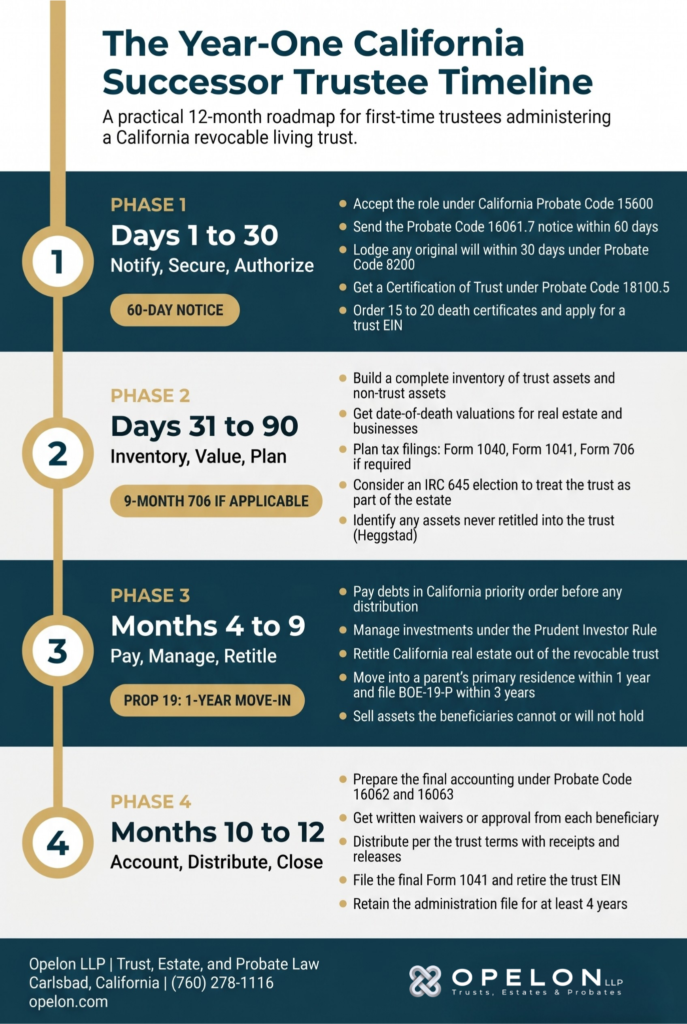
Days 1 to 30: Accept the Role, Notify Beneficiaries, Secure the Assets
Phase one is the highest-stakes month. The section 16061.7 notice and the Certification of Trust both belong here. So does the practical work of locating original documents and securing the home.
Confirm You Are the Successor Trustee (and Decide Whether to Accept)
Locate the original trust document. The successor trustee provision usually sits in Article III or IV. Confirm that the death of the prior trustee triggers your role, rather than incapacity or resignation alone.
A named successor trustee is not obligated to accept. You can decline, or reject the trust, under Probate Code 15601, and the trust’s named alternate (or a court-appointed substitute) takes over. Under Probate Code 15600, acceptance also requires affirmative action on your part: signing the trust instrument or a separate written acceptance, or knowingly acting under the trust in a non-emergency. Your decision is binary, but you should make it deliberately.
In our experience, the most common reason a named successor declines is geographic distance. A trust administered from out of state is workable but slower. California real estate transactions in particular benefit from a local trustee or California-licensed counsel.
Should I Accept the Role of Successor Trustee? A Quick Decision Tree
|
Send the Probate Code 16061.7 Notice (the 60-Day Clock)
This is the single most legally consequential action in year one. Within 60 days of the settlor’s death (or 60 days after the trustee becomes aware of a person entitled to receive notice, if that person was not previously known), the successor trustee must send a written notice meeting Probate Code 16061.7 to every named beneficiary of the trust and every legal heir of the settlor, including heirs not named in the trust.
Required content includes the trust’s existence, the trustee’s identity and contact information, a statement that the recipient may request a copy of the trust, and the statutory warning about the limited window to contest the trust under Probate Code 16061.8. The contest window runs 120 days from the date the notice is served, or 60 days from the date a copy of the trust terms is delivered during that 120-day period, whichever is later. In practice, most trustees deliver the trust terms with the notice itself so the 120-day clock runs cleanly.
Sample template language is widely available. The section 16061.7 notice has multiple required statutory elements, and it is the highest-risk DIY document a successor trustee handles. A defective notice can leave the contest window open longer than it should be. We do not recommend drafting it without counsel review.
Across the trusts Opelon has administered, we see DIY section 16061.7 notices fail in three common ways. The notice is missing required statutory language. The notice goes only to named beneficiaries, not legal heirs. The notice is sent after the 60-day window. Each one creates personal liability exposure.
Who Counts as a Legal Heir Even If Not Named in the Trust?
|
Get a Certification of Trust (Probate Code 18100.5)
Banks, brokerages, and title companies will not give you access to trust assets without proof that you are the current trustee. Probate Code 18100.5 lets you provide a short-form Certification of Trust instead of the full trust document. The full document contains private terms beneficiaries do not need to see.
The Certification names the current trustee, recites the trustee’s powers, and certifies the trust is in full force and effect. Third parties acting in good faith may rely on the Certification, and the statute provides remedies (including damages) against a third party that refuses to accept a properly prepared Certification without good cause.
Have a real-estate-grade Certification ready before you walk into the bank. Banks routinely add their own additional forms. That is fine. The section 18100.5 Certification is what gives you legal authority.
We typically prepare a Certification of Trust as the very first deliverable when a San Diego County family hires us for trust administration. Without it, the rest of the year-one work cannot start.
Secure the Decedent’s Home and Documents
If the decedent lived alone or the home is now empty, secure it. Lock the doors. Change the locks if keys are unaccounted for. Move obvious valuables to a safe location.
Locate and secure the original trust amendments (most trusts have one or more), the pour-over will, deeds, life insurance policies, retirement-account statements, recent bank and brokerage statements, vehicle titles, safe-deposit-box contents, and any letters of intent.
California law requires the custodian of the original will to lodge it with the Superior Court within 30 days of learning of the death under Probate Code 8200, even if no probate is anticipated. The custodian is whoever happens to hold the original will, which is often the trustee or a family member.
Where Successor Trustees Can Look First for Trust Documents
|
Get Death Certificates and an EIN
Order 15 to 20 certified copies of the death certificate. Each bank, brokerage, insurance carrier, the IRS, the Franchise Tax Board, real-property recording, vehicle title transfers, Social Security, and pension administrators will require one.
Apply for a trust EIN (Employer Identification Number) at IRS.gov. The trust becomes its own taxpayer once the settlor dies, so the settlor’s Social Security number no longer applies. EIN application is free and takes about 10 minutes online.
Banks and brokerages will require the trust EIN before they retitle accounts into the trust’s name. Get this within the first week. Trustees who delay the EIN delay every other phase that depends on funded accounts.
Days 31 to 90: Inventory, Valuation, and Tax Planning
Phase two is operational. The section 16061.7 contest window is running. The trustee uses these weeks to map every asset, set defensible date-of-death values, and plan the tax filings.
Build the Trust Asset Inventory
The successor trustee must identify every asset titled in the trust’s name and every asset that should have been but was not. Both categories matter. The second category is where Heggstad petitions originate.
For each asset, record the description, date-of-death value (not cost basis), location, and current title. Build the inventory as a spreadsheet from day one. You will refer back to it for the next 12 months.
Common assets the trustee inventories include:
- Real estate (residential, rental, vacation, raw land).
- Brokerage and investment accounts.
- Bank accounts (checking, savings, money market, CDs).
- Business interests (LLC membership, S-corp shares, partnership interests).
- Vehicles, boats, and registered toys.
- Life insurance policies with the trust as beneficiary.
- Retirement accounts. These usually pass to named beneficiaries outside the trust.
- Tangible personal property of meaningful value (jewelry, art, collections).
In our experience, a meaningful number of California trusts have at least one asset that was never retitled into the trust before the settlor died. That is when a Heggstad petition becomes necessary to bring the asset into the trust without a full probate.
Get Date-of-Death Valuations
Real estate requires a written appraisal as of the date of death (not the current value). The appraisal is required for tax basis step-up purposes under IRC 1014. Cost typically runs $400 to $800 per property and is worth every dollar.
Brokerage accounts are easier. The brokerage will provide a date-of-death statement on request. Closely-held businesses require a formal valuation by a qualified appraiser. This is the highest-cost line item, but it is mandatory if the trust holds a business interest of any size.
Tangible personal property usually does not need formal appraisal. A reasonable estimate is fine unless total tangible value crosses into the tens of thousands.
The basis of inherited assets steps up to date-of-death value under IRC 1014, which usually eliminates capital gains tax on lifetime appreciation. Without contemporaneous valuations, the IRS can challenge the step-up. Get the appraisals.
Tax Filings the Trustee Handles
The trustee oversees several returns in year one:
- Decedent’s final Form 1040. Due April 15 of the year after death. Covers income from January 1 through date of death.
- California final Form 540. Same deadline as the federal return.
- Trust income tax returns (Form 1041 federal, Form 541 California). Filed for any income the trust generates after the date of death. Required annually until the trust is fully distributed.
- Federal estate tax return (Form 706). Due 9 months from date of death, and required only if the estate meets the filing requirements based on federal law in effect for the year of death. Many families will not owe estate tax, but a portability election or other planning may still warrant filing. Confirm with a CPA or attorney.
- California has no state estate tax, so there is no California Form 706.
- Optional IRC 645 election. Treats a qualifying revocable trust as part of the decedent’s estate for income tax purposes. The election period runs until the later of (a) 2 years after the date of death if no estate tax return is required, or (b) 6 months after final determination of estate tax liability if Form 706 is filed. The election can be useful even when no probate estate exists, because it allows the combined entity to use a fiscal year.
The IRS publishes plain-English guidance on trustee tax responsibilities in Publication 559. Trustees handling their first administration find it useful as a reference, though it does not replace a CPA.
When Successor Trustees Need a CPA, Not Just a Tax Preparer
|
Months 4 to 9: Manage, Sell, and Pay
Phase three is the operational discretion phase. Most trusts spend the most calendar time here. The deadlines are quieter, but the personal-liability exposure stays high.
Pay the Decedent’s Debts and Final Bills
The trustee identifies and pays valid debts of the decedent from trust assets in the priority order set by California law. Secured debts come first, then funeral and last-illness expenses, then taxes, then unsecured debts.
The trustee should not distribute to beneficiaries before debts and taxes are paid. Personal liability attaches if the trustee distributes prematurely and a creditor surfaces afterward.
We typically advise our trustee clients to wait at least 4 to 6 months after sending the section 16061.7 notice before any meaningful distribution. The waiting period lets creditors surface and the contest window close.
Creditor deadlines can be technical. California Code of Civil Procedure section 366.2 is commonly implicated in claims against a decedent and is often described as imposing a 1-year limitation period from the date of death, but how it applies depends on the nature of the claim and the facts.
In some situations, a trustee may consider the optional trust creditor-claims procedure (Probate Code sections 19000 through 19403), which can, if properly implemented, shorten the time for certain creditor claims; the deadlines and notice requirements differ for known versus unknown creditors and mistakes can increase exposure. If creditor issues are possible, get California counsel before using this procedure or making early distributions.
Manage Trust Investments Per the Prudent Investor Rule
The successor trustee must manage trust investments under California’s Uniform Prudent Investor Act, codified at Probate Code 16045 through 16054. The standard of care for investment decisions is in Probate Code 16047. The duty to diversify is in Probate Code 16048, which requires the trustee to diversify the trust’s investments unless, under the circumstances, it is prudent not to do so.
A common error is leaving the entire trust in a single concentrated stock position the settlor held for 30 years. The settlor’s preferences do not bind the trustee after death. The beneficiaries’ interests, viewed as a whole, do. Holding a concentrated position out of sentiment is a personal-liability landmine.
The trustee can hire a financial advisor to manage trust investments and is generally protected from liability for the advisor’s decisions under Probate Code 16052, but only if the trustee (a) exercises prudence in selecting the agent, (b) establishes appropriate scope and terms of the delegation, and (c) periodically reviews the agent’s performance and compliance with those terms. Selection alone is not enough. For non-investment assets like real estate, the trust will sell or a closely-held business interest, the trustee acts as a reasonable steward until disposition.
Real Property Retitling and Prop 19
If the trust holds California real estate, retitle the property as required by the trust’s post-death administration (often from the decedent’s revocable living trust into the appropriate post-death/irrevocable trust share or to the beneficiary). The trust terms and title history control the correct deed and supporting filings.
To seek to preserve a parent’s property tax base under the Prop 19 parent-child exclusion, several requirements may apply when a child inherits a parent’s primary residence (and County Assessor procedures can vary):
- Occupancy: The child generally must make the home their primary residence within the required timeframe after the transfer and continue to use it as their primary residence to maintain the exclusion.
- Homeowners’ exemption: The child generally must timely claim the homeowners’ (or disabled veterans’) exemption on the residence as part of the exclusion process; confirm the County Assessor’s timing and documentation requirements.
- BOE-19-P claim: The child should file the Claim for Reassessment Exclusion for Transfer Between Parent and Child (BOE-19-P) with the County Assessor as soon as possible and confirm the applicable filing deadlines and “transfer date” for a trust administration. Late filing can have adverse consequences, and any relief available for late-filed claims may be limited. Verify current rules with the County Assessor.
Without an applicable exclusion, the property may be reassessed at current market value, which can materially increase property taxes (the amount varies by county and value). The parent-child exclusion is subject to limits, including a cap tied to the property’s factored base year value plus an additional amount; any value above the cap may be partially reassessed. Confirm the current cap and calculations with the County Assessor.
For non-primary-residence real estate inherited from a parent, Prop 19 significantly limited reassessment exclusions, and many transfers of second homes, rentals, and vacation properties are reassessed. Because there are exceptions and fact-specific rules, confirm the current treatment with the County Assessor and plan accordingly. The San Diego County Assessor publishes the BOE-19-P form and current filing instructions.
Sell Assets the Beneficiaries Cannot or Will Not Hold
Real estate the beneficiaries do not want to keep should be listed with a real estate professional experienced with trust sales. Pricing reflects date-of-death basis, so capital gains exposure is usually minimal in a same-year sale.
Closely-held business interests usually require a formal valuation and either a buy-sell agreement execution or a sale negotiation. Tangible personal property typically works better with an estate-sale company or auction house than with multi-month family negotiations over individual items.
In our experience, asset sales drag out significantly longer when family negotiations replace professional disposition. Empower the trustee to sell efficiently. Beneficiaries who want particular items can buy them at fair-market value.
Months 10 to 12: Final Accounting and Distribution
Phase four is the closing phase. Most uncontested California trusts reach distribution between months 9 and 12. Trusts with real estate sales or business interests often run 18 to 24 months.
Prepare the Trustee’s Final Accounting
The trustee’s duty to account is in Probate Code 16062, and the required contents of the accounting are in Probate Code 16063. The accounting shows all receipts, disbursements, distributions, and the property on hand.
Beneficiaries can waive accounting in writing under Probate Code 16064. Waivers are common in straightforward trusts with cooperative beneficiaries. A signed waiver is the trustee’s strongest liability protection going forward.
If beneficiaries do not waive, the trustee must produce an accounting that complies with Probate Code 16063, which governs required contents. For unsupervised trust administrations, an informal accounting that satisfies section 16063 is typically used. If the matter goes to court, or if the trustee submits the account for court approval, the formal court accounting format under Probate Code sections 1060 through 1064 applies. Once beneficiaries either approve or waive, the trustee can distribute and close out.
Distribute According to the Trust Terms
Distributions follow the trust’s express terms. Some trusts call for outright distribution to named beneficiaries. Others fund continuing sub-trusts (a child’s lifetime trust, a special needs trust) or follow a formula (such as spousal trust funding).
Get a written receipt and release from each beneficiary before final distribution. This is the trustee’s discharge document. Without it, even a satisfied beneficiary can revisit the administration months later.
For continuing sub-trusts, the trustee transfers assets to the sub-trust and provides the sub-trust trustee (often the same person, often a beneficiary) the documentation they need. After all distributions are complete, the trust EIN can be retired with the IRS (final Form 1041 marked “final return”) and bank or brokerage accounts closed.
Document Everything for Future Reference
Keep a complete trust administration file for at least 4 years after final distribution. Save every receipt, every valuation, every notice sent, every accounting, and every beneficiary waiver or release.
This file is the trustee’s defense if a beneficiary later raises a question about the administration. Many trustees underestimate document retention. An organized binder or cloud folder costs nothing and provides full protection.
Decision Tree: When to Hire a Trust Administration Attorney
Not every California trust requires counsel. Many do. The table below summarizes when retaining a trust administration attorney is the cleaner path.
Situation | Hire Counsel? |
Trust holds California real estate | Strongly recommended. |
Trust holds an active business interest | Strongly recommended. |
Gross estate may exceed the federal estate tax filing threshold or raise portability questions | Strongly recommended. |
Any beneficiary conflict or credible risk of dispute | Strongly recommended. |
An asset was never retitled into the trust (possible Heggstad petition) | Yes. |
You live out of state administering a California trust | Strongly recommended. |
Trust holds more than $1 million in assets | Probably. |
Multiple sub-trust funding formulas | Probably. |
Section 16061.7 notice involves heirs not named in the trust | Probably. |
You are uncertain about any tax filing | Probably. |
Trust under $200,000, simple assets, single beneficiary | May be reasonable to handle without full-scope counsel; consider a limited-scope review (for example, notice, deed, and tax-filing checklist). |
Sole trustee is also the sole beneficiary | May be reasonable to handle without full-scope counsel, depending on assets and tax issues; consider a limited-scope consult for high-risk steps (notice, deeds, and tax filings). |
Trustee Fees Under California Law Probate Code 15681 allows the trustee to take “reasonable compensation” for services when the trust instrument is silent. The Probate Code does not set a percentage, and California courts assess reasonableness based on the size of the trust, the complexity of the assets, and the services performed. As a rough benchmark, local court guidelines for individual trustees often reference roughly 1 percent of trust value per year for active administration, although hourly rates ($150 to $200 per hour for professional and corporate fiduciaries) are also common. The trustee’s compensation is a deductible administrative expense to the trust and reportable as ordinary income to the trustee. |
Common Mistakes That Create Personal Liability for Successor Trustees
The trustees who get into trouble usually share a small set of patterns. Each one is avoidable with structure.
- Skipping or botching the section 16061.7 notice. The 120-day contest window does not start running. The trustee personally pays for the unnecessary exposure.
- Distributing before debts and taxes are paid. A creditor surfaces after distribution. The trustee may personally owe the creditor.
- Self-dealing. Buying trust property at a discount, lending to oneself, or paying oneself excessive fees. Probate Code 16004 strictly prohibits self-dealing, with limited exceptions where the trust instrument authorizes the transaction, the beneficiaries provide informed written consent, or the court approves. Even a trustee who is also a beneficiary should never mix personal benefit with trustee discretion without proper safeguards.
- Failing to diversify. Holding a concentrated stock position because the settlor would have wanted it. Probate Code 16048 requires the trustee to diversify unless, under the circumstances, it is prudent not to do so. The settlor’s preferences do not override the trustee’s post-death investment duties.
- Treating the trust like personal money. Commingling trust funds with personal accounts or paying personal bills with trust money “intending to pay back later.” This is the single most common path to a removal petition.
- Failing to communicate with beneficiaries. Beneficiaries who feel ignored escalate. Beneficiaries who get a brief monthly update almost never escalate.
In our experience, the trustees who avoid trouble treat communication and documentation as half the job. The financial decisions are usually the easy part.