


In This Guide
- Does California Have an Estate Tax?
- Federal Estate Tax Under OBBBA (2026 and Beyond)
- Who Needs California Estate Tax Planning?
- Federal Gift Tax: Annual Exclusion and Lifetime Exemption
- Generation-Skipping Transfer Tax (GSTT)
- Step-Up in Basis at Death
- Portability Between Spouses (DSUE)
- 10 Estate Tax Planning Strategies for California Families
- California-Specific Considerations
- How Much Does California Estate Tax Planning Cost?
- Common HNW Estate Tax Planning Mistakes
- When to Hire a California Estate Tax Planning Attorney
- Frequently Asked Questions
Does California Have an Estate Tax?
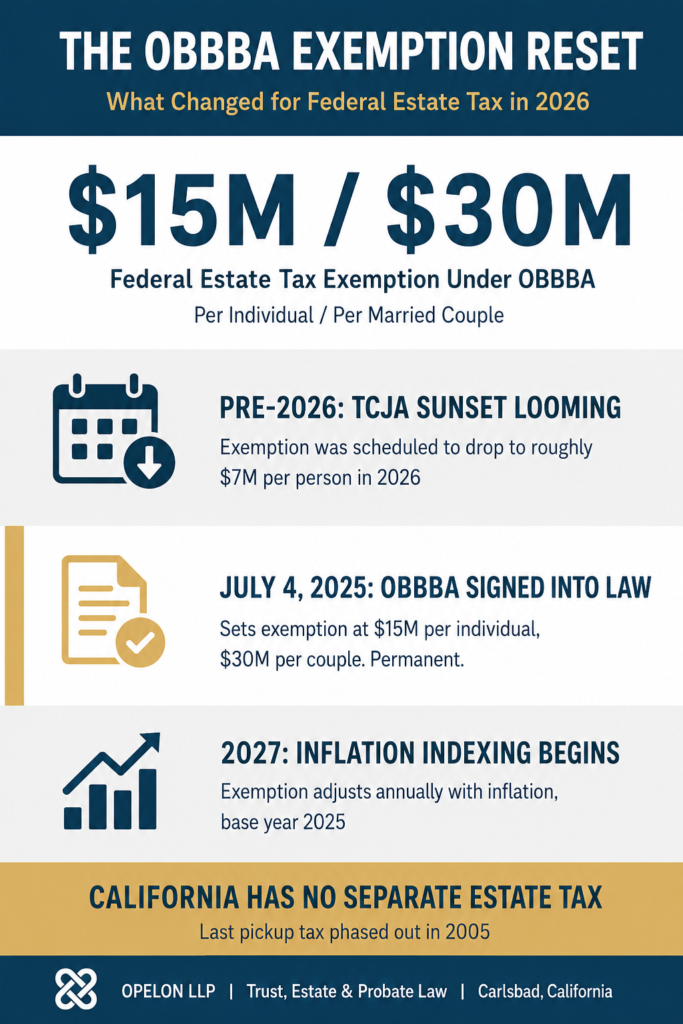
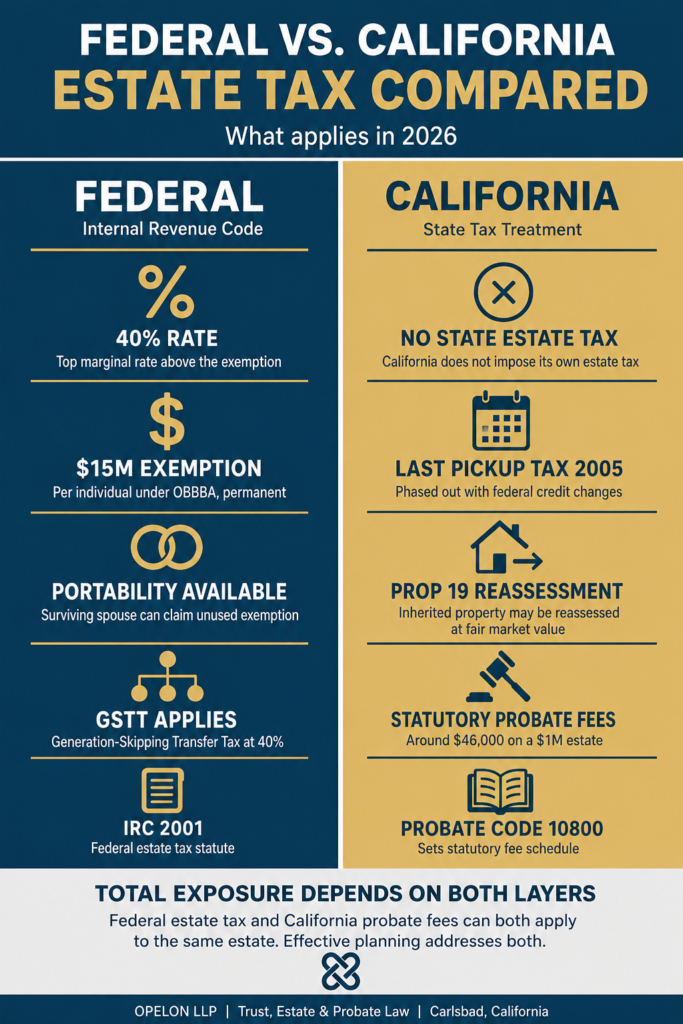
No. California has no state estate tax. The last California state estate tax phased out in 2005 when the federal credit it relied on was repealed. As of 2026, only the federal estate tax applies to California estates.
Several state-tax proposals have been introduced over the years, but none have passed. The headline rule is simple: the federal estate tax is the only estate tax that applies to California families.
This can be a meaningful planning advantage. California is one of 38 states with no state estate tax. Compare this to Oregon (which generally taxes estates over $1 million), Washington, Hawaii, Massachusetts, and New York. Each of those states imposes a state-level estate tax with much lower exemptions than the federal threshold. California domiciliaries generally avoid that additional layer, though planning may still be needed for property held in a state with its own estate or inheritance tax.
The other side of the picture matters too. California still imposes high statutory probate fees on probate-administered estates (Probate Code 10800 and 10810). Those sections apply identical sliding scales to both the personal representative and the attorney.
On a $1 million gross probate estate (calculated on the inventory value before deducting debts and most encumbrances), combined statutory compensation for the personal representative and the attorney reaches approximately $46,000. That figure does not include court filing fees, probate referee fees, bond premiums, publication costs, or any extraordinary fees the court may award under Probate Code Sections 10801 and 10811. This is why most California families use revocable living trusts to avoid probate, even though no state estate tax applies.
California also taxes income retained inside an irrevocable trust (FTB Form 541). That issue is separate from estate tax and we cover it in a later section.
Federal Estate Tax Under OBBBA (2026 and Beyond)
The 2026 federal estate tax exemption is $15 million per individual, or up to $30 million per couple with portability under IRC 2010(c). The exemption is permanent and indexed for inflation starting 2027. The federal estate tax rate above the exemption is 40 percent under IRC 2001.
The One Big Beautiful Bill Act (OBBBA) was signed into law on July 4, 2025. It made the elevated federal estate tax exemption permanent. Here are the figures every California family should know.
2026 federal estate tax exemption: $15 million per individual. A married couple may have a combined exemption of up to $30 million through portability under IRC 2010(c) (if a timely Form 706 is filed and portability is properly elected). The exemption is indexed for inflation starting in 2027. The federal estate tax rate above the exemption is 40 percent (IRC 2001).
The shift here is important. Under the Tax Cuts and Jobs Act of 2017, the elevated exemption was scheduled to sunset at the end of 2025. Many families spent the last few years racing to fund SLATs and other gifting trusts before that deadline. OBBBA eliminated the sunset.
The strategic case for HNW gifting trusts is now different. The reasons to use exemption today are:
- Lock in current exemption levels against future legislative change. Permanent only lasts until Congress changes the law again.
- Remove future appreciation from the taxable estate. Gifted assets grow outside the estate.
- Generation-skipping transfer planning to extend wealth across multiple generations.
- Possible Asset protection benefits that come with properly drafted irrevocable trusts.
What is no longer true: there is no sunset deadline. There is no “use it or lose it” pressure. Families with meaningful wealth can plan thoughtfully rather than reactively.
For more information on the federal estate and gift tax, see the IRS Estate and Gift Taxes resource page.
Who Needs California Estate Tax Planning?
Most California families will not owe federal estate tax because the federal exemption is high. However, many still need estate planning for probate avoidance, incapacity planning, beneficiary coordination, asset protection, and income tax basis considerations. That said, the transfer-tax-driven planning conversation looks different at different estate sizes.
Under $1 million. Many California families fall here. A common package is a revocable living trust, a pour-over will, a durable power of attorney, and an advance health care directive, with probate avoidance often a key goal. Federal estate tax planning is typically not needed at this level, but planning can still be important for non-tax reasons.
$1 million to $5 million. Standard estate plan with attention to probate avoidance, step-up in basis at death (IRC 1014), and beneficiary designation coordination. An annual gifting program is optional.
$5 million to $13 million per person. Same as above, plus active monitoring of federal exemption changes. An ILIT may make sense for life insurance over a few million dollars. An annual gifting program is recommended. SLAT planning may apply for HNW couples in second-marriage or asset-protection situations.
$13 million to $30 million per couple (inside OBBBA exemption). Active estate tax planning is appropriate. Annual exclusion gifting (IRC 2503), lifetime exemption gifting through SLAT, GRAT, or ILIT structures, and Generation-Skipping Trust planning all come into play. The goal is to lock in the current exemption against future legislative change.
Over $30 million per couple (above OBBBA exemption). Sophisticated planning is required. Combinations of SLAT, GRAT, QPRT, ILIT, FLP or FLLC, charitable trusts (CRT, CLT), and Generation-Skipping Trusts. These plans coordinate with trust situs choices, business succession planning, and structured lifetime gifting.
Waiting until the estate is already over the exemption typically costs the family significant tax dollars they could have avoided.
Federal Gift Tax: Annual Exclusion and Lifetime Exemption
The 2026 annual gift tax exclusion is $19,000 per donee, the same as 2025. A married couple can split gifts under IRC 2513 to give $38,000 per donee per year. The lifetime gift tax exemption is $15 million per individual under OBBBA, unified with the estate tax exemption.
The federal gift tax (IRC 2501 et seq.) applies to gifts during life. It is unified with the estate tax under IRC 2010, so the two share a single lifetime exemption.
Annual Gift Tax Exclusion (2026)
$19,000 per donee per year. A married couple can elect gift-splitting under IRC 2513 to give $38,000 per donee per year. There is no limit on the number of donees.
Annual exclusion gifts do not use any lifetime exemption and generally do not require a gift tax return (Form 709). Split gifts always require both spouses to file Form 709 to consent to gift-splitting. Gifts to certain trusts and gifts of future interests do not qualify for the annual exclusion and require Form 709. The 2026 figure is the same as 2025 because the IRS held the inflation-adjusted amount steady. For the most current guidance, see the IRS gift tax FAQs.
Lifetime Gift Tax Exemption
$15 million per individual under OBBBA. This is the same as the estate tax exemption (they are unified under IRC 2010). Gifts above the annual exclusion erode the lifetime exemption dollar-for-dollar.
Tuition and Medical Expenses (Unlimited)
Direct payments for tuition and medical expenses (IRC 2503(e)) are unlimited. They do not count against the annual exclusion or the lifetime exemption. The payment must go directly to the school or medical provider, not to the beneficiary.
529 Plan Front-Loading
A special election under IRC 529(c)(2)(B) allows five years of annual exclusion gifts to a 529 plan in a single year. For 2026, that is $95,000 per donee per individual donor, or $190,000 for a married couple electing gift-splitting. This is a useful tool for grandparents funding college education.
Generation-Skipping Transfer Tax (GSTT)
The 2026 GSTT exemption is $15 million per individual under OBBBA, the same as the estate tax exemption. The GSTT rate above the exemption is 40 percent. The GSTT exemption is not portable between spouses.
The generation-skipping transfer tax (IRC 2601 et seq.) applies to transfers that skip a generation. The classic example is a grandparent gifting directly to a grandchild.
2026 GSTT exemption: $15 million per individual under OBBBA, the same as the estate tax exemption. The GSTT rate above the exemption is 40 percent. Importantly, the GSTT exemption is not portable between spouses. Each spouse must use their own GSTT exemption during life or at death.
Why does GSTT exist? Without it, families could avoid one layer of estate tax by transferring directly to grandchildren. GSTT closes that loophole.
The most powerful GSTT strategy is allocating exemption to a long-term Generation-Skipping Trust (sometimes called a dynasty trust). Allocating exemption at funding locks in the protection. The trust assets can grow far beyond the exemption over decades, and that appreciation is sheltered from estate tax at each generational level.
California follows the Uniform Statutory Rule Against Perpetuities, codified at Probate Code Sections 21200 through 21231. Under Probate Code Section 21205, a nonvested property interest is valid if it either (i) is certain to vest or terminate within 21 years after the death of an individual alive at the trust’s creation, or (ii) actually vests or terminates within 90 years after creation. The 90-year alternative supports meaningful multi-generational dynasty planning, although California’s window is shorter than that of perpetual-trust jurisdictions like South Dakota, Delaware, or Nevada.
Step-Up in Basis at Death (Capital Gains Planning)
Under IRC 1014, the income tax basis of an inherited asset is reset to fair market value at the date of death. Built-in capital gains during the decedent’s life are eliminated. For California community property, both halves get a step-up at the first spouse’s death under IRC 1014(b)(6).
For families under $30 million, the step-up in basis is often the single most valuable tax benefit at death. It is more important than the estate tax exemption for many of our HNW San Diego County clients. Here is how it works.
The rule (IRC 1014): the income tax basis of an inherited asset generally resets to fair market value at the date of death. The alternate valuation date under IRC 2032 may apply in some cases. Built-in capital gains during the decedent’s life are generally eliminated for income tax purposes. Heirs who sell soon after death typically do not pay capital gains tax on pre-death appreciation (subject to post-death changes in value and other rules).
Community Property Double Step-Up
This is a major California advantage. Under IRC 1014(b)(6), at the death of one spouse in a community property state, both halves of the community property receive a step-up. This is significantly better than the basis treatment of joint tenancy or separate property in non-community-property states.
Strategic Trade-Off vs. Lifetime Gifting
Here is where families make the most expensive mistake. Lifetime gifting removes assets from the donor’s estate (saving estate tax). But the donee inherits the donor’s basis with no step-up. For appreciated assets, holding until death may be more tax-efficient than gifting them. The right answer depends on the family’s total estate size, asset appreciation rate, and time horizon.
Worked Example
A married couple owns $5 million in appreciated stock with a basis of $500,000. If they hold until the first death, both halves of the community property step up to $5 million. The $4.5 million of unrealized gain disappears.
If they gift the same stock during life, the donee inherits the $500,000 basis and pays capital gains tax when they sell.
For sub-$30 million families, this trade-off often points toward holding appreciated assets and using annual exclusion gifts, rather than aggressive lifetime gifting. For families well above the exemption, gifting still makes sense because the estate tax savings outweigh the basis loss.
Portability Between Spouses (DSUE)
Portability (IRC 2010(c)) lets a surviving spouse use the deceased spouse’s unused estate tax exemption (DSUE). It requires filing IRS Form 706 at the first death even if no tax is owed. Portability is not available for the GSTT exemption.
Portability (IRC 2010(c)) lets a surviving spouse use the deceased spouse’s unused estate tax exemption. The technical name is the Deceased Spousal Unused Exclusion, or DSUE. Here is what families need to know.
To preserve portability, the surviving spouse must file IRS Form 706 at the first death. This is required even if no estate tax is owed and the estate is well under the exemption. This is an elective filing required only to “port” the DSUE to the surviving spouse. Many families miss this step and lose millions in available exemption.
A married couple with combined assets under $30 million can usually rely on portability rather than complex A-B trust structures. That said, portability is not a complete substitute for credit shelter trust planning. Several scenarios still favor an A-B trust:
- Asset growth advantage. Assets in a credit shelter trust grow outside the surviving spouse’s estate. The DSUE is not indexed for inflation.
- Blended families. A credit shelter trust locks in the remainder beneficiaries from the first marriage.
- GST exemption preservation. The GSTT exemption is not portable. Each spouse must use their own.
- Asset protection. Trust assets can be protected from a surviving spouse’s future creditors or remarriage.
- The remarriage trap. Portability is preserved only as to the most recent deceased spouse. If the surviving spouse remarries and the new spouse predeceases, the DSUE from the first spouse may be lost.
The right answer depends on the family. For most California couples under $30 million, portability is sufficient. For HNW couples or families with the scenarios above, a credit shelter trust still makes sense.
For a focused quick-reference companion that summarizes the current-year federal exemption figures, see our page
10 Estate Tax Planning Strategies for California Families
Below is a summary of the 10 strategies we use most often for HNW California families. Each strategy has a dedicated section after the table.
# | Strategy | Best For | Reversibility |
1 | Annual Exclusion Gifting | All HNW families | Reversible (annual choice) |
2 | Spousal Lifetime Access Trust (SLAT) | Married couples, $13M+ | Irrevocable |
3 | Grantor Retained Annuity Trust (GRAT) | Rapidly appreciating assets | Irrevocable |
4 | Qualified Personal Residence Trust (QPRT) | Personal residences | Irrevocable |
5 | Substantial life insurance | Irrevocable | |
6 | Charitable Remainder Trust (CRT) | Highly appreciated assets, charitable goals | Irrevocable |
7 | Charitable Lead Trust (CLT) | Charitable goals, wealth transfer | Irrevocable |
8 | Generation-Skipping Trust | Multi-generation wealth | Irrevocable |
9 | Family Limited Partnership / FLLC | Operating businesses, real estate | Modifiable |
10 | A-B (Bypass / Credit Shelter) Trust | Married couples, blended families | Becomes irrevocable at first death |
1. Annual Exclusion Gifting Program
A systematic gifting program uses the $19,000 per donee annual exclusion (IRC 2503(b)) to remove assets from the taxable estate without using any lifetime exemption. This is the simplest and most reversible HNW strategy.
A married couple gifting to four children and eight grandchildren can transfer $456,000 per year. That math is $38,000 (split gift) times 12 donees. No gift tax return is required if the gifts qualify for the annual exclusion.
An annual gifting program can be combined with 529 plan front-loading (IRC 529(c)(2)(B)) and direct tuition and medical payments (IRC 2503(e)). Together, these tools can move meaningful wealth out of the taxable estate over a decade or two. Opelon coordinates annual gifting programs as part of HNW estate planning.
2. Spousal Lifetime Access Trust (SLAT)
A SLAT is an irrevocable trust funded by one spouse (the donor) for the benefit of the other spouse and descendants. The other spouse is the beneficiary spouse. The donor uses lifetime exemption to fund the trust. Future appreciation is removed from the taxable estate. The beneficiary spouse can receive distributions during life, providing indirect access.
The technical authorities are IRC 2511 (gift tax), and Chapter 14 valuation rules under IRC 2701 to 2704 (which apply to certain asset types). SLATs work because the donor gives up control, but the donor’s spouse retains beneficial access.
Reciprocal trust doctrine warning. If both spouses create SLATs for each other with substantially identical terms, the IRS can collapse them under the reciprocal trust doctrine (United States v. Estate of Grace). Each spouse is then treated as the owner of their own trust. The estate tax benefit disappears. To avoid this, the trusts must be meaningfully different in funding date, terms, beneficiaries, and trustee structure.
Post-OBBBA, SLATs remain a powerful HNW gifting strategy. The strategic case is now about locking in current exemption levels, removing future appreciation, and providing indirect spousal access. This is a long-horizon planning tool, not a sunset-deadline play. Opelon drafts SLATs as part of HNW estate planning.
3. Grantor Retained Annuity Trust (GRAT)
A GRAT is an irrevocable trust where the grantor retains an annuity payment for a fixed term. After the term ends, the remainder passes to beneficiaries (typically children). The technical authority is IRC 2702.
The “zeroed-out” technique sets the annuity at a level designed to leave a near-zero gift tax value at funding. All asset appreciation above the IRC 7520 hurdle rate transfers to beneficiaries gift-tax-free. GRATs work best when the IRC 7520 rate is low, because a low hurdle rate increases the chance of beating it.
Mortality risk. If the grantor dies during the GRAT term, the entire trust is pulled back into the taxable estate (IRC 2036). Shorter terms reduce mortality risk but provide less appreciation transfer. Many HNW planners use rolling short-term GRATs to manage this.
GRATs work especially well for rapidly appreciating assets: pre-IPO stock, marketable securities in low-rate environments, and private business interests. Opelon drafts GRATs as part of HNW estate planning.
4. Qualified Personal Residence Trust (QPRT)
A QPRT is an irrevocable trust that holds the grantor’s personal residence. The grantor retains the right to live in the residence for a fixed term. The technical authority is IRC 2702(a)(3)(A).
After the term, the residence passes to the remainder beneficiaries. The grantor can lease the residence back at fair market rent, which further removes assets from the estate. The gift tax value at funding is the present value of the remainder interest, discounted from fair market value using IRC 7520 tables. This is typically 30 to 60 percent of fair market value, depending on the term and the grantor’s age.
Mortality risk. If the grantor dies during the QPRT term, the residence is pulled back into the estate (IRC 2036). The term must be set carefully against actuarial life expectancy.
California-specific issue. Prop 13 base-year value transfers and Prop 19 reassessment rules interact with QPRT planning. Transferring a primary residence to a QPRT may trigger reassessment unless the structure carefully preserves the parent-child exclusion. We address Prop 19 in detail in a later section. Opelon drafts QPRTs as part of HNW estate planning.
5. Irrevocable Life Insurance Trust (ILIT)
An ILIT owns a life insurance policy on the grantor’s life. The death benefit is removed from the taxable estate. The technical authority is IRC 2042, which would otherwise pull the death benefit into the estate if the decedent owned the policy. The ILIT works around this by holding ownership in the trust.
Crummey notices (Crummey v. Commissioner) qualify gifts to the trust for the annual exclusion. This allows the grantor to fund premiums via annual exclusion gifts without using lifetime exemption.
Three-year lookback rule (IRC 2035(a)). If an existing policy is transferred to the ILIT within three years before the grantor’s death, the death benefit is pulled back into the estate. The fix is to have the ILIT buy a new policy directly, avoiding the lookback entirely.
ILITs work best for estates with substantial life insurance and a need for liquidity. Common uses include paying estate tax, funding buy-sell agreements, and equalizing distributions among heirs with different needs. Opelon drafts ILITs as part of HNW estate planning.
6. Charitable Remainder Trust (CRT)
A CRT pays an annuity or unitrust amount to non-charitable beneficiaries for a term, with the remainder passing to charity. The technical authority is IRC 664. There are two main types: the CRAT (Charitable Remainder Annuity Trust, fixed annuity) and the CRUT (Charitable Remainder Unitrust, percentage of assets revalued annually).
The tax benefits stack:
- An immediate income tax deduction for the present value of the charitable remainder.
- Capital gains avoidance on appreciated assets contributed to the trust. The CRT can sell tax-free.
- An income stream to the non-charitable beneficiary during the term.
- A charitable estate tax deduction at death.
CRTs work best for HNW families with highly appreciated assets and genuine charitable goals. Opelon drafts CRTs as part of HNW estate planning.
7. Charitable Lead Trust (CLT)
A CLT is the mirror of a CRT. The charity receives the income stream for a term, with the remainder passing to family. The technical authorities are IRC 170(f)(2)(B), 2055(e)(2), and 2522(c)(2). The two main types are the CLAT (Charitable Lead Annuity Trust) and the CLUT (Charitable Lead Unitrust).
CLTs work best for HNW families with charitable goals and a desire to transfer wealth to the next generation at reduced gift tax cost. Like GRATs, CLATs are most effective when the IRC 7520 rate is low. Opelon drafts CLTs as part of HNW estate planning.
8. Generation-Skipping Trust (Dynasty Trust)
A Generation-Skipping Trust is a long-term trust designed to benefit multiple generations of descendants. The grantor’s GSTT exemption is allocated to the trust at funding to insulate it from generation-skipping transfer tax (IRC 2601 et seq.).
The 2026 GSTT exemption is $15 million per individual under OBBBA, permanent and indexed for inflation starting 2027. California Probate Code Section 21205 permits trust interests to vest or terminate within 90 years after creation as one of two alternative validating rules. That window supports real multi-generational planning.
The strategic case is straightforward. Skip a generation of estate tax. Lock in current exemption levels. Provide long-term asset protection for grandchildren and beyond. Opelon drafts Generation-Skipping Trusts as part of HNW estate planning.
9. Family Limited Partnership / Family LLC (FLP / FLLC)
An FLP or FLLC is a family-owned entity that holds investment assets, real estate, or business interests. The estate tax benefit comes from valuation discounts, typically 20 to 35 percent, for lack of marketability and lack of control on minority interest gifts.
The technical authorities are IRC 2036(a) (retained-control inclusion risk) and IRC 2704 (special valuation rules for family transfers).
Honest framing. FLPs and FLLCs work when the family treats them as real businesses, not just tax shells. The IRS regularly challenges aggressive valuation discounts when the entity lacks economic substance. The required discipline includes real economic purpose, formal meetings, separate accounting, market-rate management compensation, and no commingling with personal expenses.
Aggressive structures invite IRS audit and may collapse under the IRC 2036(a) “implied agreement” theory. Many of the most punishing tax court losses in this area involve families who treated the entity as a shell rather than an operating business. Opelon advises on FLP and FLLC structures as part of HNW estate planning, but only when there is real non-tax purpose.
10. A-B (Bypass / Credit Shelter) Trust
An A-B trust is a married-couple structure. At the first spouse’s death, the deceased spouse’s exemption funds an irrevocable trust (the “Bypass” or “B” trust). The Bypass trust benefits the surviving spouse and descendants. The technical authorities are IRC 2056 (marital deduction) and IRC 2010 (unified credit).
A-B trusts lost some favor after IRC 2010(c) portability became effective in 2011 (made permanent by the American Taxpayer Relief Act of 2012). Today, they remain useful in specific scenarios:
- Blended families wanting to lock remainder beneficiaries.
- GST exemption preservation in the deceased spouse’s name (portability is not available for GSTT).
- Asset protection from a surviving spouse’s future creditors or remarriage.
- Asset growth advantage. Assets in the Bypass trust grow free of further estate tax. The DSUE is not indexed for inflation.
For California-specific planning, the lack of a state estate tax means A-B trusts are less common than in states like Oregon or Massachusetts. They remain valuable for families with the scenarios above. Opelon drafts A-B trusts as part of HNW married-couple estate planning.
California-Specific Considerations
California Has No State Estate Tax (Comparison to Other States)
California has no state estate tax, in contrast to several states with much lower exemptions. Oregon generally taxes estates over $1 million. Washington’s exemption is $3,076,000 for deaths between January 1, 2026 and June 30, 2026, then $3,000,000 for deaths on or after July 1, 2026 (with a top rate of up to 35 percent). Hawaii is around $5.49 million. Massachusetts is $2 million. New York is $7.35 million for 2026 with a “cliff” rule. If the estate exceeds the exemption by more than 5 percent, the entire exemption is lost.
Strategic implication: California-domiciled HNW families avoid one layer of state-level estate tax that residents of those states must plan around. This is a meaningful planning advantage.
Prop 13 Base-Year Value (California Real Estate)
California Constitution Article XIII A locks the property tax base-year value at the time of acquisition. Annual increases are capped at 2 percent. For HNW families holding California real estate over decades, the gap between Prop 13 base value and current market value can be enormous.
Estate planning consideration: parent-to-child transfers historically preserved Prop 13 base value through the parent-child exclusion. Prop 19, effective February 16, 2021, significantly limited that benefit.
Prop 19 Parent-Child Reassessment Cap
Prop 19 (California Constitution Article XIII A, Section 2.1; Revenue and Taxation Code 63.2) restricts the parent-child reassessment exclusion. The current inflation-adjusted cap is $1,044,586 added to the parent’s factored base year value. This figure applies to transfers between February 16, 2025 and February 15, 2027 (Letter to Assessors No. 2025/009). The Board of Equalization adjusts it every two years.
Two strict requirements apply:
- Primary residence requirement. The child must occupy the home as their primary residence within one year of the transfer.
- Cap calculation. If the home’s current market value exceeds the parent’s factored base year value plus $1,044,586, the excess is added to the child’s new assessed value.
Practical effect: California real estate held by HNW families now faces meaningful reassessment risk at parent-child transfer. The parent-child exclusion is no longer available for most non-primary-residence property (such as many vacation homes, rentals, and other investment property), and primary-residence transfers must satisfy strict requirements.
Filing requirement. Form BOE-19-P must be filed within three years of the transfer date or before transfer to a third party, whichever comes first, to obtain the exclusion retroactive to the transfer date (Rev. & Tax. Code Section 63.1(c)(1)). A claim filed within six months after the mailing of a supplemental or escape assessment notice for the transfer is also timely. Late filings outside these windows may still be granted under Section 63.1(c)(2), but only with prospective effect from the date of filing forward.
Common planning strategies in this area include QPRTs and carefully structured family LLCs. Some families plan to ensure the inheritor uses the property as a primary residence. Family LLC structuring requires careful attention to Revenue and Taxation Code 64.
For more detail, see our Prop 19 inherited property guide and the California Board of Equalization Prop 19 page.
California Income Tax on Trust Accumulated Income
Irrevocable trusts that accumulate income (rather than distributing it currently) are subject to California income tax. The relevant filing is FTB Form 541, the California fiduciary income tax return. California taxes trust income based on residency factors of trustees and beneficiaries (Revenue and Taxation Code 17742-17745).
Planning implication: trust situs choices and trustee selection can affect California state income tax exposure. For HNW dynasty trust planning, this issue often drives trustee structure decisions. We coordinate with the family’s CPA on these questions.
How Much Does California Estate Tax Planning Cost?
Standard estate plans run $2,500 to $3,500 (Opelon flat fee). HNW packages with SLAT, GRAT, ILIT, or GST components range from $5,000 to $50,000 depending on complexity. The fee is typically a small fraction of the eventual tax savings.
Estate tax planning fees can be a small fraction of potential tax savings when an estate is expected to be taxable. A properly structured and administered $5 million SLAT funded today may remove that $5 million plus future appreciation from the donor’s taxable estate. At the 40 percent federal rate, the potential estate tax avoided on $5 million that would otherwise be taxable is $2 million, and the savings can grow as the assets appreciate. The planning fee is rarely the bottleneck.
Below are typical Opelon flat-fee ranges by package type. Final pricing depends on complexity, asset mix, and coordination requirements.
Package Type | Typical Fee Range |
Standard estate plan (will, trust, POA, AHCD, HIPAA), no tax planning | $2,500 single / $3,500 married |
Annual gifting program setup and ongoing advice | $2,000 to $5,000+ |
SLAT or ILIT (single trust) | $5,000 to $10,000+ |
GRAT or QPRT | $7,500 to $15,000+ |
Charitable Remainder Trust or Charitable Lead Trust | $5,000 to $12,000+ |
Generation-Skipping Trust | $7,500 to $20,000+ |
Comprehensive HNW package (multiple coordinated trusts) | $15,000 to $50,000+ |
FLP / FLLC formation and transfer documentation | $7,500 to $25,000 |
The cost of not doing tax planning when needed is significant. A $5 million estate above the OBBBA exemption faces $2 million in federal estate tax at the 40 percent rate. A $20 million estate above the exemption faces $8 million. The math typically favors planning by a wide margin once the estate is approaching the exemption.
Common HNW Estate Tax Planning Mistakes
In our experience working with HNW San Diego County families, the same mistakes come up year after year. Here are the most common ones, with the reasons behind each.
- Doing nothing because “the exemption is high enough.” OBBBA made the exemption permanent, but Congress can change the law again. HNW families should plan around current law without assuming it lasts forever.
- Reciprocal SLATs that mirror each other too precisely. The Estate of Grace doctrine allows the IRS to collapse SLATs when the terms are substantially identical. This is the single most expensive mistake we see. Trusts must be meaningfully different in funding, terms, beneficiaries, and trustee structure.
- Three-year ILIT lookback (IRC 2035(a)). Transferring an existing policy to an ILIT within three years of death pulls the death benefit back into the estate. The fix is to have the ILIT buy a new policy directly.
- Crummey notice failures. Failing to send required Crummey notices defeats annual exclusion qualification for ILIT funding. The notices must be timely and documented.
- Aggressive FLP / FLLC structures without real economic substance. The IRS may challenge valuation discounts and may seek estate inclusion under IRC 2036(a) based on facts suggesting retained enjoyment or an implied agreement. The discipline of real economic substance and proper administration is critical.
- Forgetting Prop 19 reassessment when transferring California real estate. Many HNW plans drafted before 2021 still assume the old parent-child exclusion. Prop 19 changed the rules. The plan needs updating.
- Failing to file Form 706 at the first spouse’s death to preserve portability. Portability generally requires a timely Form 706 and a proper portability election even when no estate tax is owed. If you do not file (or do not qualify for late relief), you may lose access to the DSUE. We have seen families lose seven-figure portability benefits by missing this filing.
- Ignoring step-up in basis (IRC 1014). Gifting appreciated assets that should have been held until death for the basis step-up. For sub-$30 million families, this is often the most expensive mistake.
- Naming a non-citizen surviving spouse without QDOT planning. The unlimited marital deduction (IRC 2056) does not apply when the surviving spouse is not a U.S. citizen. A Qualified Domestic Trust (IRC 2056A) is required.
- State income tax on trust accumulated income. Choosing a trustee or trust situs without considering California Revenue and Taxation Code 17742-17745. Poor planning can subject the trust to California income tax that better structuring would have avoided.
When to Hire a California Estate Tax Planning Attorney
You probably need a California estate tax planning attorney if any of the following apply to your situation:
- Your individual estate is approaching $13 million, or your couple estate is approaching $30 million.
- Your assets include significant appreciation potential, such as pre-IPO stock, a growing business, or a real estate portfolio.
- You own a business and need succession planning coordinated with tax planning.
- You own significant California real estate and want to plan around Prop 19 reassessment.
- You have charitable goals you want to integrate with tax planning.
- You have a non-citizen spouse and need QDOT planning (IRC 2056A).
- You have grandchildren and want Generation-Skipping Trust planning.
- You have life insurance policies over a few million dollars.
- Your heirs include children with significantly different financial situations and you want to equalize distributions tax-efficiently.
What to Look For in a California Estate Tax Planning Attorney
Estate tax planning is a specialized area within California estate planning. Generalist credentials are not enough. Consider these markers:
- California Bar admission in good standing. Owen is admitted in California (Bar #236974, admitted 2005).
- L.L.M. in Taxation. This is the specialized graduate credential for tax law. Owen earned his LL.M. in Taxation from the University of San Diego School of Law.
- Coordination with CPA, family office, and business advisors. Estate tax planning rarely happens in isolation. The right attorney works alongside the rest of your professional team.
- Experience with your specific situation. Business succession, real estate portfolios, charitable goals, and multi-generational planning each have specific patterns.