


If you are planning to inherit a home in California, or if your parents are considering how to pass their property to you, Prop 19 changed the rules in ways that could cost your family thousands of dollars every year.
Before Proposition 19 took effect on February 16, 2021, children could inherit their parents’ California home, rental properties, and other real estate and keep the low property tax bill their parents had been paying for decades under Proposition 13. That benefit is now gone for most inherited properties in the state.
For San Diego County families in Carlsbad, Oceanside, Escondido, and throughout North County, understanding how Prop 19 affects inherited property in California is essential to protecting your family’s financial future. This guide explains what changed, what limited exclusions still exist under Revenue and Taxation Code Section 63.2, and what estate planning strategies can help. If you need a California revocable living trust or other estate planning tools to address Prop 19, Opelon LLP in Carlsbad can help.
TL;DR: Prop 19 and Inherited Property in California |
|
What Is Proposition 19 in California?
Proposition 19 is a California constitutional amendment, approved by voters on November 3, 2020, that changed how inherited property is taxed for property tax purposes. The law, codified in Revenue and Taxation Code Section 63.2, took effect on February 16, 2021. It replaced the previous rules under Propositions 58 and 193, which had allowed children and grandchildren to inherit real property without triggering a property tax reassessment.
Prop 19 has two main components:
- The first restricts the parent-child and grandparent-grandchild property tax exclusion, making it much harder for families to pass property to the next generation without a tax increase.
- The second expands the ability of homeowners age 55 and older, severely disabled homeowners, and wildfire victims to transfer their property tax base to a new home anywhere in California.
This article focuses on the first component: how Prop 19 affects families inheriting property in California. For San Diego County families, the impact has been significant. Homes purchased decades ago at prices that seem modest today now carry assessed values far below current market value. When those homes change hands, the property tax bill can increase dramatically.
Want to see how Prop 19 hits your inherited home? Try our free California Prop 19 Calculator for an instant estimate of the new assessed value and annual property tax.
How Did Prop 19 Change the Parent-Child Property Tax Exclusion?
Before Prop 19 took effect, California’s Proposition 58 (1986) and Proposition 193 (1996) allowed parents to transfer real property to their children, and grandparents to grandchildren in limited cases, without triggering a property tax reassessment. The old rules were generous. A parent could pass their primary residence to a child regardless of value, and the child did not need to live in the home. Parents could also transfer up to $1 million in assessed value of other real property, including rental homes, vacation properties, and commercial real estate, without reassessment.
Proposition 19 dramatically narrowed this exclusion. The following table compares the old rules to the current Prop 19 rules for inherited property in California.
| Factor | Old Rules (Prop 58/193) | Current Rules (Prop 19) |
| Primary residence | Excluded from reassessment regardless of value; child did not need to live there | Excluded only if child moves in within 1 year and makes it their primary residence; capped at assessed value + $1,044,586 |
| Rental/investment property | Up to $1 million in assessed value excluded from reassessment | No exclusion. Fully reassessed to current market value at time of transfer |
| Grandchild transfers | Allowed if all parents of the grandchild who were children of the grandparent were deceased | Same prerequisite applies, plus all Prop 19 restrictions (primary residence, move-in requirement, value cap) |
| Child required to move in? | No | Yes, within 1 year of transfer |
| Value cap | No cap on primary residence; $1M assessed value cap on other property | Assessed value + $1,044,586 (inflation-adjusted through Feb. 15, 2027) |
| Filing deadline | Claim required within 3 years | Homeowner’s exemption (Form BOE-266) required within 1 year of transfer; exclusion claim (Form BOE-19-P) required within 3 years of transfer or before transfer to a third party |
How Does the Prop 19 Parent-Child Exclusion Work?
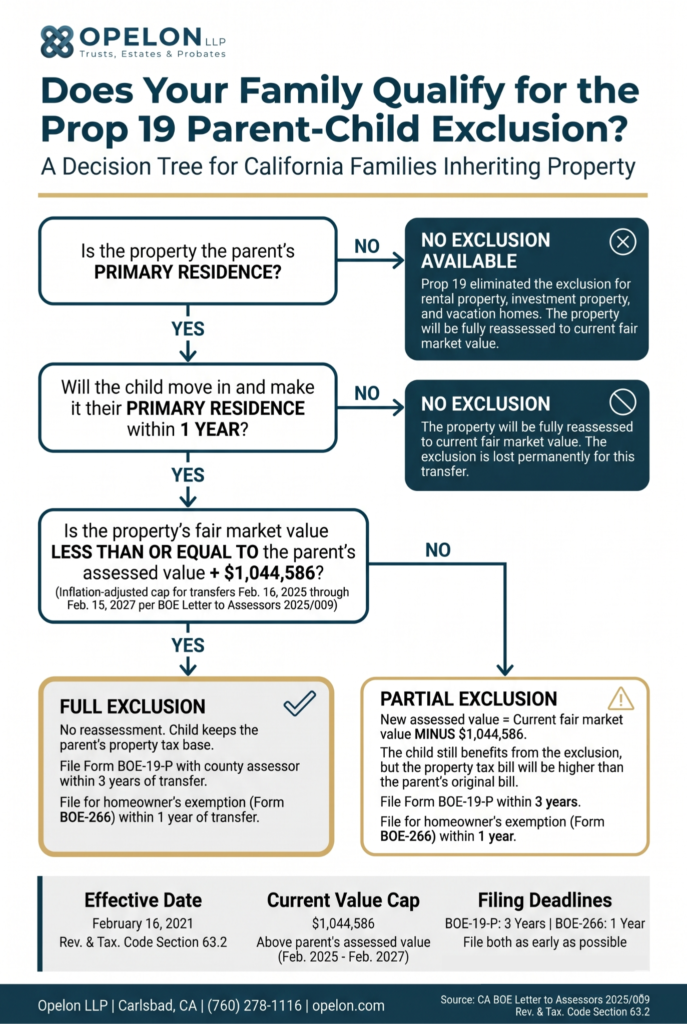
Under current California law, a parent can still transfer their primary residence to a child without triggering a full property tax reassessment, but only if specific conditions are met.
Revenue and Taxation Code Section 63.2 sets out the requirements. Understanding each condition is critical for San Diego County families who want to preserve their parents’ low property tax base.
The Child Must Make It Their Primary Residence
The child receiving the property must file for a homeowner’s exemption and establish the inherited home as their own primary residence within one year of the transfer date.
If the child does not move in within the deadline, the property will be reassessed to its full current market value, and the exclusion is lost permanently for that transfer.
The Value Cap Limits the Exclusion
Even when the child moves in, the exclusion is not unlimited. The property’s current fair market value cannot exceed the parent’s factored base year value (assessed value) plus $1,044,586.
This inflation-adjusted figure applies to transfers occurring between February 16, 2025 and February 15, 2027, as set by the California State Board of Equalization in Letter to Assessors No. 2025/009.
Here is how the calculation works in practice:
| Scenario Detail | Amount |
| Parent’s assessed value (factored base year value) | $150,000 |
| Current fair market value of home | $1,400,000 |
| Assessed value + exclusion cap | $150,000 + $1,044,586 = $1,194,586 |
| Does market value exceed the cap? | Yes ($1,400,000 > $1,194,586) |
| New assessed value for child | $1,400,000 – $1,044,586 = $355,414 |
| Without the exclusion (full reassessment) | $1,400,000 |
In this San Diego County example, the child still benefits from the exclusion, paying property taxes on an assessed value of $355,414 instead of the full $1,400,000 market value. But the tax bill is significantly higher than the parents’ original tax bill based on the $150,000 assessed value.
Filing Requirements Under Prop 19
To claim the parent-child exclusion under Prop 19, the child must file Form BOE-19-P (Claim for Reassessment Exclusion for Transfer Between Parent and Child) with the county assessor in the county where the property is located. The exclusion claim must be filed within three years of the transfer date, or before the property is transferred to a third party, whichever comes first.
Separately, the child must file for a homeowner’s exemption (Form BOE-266) or disabled veterans’ exemption within one year of the transfer date to receive the exclusion retroactively from the date of transfer. Filing both forms as early as possible is the safest approach
For grandparent-to-grandchild transfers, the form is BOE-19-G. This exclusion is available only when all parents of the grandchild who qualify as children of the grandparent are deceased at the time of the transfer.
What Happens to Inherited Rental Property Under Prop 19?
Prop 19 eliminated the property tax exclusion for inherited rental property, investment property, vacation homes, and commercial real estate in California.
Under the previous Proposition 58 rules, parents could transfer up to $1 million in assessed value of non-primary-residence real property to their children without reassessment. That exclusion no longer exists.
When a child inherits a rental property in San Diego County today, the county assessor will reassess the property to its current fair market value. For a rental property purchased in the 1980s or 1990s with a low Proposition 13 assessed value, the reassessment can increase the annual property tax bill from a few thousand dollars to $15,000 or more per year. This tax increase has forced some California families to sell inherited rental properties they had planned to keep for generations.
Opelon LLP helps San Diego County families with estate planning strategies designed to address the property tax consequences of Prop 19 for rental and investment properties. While no strategy can fully replicate the old Proposition 58 exclusion, proactive planning can reduce the financial impact.
Does a Revocable Living Trust Protect Against Prop 19 Reassessment?
A California revocable living trust does not override Prop 19’s property tax reassessment rules. Property held in a revocable trust is still subject to reassessment when the trust creator (the settlor) dies and the property passes to the beneficiaries. The county assessor treats the transfer from the trust to the beneficiary the same as a direct parent-to-child transfer for Prop 19 purposes.
However, a revocable living trust is still the foundation of a sound California estate plan for other important reasons. A trust allows your family to avoid probate, which in California can cost approximately $46,000 in combined statutory attorney and personal representative fees for a $1 million estate under Probate Code Section 10800. It also keeps your asset distribution private and allows for continued management of your property if you become incapacitated.
The key point for California families is that trust planning and Prop 19 planning work together. Your trust controls how your assets are distributed and avoids probate. Prop 19 determines whether the property inside the trust gets reassessed when it passes to your children. Both issues need to be addressed in a comprehensive estate plan.
Estate Planning Strategies to Minimize Prop 19 Property Tax Impact
While no strategy can fully restore the old Proposition 58 benefits, California families can take steps to reduce the property tax consequences of Prop 19. Opelon LLP in Carlsbad works with San Diego County families on the following approaches.
Plan for the Primary Residence Exclusion
If a child intends to live in the family home, the family should plan to meet every Prop 19 requirement. This means ensuring the child will move in within one year of the parent’s death, filing Form BOE-19-P promptly, and applying for the homeowner’s exemption within the same one-year window. An estate planning checklist can help families organize these steps in advance.
Consider the Stepped-Up Basis Separately
Prop 19 affects property tax (assessed value for annual taxes). It does not change the federal income tax stepped-up basis rules under IRC Section 1014. When a parent dies, the child receives a stepped-up basis in the property equal to its fair market value at the date of death. This means if the child later sells the property, they owe capital gains tax only on any appreciation after the date of death, not on the decades of appreciation during the parent’s ownership.
Families should evaluate both the property tax impact (Prop 19) and the capital gains tax benefit (stepped-up basis) before making decisions about inherited property. In some cases, the stepped-up basis savings may offset the increased property taxes.
Review Your Full Estate Plan
Prop 19 makes comprehensive San Diego estate planning more important than ever. Families should review their trust documents, beneficiary designations, and overall asset allocation to ensure their plan accounts for current property tax rules. Opelon LLP offers flat-fee estate planning for families throughout San Diego County.
Is There a Prop 19 Repeal Effort in California?
Yes. A third attempt to repeal Proposition 19’s inheritance restrictions is currently underway. The initiative, titled “Fix Prop 19 to Save Our Children’s Future,” began circulating petitions in late 2025. If proponents collect approximately 875,000 valid signatures by the May 2026 deadline, the measure could appear on the November 2026 ballot.
If successful, the repeal would reinstate the old Proposition 58 and Proposition 193 rules. This would allow children to inherit a parent’s primary residence without reassessment regardless of value or whether the child moves in. It would also restore the $1 million exclusion for non-primary-residence real property.
Two previous repeal attempts in 2022 and 2024 failed to gather enough signatures. Supporters point to cases where property tax bills jumped from roughly $1,300 to $18,000 per year after a parent died, forcing heirs to sell family homes they had planned to keep. Opponents note that the California Legislative Analyst’s Office estimated a repeal could reduce state and local government revenue by $1 billion to $2 billion per year.
| California Note |
| • Until a repeal is passed and takes effect, current Prop 19 rules apply to all property transfers. Opelon LLP recommends that California families plan under existing law rather than waiting for a potential ballot measure that may or may not succeed. |
For trustees administering a trust that holds inherited property, California’s new AB 565 virtual representation law may simplify the notice process.
Related Guides
- California Estate Tax Planning Guide
- Your California Estate Planning Checklist
- California Step-Up in Basis and the Community Property Double Step-Up