


If you are researching California trusts before sitting down with an attorney, you are in the right place. Opelon LLP has designed more than 700 California trusts from our Carlsbad office. Our team has also administered more than 250 San Diego County estates. California has no state estate tax. But its statutory probate fees are among the highest in the country. That is why so many California families rely on trusts. Use the table of contents below to jump to the section you need.
Key Takeaways
- California has no state estate tax, but probate fees on a $1 million estate run roughly $46,000 under Probate Code 10800 and 10810. Trusts avoid that cost.
- A California revocable living trust is the default planning tool for most families. It avoids probate, keeps your affairs private, and allows ongoing control during your lifetime.
- The federal estate tax exemption is $15 million per individual and $30 million per married couple under the One Big Beautiful Bill Act (OBBBA). The exemption is permanent and indexed for inflation starting 2027.
- Specialty trusts (SLAT, GRAT, QPRT, ILIT, SNT, charitable trusts, GST trusts) solve specific tax, asset protection, or beneficiary problems. Most California families do not need them.
- An unfunded trust is the single most common reason California trusts fail to avoid probate. Funding is not optional.
What Is a Trust in California?
Quick Answer: A California trust is a legal arrangement where a settlor transfers assets to a trustee. The trustee then manages those assets for named beneficiaries under California Probate Code Division 9. The trust can take effect during your lifetime or at your death. |
Three roles drive every California trust:
- Settlor (also called grantor or trustor). This is the person who creates and funds the trust. In a typical California revocable living trust, the settlor is also the initial trustee and the primary beneficiary during their lifetime.
- The trustee holds legal title to the trust assets and manages them under California fiduciary law. Probate Code Sections 16000 through 16105 set the rules. The trustee owes duties of loyalty, prudence, and impartiality to the beneficiaries.
- The beneficiary holds equitable title and receives distributions from the trust. A trust can name current beneficiaries (people who receive distributions now) and remainder beneficiaries (people who inherit what is left).
Here is why trusts matter so much in California. California probate fees are not negotiated. They are set by statute in Probate Code Sections 10800 and 10810. The same sliding scale applies to both the personal representative and the attorney.
On a $1 million California estate, combined statutory fees total roughly $46,000. That figure does not include court filing fees or probate referee fees. California probate also typically takes 9 to 18 months from start to finish. A properly drafted and funded California revocable living trust avoids that entire process.
In our experience working with San Diego County families, the biggest reason California families create trusts is not federal estate tax planning. It is avoiding California probate. Privacy, control over how and when adult children inherit, and continuity if you become incapacitated all matter too. But probate avoidance is the headline benefit for most California households.
California trust law lives in Probate Code Division 9, Sections 15000 through 19403, which governs trust creation, trustee duties, beneficiary rights, modification, and termination. For a primer on the broader probate process this guide is designed to help you avoid, see our California probate guide. If you are still deciding whether you need a trust at all or whether a simple will is enough, start with our breakdown of the difference between a will and a trust. The California courts also publish a useful overview at selfhelp.courts.ca.gov/wills-and-trusts.
Read More: California Trusts Complete Guide
How Trusts Work in California
A California trust works in three stages: creation, funding, and administration. Each stage has specific legal requirements. Skip any of them and the trust may fail when you need it most.
Funding the Trust
Funding is the process of transferring legal title to your assets into the trust. Different assets require different methods.
- Real estate transfers require a recorded deed. The deed moves title from your name to the trust’s name.
- Bank and brokerage accounts require retitling. The account is reopened or restyled in the name of the trustee.
- Retirement accounts and life insurance use beneficiary designations. The trust is named as primary or contingent beneficiary. Before naming a trust as the beneficiary of an IRA or 401(k), review how post-death distributions will be taxed.
- Business interests transfer through assignment documents and updated entity records.
In our experience working with San Diego County families, the most common reason a trust fails to avoid probate is incomplete funding. People sign the trust document and assume the work is done. It is not. The trust controls only what you put into it.
Trustee Duties Under California Law
Probate Code Sections 16000 through 16105 set the trustee’s legal duties. The core duties are loyalty, prudence, impartiality, and full disclosure to beneficiaries.
Loyalty means the trustee acts solely in the best interest of the beneficiaries. Prudence means the trustee invests and manages assets the way a careful person would handle their own affairs. Impartiality means the trustee treats all beneficiaries fairly. Full disclosure means the trustee provides accountings and keeps beneficiaries reasonably informed.
When a Revocable Trust Becomes Irrevocable
A California revocable living trust becomes irrevocable at the death of the grantor. The successor trustee then takes over. The successor trustee notifies beneficiaries, inventories assets, pays final debts and taxes, and distributes what remains under the terms of the trust.
A pour over will acts as a safety net. It catches any assets that were not properly transferred to the trust during your lifetime. Those assets get directed into the trust at death. Pour over assets must still pass through probate if their value exceeds $208,850 (Probate Code 13100, effective April 1, 2025). That is why complete funding matters.
For a deeper walk-through of the funding process, see our guide to how to fund a California trust. For trustee responsibilities, see what does a trustee do and our overview of the California trust administration process.
Major Trust Categories
Before you can choose the right California trust, you need to understand the main ways trusts are classified. Three distinctions matter most.
Revocable vs. Irrevocable Trusts
The biggest division in trust law is whether the trust can be changed after it is created. The answer drives tax treatment, asset protection, and how much control you keep.
Feature | Revocable Trust | Irrevocable Trust |
Control | Settlor keeps full control. Can amend or revoke at any time. | Settlor gives up control. Changes require court action or beneficiary consent. |
Modifications | Allowed at any time during settlor’s life. | Generally not allowed. Limited modification under Probate Code 15403-15414. |
Tax Treatment | Grantor trust during settlor’s life. Income reports on settlor’s 1040. | Files its own returns on FTB Form 541 and IRS Form 1041. |
Asset Protection | None. Assets remain reachable by settlor’s creditors. | Strong. Properly structured trusts protect assets from creditors. |
Probate Avoidance | Yes, if properly funded. | Yes. Assets are no longer in the settlor’s estate. |
Estate Tax | Assets remain in taxable estate. | Assets generally removed from taxable estate. |
Most California families start with a revocable trust during their lifetime. High net worth families and clients with specific tax or asset protection goals add irrevocable trusts on top of the revocable foundation.
Living Trusts vs. Testamentary Trusts
A living trust takes effect during your lifetime. You sign it, fund it, and it operates immediately.
A testamentary trust is created by your will. It does not exist until you die and your will is probated. That is the problem. A testamentary trust must pass through probate first, which defeats one of the main reasons to use a trust in California. We rarely recommend testamentary trusts for California clients.
Funded vs. Unfunded Trusts
A funded trust holds assets that have been legally transferred into it. An unfunded trust is just a document. It controls nothing.
An unfunded trust is the single most common reason California trusts fail to avoid probate. To confirm your trust is funded, check three things. First, your real estate deeds should show the trustee as record owner. Second, your bank and brokerage statements should show the account titled in the name of the trustee. Third, your retirement and life insurance beneficiary designations should name the trust where appropriate. If any of those is missing, the trust is incomplete.
For step-by-step funding instructions, see our guide to funding a California trust.
14 Types of California Trusts
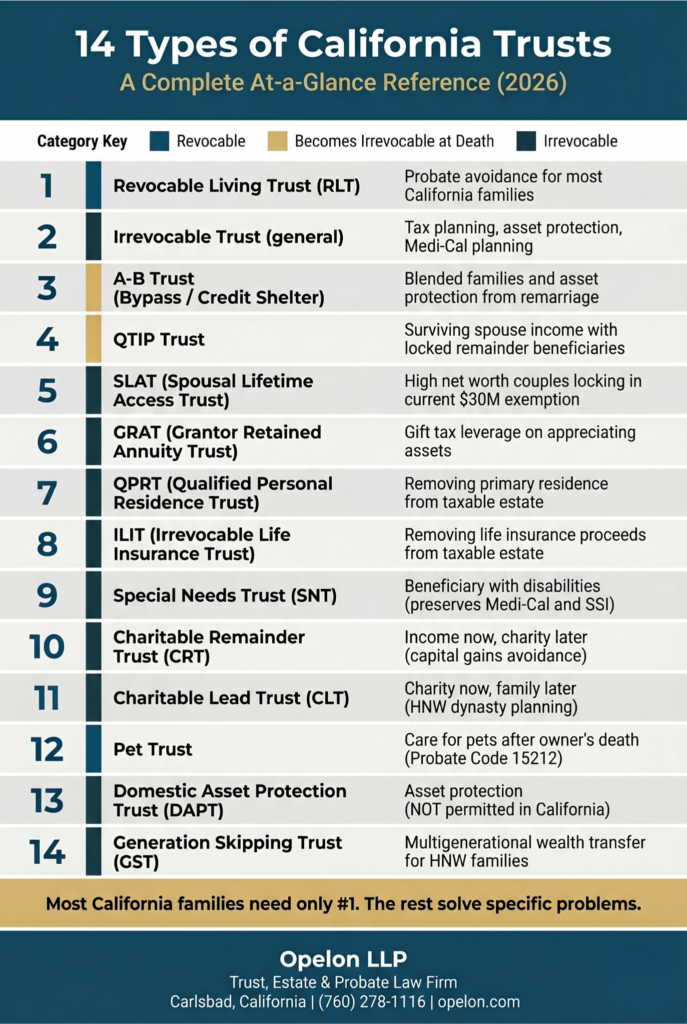
California recognizes more than a dozen distinct trust types, each designed to solve a specific problem. The table below summarizes when each one is the right tool. The detailed sections that follow explain how each trust works and when Opelon LLP drafts them.
Trust Type | Best For | Type |
Revocable Living Trust | Probate avoidance for most California families | Revocable |
Irrevocable Trust (general) | Tax planning, asset protection, Medi-Cal planning | Irrevocable |
Blended families, GST planning, asset protection from remarriage | Becomes irrevocable at first death | |
Surviving spouse income with locked remainder beneficiaries | Becomes irrevocable at first death | |
SLAT | High net worth couples locking in current $30M exemption | Irrevocable |
GRAT | Gift tax leverage on appreciating assets | Irrevocable |
QPRT | Removing primary residence from taxable estate | Irrevocable |
ILIT | Removing life insurance proceeds from taxable estate | Irrevocable |
Beneficiary with disabilities (preserves Medi-Cal and SSI) | Irrevocable | |
Charitable Remainder Trust | Income now, charity later (capital gains avoidance) | Irrevocable |
Charitable Lead Trust | Charity now, family later (HNW dynasty planning) | Irrevocable |
Care for pets after owner’s death (Probate Code 15212) | Can be either | |
Domestic Asset Protection Trust | Asset protection (not permitted in California) | Irrevocable |
Generation Skipping Trust | Multigenerational wealth transfer for HNW families | Irrevocable |
1. California Revocable Living Trust (RLT)
The California revocable living trust is the default tool for most California estate plans. It avoids probate, keeps your affairs private, and lets you keep full control during your lifetime.
You serve as the initial trustee. You manage trust assets the same way you managed them before. At death, your successor trustee takes over without court involvement. Beneficiaries receive distributions under the terms you wrote into the document.
Opelon drafts revocable living trusts as our core practice. The standard package includes the trust document, a pour over will, durable financial power of attorney, advance health care directive, and HIPAA authorization.
Learn more in our complete guide to the California revocable living trust.
2. California Irrevocable Trust (Overview)
An irrevocable trust is any trust that the settlor cannot change or revoke after creation. The category covers most of the specialty trusts discussed below: ILITs, SLATs, GRATs, QPRTs, SNTs, charitable trusts, and GST trusts.
Irrevocable trusts file their own tax returns on FTB Form 541 and IRS Form 1041. They have their own taxpayer identification number. They are treated as separate legal entities for tax and asset protection purposes.
Modifications are not impossible, but they are difficult. California Probate Code Sections 15403 through 15414 allow limited modification with court approval or beneficiary consent. The bar is high. Treat irrevocable trusts as permanent.
3. A-B Trust (Bypass or Credit Shelter Trust)
An A-B trust splits into two parts when the first spouse dies. The “A” trust (survivor’s trust) holds the surviving spouse’s share. The “B” trust (bypass or credit shelter trust) holds the deceased spouse’s share and uses their estate tax exemption.
A-B trusts lost favor after 2012 portability and remain less common today. Portability lets a surviving spouse use any unused exemption from the deceased spouse without an A-B structure. But A-B trusts are still useful in specific scenarios:
- Blended families wanting to lock remainder beneficiaries (preventing the surviving spouse from redirecting assets to a new family).
- State estate tax states (not relevant to California, which has no state estate tax).
- GST exemption preservation in the deceased spouse’s name.
- Asset protection from a surviving spouse’s future creditors or remarriage.
Opelon drafts A-B trusts as part of married couples estate planning when one of these scenarios applies.
4. QTIP Trust (Qualified Terminable Interest Property)
A QTIP trust gives the surviving spouse income for life. The remainder passes to beneficiaries the deceased spouse named in advance, often children from a prior marriage.
QTIP trusts solve a common blended-family problem. The first spouse to die wants to provide for the surviving spouse. They also want to make sure the surviving spouse cannot redirect the assets to a new family or new beneficiaries. The QTIP locks the remainder in place.
QTIP trusts also qualify for the federal estate tax marital deduction, deferring estate tax until the surviving spouse dies. Opelon drafts these as part of blended-family estate planning.
Learn more in our guide to the California QTIP trust.
5. SLAT (Spousal Lifetime Access Trust)
A Spousal Lifetime Access Trust, or SLAT, is an irrevocable trust. One spouse creates and funds it for the benefit of the other spouse. Children and other descendants are often added as beneficiaries too.
The funding spouse uses part of their federal gift and estate tax exemption to make the gift. The beneficiary spouse can receive distributions during their lifetime. Because the beneficiary is the funding spouse’s husband or wife, the family keeps indirect access to the gifted assets. At the same time, the assets and all of their future appreciation leave both spouses’ taxable estates.
SLATs remain a powerful planning tool for high net worth California couples under current federal law. The One Big Beautiful Bill Act (OBBBA), signed on July 4, 2025, set the federal estate and gift tax exemption at $15 million per individual. Married couples have a combined $30 million exemption. OBBBA made the exemption permanent and indexed it for inflation starting in 2027.
The strategic case for a SLAT is no longer about beating a sunset deadline. It rests on three goals:
- Locking in current exemption levels for assets that are likely to appreciate.
- Removing future growth from the taxable estate.
- Providing the funding spouse with indirect access through the beneficiary spouse if cash flow is ever needed.
In our experience working with high net worth San Diego County couples, two issues come up repeatedly. The first is the reciprocal trust doctrine. If both spouses create SLATs for each other and the trusts are too similar, the IRS can collapse them. Each spouse is then treated as the owner of their own trust. The estate tax benefit disappears. Opelon deliberately staggers the timing, terms, beneficiaries, and trustee structure of paired SLATs to avoid this outcome.
The second issue is divorce risk. If the marriage ends, the funding spouse loses indirect access to the trust assets. The trust continues for the now-former spouse. SLATs are a long-horizon planning tool, not a one-size solution.
6. GRAT (Grantor Retained Annuity Trust)
A GRAT is an irrevocable trust that pays the grantor a fixed annuity for a set number of years. Whatever remains in the trust at the end of the term passes to the beneficiaries gift tax free. The catch: trust assets must outperform the IRS Section 7520 interest rate.
GRATs are a leveraged gifting strategy for high net worth clients with appreciating assets such as concentrated stock positions or pre-IPO equity. The grantor takes very little exemption to fund the trust. If the assets grow faster than the IRS hurdle rate, the excess passes tax-free.
The main risk is mortality. If the grantor dies during the GRAT term, the assets are pulled back into the taxable estate. Shorter GRATs (two or three years) reduce mortality risk. Opelon drafts GRATs as part of high net worth estate planning.
7. QPRT (Qualified Personal Residence Trust)
A QPRT is an irrevocable trust that holds your primary residence or vacation home. You retain the right to live in the home for a fixed term. After the term ends, the home passes to your beneficiaries at a discounted gift tax cost.
California adds a wrinkle: Proposition 13 and Proposition 19. A QPRT transfer can trigger property tax reassessment if the trust structure is not carefully drafted. The Prop 19 parent-child exclusion has an inflation-adjusted cap of roughly $1,044,586 through February 15, 2027. Anything over that cap reassesses to fair market value.
Opelon drafts QPRTs as part of high net worth estate planning, with careful attention to California property tax consequences.
8. ILIT (Irrevocable Life Insurance Trust)
An ILIT owns your life insurance policy. Because the trust owns the policy (not you), the death benefit is excluded from your taxable estate. For a $5 million policy, that can mean $2 million in estate tax savings.
ILITs require careful administration. Crummey notices must be sent to beneficiaries each year when premiums are paid, giving them a temporary right to withdraw the contribution. This converts the premium payment into a present-interest gift that qualifies for the annual gift tax exclusion.
ILITs also carry a three-year lookback. If you transfer an existing policy into the trust and die within three years, the IRS pulls the death benefit back into your estate. The cleanest approach is for the ILIT to apply for and own the policy from day one.
Opelon drafts ILITs as part of high net worth estate planning. Learn more in our guide to irrevocable life insurance trusts (ILITs).
9. Special Needs Trust (SNT)
A Special Needs Trust holds assets for a person with a disability. It does not disqualify the beneficiary from means-tested government benefits like Medi-Cal and Supplemental Security Income (SSI). California recognizes two main types. The difference matters for what happens at the beneficiary’s death.
A first-party SNT (also called a (d)(4)(A) trust under 42 U.S.C. 1396p) is funded with the disabled beneficiary’s own money. This usually happens when a person with a disability receives a personal injury settlement. It also happens with an unexpected inheritance left outright or back-pay from Social Security.
First-party SNTs must be irrevocable, established before the beneficiary turns 65, and include a Medi-Cal payback provision. When the beneficiary dies, the California Department of Health Care Services has a statutory right to recover Medi-Cal benefits paid during the beneficiary’s lifetime, up to the value of remaining trust assets. See dhcs.ca.gov for the current payback rules.
A third-party SNT is funded by someone other than the beneficiary, typically a parent or grandparent planning ahead. These are most often built into a parent’s revocable living trust and only spring into existence at the parent’s death. Third-party SNTs do not require a Medi-Cal payback provision. Whatever remains when the beneficiary dies can flow to siblings, charities, or other named heirs.
In our experience working with San Diego County families, the most common planning mistake is leaving an inheritance directly to a disabled adult child. The same problem happens when parents name that child as a retirement account beneficiary. Even a modest inheritance can wipe out years of carefully maintained Medi-Cal eligibility overnight. A properly drafted third-party SNT inside a parent’s revocable trust avoids this entirely.
Opelon drafts both first-party and third-party Special Needs Trusts.
10. Charitable Remainder Trust (CRT)
A Charitable Remainder Trust pays you (or another non-charitable beneficiary) an income stream for life or for a fixed term. Whatever remains at the end goes to a named charity.
CRTs are powerful for clients holding highly appreciated assets. You contribute the appreciated asset to the CRT, and the CRT sells it without paying capital gains tax. The full proceeds reinvest to fund the income stream. You receive a partial charitable income tax deduction in the year of the gift. The deduction equals the present value of the remainder interest going to charity.
Opelon drafts Charitable Remainder Trusts as part of high net worth and charitable estate planning.
11. Charitable Lead Trust (CLT)
A Charitable Lead Trust is the mirror image of a CRT. The charity receives the income stream first. The remainder passes to your family at the end of the term.
CLTs are common in high net worth dynasty planning. The charitable lead reduces the gift tax cost of transferring assets to children or grandchildren. If trust assets outperform the IRS hurdle rate during the charitable term, the excess passes to the family beneficiaries gift-tax free.
Opelon drafts Charitable Lead Trusts for clients pairing significant charitable goals with multigenerational wealth transfer.
12. Pet Trust
California Probate Code Section 15212 authorizes pet trusts. The trust provides for the care of one or more pets after the owner’s death and lasts until the last covered animal dies.
A pet trust names a trustee (who manages the funds) and a caregiver (who actually has custody of the pet). The two roles can be the same person or different people. Splitting the roles adds a layer of accountability, since the trustee can withhold funds if the caregiver fails to provide proper care.
Funding amounts should match the realistic cost of caring for the pet over its remaining life expectancy. A court can reduce excessive funding if the amount substantially exceeds reasonable care costs. Opelon drafts pet trusts as part of individual estate planning.
13. Domestic Asset Protection Trust (DAPT) – Informational Only
Important: California does not permit DAPTs created by California residents. Opelon LLP does not draft DAPTs. This section is included so California residents understand the landscape before consulting an out-of-state attorney.
A Domestic Asset Protection Trust is a self-settled spendthrift trust. The settlor is also a beneficiary, and the trust is designed to protect the settlor’s own assets from future creditors. Probate Code Sections 15403 and 15404 restrict self-settled spendthrift trusts in California, which is why DAPTs do not work for California residents.
A handful of states (Nevada, Delaware, South Dakota, and Alaska, among others) have enacted DAPT statutes. But their effectiveness for a California resident is heavily contested. California courts have not consistently honored out-of-state DAPTs in cases involving California assets or California creditors. Federal bankruptcy law also imposes a 10-year lookback for self-settled trusts under 11 U.S.C. Section 548(e), further limiting the strategy.
If asset protection is a priority, several California-permitted strategies remain available. Professional liability insurance and umbrella personal liability policies are the foundation. Retirement account creditor exemptions under federal and California law add another layer. Irrevocable gifts to family-benefit trusts (which are not self-settled) work too. Opelon can help with the family-benefit trust portion of an asset protection plan.
14. Generation Skipping Trust (GST)
A Generation Skipping Trust transfers assets to grandchildren or later generations. It skips the children’s generation for estate tax purposes. The Generation-Skipping Transfer Tax (GSTT) was created to close a loophole. Without GSTT, families could avoid estate tax at the children’s generation by leaving assets directly to grandchildren.
The GSTT exemption is now $15 million per individual under OBBBA. The exemption is permanent and indexed for inflation starting in 2027. A married couple can shelter $30 million in generation-skipping transfers.
GST trusts remain a core multigenerational wealth transfer tool for high net worth families. The strategic case is to skip a generation of estate tax, lock in current exemption levels, and provide long-term asset protection for grandchildren and beyond. Opelon drafts GST trusts as part of high net worth and dynasty planning.
How to Choose the Right Trust for Your Situation
Most California families need a revocable living trust. Some need additional irrevocable trusts layered on top. The five questions below identify which scenario you are in.
- Are you married, and is your combined estate near or above the $30 million federal exemption (OBBBA)?
- Do you have a beneficiary with disabilities or special needs?
- Do you own a business, real estate portfolio, or significant investment assets?
- Do you have charitable goals you want to fund through your estate?
- Do you have aging parents or potential incapacity concerns of your own?
Your answers point to the right trust pairing. Common scenarios and the trusts that solve them:
Common California Trust Pairings Married couples near or above the $30M federal exemption: RLT + SLAT + ILIT Blended families: RLT + QTIP Special needs beneficiaries: RLT with third-party SNT carve-out Business owners: RLT + irrevocable gifting trust Real estate investors: RLT + LLC structure Charitable donors: RLT + CRT or CLT Aging parents or incapacity concerns: RLT + Advance Health Care Directive + Durable Power of Attorney |
If you are not sure which scenario fits your situation, an experienced California trust attorney can help you map your assets, family dynamics, and goals to the right structure. See our overview of what to look for in a Carlsbad estate planning attorney.
California-Specific Trust Law Considerations
California trust law has features that distinguish it from other states. Understanding these features matters whether you are creating a California trust or evaluating whether to use a non-California trust.
Probate Code Division 9
California trust law lives in Probate Code Division 9, Sections 15000 through 19403. Division 9 covers trust creation, modification, termination, trustee duties, beneficiary rights, and trust litigation procedures. Every California trust is interpreted under these sections.
California Rule Against Perpetuities
California modernized its rule against perpetuities. Under AB 1837, a California trust can now last 90 years from the date of creation. The old common law rule (lives in being plus 21 years) no longer applies to trusts created after the effective date.
See our explainer on the California rule against perpetuities for the full history and current rule.
Trust Situs: California vs. Other States
Trust situs is the legal “home” of a trust for tax and administration purposes. Some high net worth California residents move trust situs to states like Nevada or South Dakota. The reasons include favorable income tax treatment, longer perpetuities periods, and in some states no perpetuities limit at all.
Out-of-state trust situs is not a magic shield. The California Franchise Tax Board aggressively pursues trusts with California beneficiaries or California-source income. Talk to a qualified attorney before assuming a non-California trust will save you California tax.
AB 565 Virtual Representation
California adopted virtual representation under AB 565. Virtual representation lets one beneficiary represent the interests of similarly situated beneficiaries. This often applies to minors, unborn descendants, or beneficiaries who cannot be located. It streamlines trust modifications and accountings. It also avoids the cost of court-appointed guardians ad litem in many situations. See our guide to California AB 565 and virtual representation.
Trust Funding and Trustee Requirements
Probate Code Section 15200 sets the basic requirements for creating a California trust. The settlor must have capacity. The settlor must intend to create a trust. The settlor must identify trust property and beneficiaries. The trust document must be executed with proper formalities.
Probate Code Sections 15600 and following set trustee qualifications. Any adult of sound mind can serve as trustee. Banks and trust companies regulated under California Financial Code can also serve. Out-of-state corporate trustees face additional registration requirements.
Tax Treatment of California Trusts
Quick Answer: California has no state estate tax. The federal estate and gift tax exemption is $15 million per individual ($30 million per married couple) under OBBBA. The exemption is permanent and indexed for inflation starting 2027. Most California families pay no estate tax. |
Federal Estate and Gift Tax
The One Big Beautiful Bill Act (OBBBA), signed on July 4, 2025, set the federal estate and gift tax exemption at $15 million per individual. Married couples have a combined $30 million exemption when portability is properly elected. OBBBA made the exemption permanent and indexed it for inflation starting in 2027.
Estates above the exemption pay federal estate tax at a top rate of 40 percent on the excess. The Generation-Skipping Transfer Tax (GSTT) exemption is the same $15 million per individual under OBBBA.
For more on the federal exemption math, see our guide to the federal estate tax exemption. The IRS publishes current rules at irs.gov/businesses/small-businesses-self-employed/estate-tax.
Annual Gift Tax Exclusion
The annual gift tax exclusion lets you give up to $19,000 per recipient per year (2026 figure) without using any of your lifetime exemption. Married couples can split gifts and effectively give $38,000 per recipient per year. Annual exclusion gifts are a foundational tool in long-term estate tax planning.
Grantor Trust vs. Non-Grantor Trust
A grantor trust is treated as the same taxpayer as the settlor for income tax purposes. The trust’s income reports on the settlor’s personal Form 1040. Most revocable living trusts are grantor trusts during the settlor’s life.
A non-grantor trust is a separate taxpayer. It files its own returns on FTB Form 541 (California) and IRS Form 1041 (federal). It pays tax on income it accumulates. Distributions to beneficiaries shift the tax to them via Schedule K-1. Most irrevocable trusts (other than intentionally defective grantor trusts) are non-grantor trusts.
Capital Gains Step-Up at Death
Assets held in a revocable living trust receive a full step-up in basis at the settlor’s death. The cost basis resets to fair market value as of the date of death. Beneficiaries who later sell those assets pay capital gains tax only on appreciation that occurred after the settlor died.
This is one of the largest tax benefits of a revocable trust. A long-time California homeowner whose home appreciated from $200,000 to $1.5 million can pass that home through a revocable trust with full step-up. If the family later sells, capital gains tax applies only to appreciation above $1.5 million.
Assets in irrevocable trusts that are excluded from the taxable estate generally do not receive a step-up. This is one of the trade-offs of advanced estate planning: estate tax savings now in exchange for capital gains exposure later.
How Much Does a California Trust Cost?
Quick Answer: A basic California revocable living trust typically costs $2,500 to $5,000 as a flat fee. Joint revocable trusts for married couples run $3,000 to $6,000. Specialty trusts (SLAT, GRAT, ILIT, SNT, charitable trusts) range from $4,000 to $15,000, depending on complexity. |
Trust Type | Typical Flat Fee Range |
Basic revocable living trust (single) | $2,500 to $5,000 |
Joint revocable trust (married couple) | $3,000 to $6,000 |
SLAT or ILIT | $5,000 to $10,000 |
GRAT or QPRT | $7,500 to $15,000 |
Special Needs Trust | $4,000 to $8,000 |
Charitable Remainder or Charitable Lead Trust | $5,000 to $12,000 |
Flat Fee vs. Hourly Billing for California Trusts
Opelon charges flat fees for estate planning work. You know the total cost before we start. There are no surprise invoices, no clock-watching, and no incentive to slow the work down. Our flat fee estate planning gives you the total cost in a single, upfront quote.
Some California estate planning attorneys still bill hourly. Hourly billing makes sense for litigation and contested matters, but it creates uncertainty for planning work that should have a defined scope.
What Is Included in a California Trust Package
Our standard California estate planning package includes more than just the trust document. The full package contains:
- Revocable Living Trust (the core document)
- Pour Over Will (catches assets that were not transferred to the trust during your lifetime)
- Durable Power of Attorney for Financial Matters (allows a trusted person to handle your finances if you become incapacitated)
- Advance Health Care Directive (medical decisions if you cannot make them yourself)
- HIPAA Authorization (allows your designated agents to access medical information)
- Trust funding instructions and document execution
Why DIY Trust Kits Often Cost More
Online trust kits and form documents look cheap upfront. The hidden cost shows up at death. The most common DIY failures are improper funding and generic provisions that conflict with California-specific law. Missing ancillary documents like the durable power of attorney and advance health care directive add to the problem.
When a DIY trust fails to avoid probate because of incomplete funding, the family pays full statutory probate fees. On a $1 million estate, that is roughly $46,000. The savings from a $200 form kit disappear instantly.
For a deeper comparison, see attorneys for living trust vs. DIY trust kits.
Common Mistakes with California Trusts
In our experience working with San Diego County families, the same mistakes appear over and over. Each one is preventable. Each one can defeat the purpose of having a trust at all.
- Not funding the trust. The single most common failure. A trust controls only what is titled in its name. Real estate, bank accounts, and brokerage accounts must be retitled. Beneficiary designations on retirement and life insurance must name the trust where appropriate.
- Naming the wrong trustee. Choose a trustee based on judgment, integrity, and willingness to serve. Naming an oldest child by default, without considering whether they actually want the role or have the skills, creates problems later.
- Failing to update after life events. Marriage, divorce, the birth of a child, the death of a beneficiary, or a move out of state can each change what your trust should say. Review every three to five years. Also review after any major life event.
- Using a generic out-of-state form. California has specific requirements that out-of-state forms often miss. California Probate Code Section 15212 (pet trusts), AB 565 (virtual representation), and Prop 19 (property tax reassessment) are all California-specific.
- Skipping the pour over will. The pour over will is your safety net. Without it, any asset that was not properly funded into the trust during your lifetime passes by intestate succession instead of your trust’s instructions.
- Not coordinating beneficiary designations with the trust. Retirement accounts, life insurance, and transfer-on-death accounts pass by beneficiary designation, not by your trust’s terms. If those designations are out of sync with your trust, the wrong person can inherit.
- Putting a primary residence in an irrevocable trust without considering Prop 13 and Prop 19. California property tax reassessment is triggered by certain transfers. The wrong structure can double your annual property tax bill.
- DIY funding. Recording deeds incorrectly leads to title problems that surface only when the family tries to sell. By then, the original drafter may be unavailable to fix the issue, and the family pays escrow and title attorneys to clean up the mess.
Number 7 deserves special attention. For a deeper dive on California property tax reassessment, see our guide to Prop 19 and inherited property in California.
When to Hire a California Trust Attorney
Some signals that you need professional help with your California estate plan:
- You own real estate in California or a combined estate over $208,850 (the small estate threshold).
- You are married and your combined estate is significant or contains complex assets.
- You have a beneficiary with disabilities, a blended family, or a child you do not want to inherit.
- You own a business or have concentrated equity in a single company.
- You have charitable goals or want to leave a legacy beyond cash distributions.
- You are concerned about incapacity or have aging parents whose plan you are managing.
Read More: What to do when a Parent Dies in California: 30-day Checklist
What to Look For in a California Trust Attorney
- California Bar admission in good standing. Ask for the bar number and verify it.
- Significant California estate planning experience. General practice attorneys often miss California-specific issues.
- M. in Taxation or specific tax planning credentials for high net worth work.
- Track record of California trusts designed and funded. Ask about case volume and typical scope.
- Experience with your specific situation, whether that is HNW planning, special needs, business succession, or blended family planning.
Read More: Finding a specialized Trust Attorney in California