

Most California adults need a power of attorney long before they need a will. At Opelon LLP, our Carlsbad firm has drafted more than 700 California estate plans, and every single one includes a coordinated power of attorney. We have also administered over 250 San Diego County estates. That dual experience tells us one thing clearly: the families who avoid the worst incapacity scenarios are the ones who put a properly drafted POA in place years before they thought they needed one. Without it, an aging parent’s family typically faces a conservatorship petition. The process runs four to eight months, costs thousands in legal fees, and stays under court supervision for life.
This guide explains every type of California power of attorney, the legal requirements, agent selection, costs, and how to avoid the bank-rejection problems that derail so many families.
Key Takeaways
- A California power of attorney lets one person (the principal) authorize another (the agent) to act on their behalf, governed by California Probate Code §4000 et seq.
- Every California estate plan should include a durable power of attorney for finances and an Advance Health Care Directive. These are two separate documents under California law.
- Without a POA, family members typically must petition the Superior Court for a conservatorship, which often takes four to eight months and costs $5,000 to $10,000 or more.
- Probate Code §4264 lists specific powers (trust authority, gifting, disclaimers, survivorship interests, beneficiary designations, and loans to the agent) that require express grant. Digital asset access requires its own express grant under Probate Code §870 et seq. Generic forms often miss these.
- Choosing between an immediate-effective and a springing durable POA involves real trade-offs. Immediate-effective POAs avoid friction at incapacity. Springing POAs (typically activated on a two-physician determination under Probate Code §4129) preserve principal control during competence. The right choice depends on the family’s circumstances.
What Is a Power of Attorney in California?
A California power of attorney is a written legal document where one person (the principal) authorizes another person (the agent or attorney-in-fact) to act on the principal’s behalf for specified purposes. The document is governed by California Probate Code Division 4.5 (Sections 4000 through 4545). It only operates while the principal is alive.
The Three Actors in Every California POA
Every California power of attorney involves three parties. The principal is the person granting authority. The agent (also called the attorney-in-fact) is the person receiving authority and exercising it on the principal’s behalf. The third parties are the banks, title companies, brokerages, hospitals, and government agencies that must rely on the document to honor the agent’s actions.
Why Every California Adult Needs a POA
The single biggest reason to execute a California power of attorney is incapacity planning. Without a POA, family members typically must petition the Superior Court for a conservatorship under California Probate Code §1820 et seq.. A conservatorship usually takes four to eight months from filing to appointment. Legal fees commonly run $5,000 to $10,000 or more. The conservatorship then remains under court supervision for the rest of the conservatee’s life, with annual accountings, court approval for major decisions, and ongoing attorney involvement.
A POA is not a will or a trust. It governs what happens during the principal’s life. Authority terminates immediately at the principal’s death under Probate Code §4152(a)(4). After death, the executor named in the will or the successor trustee named in the trust takes over.
How Powers of Attorney Work in California
A valid California power of attorney must satisfy three core requirements under Probate Code §4121. The document must be in writing, signed by the principal, and either witnessed by two adults or notarized. Most attorney-drafted POAs use both witnesses and notarization for maximum third-party acceptance.
Execution Requirements
Probate Code §4121 requires the document to be in writing, dated, and signed by the principal. The principal can also direct another adult to sign on their behalf in their conscious presence. The document must then be either acknowledged before a notary public or signed by at least two adult witnesses. Witness qualifications are set out in Probate Code §4122.
Best practice in our office is to use both. Notarization helps with bank and title company acceptance. Witnesses help if the document is later challenged on capacity or undue influence grounds.
The Capacity Requirement
The principal must have legal capacity at the time of execution. California recognizes a presumption of capacity under Probate Code §810. A POA executed during diminished capacity (early-stage dementia, hospitalization, or a medication-altered state) is contestable. We have seen POAs invalidated years later when family members produced medical records showing the principal could not have understood the document.
The Agent’s Fiduciary Duty
A California agent owes the principal a fiduciary duty. Probate Code §§4230 through 4238 set the rules. The agent must act with the care, competence, and diligence ordinarily exercised by agents in similar circumstances. The agent must avoid conflicts of interest. The agent must keep records of all transactions. Probate Code §4234 imposes a duty to communicate. To the extent reasonably practicable, the agent must keep in regular contact with the principal, communicate with the principal, and follow the principal’s instructions.
When the Authority Ends
Probate Code §4152 lists the events that terminate the agent’s authority. The most common are death of the principal and revocation by the principal. Dissolution or annulment of the marriage between principal and agent terminates the spouse’s appointment under Probate Code §4154. The agent’s own death or incapacity also ends the authority. In our experience working with San Diego County families, the most common reason a California POA fails in practice is execution defects at signing.
Major POA Categories
California recognizes several categories of power of attorney. The differences matter, because choosing the wrong category can leave a family without authority at the worst possible moment.
Durable vs. Non-Durable Powers of Attorney
A durable POA continues to be effective even after the principal becomes incapacitated. A non-durable POA terminates automatically when the principal loses capacity. For incapacity planning, you almost always want a durable POA.
Feature | Durable POA | Non-Durable POA |
Authority begins | On execution (immediate) or on a triggering event (springing) | On execution |
What happens at incapacity | Continues | Terminates automatically |
What happens at death | Terminates (Probate Code §4152(a)(4)) | Terminates |
Common use case | Estate planning, incapacity planning | Single transaction during full capacity |
Required language | Probate Code §4124 durability statement | None |
Probate Code §4124 requires specific durability language. The standard wording is: “This power of attorney shall not be affected by my subsequent incapacity.” Substantially similar wording also satisfies the statute.
Immediate vs. Springing Powers of Attorney
An immediate-effective POA gives the agent authority the moment the document is signed. A springing POA gives the agent no authority until a triggering event occurs, typically a written determination of incapacity by one or two physicians. Probate Code §4129 authorizes the springing-power designation by allowing the principal to identify one or more persons who can declare under penalty of perjury that the triggering event has occurred.
Feature | Immediate-Effective POA | Springing POA |
Activation | On execution | On occurrence of triggering event (typically incapacity) |
Friction at incapacity | None (already active) | Physician letters typically required |
Third-party acceptance | Generally accepted on presentation | Often requires the trigger documentation before acceptance |
Best fits | Families who need agent authority the day of signing | Families who want the principal to retain sole control during competence |
The honest framing matters here. The choice between immediate-effective and springing is genuinely close, and California attorneys differ on the default. Immediate-effective POAs avoid friction at the moment of incapacity, when the family needs to act fast. Springing POAs sound safer because the agent cannot act prematurely. They preserve principal control during competence, which matters in many family situations. The trade-offs are real on both sides. Springing POAs require physician letters at the trigger moment. Banks may delay or sometimes refuse them while waiting for documentation. Immediate-effective POAs put authority in the agent’s hands the day the document is signed, which requires absolute trust in the agent throughout the principal’s life.
When does a springing POA still make sense? Estranged-family situations. Second-marriage spouses with separate finances. Business partnerships where the principal genuinely does not want the agent to access funds during competence. In those narrow cases, the principal’s control benefit outweighs the practical friction.
General vs. Limited (Special) Powers of Attorney
A general POA grants broad authority across multiple categories: banking, real estate, taxes, business, government benefits, and so on. A limited or special POA grants authority for one specific purpose. Common examples include signing a single real estate closing, filing one year of tax returns, or managing one bank account during military deployment.
A limited POA can also be durable. The durability language under Probate Code §4124 attaches to whatever scope of authority the principal grants.
Financial POA vs. Health Care POA
This is where California families often get confused. California requires two separate documents for financial decisions and health care decisions. Some states combine them. California does not.
A financial POA controls money decisions and is governed by Probate Code §§4000 through 4545. A health care POA controls medical decisions and is governed by the Health Care Decisions Law at Probate Code §§4600 through 4806, with the AHCD-specific provisions at §§4670 through 4678. The standard health care document is called an Advance Health Care Directive, with the statutory form found at Probate Code §§4700 through 4701. A complete California estate plan includes both documents, plus a HIPAA authorization so the agent can access medical records.
6 Types of California Powers of Attorney
California recognizes six functional types of power of attorney. The table below provides a quick reference. Each type is then explained in detail.
POA Type | Best For | Recommended Execution |
Durable Financial POA | Standard incapacity planning | Notarized + 2 witnesses |
Springing Durable POA | High-trust-deficit situations | Notarized + 2 witnesses + physician trigger |
Limited (Special) POA | Single transaction or short period | Notarized |
Statutory Form POA (§4401) | Simple needs without custom drafting | Notarized + 2 witnesses |
Advance Health Care Directive | Medical decisions during incapacity | Notarized OR 2 qualifying witnesses |
Military / Active Duty POA | Service members on deployment | Per 10 U.S.C. §1044a |
1. California Durable Power of Attorney for Finances
The durable financial POA is the default for any attorney-drafted California estate plan. The document gives the agent authority to handle the principal’s financial affairs both during competence and after incapacity. The Probate Code §4124 durability language is mandatory: “This power of attorney shall not be affected by my subsequent incapacity,” or substantially similar wording.
The powers granted typically include banking, real estate transactions, tax filings, business operations, retirement accounts, government benefits applications, claims and litigation, and digital assets.
Probate Code §4264 lists specific categories of authority that require express grant in the document text. These cannot be assumed from general language. The express-grant categories are:
- Create, modify, revoke, or terminate a trust
- Fund with the principal’s property a trust not created by the principal
- Make or revoke a gift of the principal’s property
- Exercise the right to disclaim, reject, release, or consent to a reduction in or modification of a share or payment
- Create or change survivorship interests
- Designate or change beneficiary designations
- Make a loan to the attorney-in-fact
Digital asset access sits outside §4264. It is governed by California’s adoption of the Revised Uniform Fiduciary Access to Digital Assets Act at Probate Code §870 et seq. It should also be expressly granted in any modern POA. A generic POA that omits the §4264 express grants will fail at the bank or title company. A POA that fails to address digital assets under §870 et seq. will fail at the online service provider.
Opelon drafts a durable financial POA as part of every California estate plan we prepare.
2. California Springing Durable Power of Attorney
A springing durable POA uses the same Probate Code §4124 durability language as an immediate POA, but adds an activation trigger under Probate Code §4129. Standard trigger language reads as follows. “This power of attorney shall become effective upon the written determination by one or two physicians that I am unable to manage my own financial resources, or to resist fraud or undue influence.”
The practical friction is real. Banks often request the physician letters and the underlying medical records. Both can take weeks to obtain. Some banks reject springing POAs entirely on the grounds that they cannot verify the trigger has occurred.
When does a springing POA fit a particular family? Common scenarios include estranged-family situations, second-marriage spouses with separate finances, or business partnerships. The common thread is the principal’s preference to retain sole control during competence. Opelon drafts both immediate-effective and springing durable POAs, calibrated to the client’s family circumstances and risk tolerance after a focused planning conversation.
3. California Limited (Special) Power of Attorney
A limited POA grants authority for one specific transaction or time period. Common uses include a real estate closing while the principal is traveling, signing one year’s tax returns, or executing one specific contract. Service members often use limited POAs to manage one bank account during deployment.
Probate Code §§4000 et seq. apply to limited POAs the same as general POAs. Execution requirements, agent duties, and termination rules are identical. A limited POA can also be durable if the durability language is included.
Opelon drafts limited POAs for clients who need transaction-specific authority.
4. California Statutory Form Power of Attorney (Probate Code §4401)
California provides a fill-in-the-blank statutory POA form authorized by Probate Code §4401. The form is set forth in the text of §4401 itself and is widely available. The principal initials the categories of authority being granted: real property, banking, business, tax matters, and so on.
The statutory form must still be executed under Probate Code §4121 (witnesses or notary). The benefit is simplicity and statutory recognition. Probate Code §4406 gives the agent a remedy when a third party refuses to honor the statutory form without reasonable cause. The third party can be compelled to honor it, and the court may award attorney’s fees.
The limitations are also real. The statutory form lacks flexibility for complex family structures. It does not include express grants for trust amendment authority, expanded gifting, or modern digital-asset provisions. Most attorney-drafted estate planning POAs go beyond the statutory form for those reasons.
Opelon does not typically draft from the statutory form, because clients usually need broader trust-coordinated drafting. We mention it here for completeness.
5. California Advance Health Care Directive (Health Care POA)
California’s health care POA is called an Advance Health Care Directive. It is a separate document from the financial POA. It is governed by the Health Care Decisions Law at Probate Code §§4600 through 4806. The AHCD-specific provisions appear at §§4670 through 4678. The statutory form appears at Probate Code §§4700 through 4701.
Key components include agent designation, agent powers, end-of-life preferences, organ donation choices, and primary physician designation. The Advance Health Care Directive becomes effective when a physician determines the patient lacks capacity to make health care decisions.
Execution requirements are set out in Probate Code §4673. The directive must be either acknowledged before a notary public or signed by at least two qualifying witnesses who satisfy Probate Code §4674. The witness restrictions matter. Under §4674(c), the agent cannot serve as a witness. The patient’s health care provider and any employee of that provider are disqualified. So is the operator of a community care facility or a residential care facility for the elderly. Under §4674(e), at least one witness must be unrelated to the patient by blood, marriage, or adoption. That same witness must not be entitled to any portion of the patient’s estate.
A complete Advance Health Care Directive should pair with a HIPAA authorization. The HIPAA authorization (Health Insurance Portability and Accountability Act) lets the agent access the principal’s medical records. For terminally ill or end-of-life patients, the directive often pairs with a Physician Orders for Life-Sustaining Treatment (POLST) form.
Opelon drafts Advance Health Care Directives in every California estate plan.
6. Military / Active Duty Power of Attorney
Federal law at 10 U.S.C. §1044a addresses military powers of attorney. A POA executed by a service member is legally valid in every U.S. state if it was prepared by a military legal assistance attorney and properly notarized. The state-law execution requirements do not control. California honors military POAs, and out-of-state POAs generally, under Probate Code §4053.
Military POAs are common during deployment situations where state-specific execution may not be practical. Service members can also execute a standard California POA if they prefer.
Opelon does not typically draft military POAs. These are usually drafted by base legal assistance offices at no cost to the service member.
Legal Requirements for a Valid California POA
A California power of attorney is legally sufficient when six elements are satisfied. These elements come from Probate Code §§4121, 4122, 4124, 4264, and 810. Missing any one of them creates a defect that may cause the document to fail when the agent tries to use it.
Six-Element Validity Checklist
- The principal had legal capacity at the time of execution (Probate Code §810 presumption of capacity).
- The principal was an adult with capacity to contract (Probate Code §4120).
- The POA is in writing. Oral powers of attorney are not valid in California.
- The POA is signed by the principal, or by another adult at the principal’s direction in the principal’s conscious presence (Probate Code §4121).
- The POA is either witnessed by at least two qualifying adults or notarized (Probate Code §4121).
- The agent’s authority is specifically granted, with express language for the powers that require it under Probate Code §4264.
The Capacity Requirement in Practice
California law presumes capacity. The presumption can be rebutted with medical evidence. A POA executed during early-stage dementia, hospitalization, or a medication-altered state is contestable. In our experience, the safest practice is to execute estate planning documents when the principal is fully competent and to update them periodically rather than wait for a crisis.
Common Defects That Void California POAs
The defects we see most often in our trust administration practice include:
- Missing witness signatures, or witnesses who were not present at the same time
- Missing notary acknowledgment when the document relies on notary execution
- An interested witness who is also the agent or a beneficiary
- Vague language that fails to grant specific Probate Code §4264 powers (especially gifting and trust-amendment authority)
- Out-of-date forms missing modern provisions for digital assets and electronic communications
How to Make a Power of Attorney in California
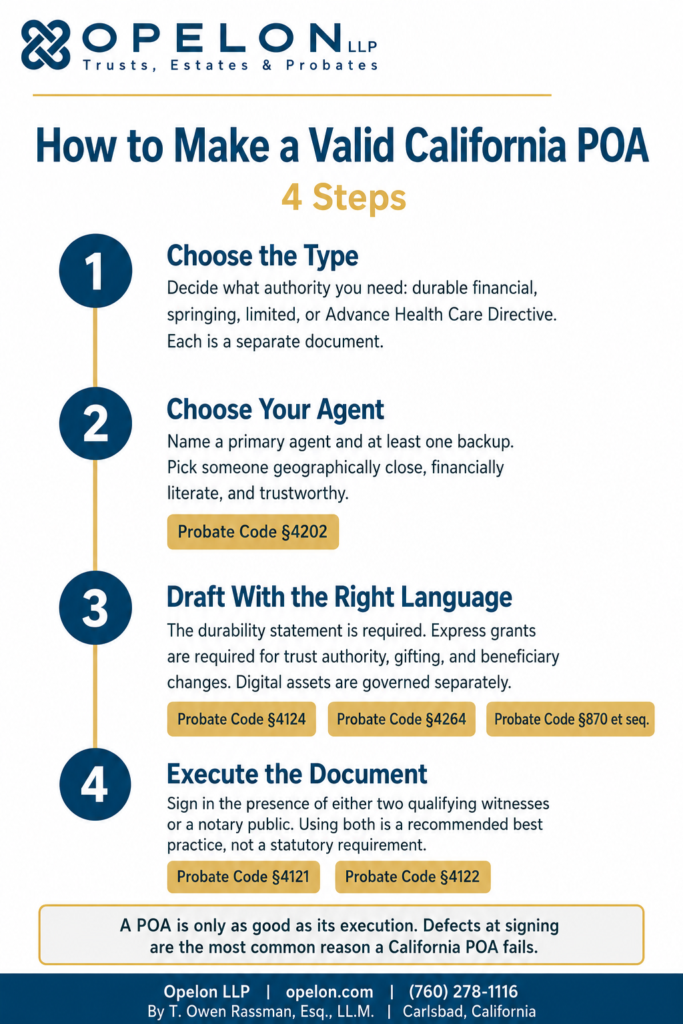
Making a valid California power of attorney is a four-step process. First, decide what powers to grant. Second, choose your agent. Third, draft the document with the right language under Probate Code §4264. Fourth, execute it under Probate Code §4121 with witnesses or a notary. Most California families use an attorney for the drafting step because of the express-grant requirements.
Step-by-Step Process
- Decide what type of POA you need (durable financial, springing, limited, or Advance Health Care Directive).
- Inventory the powers you need to grant: banking, real estate, business, tax, health care, digital assets.
- Choose your agent. Name a primary agent and at least one backup under Probate Code §4202.
- Decide whether the POA will be immediate-effective or springing.
- Decide whether the POA terminates on a specific date or continues until revocation.
- Draft the document. The choices are attorney-drafted, the statutory form (Probate Code §4401), or DIY.
- Execute the document under Probate Code §4121. The principal signs in the presence of either two witnesses or a notary public. Best practice is to use both.
- Provide a copy to the agent and to any third parties (banks, brokerages) the agent will need to interact with.
- Store the original safely where the agent can find it when needed.
Notarization vs. Witnesses
Most California banks and title companies prefer notarized POAs. Best practice in our office is to use both witnesses and notarization to maximize third-party acceptance. The dual approach also helps if the document is later challenged on execution-defect or capacity grounds.
In our experience, the single biggest practical headache with California POAs is bank rejection. Notarized POAs with explicit Probate Code §4264 powers are accepted far more reliably than statutory forms or DIY drafts. Coordinating the POA with the rest of your California estate planning checklist helps avoid the common rejection points. Weighing attorney drafting versus DIY trust kits is part of that decision.
Choosing the Right Agent
The agent decision is one of the highest-stakes choices in an entire estate plan. A POA agent has access to all of the principal’s finances during incapacity. Misuse is a real risk, and California treats agent abuse as elder financial abuse with serious civil and criminal consequences.
Five-Question Agent Selection Framework
Use these five questions to evaluate any potential agent.
- Does this person live close enough to handle in-person banking, real estate signings, or hospital visits when needed?
- Does this person have the financial literacy to manage the principal’s affairs, or the willingness to hire professionals?
- Does this person have the time and capacity to take on the role, with no conflicting demands like young children or a demanding job?
- Does this person have the temperament to act in the principal’s best interest, even under family pressure?
- Will the other family members accept this person’s authority, or will the choice create conflict?
Backup Agents Are Mandatory
Probate Code §4202 permits naming successive agents. Always name at least one backup. We have administered estates where the primary agent died or became incapacitated before the principal, and the family had no fallback. The result was a conservatorship that should never have been needed.
Multiple Agents
California permits naming co-agents who must act unanimously or independently under Probate Code §4203. Joint co-agents create more friction in practice. A bank that requires two signatures on every transaction will slow things down at the worst moment. We generally recommend a single primary agent with successive backups, unless the family circumstances genuinely require shared authority.
The Trust Factor
In our experience working with San Diego County families, the most painful POA disputes come from naming an agent because of family obligation rather than fitness. The right agent is the one who is competent, available, and trustworthy. The right agent is not always the eldest child or the closest relative. If you do suspect a family member is misusing a POA, the California Office of the Attorney General maintains elder financial abuse resources.
Powers a California POA Can Grant (and Cannot)
Not every authority can be delegated through a power of attorney. California law draws clear lines between what the agent can do and what the principal must do personally.
What a California POA CAN Authorize
A California POA can grant authority for a wide range of financial and administrative matters. The most common categories include:
- Banking and brokerage transactions
- Real estate transactions: purchase, sale, refinance, lease
- Tax filings and IRS representation (federal tax matters also require IRS Form 2848)
- Business operations and contract execution
- Government benefit applications: Social Security, Medi-Cal, Medicare, VA benefits
- Claims and litigation: filing, settling, defending lawsuits
- Insurance decisions
- Retirement account management
- Beneficiary designation changes (only if expressly granted under Probate Code §4264)
- Gifting (only if expressly granted, with limits, under Probate Code §4264)
- Trust creation, amendment, or termination (only if expressly granted)
- Digital asset access (only if expressly granted)
What a California POA CANNOT Authorize
Some decisions cannot be delegated through a financial POA, no matter how broadly the document is drafted.
- Health care decisions (those require an Advance Health Care Directive under Probate Code §§4600 through 4806, with AHCD-specific provisions at §§4670 through 4678)
- Marriage, divorce, or adoption decisions
- Voting in elections
- Making or revoking the principal’s will (Probate Code §4265 expressly prohibits this)
- Acts the principal could not legally do
- Anything that violates the agent’s fiduciary duty under Probate Code §§4230 through 4238
How to Revoke a California POA
A California POA can be revoked by the principal at any time while the principal has capacity. Probate Code §§4150 through 4155 govern the methods of revocation. The mechanics matter, because revocation does not become effective against a third party until the third party has actual notice of it.
Methods of Revocation
Probate Code §4151(a) permits revocation of a POA in two statutory ways: (1) in accordance with the terms of the power of attorney itself, or (2) by a writing. In practice, this is accomplished by either of the following:
- A signed written revocation. Best practice: notarize the revocation.
- Executing a new POA that expressly revokes prior POAs. This is best practice when updating an estate plan.
Unlike wills, California does not statutorily recognize physical destruction of a POA as a revocation method. A signed writing is the safer route.
Notice Requirements
Revocation is effective against a third party only when the third party has actual knowledge of the revocation. Probate Code §4303 protects a third party who acts in good faith reliance on a POA without actual knowledge of revocation. The practical takeaway: written revocation notices should be delivered to every bank, brokerage, title company, and other third party that may have a copy of the POA on file. Send by certified mail with return receipt where possible.
Effect of Marriage Dissolution
Probate Code §4154(a) provides that dissolution or annulment of the principal’s marriage to the agent automatically revokes the former spouse’s appointment. Under §4154(b), the appointment is revived if the principal remarries the same agent. Dissolution does not automatically revoke other agents named in the document.
Death of the Principal
Death terminates the agent’s authority automatically under Probate Code §4152(a)(4). No separate revocation is needed. After death, authority passes to the executor named in the will or the successor trustee named in the trust.
What Happens to a POA at Death
The agent’s authority terminates immediately at the principal’s death under Probate Code §4152(a)(4). The POA does not continue to control bank accounts, real estate, or any other asset after death. Continued use of the POA after death is a breach of fiduciary duty and may constitute elder financial abuse.
After death, authority passes to two possible parties. The executor (also called the personal representative) named in the will takes authority over probate-administered assets after the court issues letters testamentary. The successor trustee named in the trust takes authority over trust-held assets without court involvement, following the California successor trustee duties checklist.
A common confusion we see in administration: family members assume the POA continues to control bank accounts after death. It does not. Banks should freeze the principal’s individual accounts at death, pending probate or trust administration. If a family member continues to write checks under a POA after death, they may face civil liability. Continued use can also lead to criminal charges for elder financial abuse. For families navigating the days and weeks after a loss, the what to do when a parent dies in California guide walks through the next steps.
When Banks Reject California POAs (Practical Issues)
Bank rejection of California POAs is a real and common problem, even for properly executed documents. The Probate Code provides remedies, but resolving a rejection takes time the family may not have. Understanding why banks reject POAs is the first step to avoiding the problem.
Common Reasons Banks Reject California POAs
Based on our trust administration practice, the most common reasons banks reject California POAs include:
- The POA is more than a few years old, and the bank has an informal “freshness” policy.
- The POA is a generic out-of-state form that does not match California execution requirements.
- The POA does not specifically grant the power the agent is trying to exercise. Probate Code §4264 powers are common rejection points.
- The bank’s internal policy requires its proprietary form. Some institutions have tried this approach. Probate Code §4406 limits the practice for statutory form POAs.
- Notarization defects: missing notary stamp, expired commission, or out-of-state notary.
- Witness defects: missing signature or interested witness.
- The POA is springing, and the agent has not provided the physician letters required to trigger authority.
What to Do When a Bank Rejects a POA
There is a pathway when this happens. The steps below reflect how we handle rejections in our trust administration practice.
- Step 1: Ask the bank for a written explanation of the rejection. Get the policy citation if possible.
- Step 2: Provide a notarized agent’s affidavit confirming validity of the POA under Probate Code §4305. This often resolves the issue.
- Step 3: For statutory form POAs, send a formal demand letter citing Probate Code §4406. This statute compels acceptance and authorizes attorney’s fees against a third party that refuses without reasonable cause.
- Step 4: If rejection persists, legal action under Probate Code §4406 may be necessary.
In our experience, the most reliable defense against bank rejection is using an attorney-drafted POA with explicit Probate Code §4264 grants, executed with both two witnesses and a notary public, and updated within the last few years.
Practice scope note: Opelon LLP focuses on uncontested California estate planning. We do not handle agent-abuse litigation or contested third-party-acceptance lawsuits. We can refer you to a probate litigation attorney if your situation has progressed to that stage.
How Much Does a California POA Cost?
Standalone California POA costs range from $0 for DIY templates to roughly $800 for an attorney-drafted document. Most California families get the POA as part of a complete estate plan. The marginal cost of the POA is small relative to the trust and will. The cost of not having a POA is substantially higher: a conservatorship petition typically runs $5,000 to $10,000 or more.
Cost Ranges by POA Type
POA Type | Typical Cost | Notes |
DIY template (online form) | $0 to $200 | High rejection rate at banks |
California Statutory Form (Probate Code §4401) | Free (self-prepared) | Limited to checklist powers; still needs witnesses or notary |
Attorney-drafted standalone durable POA | $200 to $800 | Wide variation by drafting attorney |
Standalone Advance Health Care Directive | $150 to $500 | Wide variation by drafting attorney |
Complete estate planning package (will, trust, POA, AHCD, HIPAA) | $2,500 single / $3,500 married (Opelon flat fee) | All documents coordinated |
The Real Cost Comparison
The cost of not having a POA is the cost of a conservatorship. A California conservatorship petition under Probate Code §1820 et seq. typically runs $5,000 to $10,000 or more in legal fees. The process takes four to eight months from filing to appointment. The conservatorship then remains under court supervision indefinitely, with annual accountings, court approval for major decisions, and ongoing attorney involvement.
The math is straightforward. A few hundred dollars now, or several thousand dollars and several months of court delay later.
Common California POA Mistakes
The mistakes below come from our trust administration practice. Each one has cost a family money, time, or both.
- Naming an agent who lives far from the principal. In-person tasks become impractical.
- Failing to name a backup agent. Probate Code §4202 permits successive agents. Use it.
- Choosing a springing structure without considering the friction at the trigger moment, or choosing immediate-effective without considering the principal-control trade-off.
- Using an out-of-state form that does not satisfy Probate Code §4121 execution requirements.
- Forgetting Probate Code §4264 express grants for trust authority, gifting, disclaimers, survivorship interests, beneficiary designations, and loans to the agent.
- Forgetting digital asset authority under Probate Code §870 et seq.
- Skipping notarization. Most banks prefer notarized POAs.
- Storing the original where no one can find it at the moment of incapacity.
- Not updating after major life events: marriage, divorce, agent’s death, agent’s incapacity, move out of state.
- Naming co-agents who must act unanimously when joint action will be impractical. Probate Code §4203 permits independent action when appropriate.
- Using a generic financial POA without pairing it with an Advance Health Care Directive.
In our experience working with San Diego County families, the most expensive POA mistake is using an old generic form that does not include the Probate Code §4264 express grants. We have watched families spend months trying to get banks to accept POAs that should have worked from day one.
When to Hire a California Estate Planning Attorney
Most California families benefit from working with an estate planning attorney for their POA. The Probate Code §4264 express-grant requirements alone justify the cost. The signals below indicate that DIY or statutory form drafting is unlikely to meet the family’s needs.
Signals You Need Professional Help
- You want to authorize trust amendment, gifting, or beneficiary changes (Probate Code §4264 requires precise language).
- You have a complex family situation: blended family, estranged adult child, or second marriage.
- You own a business and need agent authority for ongoing operations.
- You own real estate, where titling and POA authority interact.
- You have a beneficiary with disabilities or special needs.
- You are coordinating a POA with a revocable living trust.
- Your estate exceeds the $208,850 small estate threshold (Probate Code §13100, effective April 1, 2025) and you want to avoid both probate and conservatorship.
- Your estate approaches the $15 million individual or $30 million couple federal estate tax exemption (One Big Beautiful Bill Act, signed July 4, 2025).
- You moved to California from another state, and your prior POA may not satisfy California execution requirements under Probate Code §4121.
- You want a coordinated plan with a financial POA, an Advance Health Care Directive, a HIPAA authorization, a will, and a trust.
What to Look For in a California Estate Planning Attorney
Look for California Bar admission in good standing. An LL.M. in Taxation is helpful for tax-sensitive estates. A track record of California estate plans drafted is more meaningful than years in practice alone. Most importantly, look for experience with situations like yours. Our Carlsbad estate planning attorney page and San Diego estate planning attorney page describe Owen’s background and Opelon’s flat-fee approach in more detail.
Related Guides
Frequently Asked Questions
Almost every California adult should have a durable power of attorney for finances and an Advance Health Care Directive. Without these, family members typically must petition the Superior Court for a conservatorship under Probate Code §1820 et seq. The conservatorship process usually takes four to eight months. Legal fees commonly run $5,000 to $10,000 or more, and the conservatorship remains under court supervision for life.
A durable POA can be either immediate-effective or springing. An immediate-effective POA gives the agent authority the moment the document is signed. A springing POA gives the agent no authority until a triggering event occurs, typically a written physician determination of incapacity. Probate Code §4124 governs durability. Probate Code §4129 governs springing activation. Banks generally accept immediate-effective POAs on presentation but typically require trigger documentation before honoring a springing POA. Each structure has trade-offs, and California estate planning attorneys differ on which one to use as the default.
Yes. California permits self-prepared POAs and provides a statutory form under Probate Code §4401 that is legally valid when properly executed. The trade-off: DIY POAs have a meaningfully higher rejection rate at banks and title companies than attorney-drafted POAs with explicit Probate Code §4264 powers.
Choose a person who is geographically close, financially literate, available, trustworthy, and acceptable to other family members. Probate Code §4202 permits naming successive agents. Always name at least one backup. Naming the eldest child or closest relative is not always the right choice. The right agent is the one who is competent, available, and trustworthy.
No. Probate Code §4152(a)(4) terminates the agent’s authority immediately at the principal’s death. Continued use of the POA after death is a breach of fiduciary duty and may constitute elder financial abuse. After death, authority passes to the executor named in the will or the successor trustee named in the trust.
DIY templates run $0 to $200. Attorney-drafted standalone durable POAs typically range from $200 to $800. A complete California estate planning package (will, trust, POA, Advance Health Care Directive, HIPAA authorization) is $2,500 single or $3,500 married at Opelon under our flat-fee structure.
Banks reject California POAs for several reasons. The document is too old. It uses an out-of-state form. It lacks Probate Code §4264 express grants for the specific power being exercised. It has notarization or witness defects. Or it is a springing POA without physician letters on file. Probate Code §4303 protects third parties acting in good faith reliance. Probate Code §4406 provides a remedy compelling acceptance of statutory form POAs and authorizing attorney’s fees if a third party refuses without reasonable cause. Attorney-drafted POAs with explicit grants and proper execution are accepted far more reliably than DIY or statutory forms.
Probate Code §§4150 through 4155 govern POA revocation. Section 4151(a) permits revocation either in accordance with the terms of the POA itself or by a writing. The two practical methods are a signed written revocation (best practice: notarized) or executing a new POA that expressly revokes prior POAs. Revocation is effective against third parties only when they have actual knowledge of it. Send written notice to every bank, brokerage, and other third party that has a copy on file.
Generally yes, if the POA was valid where executed under Probate Code §4053. However, California banks and title companies often reject out-of-state POAs in practice, because the format and powers may not match California expectations. Most attorneys recommend executing a new California POA after relocating.
A POA is voluntary, executed during competence, and chosen by the principal. A conservatorship is court-ordered, petitioned after capacity is lost, and supervised by the court. POA costs typically run $200 to $800 for a standalone document. They are bundled in a $2,500 to $3,500 estate plan in our office. Conservatorship petitions usually cost $5,000 to $10,000 or more, plus ongoing court costs and required annual accountings under Probate Code §2620 et seq. The POA is the primary tool to avoid conservatorship.
A financial POA controls money decisions and is governed by Probate Code §§4000 through 4545. A health care POA, called an Advance Health Care Directive in California, controls medical decisions. It is governed by the Health Care Decisions Law at Probate Code §§4600 through 4806, with AHCD-specific provisions at §§4670 through 4678. California requires two separate documents for these purposes. A complete California estate plan includes both.
Get Help Drafting Your California Power of Attorney
Opelon LLP has drafted more than 700 California estate plans, every one with a coordinated power of attorney, Advance Health Care Directive, and HIPAA authorization. Opelon has administered more than 250 San Diego County estates, giving the firm firsthand experience with what makes a POA succeed or fail in practice. Owen has been recognized by San Diego Super Lawyers (2023, 2024, 2025). He was also named to the San Diego Business Journal’s Top 100 Leaders in Law in 2023.
To discuss a California power of attorney, an Advance Health Care Directive, or a complete estate plan, call (760) 278-1116. You can also email info@opelon.com for a free consultation.
Opelon LLP, a Trust, Estate & Probate Law Firm
1901 Camino Vida Roble, Suite 112, Carlsbad, CA 92008
(760) 278-1116
info@opelon.com
opelon.com