


What Is a California Pet Trust?
Quick answer: A California pet trust is a legal arrangement created under Probate Code Section 15212 that holds assets for the benefit of one or more pets. A named caregiver looks after the pet, a trustee manages the money and pays the caregiver, and the trust ends at the pet’s death, with any remainder going to the people or organizations you name. |
California Probate Code Section 15212 explicitly authorizes a trust for the care of one or more domestic or pet animals that are alive during the settlor’s lifetime. Subsection (i) of Section 15212 defines “animal” for this purpose to mean a domestic or pet animal, though it does not further define those terms. The trust terminates when no covered animal is still living. You can read the statute directly at California Probate Code Section 15212 on the California Legislative Information website.
California has not always treated these arrangements as enforceable. For years, the state recognized only “honorary” pet trust provisions. Courts had no human or animal beneficiary with standing to enforce them, so the caregiver could keep the money and ignore the pet.
A 2008 amendment to Probate Code Section 15212 changed that. Today a California pet trust is a fully enforceable fiduciary structure, on par with any other trust in your estate plan.
Pet trust language can sit inside your California revocable living trust as a dedicated article, or it can be a standalone document. Both options are valid under California law. The right choice depends on the number of pets, the funding amount, and how complex the care plan is.
Why a Will Provision Alone Is Not Enough
Quick answer: A will provision that leaves your pet plus money to a person gives that person both the animal and the cash outright. There is no enforceable duty to spend the money on the pet. Probate also delays the handoff for weeks or months, leaving the pet with no immediate home. |
Consider a typical will clause: “I leave my dog to my sister, along with $50,000 for her care.” Under California law that gift transfers both the dog and the $50,000 to the sister. She owns the money outright. She can keep it, spend it on herself, or rehome the dog the next day. Under that structure, no enforceable duty runs to the dog, and a California court generally will not compel the sister to spend the funds on the dog’s care.
A will also runs through probate. California probate typically takes nine to eighteen months from filing to distribution. Until the will is admitted and an executor is appointed, there is generally no enforceable arrangement for the pet’s care and no access to the bequeathed funds. In our experience, pets in this situation can end up with whoever is willing to take them in the moment, which may not be the person the owner would have chosen.
A pet trust solves both problems. First, it creates an enforceable fiduciary structure. The caregiver receives funds only in exchange for actual care, and the trustee can withhold payment if care is not delivered. Second, when the pet trust is funded through your revocable living trust, it avoids probate entirely. The trustee can step in within days of your death.
In our experience drafting pet trust provisions for San Diego County families, the most common gap in pet-related estate planning is the assumption that “I will just leave the dog to my brother in the will.” That works only if the brother actually wants the dog and actually uses the money for the dog. A pet trust removes both assumptions.
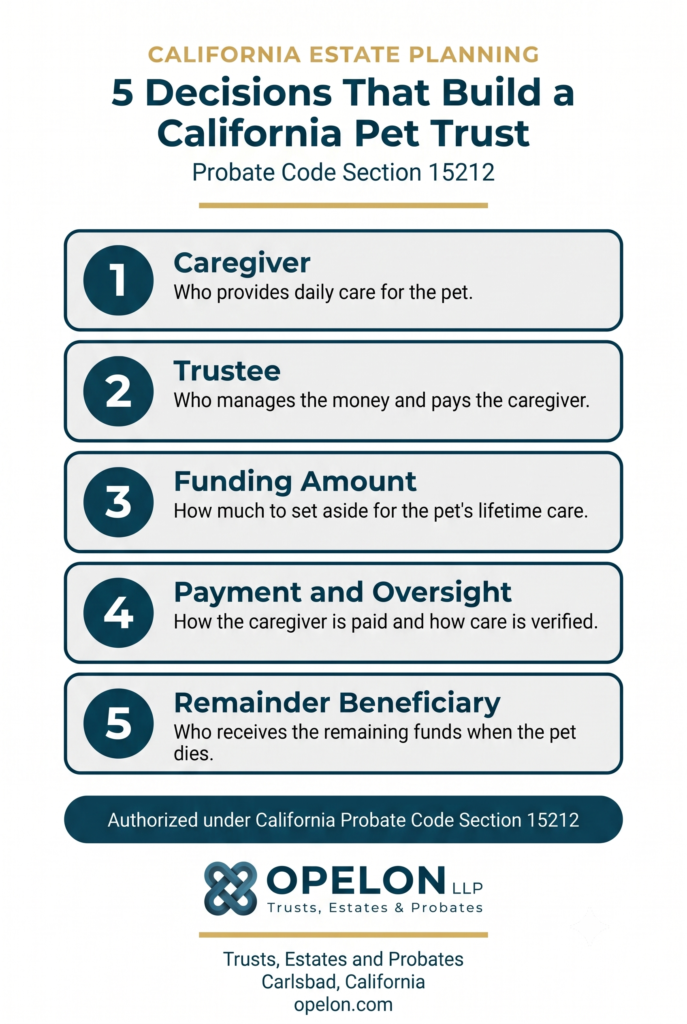
The Five Decisions You Need to Make for Your California Pet Trust
Quick answer: Every California pet trust under Probate Code Section 15212 turns on five decisions: who the caregiver is, who the trustee is, how much to fund, how the caregiver is paid and overseen, and who receives the remainder when the pet dies. |
These five decisions form the practical core of the document. Get them right and the trust functions as intended. Get one of them wrong and the trust can fail in ways that leave your pet without care.
Decision 1: Who Will Be the Caregiver?
The caregiver is the person physically caring for your pet day to day after your death. This person is not the trustee. The caregiver feeds the animal, walks the dog, takes it to the vet, and handles the daily routine.
Look for someone who actually wants the animal. Pets are not easy gifts. Good caregivers have the space, the time, and the lifestyle to absorb a new pet. They live close enough that a sudden cross-country move will not be needed, which can be stressful for older animals. Most important, they have agreed in advance to serve.
Always name a successor caregiver in case the primary cannot serve. The named caregiver’s circumstances often change between the day the trust is signed and the day the pet trust activates. The successor language closes that gap.
Have the conversation before the document is signed. Do not surprise someone by naming them in a trust they did not agree to. The most common cause of pet trust failure at the moment of need is the named caregiver declining the role.
A backup option is a pet survivor program. Many California humane societies and animal welfare organizations operate paid programs where the organization takes the pet at the owner’s death and either fosters or places the animal. The ASPCA pet-planning resources describe how these programs work in general terms. Evaluate any program on its own merits before naming it in your plan.
Decision 2: Who Will Be the Trustee?
The trustee manages the money. The trustee is typically a different person from the caregiver. That separation creates fiduciary oversight and protects the funds from misuse.
The trustee pays the caregiver on a set schedule, often monthly. The trustee can also pay direct expenses such as vet bills, food costs, and grooming. The trustee reports on trust activity and verifies that the pet is actually being cared for.
Common trustee options include the same person serving as trustee of your revocable living trust, a co-trustee structure, an independent family member, or a professional trustee. For a standalone pet trust with substantial funding, such as a multi-horse property or a multi-animal household, a professional trustee may be appropriate. Our guide on how to choose a trustee walks through the selection factors in more detail.
Decision 3: How Much to Fund?
This is the most-asked question we hear from California clients setting up a pet trust. The honest answer is that the right amount is the amount reasonably needed to cover your pet’s expected lifetime care, with a margin for unexpected veterinary costs. There is no statutory minimum or maximum.
A useful funding calculation has three steps. First, list the annual costs: food, grooming, routine vet care, medications, pet sitting and boarding, and caregiver compensation. Second, multiply by the pet’s expected remaining years. Third, add a margin for emergency veterinary care. A margin of 10 to 25 percent is typical in our experience.
Typical funding amounts vary widely. The table below reflects ranges we see in California pet trust planning. Treat them as starting points, not formulas.
Type of Pet | Typical Funding Range | Drivers of Higher Funding |
Cat or small dog | $15,000 to $50,000 | Older pet, chronic medical needs |
Medium to large dog | $30,000 to $100,000 | Higher food costs, joint or breed-specific care |
Horse | $50,000 to $200,000 or more | Boarding fees that often run $500 to $2,000 per month |
Multiple pets or exotic animals | Scale up accordingly | Specialized vets, longer expected life spans |
The Risk of Overfunding
California Probate Code Section 15212(e) authorizes a court to reduce the funding amount on petition if the court determines the amount “substantially exceeds” what is required for the intended use. The most famous example is the Leona Helmsley estate. Her trust set aside $12 million for the care of her dog. A New York court reduced the amount sharply on the ground that no dog could reasonably consume that level of funding. The Helmsley case arose under New York law, but California Probate Code Section 15212(e) is a parallel California provision and authorizes the same type of judicial reduction. Plan for reasonable care, not extravagance.
The Risk of Underfunding
In our experience, underfunding is the more common practical risk. If the trust runs out of money before the pet dies, the caregiver has no contractual duty to keep paying out of pocket. The pet can end up surrendered or rehomed in its later years, which is exactly the outcome the trust was designed to prevent. Err toward a modest cushion, not a bare minimum.
Drafting framing: A reasonable funding amount is one a California probate court would view as sufficient for the comfortable care of the animal over its remaining life, without substantially exceeding that amount. That framing is consistent with the funding-reduction standard in Probate Code Section 15212(e) and is the lens we use during the funding conversation with clients. |
Decision 4: How Will the Caregiver Be Paid and Overseen?
Compensation typically takes the form of a monthly stipend paid to the caregiver. The amount depends on the animal and the intensity of care. A common range we see in California pet trusts is $200 to $1,000 per month. The trustee usually pays major veterinary bills and other large expenses directly from the trust, rather than reimbursing the caregiver after the fact.
A reimbursement structure is also workable. The caregiver fronts day-to-day costs and submits receipts to the trustee. This approach can be simpler for smaller trusts and informal family caregiver arrangements.
Oversight is the second half of this decision. The trustee can require periodic reports on the pet’s condition. Common options include an annual veterinary exam confirmation, a few dated photographs each year, or in higher-stakes cases a third-party trust protector who can visit the pet and verify proper care.
For higher-value pet trusts, such as a horse or a multi-animal household, we typically recommend requiring an annual veterinary examination by a vet of the trustee’s choice, with documented results.
Consider a structure that pair a familiar family-member caregiver with an independent trustee, plus modest reporting requirements such as an annual vet exam result and photos a few times a year. That mix balances trust in the caregiver against the fiduciary’s duty to verify proper care.
Decision 5: Who Gets the Remainder When the Pet Dies?
Every California pet trust ends. Probate Code Section 15212 terminates the trust when no covered animal is still alive. Whatever is left in the trust must go somewhere. That destination should be named in the document.
If the remainder beneficiary is not named, the funds typically revert to the settlor’s estate or to intestate heirs. That default rarely matches what the client actually wants. A named remainder beneficiary closes the loop.
Common remainder choices include family members, animal welfare charities, scholarship funds, the caregiver as a thank-you payment, or back into the residue of the settlor’s revocable living trust. Many of our pet trust clients direct the remainder to an animal welfare cause they cared about during life. We do not recommend specific organizations, but we encourage clients to name a charity they have actually researched and supported.
Pet Trust Within Your Revocable Trust vs. Standalone Pet Trust
Quick answer: Most California families with one or two pets use a pet trust article inside their existing revocable living trust. A standalone pet trust makes sense for higher-value, multi-pet, or higher-complexity situations such as horses or exotic animals. |
Choosing the Structure
Feature | Pet Trust Within RLT | Standalone Pet Trust |
Drafting complexity | Lower. Added as an article in the existing trust. | Higher. Separate document with its own provisions. |
Cost | May incur an additional fee to the standard estate plan flat fee. | Separate engagement, priced on complexity. |
Best fit | One or two pets, moderate funding, integrated plan. | Multiple pets, higher funding, horse or exotic animals. |
Trustee | Same as the RLT trustee or a co-trustee. | Often a dedicated trustee. |
Funding source | Funded at the settlor’s death from RLT residue. | Funded separately. May be funded during lifetime. |
For most California families with one or two pets and moderate funding, the pet trust article inside the revocable living trust is sufficient. For higher-value or higher-complexity situations, a standalone pet trust is usually worth the additional drafting time.
What a California Pet Trust Costs to Set Up
Quick answer: A pet trust provision inside a revocable living trust is typically an additional $500 on top of Opelon LLP’s standard estate planning flat fee. A standalone pet trust is a separate engagement, priced on complexity. The funding itself is internal trust accounting, not an additional out-of-pocket cost. |
When we include pet trust provisions inside an existing revocable living trust for a Carlsbad client or another San Diego County family, the provision is an addtional $500 to the flat fee for the estate plan.
A standalone pet trust is different. It is its own document, often with its own trustee and its own oversight structure. Standalone work is engaged separately, on a flat-fee basis that scales with complexity. Our published California estate planning attorney fees page describes how we structure pricing in general terms.
Funding the pet trust at the settlor’s death is internal trust accounting. The assets come from the residue of the settlor’s revocable living trust. There is no additional out-of-pocket cost at funding time, beyond the underlying value being set aside for the pet.
What Happens If You Become Incapacitated Before You Die?
Quick answer: Pet trusts under California Probate Code Section 15212 typically activate at death. Strong pet planning also addresses incapacity, using a combination of durable power of attorney language, a trust provision that activates on physician-certified incapacity, and a caregiver communication plan. |
Pet trusts most commonly activate at the settlor’s death. That leaves a gap during any period of incapacity. If you spend six months in a memory care facility before death, the pet trust may not yet be in force. Someone still has to feed the dog and pay the vet during that period.
We close that gap with overlapping provisions across several documents. Mechanisms include:
- Durable power of attorney provisions. Your agent under a California durable power of attorney can be authorized to make pet-care arrangements. A power of attorney ends at death, but it covers the incapacity period.
- Pet trust provisions that activate on either death or physician-certified incapacity. The trustee can then begin paying the caregiver before the settlor dies.
- Caregiver communication. The named caregiver should know in advance where the pet is, who to call, the vet’s name, and any medication routine. This information rarely fits inside a legal document, but it matters more than the legal document during a crisis.
Incapacity-stage pet planning is a common gap we see when reviewing existing pet planning documents. The pet trust activates at death, but the settlor spent the last several months unable to direct anyone, and the dog ended up at a shelter because no one knew who to call. A well-drafted set of overlapping provisions, plus an honest conversation with the named caregiver, closes that gap.
When to Consult a California Pet Trust Attorney
Pet trust planning is not urgent for every pet owner. It does become important in several recognizable situations:
- You have a pet and no current estate plan, or a current plan that does not mention your pet.
- You have multiple pets, a horse, or an exotic animal with specialized care needs.
- You have already identified a caregiver informally and want to formalize the role with proper funding and oversight.
- You want to dedicate a meaningful sum to your pet’s care and ensure the funds cannot be diverted.
- You are concerned about who will look after your pet during a possible incapacity period before death.
Opelon LLP includes pet trust provisions in estate plans for San Diego County families across the spectrum, from single-cat households in Carlsbad to multi-horse properties in inland North County. We can draft pet trust language as a component of our revocable living trust plans, and as standalone documents where the situation calls for it. To start the conversation, you can request a free estate planning consultation in Carlsbad.
Related Guides
- Complete Guide to California Trusts (All Trust Types)
- California Revocable Living Trust: 7 Critical Steps