

If you are reading this in the days right after losing a parent, take a breath. Most adult children search for a checklist like this within the first week, often late at night, with funeral decisions and unfamiliar paperwork piling up.
The next 30 days have a clear, knowable structure. Opelon LLP’s Managing Partner Owen Rassman has administered more than 300+ San Diego County estates from our Carlsbad office, and the families we work with are almost always navigating this for the first time. This guide walks you through what to do, in the order to do it.
TL;DR — Key Takeaways
- Take a breath. The first 30 days after a parent dies in California have a clear structure: immediate logistics in Days 1 to 3, notifications and asset discovery in Days 4 to 14, and legal and financial decisions in Days 15 to 30.
- Order multiple certified death certificates early. Banks, brokerages, insurance carriers, government agencies, and the recorder may each request one. Order based on the institutions involved, often 8 to 15 copies.
- Whether probate is required depends on titling and asset type, not just total value. Trust-titled assets, joint-tenancy property, and accounts with valid named beneficiaries typically pass outside probate. Real property held in a parent’s sole name often triggers a court procedure.
- The probate clock generally does not start until a petition is filed and the court issues Letters. A consultation with a California probate attorney in the first 30 days clarifies the path before delays compound. Opelon LLP handles non-contested probate from our Carlsbad office.
- Do not pay your parent’s bills from your personal funds, and do not distribute personal property before authority is confirmed. Both create avoidable exposure for whoever is later appointed.
The First 30 Days at a Glance
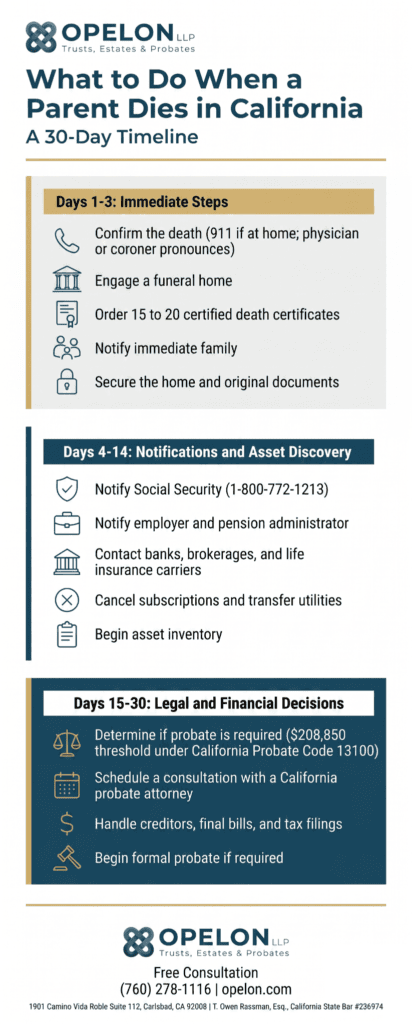
Three phases organize what to do when a parent dies in California: Days 1 to 3 cover immediate logistics and ordering certified death certificates. Days 4 to 14 cover notifications and asset discovery. Days 15 to 30 cover legal and financial decisions, including whether the estate may require probate or may qualify for a simplified transfer procedure under California law. Small-estate procedures have statutory requirements and value thresholds that are adjusted periodically, so confirm the current limits and what assets count before relying on a specific dollar figure.
You do not need to do everything in week one. The California probate process has built-in waiting periods, and most legal decisions can wait until you have certified death certificates and a basic asset list in hand.
The Three Phases at a Glance- What to do after a Parent Dies is CaliforniaDays 1 to 3: Confirm the death, choose a funeral home, order multiple certified death certificates (the right number varies by the institutions involved), secure the home and original documents. Days 4 to 14: Notify Social Security, employers, pensions, and insurance carriers. Contact banks and brokerages. Begin the asset inventory. Days 15 to 30: Determine whether probate is required, schedule a consultation with a California probate attorney, and address creditor and tax filings. |
Days 1 to 3: Immediate Steps After a Parent Dies in California
Confirm the Death and Notify Authorities
If your parent died at home and was not under hospice care, call 911. Paramedics or law enforcement will coordinate with the coroner. If your parent died under hospice care or in a hospital, the staff handles the medical pronouncement.
A licensed physician or coroner must legally pronounce the death. That pronouncement is required before the death certificate can be issued. In our experience working with San Diego County families, the funeral home (not the family) files the death certificate with the local registrar.
Choose a Funeral Home and Order Death Certificates
The funeral director files the death certificate with the local registrar after the medical pronouncement, generally within 8 calendar days of death and before disposition of the body, under California Health and Safety Code Section 102775. Timing can vary if an autopsy or coroner’s inquest is required.. Once filed, you can order certified copies through the funeral home or, in many counties, through the county recorder.
Order multiple certified copies, based on the number of financial institutions, insurers, and real-property or court filings involved (often 8 to 15, sometimes more).
Many banks, brokerages, and life insurance carriers request a certified death certificate, but requirements vary by institution and by the type of request (some accept a copy or return the certificate after review).
Government agencies and recorders may request certified copies in certain contexts, while others may accept alternative documentation. Add the county recorder for many real-property transfers, pension administrators, and the probate court if a probate case is filed. Order enough copies for your situation, and confirm each institution’s specific requirement before ordering extras.
Cremation versus burial is a personal and family decision. This guide focuses on the legal and financial path that runs alongside it.
Notify Immediate Family
Notify the surviving parent or spouse first, then siblings, then any adult children of the deceased. Designate one family member as the primary contact for outside calls and condolences. That single decision saves hours of repeat conversations during the first week.
Secure the Home and Original Documents
If your parent lived alone, secure the home. Lock doors, forward mail, and move obvious valuables to a safe location. Then locate and secure the original will and any trust documents. Also gather real-property deeds, life insurance policies, retirement-account statements, recent bank statements, vehicle titles, and any safe-deposit-box keys.
If you end up holding the original will, California Probate Code Section 8200 requires the person who has custody of a will to deliver it to the clerk of the superior court in the county where the parent resided within 30 days of learning of the death, and to deliver a copy to the executor named in the will. The custodian who fails to deliver the will within that period can be held liable for damages caused by the delay.
Where to Look First for Original Documents
|
Days 4 to 14: Notifications and Asset Discovery
Notify Social Security
The funeral home typically reports the death to the Social Security Administration as part of its standard process. Confirm this happened. If the funeral home did not report it, call SSA at 1-800-772-1213 (TTY 1-800-325-0778) or visit the local SSA office in person.
Any benefits paid for the month after the month of death must be returned. A surviving spouse may be eligible for survivor benefits. Adult children of the deceased generally are not, unless they are under 18, age 18 to 19 and a full-time elementary or secondary school student, or were disabled before age 22, subject to SSA eligibility rules. The Social Security survivor benefits page explains eligibility in more detail.
Notify Employer, Pension Administrators, and Insurance Carriers
Contact your parent’s most recent employer. Ask about the final paycheck, accrued vacation, employer-paid life insurance, the 401(k) administrator, and COBRA continuation for any covered dependents. Pension administrators are separate from 401(k) custodians, so call each one with a death certificate.
Term and whole-life insurance carriers typically pay the named beneficiary directly without probate. Each carrier has its own claim form. Locate the policy or call the carrier with the policy number to start the claim. See our guide to beneficiary designations and probate for how these assets bypass court.
Contact Banks, Brokerages, and Investment Accounts
Many financial institutions will request a certified death certificate. How an account transfers depends primarily on its titling and beneficiary designations, and institution-specific requirements may also apply.
- Beneficiary-designated accounts (POD/TOD): Often transfer to the named beneficiary outside probate if the designation is valid and the institution accepts the claim paperwork.
- Trust-titled accounts: Typically are administered by the successor trustee under the trust terms, subject to the institution’s documentation requirements and any applicable creditor or tax obligations.
- Sole-name accounts with no beneficiary: Often become probate assets. Access may be restricted until a personal representative is appointed or a simplified transfer procedure applies, depending on the institution and the account balance.
Our guide on probate vs. non-probate assets in California walks through how titling decides which path each account takes.
Cancel or Transfer Subscriptions, Utilities, and Recurring Bills
Keep utilities active at the home if it is not yet sold or vacated. Transfer or cancel them once the home is empty. Mail forwarding through USPS to the executor or successor trustee’s address keeps statements and notices flowing in one direction.
Cancel or pause streaming subscriptions, gym memberships, magazine subscriptions, and club dues. Notify credit card companies, but do not close accounts immediately. Ongoing access is often needed for funeral expenses and final bills, which can be reimbursed from the estate later.
Begin the Asset Inventory
Start a single document or spreadsheet listing every asset your parent owned. You will refine this list during probate or trust administration. The first pass should capture:
- Real estate (primary home, rental property, out-of-state property)
- Bank and brokerage accounts with current balance approximations
- Vehicles with VIN numbers and approximate value
- Retirement accounts (IRA, 401(k), 403(b), pension)
- Life insurance policies and named beneficiaries
- Business interests (sole proprietorship, LLC membership, partnership)
- Personal property of meaningful value (jewelry, art, collectibles)
If the estate enters probate, this list will form the basis for the formal Inventory and Appraisal filed with the court.
Days 15 to 30: Legal and Financial Decisions
Determine Whether the Estate Requires Probate
California probate is often required when a parent’s probate-eligible assets (generally, assets in the parent’s sole name with no beneficiary designation, not held in a trust, and not passing by right of survivorship) exceed the applicable small-estate limit for the procedure you are considering.
However, whether probate is required can depend on the specific assets, their titling, and whether another court procedure is available. Trust-titled assets, joint-tenancy property, and many accounts with valid named beneficiaries typically pass outside probate, subject to confirmation of title and the institution’s requirements.
California probate is the court-supervised process governed by California Probate Code Sections 8000 and following. The California Courts Self-Help probate page explains the basics and links to simplified procedures.
Some estates may qualify for simplified transfer procedures, but the rules differ for personal property versus real property and depend on what assets are included, how they are titled, and the current statutory thresholds. Real property transfers in particular have additional requirements and may require a court procedure even when personal property can be collected by declaration. In our experience, a common surprise for North County San Diego families is that a home held outside a trust is often enough to make a formal probate (or another court procedure) necessary.
For a deeper walk-through, see our guides on the California probate threshold and the California Small Estate Affidavit procedures.
Schedule a Consultation With a California Probate Attorney
The 9-to-18-month probate timeline typically does not begin in a meaningful way until a petition is filed and the court issues Letters. Delays in starting the case often delay the point at which a personal representative has authority to act, though the overall timeline can vary based on court backlog, notice periods, and the assets involved.
A consultation in the first 30 days helps clarify whether probate is required or avoidable and, if probate is needed, what the likely timeline and statutory fees will look like.
California statutory probate fees are set by Probate Code Sections 10800 and 10810. Both sections apply identical sliding scales: 4% of the first $100,000, 3% of the next $100,000, 2% of the next $800,000, and 1% of the next $9,000,000. Section 10800 covers the personal representative. Section 10810 covers the attorney.
On a $1 million estate, combined statutory fees total approximately $46,000 ($23,000 each side), calculated on the probate estate value for fee purposes (which is not necessarily the net value after debts or mortgages). See our full breakdown of California probate fees with examples.
Handle Creditors, Final Bills, and Tax Filings
Several tax filings may be triggered by a parent’s death. The person authorized to act (such as a court-appointed personal representative, a successor trustee, or in some situations a surviving spouse or other authorized signer) typically handles them, rather than other family members acting without authority.
- Federal final income tax return (Form 1040): For the year of death, covering January 1 through the date of death, due April 15 of the following year (subject to extensions and special filing rules for the year of death).
- California final income tax return (FTB Form 540): Same due date as the federal return.
- Estate income tax returns (Form 1041 federal, FTB Form 541 California): May be required if the estate or trust generates sufficient income during administration, depending on the circumstances and filing thresholds.
- Federal estate tax return (Form 706): Generally required only if the gross estate plus adjusted taxable gifts exceeds the federal filing threshold for the year of death (which can change by law). Confirm the current exemption and filing requirements with a qualified tax professional or the IRS.
California has no state estate tax. Creditor claim deadlines in a California probate are time-sensitive and depend on the notice and publication requirements in the case; do not assume a single deadline applies in every situation. Our guide to Letters Testamentary vs. Letters of Administration explains the difference and why timing and authority matter.
Decision Tree: Does My Parents’ Estate Need Probate?
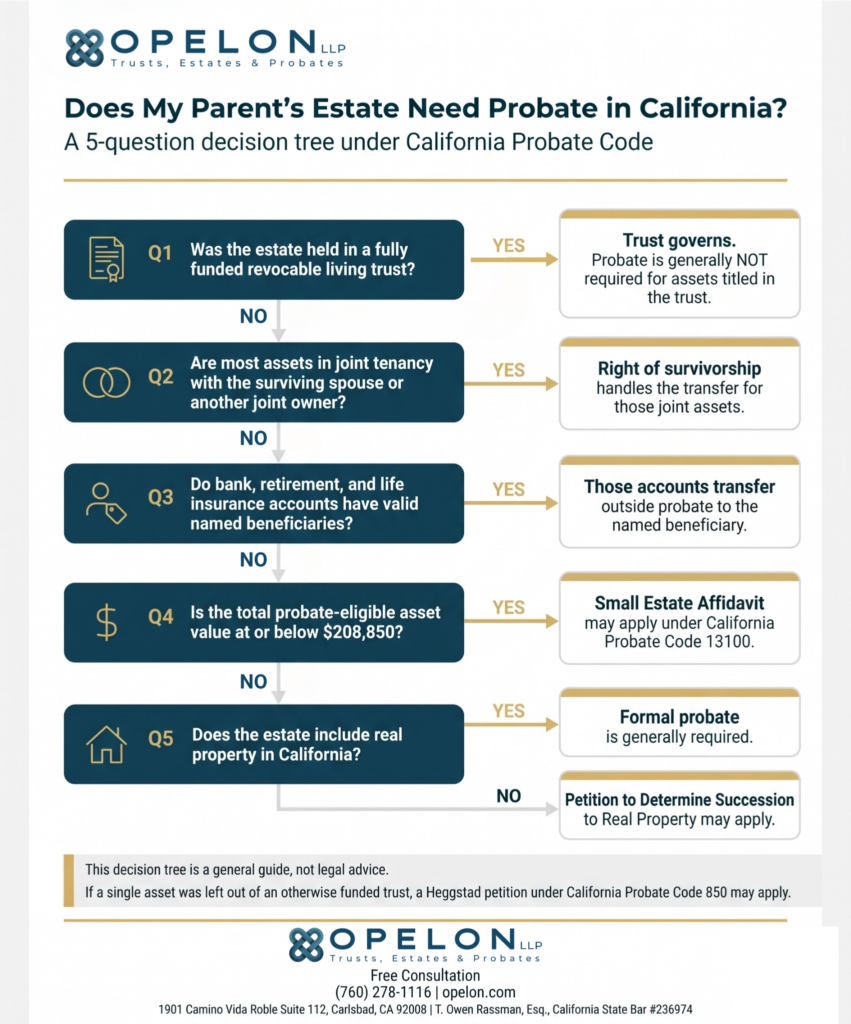
Run through these five questions in order. The answers tell you, in most cases, whether your parents’ California estate needs formal probate.
- Did your parent have a fully funded revocable living trust? If yes, probate is often not required for assets actually titled in the trust, though a court procedure may still be needed in some situations (for example, to address an omitted asset, a dispute, or a title issue).
- Are most assets held in joint tenancy with the surviving spouse or another joint owner? If yes, those assets are transferred by right of survivorship, outside probate.
- Do bank accounts, retirement accounts, and life insurance have valid named beneficiaries? If yes, those transfer outside probate to the named beneficiary.
- Is the total probate-eligible asset value below the current California small-estate limit for the applicable simplified procedure? If yes, a simplified collection/transfer procedure may apply under California law (including Probate Code Section 13100 and related statutes), depending on the asset type and eligibility requirements.
- Does the estate include California real property that is not in a trust and does not pass by survivorship or beneficiary designation? If yes, a court procedure is often required (which may be a formal probate or, depending on the facts and current thresholds, another statutory process).
Trust Funded but One Asset Left Out?This is one of the most common patterns we see. Your parent created a trust but never retitled a bank account or never recorded a deed transferring the home into the trust. California Probate Code Section 850 may allow a Heggstad petition, a court procedure that can confirm an asset as trust property based on clear written evidence of intent. It is often faster and less expensive than a full probate, but timing and cost depend on the county, the evidence, and whether anyone contests the petition. |
Download Our 30-day checklist
For Adult Children Navigating the Death of a Parent in California
Document and Information Checklist
Use this table as your gathering checklist during the first 30 days. Keep originals in one secure location and scan copies to a single cloud folder.
Document | Where to Find It | What You Need It For |
Certified death certificates (multiple) | Funeral home or county recorder | Often needed for court filings and many recorder transactions; may be requested by financial institutions and agencies depending on the request. |
Original will and codicils | Home safe, attorney’s office, safe-deposit box | Probate filing, executor authority |
Trust document and amendments | Home safe, attorney’s office | Successor trustee authority, distribution |
Real property deeds | Home files, county recorder | Title transfer, probate inventory |
Vehicle titles and registrations | Home files | DMV transfer or sale |
Bank statements (last 6 months) | Online portals, mailed statements | Asset inventory, creditor review |
Brokerage statements | Online portals | Asset inventory, valuation |
Retirement-account statements | Custodian portals | Beneficiary claim, valuation |
Life insurance policies | Home files, employer | Beneficiary claim |
Pension or annuity statements | Plan administrators | Survivor benefits, claims |
Federal and California tax returns | Home files, prior preparer | Final income tax filings |
Social Security statement | ssa.gov account | Survivor benefits review |
Mortgage and property tax bills | Lender portals, county assessor | Ongoing property obligations |
Credit card statements | Online portals | Creditor identification, final bills |
Safe-deposit box keys | Home, with executor | Access to original documents |
Business documents (LLC, partnership) | Business records, attorney files | Business succession, valuation |
Digital asset access | Password manager, recovery keys | Online accounts, cryptocurrency, photos |
Digital assets are easy to overlook. Our guide to digital assets in California estate administration covers password managers, cryptocurrency wallets, and online accounts.
California-Specific Considerations
California probate runs through the Superior Court of the county where the decedent lived, under Probate Code Sections 8000 and following. For Carlsbad and North County San Diego residents, the court of jurisdiction is the San Diego County Superior Court Probate Division. Filings happen at the downtown San Diego courthouse. A North County branch in Vista handles many local matters.
California has no state estate tax. California residents may still be subject to the federal estate tax, which generally applies only to estates above the federal exemption and filing threshold for the year of death (and those thresholds can change). Our guide to the federal estate tax exemption amount explains how the current rules affect planning.
The 9-to-18-month formal probate timeline depends on county court backlog and asset complexity. It also depends on whether the personal representative uses Independent Administration of Estates Act authority under Probate Code Sections 10400 to 10592. Our overview of the California Independent Administration of Estates Act (IAEA) walks through what IAEA powers do and do not allow.
Common Mistakes Adult Children Make in the First 30 Days
These are the patterns we see most often when families call us for help cleaning up an early misstep.
- Closing the parent’s bank accounts immediately. Some ongoing access is often needed for funeral expenses and final utility bills, which can be reimbursed from the estate later.
- Selling or moving real estate before consulting an attorney. Transfer rules depend on titling. A premature sale can trigger probate complications or capital gains issues.
- Filing taxes for the deceased without confirming authority. Some filings and account access require proof of authority (such as Letters, trustee documentation, or IRS/FTB authorization), while other filings may be handled by a surviving spouse or other authorized signer depending on the situation. Whether Letters are required depends on the institution, the asset, and the specific task.
- Distributing personal property before the will is validated. In our experience working with San Diego County families, even well-intentioned early distributions create exposure for the executor.
- Assuming the parent’s living trust is fully funded. Verify titling before relying on the trust to skip probate. If a single asset was left out, a Heggstad petition under Probate Code Section 850 may bring it back in.
- Waiting too long to consult a probate attorney. In our experience, families who delay six months often add months to the overall timeline. The court process generally cannot move forward (and authority is limited) until a petition is filed and the court issues Letters, and timelines also vary with court backlog, notice periods, creditor issues, and asset complexity.
- Forgetting to notify Social Security if the funeral home did not. Any benefits paid after the month of death must be returned. A short call to SSA closes the loop.
When to Call a California Probate Attorney
Some signals point clearly toward professional help. If any of the following apply, schedule a consultation:
- Your parents’ probate-eligible assets appear to exceed the current small-estate limit for simplified procedures (or include assets that typically require a court process).
- Real estate is involved and is not titled in a fully funded trust.
- There is no will, or the will is unclear or outdated.
- Multiple beneficiaries are listed, and at least one lives out of state.
- Your parent owned a business interest that needs to be transferred or wound down.
- Disagreements among family members are arising. (Note: Opelon LLP handles non-contested probate. If a matter becomes contested, we can refer you to a California probate litigation specialist.)
What to Look For in a California Probate Attorney
- California Bar admission in good standing.
- Experience administering California estates of similar size and complexity.
- Tax depth, particularly an LL.M. in Taxation if the estate has any complexity.
- Transparent fee structure that explains statutory fees up front.
FAQ's: What to Do When a Parent Dies in California
What is the first thing to do when a parent dies in California?
If your parent died at home and was not under hospice care, call 911. If they died under hospice or hospital care, the staff coordinates the medical pronouncement. Once the funeral home is engaged, the funeral director files the death certificate with the local registrar, generally within the statutory time period under California law (timing can vary by circumstances
How many copies of the death certificate do I need in California?
Order multiple certified copies (often 8 to 15, sometimes more). Many banks, brokerages, and life insurance carriers request certified copies, but requirements vary; some agencies and institutions accept alternatives or return the certificate after review. Pension administrators, the county recorder, and the probate court may require certified copies in certain contexts, so confirm requirements before ordering a large number.
Do I need to file probate if my parent had a trust in California?
It depends on whether the trust was fully funded. A revocable living trust typically avoids probate only for assets actually titled in the trust’s name. If your parent created a trust but never retitled their California home or never updated bank-account beneficiaries, those assets may remain outside the trust and may require a court procedure. In that case, California Probate Code Section 850 may allow a Heggstad petition. A successor trustee can petition the court to confirm the asset as trust property based on clear written evidence of the parent’s intent; timing and cost depend on the county, the evidence, and whether anyone contests the petition. Learn more in our Heggstad petition guide.
How long after a parent dies must probate be filed in California?
California has no strict statutory deadline to file the petition. Practical deadlines apply, however, including tax filing deadlines and time-sensitive creditor-notice and claim rules in a probate case. Federal final income tax returns are typically due April 15 of the year after death (subject to extensions and special circumstances). In our experience, families who wait six months often add months to the overall timeline.
What is the small-estate threshold in California in 2026?
California provides simplified transfer procedures for certain estates under Probate Code Section 13100 and related statutes, subject to specific requirements and value thresholds that are adjusted periodically. Whether a given estate qualifies depends on the type of asset (for example, personal property versus real property interests), how it is titled, and the current statutory amounts and court forms. Confirm the current thresholds and eligibility rules before relying on a simplified procedure instead of a formal probate.
How much does probate cost in California?
California statutory probate fees are set by Probate Code Sections 10800 (personal representative) and 10810 (attorney). Both apply identical sliding scales: 4% of the first $100,000, 3% of the next $100,000, 2% of the next $800,000, and 1% of the next $9,000,000. Combined fees equal twice the schedule. On a $1 million estate, combined statutory fees total approximately $46,000. Court costs, the probate referee fee, publication costs, and any extraordinary fees are additional. A typical routine case adds $2,000 to $5,000 in costs.
Who is responsible for paying my parent's bills after they die in California?
The estate is responsible for the parent’s debts. The executor or successor trustee typically pays valid debts from estate or trust assets before any distribution to beneficiaries. Adult children are generally not personally responsible for a parent’s debts unless they cosigned or are otherwise legally obligated. Do not assume you can access estate accounts immediately; payment timing and authority depend on the assets, the institution, and whether a probate or another procedure is required.
How do I notify Social Security when a parent dies in California?
The funeral home typically reports the death to Social Security as part of its standard process. Confirm this happened. If not, call SSA at 1-800-772-1213 or visit the local office in person. Any benefits paid after the month of death must be returned, so notify SSA promptly.
What if my parent died without a will in California?
The estate is administered under California’s intestate succession rules in Probate Code Sections 6400 to 6455. The court appoints an administrator, typically the surviving spouse or an adult child. The administrator handles the same probate process as if there were a will. Assets are then distributed under the intestate statutes rather than under the parent’s wishes.
When should I hire a California probate attorney after a parent dies?
Schedule a consultation in the first 30 days, even if you are not yet sure whether probate is required. The consultation clarifies whether the estate qualifies for simplified procedures or requires formal probate. The court process generally cannot move forward (and authority is limited) until a petition is filed and the court issues Letters, and timelines vary with court backlog, notice periods, creditor issues, and asset complexity, so early counsel can help avoid preventable delays
Get Help With Your Parent’s California Estate
If you would like guidance on the next steps, Opelon LLP offers free 30-minute consultations from our Carlsbad office. Same-week scheduling is usually available.
Schedule a ConsultationPhone: (760) 278-1116 Email: info@opelon.com Office: 1901 Camino Vida Roble, Suite 112, Carlsbad, CA 92008 Website: opelon.com |
This article provides general information about California estate planning, probate, and trust administration. It is not legal advice. Laws change, and every situation is different. Consult with a California estate planning attorney about your specific circumstances. Reading this article does not create an attorney-client relationship with Opelon LLP. Opelon LLP is a California-licensed law firm with its office in Carlsbad, San Diego County, California. Attorney responsible for this content: T. Owen Rassman, Esq., California State Bar #236974.