


What Are Letters Testamentary in California Probate?
Letters Testamentary are official court orders. They give an executor named in a valid will the authority to administer a California estate. The California Superior Court issues them. This step turns a private will into enforceable administrative power.
Once the letters are issued, banks, brokers, title companies, and government agencies recognize the executor’s authority. The executor can then act on behalf of the estate.
What Legal Authority Do Letters Testamentary Grant?
Letters Testamentary authorize the executor to take the following actions:
- Collect and secure estate assets in preparation for administration.
- Open an estate bank account and access investment accounts using certified letters and a new EIN for the estate.
- Sell or transfer property to satisfy debts and taxes, subject to court approval unless California IAEA authority has been granted.
- Distribute assets to beneficiaries under the will, after payment of expenses, taxes, and allowed creditor claims.
The court may limit the scope of authority. Any conditions in the letters themselves also apply, including whether IAEA authority is included.
When Are Letters Testamentary Required?
An executor must obtain Letters Testamentary when three conditions are met:
- A valid will names them as executor.
- The estate includes titled assets such as real estate or brokerage accounts.
- No trust or other mechanism bypasses probate.
Limited alternatives may apply to qualifying small estates. Other assets pass outside probate entirely. Examples include beneficiary-designated accounts and property held in joint tenancy with right of survivorship.
Fiduciary Duties of an Executor Under Letters Testamentary
An executor’s core fiduciary responsibilities include:
- Filing an Inventory and Appraisal (Forms DE-160 and DE-161), verified by the personal representative and a court-appointed probate referee, within the statutory deadline.
- Notifying creditors in writing and publishing a Notice to Creditors as required by the California Probate Code.
- Paying legitimate debts, taxes, and administrative expenses before any distributions.
- Acting impartially for all beneficiaries and avoiding conflicts of interest.
- Filing accountings and reports with the court as required, unless excused by statute or court order.
How to Obtain Letters Testamentary: Step-by-Step
If you are wondering how to get Letters Testamentary in California, follow these steps:
- File a Petition for Probate (Form DE-111) with the Superior Court in the county where the decedent lived. Attach the original will and a certified copy of the death certificate.
- Provide required notices to all named beneficiaries, heirs, and creditors under California Probate Code notice rules.
- Attend the court hearing. The judge validates the will, confirms the executor’s appointment, and sets any bond requirement.
- Take the oath and post bond if required. Receive Letters Testamentary on Form DE-150 from the probate clerk. Request certified copies for use with banks and other third parties.
What Are Letters of Administration in California Probate?
Letters of Administration are court-issued orders that empower an administrator to oversee estate settlement. The court issues them when a decedent dies intestate (without a valid will), or when a named executor cannot or will not serve. Distribution then follows the California intestate succession rules in Probate Code Sections 6400 through 6414.
When Are Letters of Administration Necessary?
Letters of Administration become necessary in several common situations:
- No valid will exists that names an executor.
- A will exists but does not name an executor, or the nominee declines.
- The nominated executor is disqualified, incapacitated, or deceased.
An interested person petitions the court for appointment. This is typically a surviving spouse, an adult child, or another heir. The court may grant administration with or without full court supervision, depending on the facts and complexity of the estate.
Authority and Responsibilities Under Letters of Administration
An administrator’s duties mirror those of an executor in most practical respects:
- Inventory and appraise all estate assets using the same forms an executor uses (DE-160 and DE-161).
- Notify creditors and satisfy valid debts, taxes, and administrative expenses.
- Distribute assets to heirs in the order and proportions set by California intestacy law, subject to court orders and payment of all allowed claims.
- File accountings and reports with the court as required, or obtain court-approved waivers where permitted.
The key difference is the source of distribution guidance. An administrator follows the statutory succession hierarchy rather than written instructions from the decedent.
How to Obtain Letters of Administration: Step-by-Step
If you are wondering how to get Letters of Administration in California, follow these steps:
- File a Petition for Probate (Form DE-111). State that the decedent died intestate, list all potential heirs, and identify the proposed administrator.
- Serve statutory notices on all known heirs and creditors as required by California Probate Code.
- Attend the court hearing. The judge determines appointment priority among competing petitioners and formally appoints the administrator.
- Post any required bond and receive Letters of Administration on Form DE-150. Request certified copies for use with banks, title companies, and other third parties.
Letters Testamentary vs. Letters of Administration: Side-by-Side Comparison
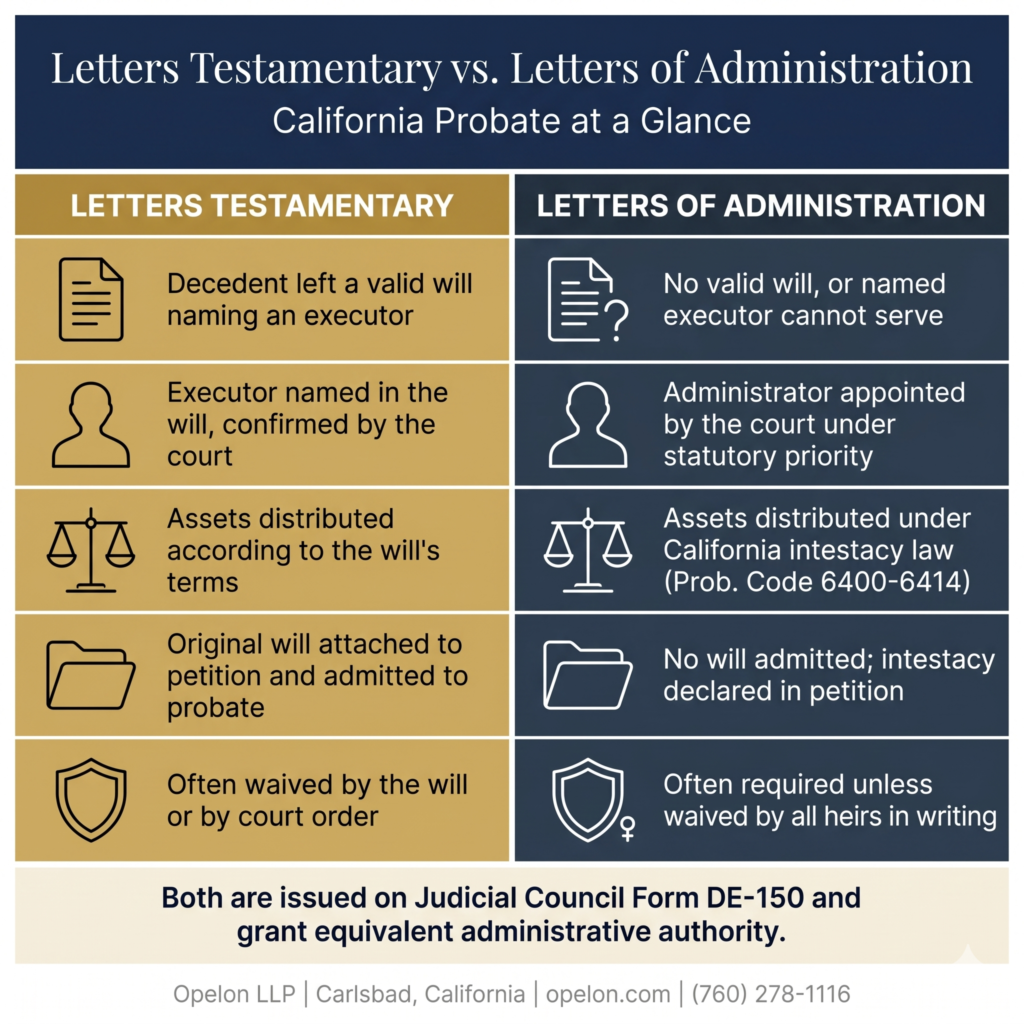
Both documents are issued on Form DE-150. Both grant substantially the same authority to administer a California estate.
The differences lie in when each is issued, who is appointed, and what distribution rules apply.
Factor | Letters Testamentary | Letters of Administration |
When issued | Decedent left a valid will naming an executor. | No valid will, or the named executor cannot serve. |
Court form | Form DE-150. | Form DE-150. |
Representative title | Executor (or executrix). | Administrator (or administratrix). |
Source of appointment | Named in the will and confirmed by the probate court. | Court-appointed based on the statutory priority list. |
Distribution rules | Under the will’s terms. | Under California intestacy law (Probate Code Sections 6400 through 6414). |
Will submitted to court | Yes. The original will is attached to the petition. | No. The petition declares intestacy. |
Core fiduciary duties | Inventory, notify creditors, pay debts, distribute, file accountings. | Same: inventory, notify creditors, pay debts, distribute, file accountings. |
Bond requirement | May be waived by the will or by court order. | Often required unless all heirs waive it in writing. |
Both roles carry equal legal accountability to the court, creditors, and beneficiaries. The source of appointment and the distribution roadmap differ. The duties to all parties do not.
Letters of Special Administration and Administration with Will Annexed
California probate recognizes two specialized forms of letters. Each applies when standard appointments are delayed, incomplete, or impractical.
Letters of Special Administration
Letters of Special Administration grant limited authority for specific or urgent tasks before general letters are issued. Common reasons include preserving perishable assets, meeting an imminent filing deadline, or handling a financial emergency that cannot wait for the full probate process.
Special administration authority is narrowly defined by the court order that creates it. These letters end automatically or are replaced when general Letters Testamentary or Letters of Administration are issued.
Letters of Administration with Will Annexed
These letters apply when a valid will exists but the named executor cannot or will not serve, and no successor executor is named or able to act. The court appoints an administrator who is bound to carry out the will’s terms.
The administrator follows the will’s distribution instructions rather than intestacy law. Authority comes from the court, not from the will itself. This preserves the decedent’s distribution intentions even when the original executor is unavailable.
How the California Probate Court Oversees These Letters
The California Superior Court supervises all personal representatives from the petition through final distribution. Judicial oversight protects estate integrity, enforces fiduciary standards, and creates a formal record of all estate transactions.
The Court’s Role in Issuing Letters
The probate court reviews each petition for completeness. It confirms the validity of the will or the fact of intestacy. The court then appoints the appropriate personal representative. Once approved, the court issues letters on Form DE-150 and sets any bond requirement.
The letters serve as the personal representative’s official credentials with third parties. Court jurisdiction continues through administration. The court remains available to resolve disputes, approve extraordinary transactions, and confirm final distribution.
How Forms DE-111 and DE-150 Work Together
Form DE-111 is the Petition for Probate. It opens the proceeding by identifying the proposed representative, listing heirs or beneficiaries, and supplying required documents, including the will if one exists.
Form DE-150 is the letters themselves. The probate clerk issues Form DE-150 after the court approves the petition. The personal representative must also take the oath and post any required bond. Third parties rely on certified copies as official proof of authority to act.
Common Challenges and Timelines for Obtaining Probate Letters in California
Obtaining letters rarely happens immediately. Procedural requirements, court scheduling, and disputes all affect how quickly a personal representative can begin formal estate administration.
Typical Causes of Delay
The most common causes of delay include:
- Court calendar congestion, which can push hearings out by several weeks or months. San Diego County Superior Court probate hearings are scheduled through the Probate Division in downtown San Diego.
- Incomplete documentation, such as missing witness signatures, unfiled attachments, or irregular service of notice. These issues require corrective filings and added hearings.
- Family disputes over will validity or the identity of heirs. Formal objections can extend the proceedings.
Typical Timelines and Costs
In uncontested matters with complete filings, letters are typically issued within a few weeks to a few months. Timing depends on county court calendars and case complexity.
Costs generally include Superior Court filing fees, publication fees for the required creditor notice, bond premiums if a bond is required, and attorney fees calculated under the California probate fees statutory schedule based on the gross value of the estate.