When a loved one passes away in California, you may assume their estate must go through the lengthy probate process. However, if the estate qualifies as a “small estate,” you may be able to use a small estate affidavit to collect and transfer the deceased person’s assets without ever stepping foot into a courtroom.
This simplified procedure, governed by California Probate Code Sections 13100 through 13116, helps families across San Diego County and throughout California avoid the time and expense of formal probate administration. Qualifying for the affidavit depends on what an estate looks like after a death, while keeping an estate out of probate from the start is something families can plan for during life.
In this guide, we explain exactly how the small estate affidavit process works, who qualifies to use it, and the step-by-step process for transferring property.
Whether you are dealing with a bank account, investment holdings, or other personal property left behind by a family member, understanding this streamlined option may save your family significant time and expense.
Key Takeaways
A California small estate affidavit allows you to collect a deceased person’s personal property without formal probate when the estate value is $208,850 or less (effective April 1, 2025).
You must wait at least 40 days after the person’s death before using the affidavit.
The small estate affidavit cannot be used to transfer real property (land or houses); a separate procedure is required for real estate.
No court filing is required for the affidavit; you present it directly to the institution holding the deceased person’s property.
Many San Diego County families use this process to access bank accounts, collect final paychecks, and claim other assets without hiring an attorney.
What Is a California Small Estate Affidavit?
A small estate affidavit is a sworn, written statement that authorizes someone to claim a deceased person’s assets outside of the formal probate process.
Under California Probate Code Section 13100, this affidavit can be used when the total value of the deceased person’s California estate (excluding specific exempt property) does not exceed the statutory threshold.
Think of it as a shortcut. Instead of filing paperwork with the probate court, waiting for a judge to appoint you as executor or administrator, and going through months of formal administration, you prepare the affidavit, attach the required documents, and present it directly to the bank, brokerage, employer, or other entity holding the deceased person’s property.
The recipient of the affidavit is legally required to release the property to you, provided you meet all the requirements. If they refuse without good reason, California law even allows you to recover attorney fees if you have to take them to court.
What Is the Current Small Estate Threshold in California?
As of April 1, 2025, the California small estate affidavit threshold is $208,850.
This means you can use the affidavit procedure if the gross fair market value of all the deceased person’s real and personal property in California (excluding certain exempt assets) does not exceed this amount.
California adjusts this threshold every three years based on the Consumer Price Index to account for inflation. Here is the recent history of threshold changes:
Date of Death
Threshold Amount
Authority
Before April 1, 2022
$166,250
Prob. Code 13100
April 1, 2022 to March 31, 2025
$184,500
Prob. Code 13100
On or after April 1, 2025
$208,850
Prob. Code 13100
How to Calculate the Estate Value
The estate value for small estate affidavit purposes includes all California real and personal property owned by the deceased person at the time of death, minus certain excluded assets.
Getting this calculation right is essential because using the affidavit when the estate exceeds the threshold could create legal problems.
Assets to Include in Your Calculation for Small Estate Affidavit
Bank accounts held solely in the deceased person’s name
Investment and brokerage accounts without transfer-on-death designations
Retirement accounts and life insurance payable to the estate (not to named beneficiaries)
Personal property such as furniture, jewelry, and collectibles
Other California real property, for calculation purposes only. A qualifying primary residence worth up to $750,000 is excluded from this calculation under AB 2016 (see the real property section below).
Amounts owed to the deceased (final paychecks, pending refunds, debts owed)
Assets to Exclude From Your Calculation for Small Estate Affidavit
Vehicles, boats, and mobile homes (these have separate transfer procedures)
Property held in a living trust
Property owned as joint tenancy with right of survivorship
Community property with right of survivorship
Property that passes directly to the surviving spouse or domestic partner
A qualifying primary residence worth up to $750,000. It transfers through the separate petition described below and does not count toward the $208,850 calculation.
Life insurance, retirement accounts, and bank accounts with named beneficiaries
Real property located outside California
Multi-party bank accounts where the deceased was one of several owners
Important: Value the property as of the date of death, not the date you complete the affidavit. You do not need to hire a professional appraiser. A good-faith estimate of fair market value is acceptable. For personal property, consider what the items would sell for at a garage sale, not their sentimental value.
Step-by-Step Process for Using a Small Estate Affidavit
Using a California small estate affidavit involves preparing a sworn declaration, gathering supporting documents, and presenting them to the person or institution holding the deceased person’s property. Here is precisely how to do it.
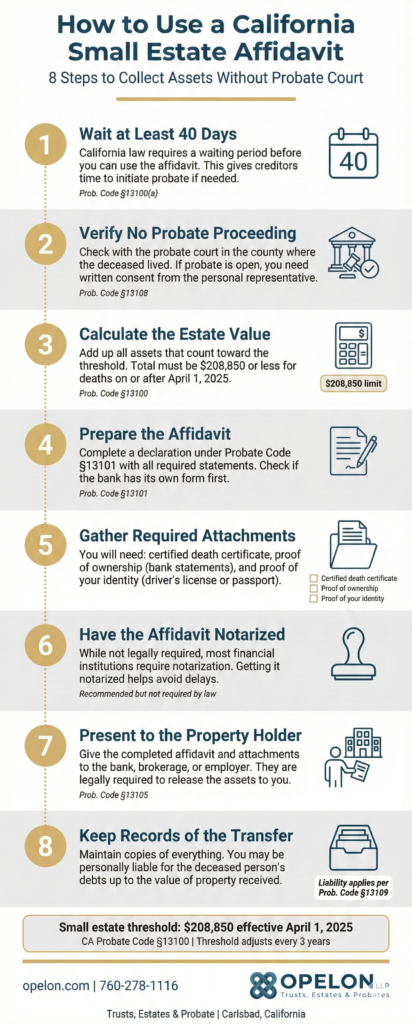
Wait at least 40 days after the death. California law requires a waiting period before you can use the small estate affidavit. This gives any creditors or interested parties time to initiate formal probate if needed.
Verify no probate proceeding has been filed. Check with the probate court in the county where the deceased person lived. If a probate case is already open, you generally cannot use the small estate affidavit unless the personal representative provides written consent.
Calculate the estate value. Add up all assets that count toward the threshold using the guidelines above. Make sure the total is $208,850 or less (for deaths on or after April 1, 2025).
Prepare the small estate affidavit. Complete a declaration under California Probate Code Section 13101 that includes all required statements. Many banks and financial institutions have their own forms, so check with them first.
Gather required attachments. You will need a certified copy of the death certificate, proof that the deceased owned the property (bank statements, stock certificates), and proof of your identity (driver’s license or passport).
Have the affidavit notarized. While California law does not strictly require notarization, most financial institutions require it as part of their process. Getting the affidavit notarized helps avoid delays.
Present the affidavit to the property holder. Give the completed affidavit and all attachments to the bank, brokerage, employer, or other entity holding the property. They are legally required to release the assets to you.
Keep records of the transfer. Maintain copies of everything for your records. As the person who received assets through the affidavit, you may be personally liable for the deceased person’s debts up to the value of the property you received.
What Must the Affidavit Include?
Under California Probate Code Section 13101, your small estate affidavit must contain specific statements:
The name of the deceased person and the date of death
A statement that at least 40 days have passed since the death
A statement that no probate proceeding is pending or planned (or that the personal representative has consented in writing)
A statement that the gross value of the estate does not exceed the statutory threshold
A description of the specific property being claimed
The names of all successors (heirs or beneficiaries) entitled to the property
A statement that the affiant is entitled to receive the property as a successor or is authorized to act on behalf of a successor
A statement that no other person has a superior right to the property
How to Transfer California Real Property Without Full Probate
The personal property small estate affidavit, capped at $208,850 for deaths on or after April 1, 2025, cannot transfer real estate. California offers separate streamlined routes for real property instead. A 2024 law, AB 2016, expanded the most important one. Which route applies depends on the property’s value and whether it was the decedent’s primary residence.
California recognizes three main ways to move real property after a death without opening a full probate. A fourth route, the spousal property petition, applies when the property passes to a surviving spouse. The right path depends on value, property type, and family situation. Our California probate guide explains when formal administration is still the better choice.
Petition to Determine Succession to a Primary Residence (Up to $750,000)
California now lets families clear title to a primary residence worth up to $750,000 without full probate. This route uses a court petition under Probate Code Sections 13150 through 13158, filed on Judicial Council form DE-310. AB 2016 raised the limit from $184,500, effective for deaths on or after April 1, 2025.
The petition applies only to the decedent’s primary residence. Rental, vacation, and commercial property do not qualify for this route.
A successor generally must wait until 40 days have passed since the death before filing. (Cal. Prob. Code Section 13151.)
A probate referee must appraise the property, and the heirs named in the petition receive notice.
The $750,000 limit adjusts periodically for inflation under Probate Code Section 890. The next scheduled adjustment falls on April 1, 2028.
In plain terms, a family inheriting a primary residence worth up to $750,000 can now generally clear title without a full probate, where before they almost certainly could not. A family that avoids probate on an inherited primary residence still faces a separate Proposition 19 property tax deadline, so plan for both.
Affidavit re Real Property of Small Value (Up to $69,625)
For real property other than a qualifying primary residence, California allows an affidavit when the value is $69,625 or less. This route uses Probate Code Section 13200 and Judicial Council form DE-305. It is an affidavit rather than a court petition, but the waiting period is longer.
The prior figure was $61,500. The current $69,625 amount applies for deaths on or after April 1, 2025.
The affiant generally must wait six months from the date of death. That is far longer than the 40-day wait for the personal property affidavit.
A probate referee must complete an Inventory and Appraisal of the property first.
Spousal Property Petition (No Dollar Limit)
When property passes to a surviving spouse or registered domestic partner, a Spousal Property Petition can clear title with no dollar threshold. This route uses Probate Code Sections 13500 through 13660 and Judicial Council form DE-221. It is often the cleanest path for a married couple. In many cases, it applies instead of the procedures above.
How These Real Property Rules Interact With the $208,850 Affidavit
A California family can often combine these procedures. A qualifying primary residence is excluded from the $208,850 personal property calculation. So a household can transfer the home through the $750,000 petition. It can also collect up to $208,850 in personal property by affidavit, with no formal probate.
In our experience, this combination is where the AB 2016 change matters most for San Diego County families. An estate that looked headed for full probate a year ago, because of the house, can now often be handled through these streamlined procedures. If the home was meant to be held in a living trust but was never formally transferred, a different route, the Heggstad petition, may apply instead.
California Small Estate Procedures at a Glance
Procedure
Threshold (deaths on/after 4/1/2025)
Court petition or affidavit?
Waiting period
Personal property affidavit (Sec. 13100)
$208,850
Affidavit (no court filing)
40 days
Primary residence petition (Sec. 13150-13158)
$750,000
Petition (DE-310)
40 days before filing
Real property of small value (Sec. 13200)
$69,625
Affidavit (DE-305)
6 months
Spousal property petition (Sec. 13500-13660)
No limit
Petition (DE-221)
None
Thresholds adjust periodically for inflation. Confirm current figures and forms before filing in California.
What If a Bank or Institution Rejects Your Affidavit?
It happens more often than it should. You prepare everything correctly, present your affidavit to the bank, and they tell you they need “Letters” or that you need to go through probate. Here is what to do:
First, ask to speak with a supervisor. Many frontline bank employees are not familiar with California’s small estate affidavit procedure. A supervisor or manager may be more knowledgeable.
Second, request that they consult their legal department. Reference California Probate Code Sections 13100 through 13116 and explain that the law requires them to release the property when you present a proper affidavit with all the necessary documentation.
Third, put your request in writing. Send a formal letter citing the specific code sections and explaining why your affidavit complies with the law. Keep copies of all correspondence.
Under California Probate Code Section 13105, if a property holder unreasonably refuses to release property after receiving a proper affidavit, you can bring a court action to compel the transfer. The court may award you attorney fees if it finds the refusal was unreasonable.
Small Estate Affidavit vs. Full Probate: A Comparison
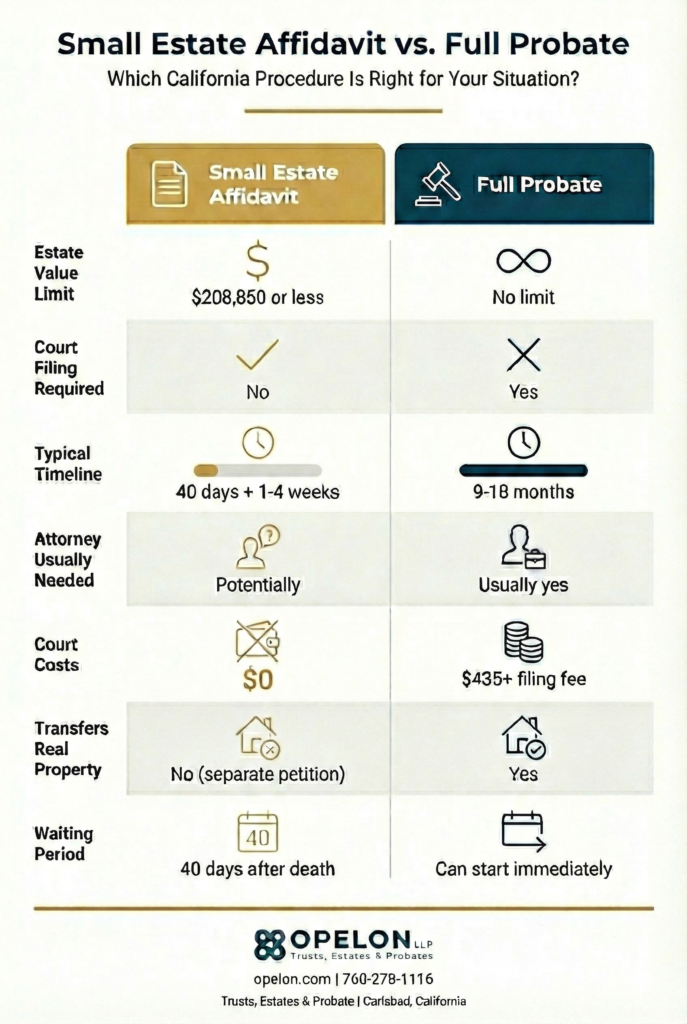
Factor
Small Estate Affidavit
Full Probate
Estate Value Limit
$208,850 or less
No limit
Court Filing Required
No
Yes
Typical Timeline
40 days plus 1 to 4 weeks
9 to 18 months
Attorney Usually Needed
Often not
Usually yes
Court Costs
None
$435+ filing fee
Real Property Transfer
No (separate procedure)
Yes
Waiting Period
40 days after death
Can start immediately
When Full Probate May Be the Better Option
While the small estate affidavit offers significant advantages, there are situations where full probate might actually serve your family better:
The estate includes real property. If the deceased person owned a home or land, you will eventually need court involvement anyway. Full probate might be more efficient than using multiple simplified procedures.
There are significant debts or potential creditors. Probate provides a formal creditor claims period that limits how long creditors can come after the estate. Without probate, creditors may have longer to pursue claims.
Family disputes exist. If there is any chance that heirs will disagree about who gets what, the court supervision in probate can help protect everyone involved.
The estate is complex. Multiple types of assets, business interests, or unusual circumstances may warrant the probate process.
After waiting the required 40 days following the death, most families complete the process within a few days to a few weeks. The timeline depends largely on how quickly you can gather documents and how responsive the institutions holding the property are. Compared to formal probate, which typically takes 9 to 18 months in California, this is significantly faster.
If multiple people are entitled to inherit, all successors must either sign the affidavit or authorize one person to sign on their behalf. The affidavit should list all successors and their respective relationships to the deceased. Once you receive the property, you are responsible for distributing it equitably among all rightful heirs.
Yes, to a limited extent. Under California Probate Code Section 13109, if you receive property through the small estate affidavit, you are personally liable for the deceased person’s unsecured debts up to the fair market value of the property you received. This liability may be enforced for the same period during which creditors could have enforced the debt against the deceased person.
The California small estate affidavit only applies to property located in California. If the deceased person owned property in other states, you would need to follow that state’s procedures for transferring small estate assets. Many states have similar simplified procedures, but the thresholds and requirements vary.
Letters Testamentary (or Letters of Administration) are court documents that prove a person has been officially appointed by the probate court to manage a deceased person’s estate. These require opening a formal probate case. A small estate affidavit is a sworn declaration you prepare yourself, without court involvement, to collect assets from estates that qualify for simplified procedures.
Vehicles, boats, and mobile homes are excluded from the small estate affidavit calculation and cannot be transferred using this procedure. California has a separate process through the DMV for transferring vehicle titles when someone dies. You will need to complete the appropriate DMV forms and may need to show proof of your relationship to the deceased person.
Often yes, for deaths on or after April 1, 2025. If the home was your parent’s primary residence and is worth up to $750,000, you can generally use a Petition to Determine Succession to Primary Residence under Probate Code Sections 13150 through 13158, filed on form DE-310, instead of full probate. AB 2016 raised this limit from $184,500. Higher-value homes, or non-residence real estate, may still require full probate.
The small estate affidavit transfers personal property, such as bank accounts, up to $208,850. It is a signed affidavit with a 40-day wait, and it cannot transfer real estate. A primary residence worth up to $750,000 instead uses a court petition under Probate Code Sections 13150 through 13158 on form DE-310. Lower-value non-residence real property, up to $69,625, uses a separate affidavit (form DE-305) with a six-month wait.
Need Help With a Small Estate in San Diego County?
Navigating the aftermath of a loved one’s death is never easy, even when the estate qualifies for simplified procedures. If you are dealing with a small estate in Carlsbad, San Diego County, or anywhere in California and have questions about whether the small estate affidavit is right for your situation, Opelon LLP is here to help.
Our team guides families through probate alternatives and trust administration throughout North County San Diego. We can review your situation, help you understand your options, and ensure you take the right approach for your family’s circumstances.
Contact Opelon LLP at (760) 278-1116 to schedule a consultation, or visit our Carlsbad office at 1901 Camino Vida Roble STE 112, Carlsbad, CA 92008.
T. Owen Rassman, Esq., LL.M. is the founding partner of Opelon LLP and a California-licensed estate planning, trust, and probate attorney based in Carlsbad. Admitted to the California Bar in 2005 (State Bar No. 236974), Owen has drafted 700+ California trusts and shepherded 250+ San Diego County estates through probate. He earned his LL.M. in Taxation at the University of San Diego School of Law, his J.D. at Pepperdine University School of Law, his M.B.A. at the Pepperdine Graziadio Business School, and his B.A. in English Literature at UCLA. Owen has been selected to Super Lawyers every year from 2023 through 2026 (4 consecutive years) and is an active member of the California State Bar Trusts and Estates Section, the San Diego County Bar Association (Taxation and Business & Corporate Law Sections), and the North County Bar Association. Opelon offers flat-fee estate planning and a free 15-minute phone consultation. Reach Owen directly at owen@opelon.com.
The information provided on this website does not, and is not intended to, constitute legal, tax, or financial advice; instead, all content available on opelon.com is for general informational purposes only and may not reflect the most current legal developments. Opelon LLP is a California law firm based in Carlsbad, California, and its attorneys are licensed to practice in California only. The firm limits its practice to non-contested estate planning, probate administration, and trust administration. This website may contain links to third-party websites, which are provided solely for the convenience of the reader; Opelon LLP and its attorneys do not endorse the contents of any third-party site.
Readers should contact a California-licensed attorney to obtain advice on any particular legal matter and should not act or refrain from acting based on information found on this site without first seeking advice from counsel. Use of this website, submission of a contact form, or transmission of an email does not create an attorney-client relationship with Opelon LLP, its attorneys, or its staff. Past results, testimonials, awards, and recognitions do not guarantee or predict a similar outcome in any future matter. For the firm's full website disclaimer, please visit https://opelon.com/website-disclaimer/.
Found this useful? Add Opelon LLP as a preferred source in Google to see more of our California estate planning and probate guides in your results.
Have a question about your own situation? Book a free 15-minute phone consultation. We will tell you whether this is something we handle and what it would cost. It is a needs evaluation, not legal advice, and we do not review documents on the call.