

California Estate Tax Calculator

Estimate Your Federal Estate Tax Under the 2025 OBBBA Exemption

California has no state estate tax. For most California families, the only estate tax that matters is the federal one. The One Big Beautiful Bill Act (OBBBA), signed on July 4, 2025, set the federal estate tax exemption at roughly $15 million per individual. Married couples have a combined exemption of about $30 million. The exemption has no scheduled sunset, and inflation indexing begins in 2027.

This California estate tax calculator estimates your federal estate tax under those rules. For the large majority of California families, the estimated result is zero. For high net worth families above the exemption, the calculator shows the 40 percent tax on the excess. It also points you toward the strategies in our California Estate Tax Planning Guide (2026) that can reduce that exposure.

Key Takeaways: California Estate Tax Calculator

  • California has no state estate tax, so most California families face only the federal estate tax, if any at all.
  • Under the 2025 OBBBA, the federal exemption is roughly $15 million per person and about $30 million per married couple.
  • This California estate tax calculator estimates federal tax at 40 percent on any amount above your available exemption.
  • The IRC section 1014 step-up in basis often saves more in capital gains tax than the estate tax itself would cost.
  • Estates near or above the exemption should review strategy with a California estate planning attorney before acting.

California Estate Tax Calculator

Estimate your approximate federal estate tax liability under the OBBBA permanent $15 million individual / $30 million couple exemption. California imposes no state estate tax.

Add the fair market value of everything you own at death: real estate, brokerage accounts, retirement accounts, business interests, life insurance owned in your own name, and tangible personal property. Use approximate values. Do not subtract mortgages here; the calculator handles that as a deduction.

Mortgages, loans, anticipated funeral and administration costs. Reduces the taxable estate dollar for dollar under IRC section 2053. Leave blank if approximately zero.

Lifetime taxable gifts above the annual exclusion (currently $19,000 per recipient) that reduced your unified exemption. Leave blank if you have not made gifts above the annual exclusion.

Married couples can combine exemptions to $30 million if portability is preserved (IRC section 2010(c) requires Form 706 filed within 9 months of the first death, 15 months with extension) or if credit shelter / A-B trust planning is in place. Single includes widowed, divorced, or never married.

Please enter a gross estate value.

Estimated Federal Estate Tax

$0

Calculation Breakdown

Gross estate $0
Less: debts and expenses $0
Taxable estate (before exemption) $0
OBBBA base exemption $15,000,000
Less: prior taxable gifts $0
Available exemption $15,000,000
Amount above exemption $0
Federal estate tax (40%) $0
California state estate tax $0 (none)
Estimated amount after federal estate tax and entered debts $0

This figure excludes income taxes, capital gains tax on later sales of inherited assets, administration costs beyond the debts you entered, and assets that pass outside probate.

This is an estimate of federal estate tax that approximates the unified-credit computation under IRC sections 2001 and 2010 by applying the 40 percent top rate to the amount above the OBBBA permanent $15 million individual / $30 million couple exemption. California imposes no state estate tax. Transfers to a U.S.-citizen surviving spouse are fully deductible under IRC section 2056 and are not reflected in this estimate. The estimate excludes generation-skipping transfer tax (IRC sections 2601-2664), valuation discounts for closely-held business or fractional real property interests, charitable deductions (IRC 2055), marital deduction nuances for non-U.S.-citizen spouses (IRC 2056A), and state estate taxes imposed by states other than California. The exemption begins inflation adjustments in 2027. For informational purposes only. Not legal or tax advice. Use of this calculator does not create an attorney-client relationship with Opelon LLP.
Schedule a Free Estate Tax Strategy Consultation

How Federal Estate Tax Works After OBBBA

Under OBBBA, the federal estate tax exemption is roughly $15 million per individual and about $30 million per married couple. The exemption has no scheduled sunset. Inflation indexing begins in 2027. Estates at or below the exemption generally owe no federal estate tax. Estates above it are generally taxed at a flat 40 percent on the excess.

  • Federal estate tax applies under IRC section 2001. It reaches the taxable estate of any decedent who was a U.S. citizen or resident.
  • The unified credit under IRC section 2010 effectively exempts the first roughly $15 million. Couples can shelter about $30 million using portability or credit-shelter planning.
  • The marital deduction under IRC section 2056 allows unlimited tax-free transfers to a U.S. citizen surviving spouse.
  • The annual gift tax exclusion under IRC section 2503(b) is $19,000 per recipient per year (2025 and 2026, per IRS Rev. Proc. 2025-32). Annual exclusion gifts do not reduce your lifetime exemption. The IRS explains the annual gift tax exclusion in more detail.
  • Portability under IRC section 2010(c) lets a surviving spouse use the deceased spouse’s unused exemption (DSUE). The executor preserves it by filing Form 706 within 9 months of death (15 months with extension), even when no tax is otherwise owed.

Want the underlying numbers and how they adjust? See our companion guide to the federal estate tax exemption amount, or review the IRS overview of the federal estate tax.

Why California Has No State Estate Tax

California repealed its inheritance and gift tax by voter initiative in 1982. California also had a pickup estate tax tied to the federal credit for state death taxes under former IRC section 2011. That tax became inoperative for deaths after December 31, 2004. Today, California families generally pay only federal estate tax. There is no California pickup estate tax, no estate transfer tax, and no inheritance tax.

The federal credit for state death taxes lived under former IRC section 2011. The Economic Growth and Tax Relief Reconciliation Act of 2001 (EGTRRA) phased out that credit over 2002 through 2004. A deduction replaced it beginning in 2005. Because California’s pickup tax was tied to the federal credit, it became inoperative for deaths after December 31, 2004.

California’s separate inheritance and gift tax had already ended by voter initiative in 1982. These are two distinct events.

Some states still impose their own estate or inheritance tax. As of the last-verified date, that list includes Washington, Oregon, Minnesota, Illinois, New York, Massachusetts, Maryland, Connecticut, Vermont, Hawaii, Rhode Island, Maine, and the District of Columbia. State regimes change over time. If the decedent owned real property in one of those states, that state may tax the property regardless of where the decedent lived.

The Step-Up in Basis Benefit (IRC section 1014)

When you inherit appreciated property, your tax basis generally steps up to its fair market value on the date of death (IRC section 1014). This step-up erases the unrealized gain that built up during the decedent’s life. For California families holding long-appreciated real estate or stock, the step-up is often the single most valuable feature of the federal transfer tax system.

In our experience, this matters most for San Diego County families who bought homes decades ago. Here is how it plays out.

A parent buys a Carlsbad home in 1985 for about $200,000. At the parent’s death, the home is worth roughly $2,500,000. The child inherits with a stepped-up basis of about $2,500,000. If the child then sells for about $2,500,000, there is generally no capital gains tax.

Now compare a lifetime sale. If the parent had sold during life, the roughly $2,300,000 gain would have triggered tax. Federal tax at the 23.8 percent rate (long-term capital gains plus net investment income tax) would run about $547,000. California income tax at the 13.3 percent top rate would add roughly $306,000. The estimated combined federal-and-state exposure is about $853,000.

  • Strategic implication: holding appreciated assets until death often beats lifetime gifting, even with a high exemption.
  • The step-up does not apply to tax-deferred retirement accounts like IRAs and 401(k)s. Those keep the decedent’s basis and pass as ordinary income to beneficiaries. Most non-spouse beneficiaries also face the SECURE Act 10-year payout rule.
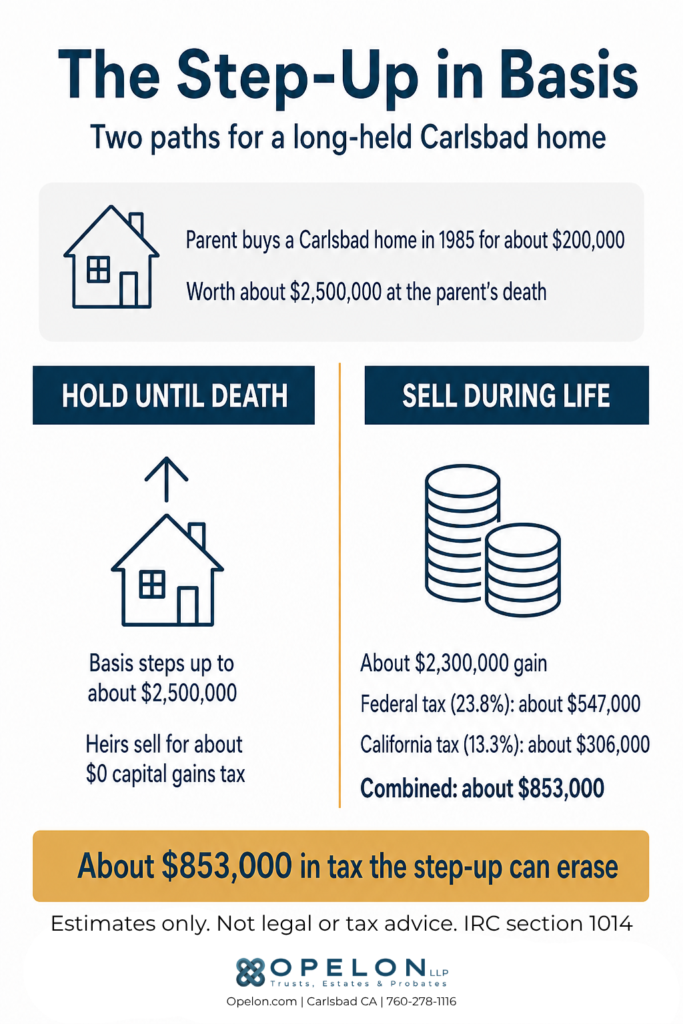
California Estate Planning Tax Calculator Infographic comparing step-up in basis on a Carlsbad home, showing about $0 capital gains tax when heirs inherit and sell versus about $853,000 when selling during life.
For a long-appreciated Carlsbad home, the IRC section 1014 step-up in basis can erase roughly $853,000 in combined federal and California capital gains tax. Holding until death and selling during life lead to very different outcomes.

Worked Examples

These three scenarios show how the calculator treats common California estates. All figures assume no prior taxable gifts.

Scenario

Gross Estate

Status

Exemption

Tax (40%)

Net to Heirs

Below exemption (typical CA family)

$4,500,000

Single

$15,000,000

$0

$4,500,000

Above single exemption

$20,000,000

Single

$15,000,000

$2,000,000

$18,000,000

Above couple exemption (both preserved)

$40,000,000

Married

$30,000,000

$4,000,000

$36,000,000


Scenario 1 covers most California families. The estimated federal estate tax is zero, and the step-up in basis preserves the full value for heirs.

Scenario 2 sits $5,000,000 over the exemption. The 40 percent tax on that excess is about $2,000,000.

Scenario 3 is a married couple preserving both $15,000,000 exemptions. Portability or credit-shelter planning shelters $30,000,000 of the $40,000,000 estate. The 40 percent tax on the remaining $10,000,000 is about $4,000,000.


What This California Estate Tax Calculator Does Not Estimate

This tool estimates federal estate tax under current OBBBA rules. It does not estimate the items below.

  • Generation-skipping transfer (GST) tax: a separate 40 percent tax under IRC sections 2601 through 2664 on certain transfers to grandchildren and other skip persons.
  • Prior taxable gifts: gifts that reduce your remaining exemption. The calculator assumes $0 in prior taxable gifts unless you enter otherwise.
  • Illiquid asset discounts: lack of marketability, lack of control, and fractional-interest discounts that can lower the taxable value of closely held interests.
  • Alternate valuation date election: the option under IRC section 2032 to value the estate 6 months after death if values have dropped.
  • Charitable deduction: the unlimited deduction under IRC section 2055 for transfers to qualified charities.
  • Marital deduction nuances: QTIP trusts and qualified domestic trusts for non-citizen spouses under IRC section 2056A.
  • State estate tax: tax owed on property located in the 12 states plus DC that impose their own estate or inheritance tax.
  • GST exemption: the separate exemption of roughly $15 million under IRC section 2631.

For estates above the exemption, these items can shift the analysis a great deal. The calculator’s number is a starting point for the conversation, not the final answer.

10 Strategies for High Net Worth Families Above the Exemption

Does your estate exceed the roughly $15 million or $30 million exemption? Planning can lower the 40 percent exposure. Our work in estate planning for high net worth estates centers on the ten strategies below. The planning guide above covers each one in depth.

  • Annual exclusion gifting (IRC section 2503(b)): give $19,000 per recipient per year, with no use of your lifetime exemption.
  • Spousal Lifetime Access Trust (SLAT): uses current exemption while preserving indirect access for a spouse.
  • Grantor Retained Annuity Trust (GRAT): leverages low IRC section 7520 rates for tax-efficient transfers.
  • Qualified Personal Residence Trust (QPRT): transfers a primary or vacation home at a discounted gift value.
  • Irrevocable Life Insurance Trust (ILIT): an irrevocable life insurance trust removes policy proceeds from the taxable estate.
  • Charitable Remainder Trust (CRT) under IRC section 664: income for life, a charitable deduction, and no estate inclusion of the remainder.
  • Charitable Lead Trust (CLT): charity receives the income interest, and the remainder passes to family.
  • GST dynasty trust: uses the roughly $15 million GST exemption for multi-generational transfers.
  • Family limited partnership or LLC: entity-level valuation discounts with centralized management.
  • Credit-shelter / A-B trust planning: preserves both spouses’ exemptions, even when no portability election is made.

Each strategy carries trade-offs and needs individualized analysis. Owen’s LL.M. in Taxation supports coordinating these tools with your broader estate plan.

When to Talk With a California Estate Tax Attorney

In our experience working with San Diego County families, a few situations call for a closer look. Consider speaking with a California estate tax attorney if any of these apply to you.

  • Your gross estate approaches roughly $10 million individual or $20 million couple. Count real estate, investments, retirement accounts, business interests, and life insurance.
  • You own closely held business interests, LLCs, or partnership interests.
  • You hold appreciated property and are weighing a gift now versus holding until death.
  • You have grandchildren or other generation-skipping beneficiaries.
  • You have made prior taxable gifts that reduced your remaining exemption.
  • You own real property in another state that imposes its own estate tax.
  • You have a non-U.S.-citizen spouse and want the marital deduction, which generally requires a QDOT.
  • You own substantial life insurance in your own name, where an ILIT may help.

Our San Diego estate planning attorney team helps families across Carlsbad and San Diego County plan with clarity. Schedule a free estate planning consultation in Carlsbad.

Frequently Asked Questions

No. California repealed its inheritance and gift tax by voter initiative in 1982. California also had a pickup estate tax tied to the federal credit for state death taxes under former IRC section 2011. EGTRRA phased out that credit, so the pickup tax became inoperative for deaths after December 31, 2004. Today, California families generally pay only federal estate tax. There is no California pickup tax, estate transfer tax, or inheritance tax.

The federal estate tax exemption is roughly $15 million per individual and about $30 million per married couple. It comes from the One Big Beautiful Bill Act (OBBBA), signed July 4, 2025. The exemption has no scheduled sunset, and inflation indexing begins in 2027. Estates at or below the exemption generally owe no federal estate tax.

Federal estate tax under IRC section 2001 follows two broad steps. First, you start with the gross estate. That generally includes everything owned at death. It also pulls back certain transfers and life insurance under IRC sections 2035 through 2042. You then subtract debts, funeral and administration expenses, the marital deduction (IRC section 2056), and the charitable deduction (IRC section 2055). That produces the taxable estate.

Second, you add back lifetime adjusted taxable gifts and compute the tentative tax. The unified credit under IRC section 2010 shelters transfers up to roughly $15 million, or about $30 million for couples preserving both exemptions. Amounts above the exemption face a flat 40 percent rate.

Portability under IRC section 2010(c) lets a surviving spouse use the deceased spouse’s unused exemption, called the DSUE. To preserve it, the executor must file Form 706 within 9 months of the first death (15 months with extension), even when no tax is owed. Without that filing, the DSUE is generally lost. The calculator treats married couples the same way. When you select married, it assumes both $15 million exemptions are preserved through portability or credit-shelter planning.

The OBBBA exemption has no scheduled sunset. Unlike the 2017 Tax Cuts and Jobs Act, which was set to revert after 2025, OBBBA has no built-in expiration date. Inflation indexing begins in 2027. The exemption stays in place unless Congress changes the law. No exemption is ever beyond future legislative change.

Under IRC section 1014, an inherited asset’s tax basis generally steps up to its fair market value on the decedent’s date of death. This erases the unrealized gain that built up during the decedent’s life. For long-appreciated California real estate, the step-up often saves more in capital gains tax than the federal estate tax would have cost.

Yes. The unified gift and estate tax system under IRC section 2010 treats large lifetime gifts as drawing down your exemption. Gifts above the annual exclusion ($19,000 per recipient in 2025 and 2026) reduce your roughly $15 million exemption. Say you made $3 million in taxable gifts during life. Your remaining exemption at death would be about $12 million. The calculator lets you enter prior taxable gifts so your available exemption stays accurate. Annual exclusion gifts under IRC section 2503(b) do not reduce the exemption.

Twelve states plus the District of Columbia impose their own estate or inheritance tax, as of the last-verified date. They are Washington, Oregon, Minnesota, Illinois, New York, Massachusetts, Maryland, Connecticut, Vermont, Hawaii, Rhode Island, Maine, and DC. California is not on this list. If you own real property in any of these states, that state may tax the property regardless of where you lived at death.

No. IRAs, 401(k)s, and other tax-deferred retirement accounts do not receive a step-up in basis. Beneficiaries pay ordinary income tax on distributions. Under the SECURE Act, most non-spouse beneficiaries must withdraw the full account within 10 years. Roth IRAs are an exception, since qualified distributions are generally tax-free.

For estates well above the roughly $15 million or $30 million exemption, lifetime gifting can help. It locks in current exemption and moves future appreciation out of the taxable estate. For estates at or below the exemption, holding until death is usually better because of the IRC section 1014 step-up. The step-up erases capital gains on a lifetime of appreciation.

If your estate is near the exemption (roughly $10 million single or $21 million couple), the answer is fact-sensitive. Small changes in asset values, prior gifts, and future growth can tip the analysis. A California estate planning attorney can model your specific situation and decide whether OBBBA strategies make sense for your facts.

When to Talk With a California Estate Planning Attorney

In our experience working with San Diego County families, a few situations call for a closer look. Consider speaking with a California estate tax attorney if any of these apply to you.

  • Your gross estate approaches roughly $10 million individual or $20 million couple. Count real estate, investments, retirement accounts, business interests, and life insurance.
  • You own closely held business interests, LLCs, or partnership interests.
  • You hold appreciated property and are weighing a gift now versus holding until death.
  • You have grandchildren or other generation-skipping beneficiaries.
  • You have made prior taxable gifts that reduced your remaining exemption.
  • You own real property in another state that imposes its own estate tax.
  • You have a non-U.S.-citizen spouse and want the marital deduction, which generally requires a QDOT.
  • You own substantial life insurance in your own name, where an ILIT may help.


Our San Diego estate planning attorney team helps families across Carlsbad and San Diego County plan with clarity. Schedule a free estate planning consultation in Carlsbad.

Disclaimer:

This page provides a federal estate tax calculator and general information about federal estate tax law. It is not legal advice and it is not tax advice. The calculator returns an estimate of federal estate tax liability under the One Big Beautiful Bill Act (OBBBA, Pub. L. 119-21, signed July 4, 2025) and the Internal Revenue Code as in effect on the date listed above.

Federal estate tax exemption amounts begin inflation adjustments in 2027 and may change. The calculator does not address generation-skipping transfer tax (IRC sections 2601 through 2664), prior taxable gifts that reduce remaining exemption, valuation discounts for closely held business or fractional real property interests, the charitable deduction under IRC section 2055, the alternate valuation date election under IRC section 2032, or state estate taxes imposed by states other than California.

California imposes no state estate tax or inheritance tax. Estates with substantial complexity, business interests, or non-U.S.-citizen spouses should consult a qualified California estate planning attorney with tax law experience. Using this calculator or reading this page does not create an attorney-client relationship with Opelon LLP.

Opelon LLP is a California limited liability partnership located at 1901 Camino Vida Roble STE 112, Carlsbad, CA 92008. Responsible attorney for this content: T. Owen Rassman, Esq., LL.M. (CA Bar No. 236974).