

California Trust Funding Calculator

Audit Your Trust Funding and Estimate Probate Exposure on Unfunded Assets

You signed a trust. So your family is protected, right? Not quite.

A trust only protects the assets you actually move into it. The most common mistake we see in California trust administration is a trust that was signed but never fully funded. Forget to retitle one bank account, brokerage account, or parcel of real estate, and that asset can land in probate anyway.

This California trust funding calculator audits your funding across six asset categories. It scores how complete your funding is. Then it estimates the probate fees your family could face on anything you left out. Funding is what turns a California revocable living trust from paper into real protection.

If you have a trust but have never checked the funding, this is a useful five-minute check before your next attorney visit.

California Trust Funding Calculator

Audit your trust funding across the six main asset categories and estimate the maximum statutory probate fees that could apply to unfunded assets under Probate Code Sections 10800 and 10810.

1. Real property Primary residence, rentals, vacation homes. Retitled via trust transfer deed.
2. Brokerage / investment accounts Non-retirement. Retitled via "Change of Account Title" form to trust name.
3. Bank accounts Checking, savings, CDs. Retitled to trust name with bank's trust certification process.
4. Business interests LLC memberships, partnership interests, S-corp shares. Assigned with operating agreement amendment.
5. Vehicles Cars, boats, RVs. Often skipped via Probate Code Section 13050 / small estate procedures.
6. Personal property Jewelry, art, collectibles, household goods. Covered by an Assignment of Personal Property.

Trust Funding Completeness

0%

This score is a general funding-completeness estimate based on weighted asset categories, not a legal determination that your trust is fully or properly funded.

Probate Exposure Estimate (Maximum, Assumes Formal Probate)

Total unfunded asset value (probate exposure) $0
Estimated personal rep fee (Prob. Code Sec. 10800) $0
Estimated attorney fee (Prob. Code Sec. 10810) $0
Maximum combined statutory probate fees (formal probate) $0
Heggstad petition risk (real property unfunded) No

Recommended Next Steps

    This is an estimate based on the values and toggles you entered. The estimated probate fees are a maximum that assumes a full formal probate. California summary procedures often eliminate or reduce them, including the small-estate affidavit for personal property up to $208,850 (Cal. Prob. Code Section 13100), the petition to determine succession to real property for a primary residence worth $750,000 or less (Section 13150), and the affidavit for real property of small value (Section 13200). The calculator does not detect joint tenancy with right of survivorship, community property with right of survivorship, or transfer-on-death and pay-on-death beneficiary designations, each of which can move an asset outside probate regardless of trust funding. Retirement accounts and life insurance use beneficiary designations rather than retitling and are not scored here. Estimated probate fees apply the statutory sliding scale under Cal. Prob. Code Sections 10800 and 10810 to the total unfunded asset value, doubled to reflect the personal representative fee and the attorney fee. That statutory fee is a maximum and is negotiable. Extraordinary fees, probate referee, filing fees, publication, and bond premiums are not included. Heggstad availability depends on evidence of settlor intent. For informational purposes only. Not legal advice. Use of this calculator does not create an attorney-client relationship with Opelon LLP.
    Schedule a Free Trust Funding Review

    Key Takeaways

    • Funding a trust means retitling assets from your name into the trust’s name. Signing the document alone does not avoid probate.
    • This California trust funding calculator scores six asset categories and estimates probate exposure on anything you forgot to retitle.
    • Real estate carries the most weight, since it is usually the largest asset and the costliest to probate in California.
    • Retirement accounts and life insurance use beneficiary designations, not retitling, so the calculator flags them separately.

    For unfunded real estate, a Heggstad petition can often move the property into the trust without full probate.

    What Does It Mean to “Fund” a Trust?

    Funding a trust means retitling assets out of your individual name and into the name of the trust. Signing the trust document creates the trust under California law. Funding is the step that makes it work. Any asset you forget to retitle passes outside the trust, usually through probate.

    Think of it this way. The trust document is the container. Funding is what you put inside. An empty container protects nothing.

    A pour-over will acts as a safety net. It catches assets you never retitled, but only by sending them through probate first. That means the same fees, the same delay, and the same public court file you were trying to avoid. To see the mechanics step by step, read our guide on how to fund a trust.

    One technical point worth knowing. California Probate Code Section 16061.7 sets the trustee’s duty to notify beneficiaries and heirs. That notice is triggered when a revocable trust becomes irrevocable at the settlor’s death, not by whether a given asset was funded. The practical lesson is the same: the trust governs only the assets actually titled in it.
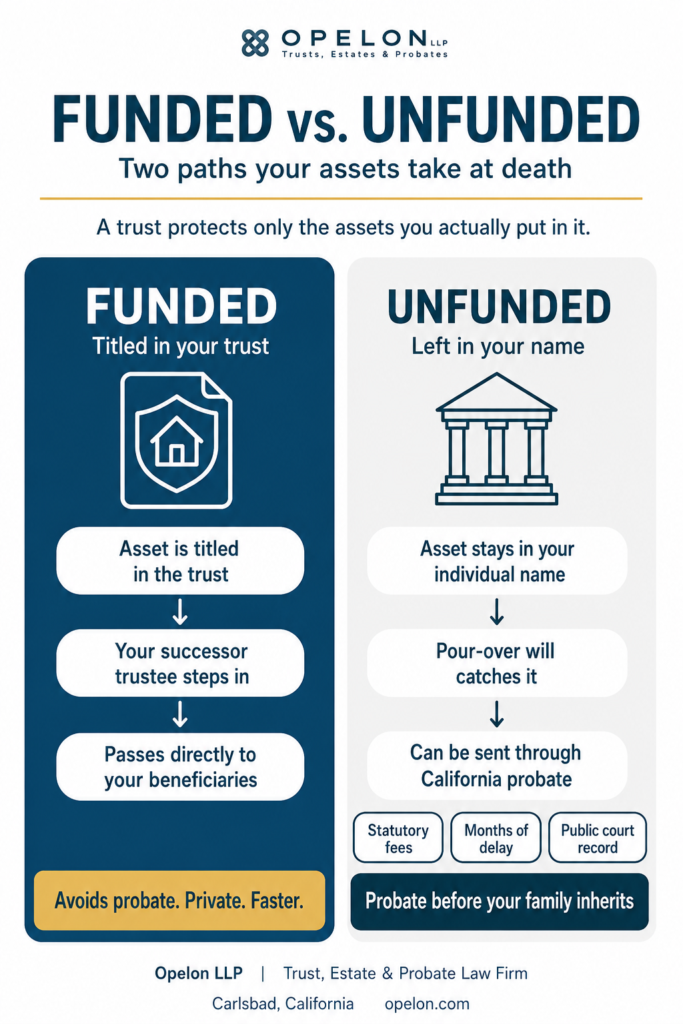
    California Trust Funding Calculator Infographic comparing a funded versus unfunded California trust, showing that a titled asset avoids probate while an asset left in your name can go through probate.
    Funding is what makes a trust work. Assets titled in your trust pass directly to your beneficiaries and avoid probate. Anything left in your individual name falls to the pour-over will and can go through California probate, with statutory fees, delay, and a public court record.

    The Six Asset Categories the Calculator Audits

    This calculator scores trust funding across the six asset categories that cover nearly all California trust funding work: real property, brokerage accounts, bank accounts, business interests, vehicles, and personal property. Each category carries a weight based on its value and its cost to probate.

    Asset category

    Score weight

    How to retitle it

    Real property (home, rentals, vacation property)

    About 40%

    Record a trust transfer deed with the county recorder. Highest weight because it is usually the largest asset and the costliest to probate.

    Brokerage and investment accounts (non-retirement)

    About 25%

    Complete the firm’s Change of Account Title form using the trust name and the trust EIN, or the grantor’s SSN for a revocable trust.

    Bank accounts (checking, savings, CDs)

    About 15%

    Re-title the account in the trust name, or add the trust as the named owner on existing accounts.

    Business interests (LLC, partnership, S-corp shares)

    About 10%

    Assign the LLC or partnership interest and amend the operating agreement. For S-corp shares, confirm the trust qualifies as an eligible shareholder (QSST or ESBT election).

    Vehicles (cars, boats, RVs)

    About 5%

    Most families can skip this. See the note below on Probate Code Section 13050 and the DMV REG 5 affidavit.

    Personal property (jewelry, art, collectibles, household goods)

    About 5%

    Sign a one-page Assignment of Personal Property naming the trust as owner of all personal property not otherwise titled.

    A quick note on vehicles. Vehicles and vessels registered under the Vehicle Code are excluded from the small-estate value count under Probate Code Section 13050. The DMV also has its own post-death transfer process, a REG 5 affidavit for transfer without probate. California does not offer a lifetime transfer-on-death registration for vehicles, so this is a post-death affidavit, not a TOD designation. The calculator treats vehicles as a low-weight item with a skip option.

    What the Calculator Does Not Score

    Two asset categories use beneficiary designations instead of retitling: retirement accounts and life insurance. The calculator flags them for a separate beneficiary review rather than scoring them, because naming the trust as beneficiary is often the wrong move.

    Retirement accounts

    For most California families, the trust should not be the primary beneficiary of an IRA or 401(k). The SECURE Act 10-year payout rule and the see-through trust rules create real tax complications. In most cases, the better answer is to name your spouse as primary beneficiary. Name your adult children as contingent beneficiaries, each at a percentage. A designated-beneficiary trust makes sense only for special situations, such as a special-needs beneficiary, asset-protection goals, or generation-skipping objectives. Review your beneficiary designations any time you sign or update a trust.

    Life insurance

    Life insurance also uses beneficiary designations. For most policies, name your spouse first and your children as contingents. Name the trust only when no individuals are available, or for minor or special-needs beneficiaries.

    Estate tax is a concern only for larger estates. The federal estate and gift tax exemption is $15 million per individual for 2026. Married couples have a combined $30 million exemption, indexed for inflation. If your estate approaches those numbers, an Irrevocable Life Insurance Trust (ILIT) can keep the proceeds out of your taxable estate under IRC Section 2042.

    How the Probate Exposure Number Is Calculated

    Probate exposure is the total value of assets that would pass through probate if you died today. The calculator adds up the unfunded asset values you enter. It then applies the California statutory fee schedule and doubles the result, because the personal representative and the attorney each receive a full fee.

    California Probate Code Sections 10800 and 10810 set the same sliding fee scale for the personal representative and the attorney.

    Estate value tier

    Statutory fee (each)

    First $100,000

    4%

    Next $100,000

    3%

    Next $800,000

    2%

    Next $9 million

    1%

    Next $15 million

    0.5%

    Above $25 million

    A reasonable amount set by the court

    The combined statutory fee is the doubled schedule, the personal representative fee plus the attorney fee. This fee is a maximum, and it is negotiable. The personal representative and the attorney may agree to a lesser amount (CEB, California Trust Administration, Section 10.26). For a standalone breakdown, see our California probate fees page. You can read the fee statute itself at California Probate Code Section 10800.

    Treat this number as a ceiling, not a prediction. It assumes a full formal probate. Many unfunded assets avoid formal probate entirely through California summary procedures. The dollar thresholds are set by Probate Code Section 890 and adjusted by the Judicial Council. Use the figure that matches the date of death.

    Summary procedure

    What it covers

    Threshold

    Small-estate affidavit (Section 13100)

    Personal property, with no probate and no statutory fee

    $208,850 for deaths 4/1/2025 to 3/31/2026; $239,700 for deaths on or after 4/1/2026

    Petition to determine succession to real property (Sections 13150 and 13151)

    The decedent’s California primary residence

    $750,000 or less (set by AB 2016, effective 4/1/2025; not on the CPI cycle)

    Affidavit for real property of small value (Section 13200)

    Low-value real property

    $69,625 for deaths 4/1/2025 to 3/31/2026; confirm the current figure on Form DE-300 for later deaths

    Confirm the current dollar limits on Judicial Council Form DE-300 for the date of death, since these figures adjust over time.

    When Funding Falls Through the Cracks: The Heggstad Petition

    A Heggstad petition under California Probate Code Section 850 is the cleanup tool when a settlor meant to put an asset into the trust but never finished retitling it. The trustee asks the court to confirm the asset belongs to the trust. Filed correctly, it can move real estate into the trust in about three to four months.

    Settlor intent is the key element. Helpful evidence includes the trust’s schedule of assets, the pour-over will, and a declaration from the attorney who drafted the trust. Any document showing the asset was meant to be funded can support the petition.

    A Heggstad petition does not work in every case. If the settlor’s intent is unclear or contested, full probate may be required. To learn more, see our Heggstad petition complete guide under Probate Code Section 850, or read the statute at California Probate Code Section 850.

    Practice scope note. From our Carlsbad office, Opelon LLP handles non-contested Heggstad petitions as part of our trust administration services in San Diego County. For contested Heggstad petitions or beneficiary disputes, we refer to California trust litigation attorneys.

    The Three Most Common Funding Mistakes We See in San Diego County

    In our experience working with San Diego County families on trust administration after a death, three funding failures come up again and again: a refinanced home left in the borrower’s name, accounts opened after the trust was signed, and brokerage TOD designations that were never updated.

    1. The house was refinanced and left in the borrower’s name. Many lenders require the property to be deeded out of the trust to refinance. The transfer back to the trust after closing is the step that gets forgotten.
    2. A new bank account was opened after the trust was signed. The account goes into the grantor’s individual name, and the funding worksheet never gets updated. Every account opened after signing is unfunded unless someone catches it.
    3. A brokerage TOD designation was never changed. The trust exists, but the firm’s transfer-on-death form still names individuals. The TOD designation controls at death, so the account skips the trust entirely.

    Each of these is fixable while you are alive. After a death, the right cleanup depends on the asset and its value. A Heggstad petition handles forgotten real estate. A small-estate affidavit covers personal property. For a primary residence worth $750,000 or less, a petition to determine succession to real property may fit. When no summary procedure applies, full formal probate may be required.

    Frequently Asked Questions

    Funding a trust means retitling assets out of your individual name and into the name of the trust. Signing the document creates the trust. Funding is what makes it operate. An unfunded trust does not avoid probate for the assets you forgot to retitle.

    Yes, in nearly every case. Real estate is the highest-value asset most California families own and the costliest to probate. Retitle it by recording a trust transfer deed with the county recorder. If you refinance, restore the title to the trust after closing.

    No, in most cases. IRAs and 401(k)s use beneficiary designations, not retitling. For most California families, name your spouse as primary beneficiary and your adult children as contingents by name, each at a percentage. Naming a trust as the IRA beneficiary triggers SECURE Act complications, since most trusts are treated as non-designated beneficiaries unless they qualify as see-through trusts. That compresses distributions and speeds up income tax. Special situations, such as a special-needs beneficiary, may justify a designated-beneficiary trust.

    A Heggstad petition under California Probate Code Section 850 is a court order confirming that an asset belongs to the trust, even though the settlor never finished retitling it. The trustee files with evidence of intent: the schedule of assets, the pour-over will, and a declaration from the drafting attorney. It usually takes about three to four months and costs a fraction of full probate. It is the standard cleanup tool when real estate was forgotten.

    You can. The mechanics, filling out forms, recording deeds, and updating beneficiary designations, are not complicated. The risk is twofold: missing assets without a full worksheet, and miscategorizing assets, such as retitling retirement accounts when you should not. A short funding review with a California trust attorney usually catches both problems.

    The most reliable check is a full asset inventory cross-referenced against title records. Check the county recorder for real estate and your bank and brokerage statements for accounts. Check the Secretary of State for business interests and a current beneficiary report for retirement and life insurance. Your funding worksheet should list every account number and every parcel APN.

    No. Assets held in joint tenancy pass to the surviving joint tenant automatically, regardless of the trust. Assets with named beneficiaries (TOD, POD, retirement accounts, life insurance) pass to the named beneficiary, regardless of the trust. If you hold accounts that way, mark them as funded here, since they will not pass through probate. Then confirm those designations route to the people you intend.

    Start with a full asset search. Pull 12 to 24 months of bank statements, brokerage 1099s, and the prior tax return (Schedules B, D, and E). Then run county recorder searches in every California county where the parent owned property. Cross-reference each asset against the trust schedule and current title. For unfunded real estate where intent to fund is documented, a Heggstad petition is usually the right tool. For a primary residence worth $750,000 or less without that documentation, a petition to determine succession to real property may be simpler. For financial accounts, the small-estate affidavit covers up to $208,850 for deaths from April 1, 2025 through March 31, 2026, and up to $239,700 for deaths on or after April 1, 2026. Above those limits, formal probate may be required.

    When to Talk With a California Trust Attorney

    A short funding review is worth scheduling if any of these apply to you:

    • You signed a trust a year or more ago and have never reviewed the funding.
    • You refinanced or sold real estate after signing the trust.
    • You opened a new bank or brokerage account after signing the trust.
    • You inherited assets and want them held in your trust.
    • You started a business or LLC after signing the trust.
    • You moved to California with a trust drafted under another state’s law.
    • A parent has died and you suspect the trust was not fully funded.

    Ready to check your funding?
    Speak with a California trust attorney at our Carlsbad office, in person or by video, anywhere in San Diego County. Schedule a free consultation with Opelon LLP.

    Disclaimer:

    This page provides a trust funding audit calculator and general information about California revocable living trusts. It is not legal advice. The calculator estimates trust funding completeness and probate exposure based on the values and toggles you enter. The estimated probate fees are a maximum that assumes a full formal probate.

    California summary procedures often eliminate or reduce them, including the small-estate affidavit for personal property under Cal. Prob. Code Section 13100 ($208,850 for deaths April 1, 2025 through March 31, 2026; $239,700 for deaths on or after April 1, 2026), the petition to determine succession to real property for a primary residence worth $750,000 or less under Sections 13150 and 13151, and the affidavit for real property of small value under Section 13200 (confirm the current dollar limit on Judicial Council Form DE-300 for the date of death).

    These dollar thresholds are adjusted periodically under Probate Code Section 890. The calculator does not account for asset titling that you may not be aware of (such as joint tenancy with right of survivorship, community property with right of survivorship, transfer-on-death or pay-on-death beneficiary designations, or community property characterization between spouses), each of which may move an asset outside probate regardless of whether it is in the trust.

    The estimated probate fees use the statutory sliding scale under Cal. Prob. Code Sections 10800 and 10810 (doubled to cover both the personal representative fee and the attorney fee, which is a maximum and is negotiable) and do not include extraordinary fees, probate referee appraisal, filing fees, publication costs, bond premiums, or other administrative costs. Retirement accounts and life insurance use beneficiary designations rather than retitling and require separate analysis.

    Heggstad petition availability depends on evidence of settlor intent. Using this calculator or reading this page does not create an attorney-client relationship with Opelon LLP. Opelon LLP is a California limited liability partnership located at 1901 Camino Vida Roble STE 112, Carlsbad, CA 92008. Responsible attorney for this content: T. Owen Rassman, Esq., LL.M. (CA Bar No. 236974).