


What Is a California Step-Up in Basis?
A step-up in basis resets the tax cost of an asset to its fair market value on the date the owner dies, under IRC 1014. Capital gains tax is charged on the sale price minus the basis. A step-up can therefore erase decades of appreciation, so a home sold soon after death often produces little or no capital gain.
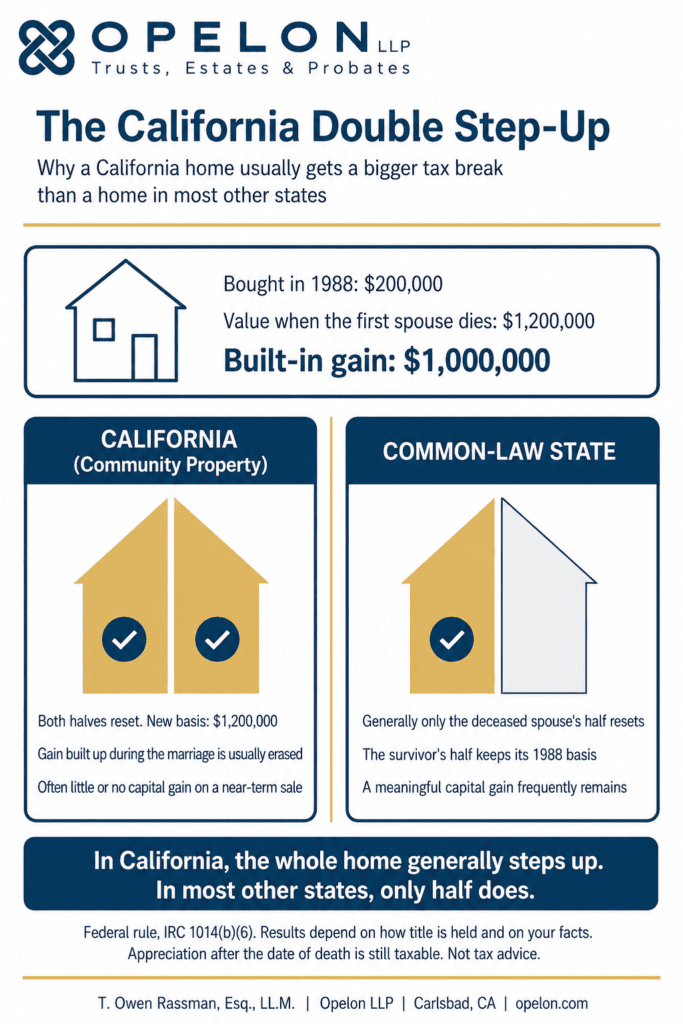
The arithmetic is easier than the label suggests. Say a San Diego County couple bought their home in 1988 for $200,000. The home is worth $1,200,000 when the first spouse dies.
Before the death, that home carries $1,000,000 of built-in gain. A step-up to $1,200,000 generally wipes out that gain for tax purposes if the home sells near that value.
The governing authority is IRC 1014, basis of property acquired from a decedent. The One Big Beautiful Bill Act (OBBBA) left IRC 1014 in place. There is no sunset and no repeal of the step-up to plan around.
One scope note before going further. The step-up is a federal income tax rule about capital gains. California has no state estate tax, no inheritance tax, and no gift tax. The step-up is also not the same thing as Proposition 19, which is covered below.
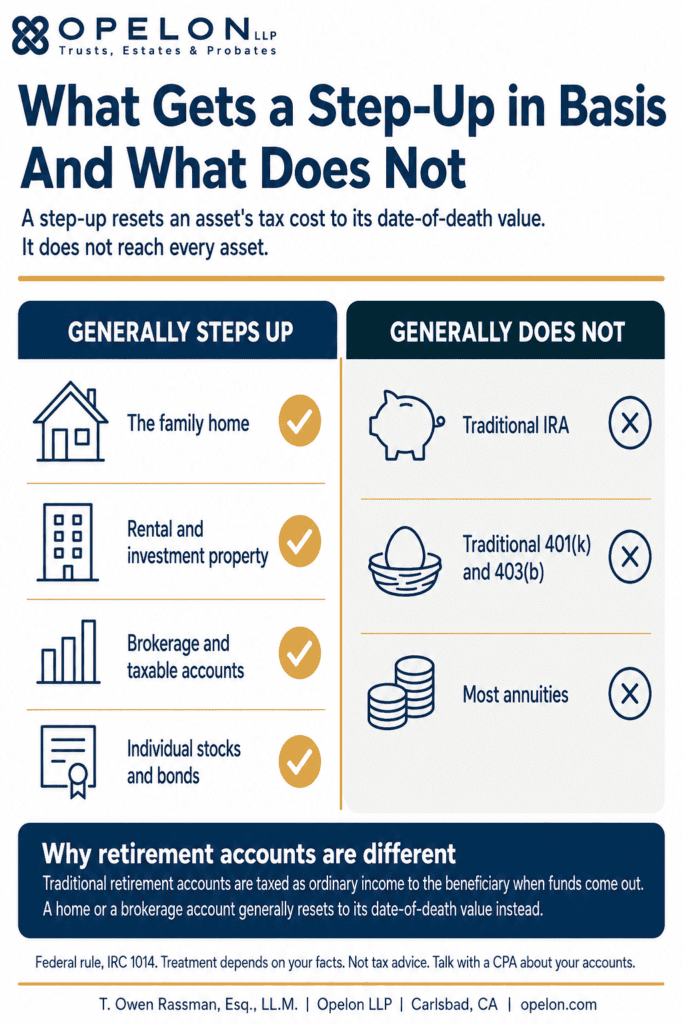
Important: Retirement Accounts Do Not Step UpA step-up applies to capital assets such as a home, a rental property, or a brokerage account. It does not apply to a traditional IRA or a 401(k). Those accounts are taxed as ordinary income to the beneficiary when withdrawn. Readers routinely assume a retirement account steps up at death. It does not. If a large share of your estate sits in retirement accounts, the planning questions are different, and your CPA should be part of that conversation. |
Why California Gives a Bigger Break: The Community Property Double Step-Up
In most states, only half of a jointly owned home steps up when the first spouse dies. The deceased spouse’s half resets to date-of-death value. The surviving spouse’s half keeps its old, often much lower, basis.
California works differently. California is a community property state under California Family Code Section 760. For a home characterized as community property, the entire basis generally steps up to date-of-death value at the first spouse’s death, under IRC 1014(b)(6).
That is the community property double step-up. Both halves reset, including the half the surviving spouse already owned.
For a surviving spouse in San Diego County, the practical effect is large. A home that appreciated for thirty years can often be sold shortly after a spouse’s death with little or no capital gains tax.
California Compared With a Common-Law State
| Question | California (community property) | Common-law state |
| What steps up at the first death? | Both halves of the home generally step up. | Generally only the deceased spouse’s half. |
| Effect on built-in gain | Gain built up during the marriage is usually eliminated. | Gain is usually cut roughly in half. |
| Result for a surviving spouse who sells | Often little or no capital gain on a near-term sale. | A meaningful capital gain frequently remains. |
Treatments in this table are general and depend on how the property is characterized and titled.
Two honest limits belong here. First, appreciation after the date of death is still taxable when the home sells. Second, the double step-up depends on the property being characterized as community property.
That second point is where title comes in, and it is the part most couples never examine.
From Our Carlsbad Office We frequently reassure a surviving spouse that the capital gains bill they are dreading may not exist. When the home was community property, the basis usually reset in full on the day their spouse died. Thirty years of appreciation often disappears for tax purposes in a single moment. |
How You Hold Title Decides Whether You Get the Full Step-Up
The double step-up is not automatic. It generally depends on the home being community property. The words on the deed can preserve that character or quietly forfeit half the benefit.
California recognizes four common ways for a married couple to hold title to a home. Each one carries a different tax consequence at the first death.
- Community property. Generally qualifies for the full double step-up. Standing alone, it does not avoid probate at the second death without a trust or a survivorship feature.
- Community property with right of survivorship. Created under California Civil Code Section 682.1. This form generally combines the full double step-up with automatic transfer to the survivor, outside probate.
- Joint tenancy. The common trap. Joint tenancy avoids probate, but the halves may be treated as separate property. The survivor can then receive only a half step-up, unless the home is shown to be community in character.
- Tenancy in common. No survivorship right. Generally only the deceased owner’s share steps up, and that share passes under the will or by intestacy.
The trust question follows directly. A properly drafted California revocable living trust can hold the home as community property. That structure generally preserves the double step-up and avoids probate at both deaths. This is a core reason California couples use a trust instead of joint tenancy title.
What We See in First Meetings One of the most common and most expensive things we see is a long-married Carlsbad couple holding their home in joint tenancy because a title officer set it up that way in the 1990s. It avoids probate. It can also cost the survivor half of the step-up. Correcting title while both spouses are living is usually a straightforward fix. After the first death, it is generally too late. |
The Surviving Spouse Home-Sale Exclusion and the Two-Year Window
Under IRC 121, a married couple can generally exclude up to $500,000 of gain on the sale of a primary residence. A single filer can generally exclude up to $250,000. A surviving spouse may still claim the full $500,000 exclusion if the California home sells within two years of the death, under IRC 121(b)(4). The other IRC 121 requirements must also be met.
These two rules stack in the survivor’s favor. In California, the double step-up often erases the gain by itself, so the exclusion may never be needed. Where post-death appreciation or a partial step-up leaves some gain, the two-year $500,000 window can matter. The IRS explains the rules in Publication 523, Selling Your Home.
A word about pace. The two-year window is worth knowing, but it is rarely a reason to rush a sale in the first weeks after a loss.
What does deserve early attention is documentation. A date-of-death appraisal is what fixes the stepped-up basis in the record. That appraisal belongs to a qualified appraiser, and the gain calculation belongs to your CPA. Neither is work Opelon LLP performs. Our estate planning guidance for widows and widowers walks through the wider set of first-year tasks.
Step-Up in Basis Is Not Prop 19
Readers merge these two rules constantly, and so do many national articles. They are different taxes, triggered by different events, administered by different agencies.
Step-up in basis is a federal income tax rule. It lowers the capital gain you report when you sell. Proposition 19 is a California property tax rule. It governs the assessed value the county uses for your annual property tax bill.
Here is the point that reassures most surviving spouses. A transfer between spouses, including a transfer at the first spouse’s death, is generally excluded from California property tax reassessment. The survivor usually keeps the existing low property tax base. At the same time, the home generally receives the federal basis step-up. The California State Board of Equalization publishes the current guidance.
Proposition 19 generally bites later, when a home passes to children or leaves the family, not at the first spouse’s death. Our post on Prop 19 and inherited property in California covers those rules in detail.
What This Means When You Sell the Family Home
Put the pieces together for a surviving spouse deciding whether and when to sell a California home. The double step-up has likely already reset the basis. The interspousal exclusion has likely protected the property tax base.
The two-year $500,000 exclusion sits behind both as a backstop, not a starting gun. In our experience with San Diego County families, the capital gains fear is usually larger than the actual bill.
Two tasks genuinely matter, and both are referrals rather than legal work. Get a date-of-death appraisal so the stepped-up basis is documented. Then have a CPA run the numbers before the home is listed.
One honest ceiling. A step-up helps at the first death, and again for the survivor’s share of later appreciation at the second death. It does not make a home tax-free forever. Appreciation after the date of death is taxable, and the exclusion drops to $250,000 once the two-year window closes.