

Community Property Is the Foundation of Every Married Couple’s Plan
California is a community property state. Property a married person acquires during marriage while domiciled here is generally community property. Property owned before marriage, or received by gift or inheritance, is generally separate property. Characterization drives what each spouse can leave, and the income tax basis result at the first death. |
The definition is broader than most people expect. It reaches all property acquired during marriage while domiciled in California, Family Code Section 760, except property acquired by gift, bequest, devise, or descent, which stays separate under Family Code Section 770. Each spouse may generally dispose of their own separate property and their own half of the community property, but not the other’s half.
The Double Step-Up in Basis
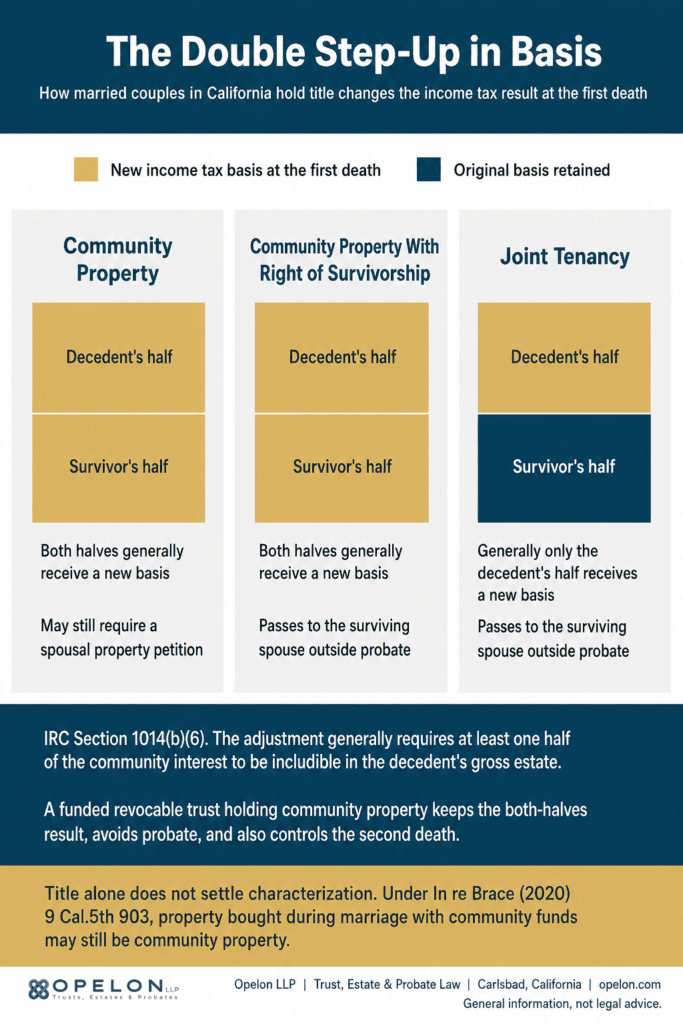
When one spouse dies, community property generally receives a new income tax basis on both halves, IRC Section 1014(b)(6). The adjustment generally requires at least one half of the community interest to be includible in the decedent’s gross estate. For true separate property, only the decedent’s interest adjusts.
Joint Tenancy and CPWROS
Many couples hold the family home in joint tenancy because that is what the title company put on the deed. The risk is characterization rather than automatic loss. Under In re Brace (2020) 9 Cal.5th 903, property bought during marriage with community funds may still be community property despite joint tenancy title.
That turns the basis question into an evidentiary one, years later. Community property with right of survivorship is the cleaner tool. It passes outside probate the way joint tenancy does, but keeps community property character and the both-halves adjustment.
One Joint Trust or Two Separate Trusts?
ANSWER Most California couples with shared finances and a first marriage use one joint revocable trust. A joint trust is simpler to administer and preserves community property character. Separate trusts are generally used for blended families, substantial separate property, second marriages, or larger estates needing independent tax structuring. |
Situation | Typically points toward | Why |
First marriage, mostly community property | Joint trust | Simpler, preserves community property character |
Children from prior relationships | Separate trusts | Survivor cannot redirect the other’s share |
Substantial separate property | Separate trusts, or schedules | Keeps characterization traceable |
Second or later marriage | Separate trusts | Different children, often a marital agreement |
A liability-exposed profession | Depends, worth discussing | No creditor protection during life either way |
Estate near the federal exemption | Separate trusts or subtrusts | GST exemption is not portable |
A non-citizen spouse | Structuring required either way | Marital deduction unavailable without a QDOT |
A joint trust generally does not lock in the first spouse’s beneficiaries unless drafted to do that. For a blended family, that is the whole question. Start with how a revocable living trust works. Separate trusts also cost more, because two documents must be drafted, funded, and kept consistent.
What Documents a Married Couple Needs in California
Estate planning for a married couple in California generally means one coordinated document set. That set includes a revocable living trust, pour-over wills, durable powers of attorney, advance health care directives, and HIPAA authorizations. It also means characterizing community and separate property before anything is drafted. |
Document | What it does | One or two |
Revocable living trust | Holds assets, controls the middle chapter | One joint, or one each |
Certification of trust | Proves the trust to banks without disclosing it, Prob. Code 18100.5 | One per trust |
Pour-over will | Catches untitled assets, nominates guardians | Two |
Durable power of attorney | Covers non-trust assets during incapacity | Two |
Advance health care directive | Names the agent; form at Prob. Code 4701 | Two |
HIPAA authorization | Lets named people receive medical information | Two |
Digital asset authorization | Fiduciary access to accounts, Prob. Code 870 to 884 | In trust and wills |
Funding deeds and designations | Moves the home and accounts into the plan | As needed |
A pet trust under Probate Code Section 15212 fits the same set, a common San Diego County request. Naming your spouse on a beneficiary form is not an estate plan. Designations generally control the account no matter what the trust says.
Guardians for Minor Children
For couples with young children, this is usually the real reason they called. The nomination generally lives in the will, so both spouses should name the same people and name successors. Who raises the children and who manages their money are separate decisions.
What Happens When the First Spouse Dies?
ANSWER When the first spouse dies, assets in a properly funded revocable trust generally pass without probate. Assets outside the trust may require a spousal property petition under Probate Code Sections 13500 through 13660. A small estate procedure or full probate may apply instead, depending on title and value. |
- Funded trust. The survivor generally becomes sole or successor trustee, and no court is involved. A joint trust often becomes partly or wholly irrevocable at the first death, depending on drafting.
- Assets passing to the survivor outside a trust. A spousal property petition is available with no dollar threshold, Prob. Code Sections 13500 through 13660, with the petition itself at Section 13650.
- Assets in the deceased spouse’s name with no plan. The small estate affidavit reaches personal property only, at $208,850 for deaths on or after April 1, 2025, Prob. Code Section 13100. Real property has its own separate procedures and thresholds.
California statutory probate fees are set by Probate Code Sections 10800 and 10810, which apply identical sliding scales to the personal representative and the attorney. On a $1,000,000 gross probate estate, that is generally $23,000 per side, or $46,000 combined, calculated on the gross estate.
Dying Without a Plan as a Married Person
A surviving spouse does not necessarily inherit everything. Under California intestate succession rules, the survivor generally takes all community and quasi-community property, Prob. Code Section 6401(a) and (b). Quasi-community property matters here, because so much of San Diego County moved from somewhere else.
Separate property is generally divided among the survivor and the decedent’s children, parents, or other relatives, Section 6401(c). With one surviving child, the spouse generally takes one half. With two or more, one third.
The Family Home and Property Taxes
Two rules get confused constantly. A transfer between spouses is generally excluded from reassessment, Rev. & Tax. Code Section 63. A parent-to-child transfer is a different and much narrower rule under Proposition 19. It reaches only a family home, meaning the parent’s principal residence, or a family farm. Rentals and vacation homes get no exclusion at all. For transfers from February 16, 2025 through February 15, 2027, the Board of Equalization caps the excludable amount at the property’s factored base year value plus $1,044,586.
That is not a flat ceiling, so a home with a low base year value has a higher limit. The child must also occupy the home as a principal residence and file for the Homeowners’ or Disabled Veterans’ Exemption within one year. See Prop 19 and inherited property for BOE-19-P mechanics.
Federal Estate Tax Planning for Married Couples, Honestly
Most married couples in San Diego County owe no federal estate tax. The exemption is $15,000,000 per individual and $30,000,000 per couple under OBBBA. California imposes no state estate, inheritance, gift, or GST tax. Couples below that level plan for probate avoidance, incapacity, and control. |
OBBBA, Pub. L. 119-21, was signed on July 4, 2025. It set the basic exclusion at $15,000,000 per individual and made it permanent, indexed for inflation from 2027. The rate above it remains 40%.
Portability, the DSUE, and Remarriage
Portability generally lets a surviving spouse elect the deceased spouse’s unused exclusion amount, or DSUE. The election is what preserves the first spouse’s unused amount instead of losing it, which is how a couple reaches the $30,000,000 figure. Per IRS estate tax guidance, it generally requires filing Form 706 even when no tax is due, nine months from death, with a six-month extension available on Form 4768.
If the estate was not otherwise required to file, a simplified late election is generally available for up to five years from death under Rev. Proc. 2022-32. Do not treat that as a reason to wait.
One further limit belongs here. DSUE comes only from the last deceased spouse, IRC Section 2010(c)(4). If the survivor remarries and then outlives the second spouse, the first spouse’s ported exclusion can be lost.
Do We Still Need an A-B Trust?
Mandatory A-B Trust splits are generally less common since portability. They still have uses: blended families locking in remainder beneficiaries, preserving the non-portable GST exemption, and out-of-state estate tax exposure. If you signed one in the 1990s, have it reviewed. A forced split can produce a worse basis result than the plan was built to avoid.
Blended Families and Second Marriages
In a first marriage with shared children, leaving everything outright to the survivor is usually uncontroversial. In a blended family, an outright gift generally lets the survivor redirect it. That is structural, not personal.
- Separate trusts, so each spouse controls their own share and the survivor cannot change the other’s beneficiaries.
- A lifetime interest with a fixed remainder, so the survivor is provided for and the remainder passes as directed.
- An independent trustee or co-trustee, so the survivor is not the sole judge of their own distributions.
California also protects a spouse who married after the plan was signed, Prob. Code Sections 21610 through 21612, so a remarriage should trigger a review. Opelon LLP plans to prevent disputes. We do not litigate contested matters or draft marital agreements.