


What Is an A-B Trust in California?
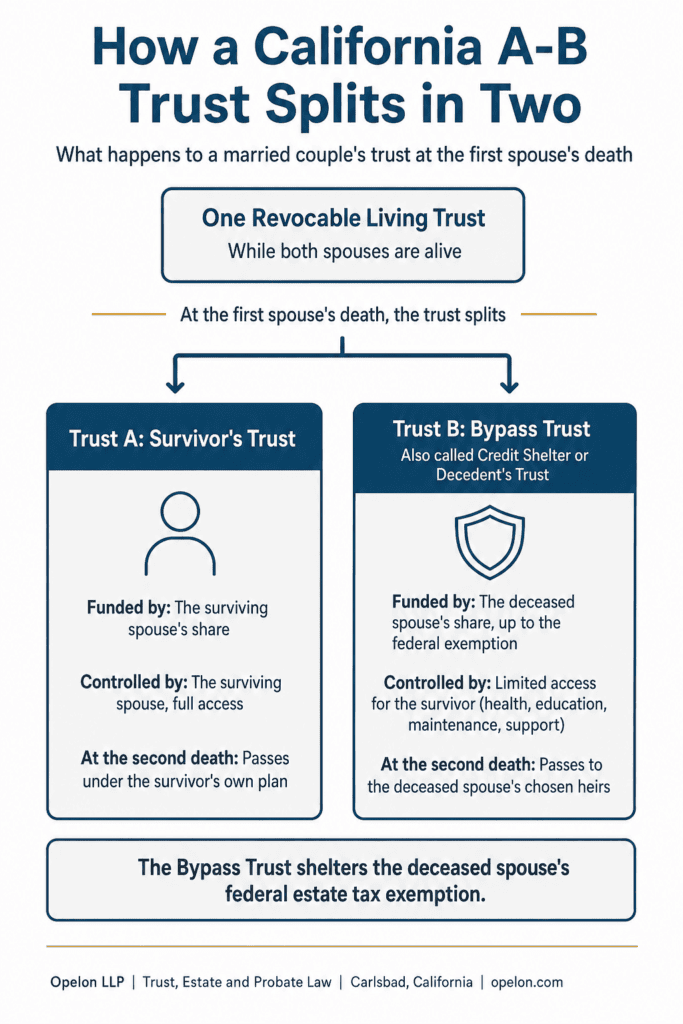
Quick answer A California A-B trust is a married couple’s revocable living trust that splits into two sub-trusts at the first spouse’s death. Trust A, the Survivor’s Trust, holds the surviving spouse’s share. Trust B, the Bypass Trust, holds the deceased spouse’s share and preserves that spouse’s federal estate tax exemption. |
The same structure goes by several names, which causes a lot of confusion. Here is the plain-English version.
- Trust A is the Survivor’s Trust. It holds the surviving spouse’s own share, and the surviving spouse controls it fully. Some plans loosely call it the Marital Trust, but it is not the same as a marital-deduction (QTIP) trust, which in a three-part plan is Trust C, discussed below.
- Trust B is the Bypass Trust. You may also see it called the Credit Shelter Trust, the Decedent’s Trust, or the Exemption Trust. These are all the same thing.
- In a three-part A-B-C structure, Trust C is usually a QTIP marital deduction trust. We cover QTIPs further below.
Both trusts begin life as one revocable living trust the couple creates together under California Probate Code Section 15200. The split happens only when the first spouse dies. You can see how the foundation works in our guide to the California revocable living trust.
One California-specific point matters here. California has no state estate tax. So the in-state reason some other states have for A-B trusts, preserving a separate state exemption, does not apply to a California estate.
Why the A-B Trust Made Sense Before 2013
To understand today’s analysis, you need the old logic. Before 2013, each spouse had a federal estate tax exemption. If the first spouse died without using theirs, that exemption was lost.
Without an A-B split, the deceased spouse’s whole estate passed to the surviving spouse using the marital deduction. That made the survivor’s eventual estate larger. It could then exceed a single exemption and owe federal estate tax at the second death.
The A-B split solved this. The deceased spouse’s exemption amount funded the Bypass Trust at the first death. The surviving spouse had limited access during life. At the second death, the remaining Bypass Trust assets passed to the family without estate tax.
The math worked well for couples whose combined estate topped one federal exemption. For decades, that described many California homeowners with appreciated real estate.
What Changed in 2013: The Portability Era
Portability changed everything. Lawmakers enacted it in 2010 and made it permanent in 2013 under the American Taxpayer Relief Act.
Under Internal Revenue Code Section 2010(c), a surviving spouse can claim the deceased spouse’s unused exemption, known as the DSUE. The survivor claims it by making a portability election on a timely-filed Form 706. For estates not otherwise required to file a return, the executor can also make a late portability election under the simplified relief in IRS Revenue Procedure 2022-32, generally available for up to five years after death.
The survivor then adds the DSUE to their own exemption. This reaches the same exemption result as a Bypass Trust. It does so with simpler administration and lower cost.
Portability also keeps a tax advantage the A-B trust gives up. That advantage is the step-up in basis, and it is the heart of the modern analysis.
The Step-Up in Basis Trade-Off
California community property gets a full step-up in basis at the first spouse’s death under Internal Revenue Code Section 1014(b)(6). Both halves reset to fair market value, not just the deceased spouse’s half. This is a major California benefit.
With portability, those assets step up a second time at the surviving spouse’s death. The family can sell with little or no capital gains tax on the lifetime of appreciation.
Bypass Trust assets do not get that second step-up. They sit outside the surviving spouse’s taxable estate, so the basis does not reset again. For highly appreciated assets, that gap can be expensive.
Why most California couples moved away from A-B trusts Imagine a couple holding $5 million in long-held California real estate. A Bypass Trust could cost the family as much as $1 million to $2 million in future federal capital gains tax. Portability would have avoided that cost. The exact number depends on basis and rates. This lost second step-up is the single biggest reason A-B trusts fell out of favor for most couples after 2013. The figures here are illustrative, not a prediction for any estate. |
The 2025 OBBBA Reset
The law shifted again in 2025. The One Big Beautiful Bill Act (OBBBA), Public Law 119-21, was signed on July 4, 2025.
OBBBA amended Internal Revenue Code Section 2010(c)(3)(A). It set the federal estate tax exemption at $15 million per individual, effective January 1, 2026. A married couple can shelter a combined $30 million, but that combined figure is not automatic: it requires either a portability election on the first spouse’s federal estate tax return or a credit shelter (Bypass) trust that captures the first spouse’s exemption.
This exemption is permanent, in the sense that it has no scheduled sunset, and it is indexed for inflation starting in 2027. The 2026 figures were published in IRS Revenue Procedure 2025-32. There is no built-in expiration to plan around, though like any tax provision it remains subject to future Congressional action.
That high exemption removes federal estate tax exposure for the large majority of California families. You can confirm the current federal estate tax exemption amount on our focused stat page.
Here is the practical effect. For couples under $30 million combined, the federal estate tax reason for an A-B trust is essentially gone. Portability plus step-up planning is almost always the better fit.
For couples over $30 million combined, estate tax planning becomes a multi-tool exercise. It can involve SLATs, GRATs, GST trusts, and charitable trusts. The A-B trust alone is rarely the answer for high net worth estate planning.
When a California A-B Trust Still Makes Sense in 2026
The tax case has narrowed, but it has not vanished. Four scenarios still justify the structure. This is the section most readers came for.
Scenario 1: Blended Families and Remainder Control
This is the most common modern reason we still draft A-B trusts today. A spouse in a second or later marriage wants their assets to reach their own children, not a future second spouse’s choices.
The mechanic is straightforward. The deceased spouse’s share funds the Bypass Trust at the first death. The surviving spouse receives income and limited principal under a HEMS standard, which means health, education, maintenance, and support.
At the surviving spouse’s death, the remainder passes to the deceased spouse’s chosen heirs. Without the split, those assets pass outright to the survivor, who could later amend their own trust and disinherit your children.
In our experience In our San Diego County practice, the blended-family scenario is by far the most common reason we still draft A-B trusts in 2026. Most clients are not motivated by federal estate tax. They want to make sure their kids inherit from them, not from a future spouse’s later decisions. The blended-family A-B trust trades two things for that control: the second step-up in basis on the deceased spouse’s share, and added administrative work. When remainder control matters more than tax efficiency, that trade is often worth it. |
We cover this use case in depth in our guide to estate planning for blended families in California.
Scenario 2: GST Exemption Preservation
This is the strongest remaining tax argument for an A-B trust. It involves the Generation-Skipping Transfer Tax, or GSTT.
The GST exemption is also $15 million per individual under OBBBA. It is permanent and indexed for inflation starting in 2027. So far it tracks the estate tax exemption.
Here is the key difference. The GST exemption is not portable. Unlike the basic estate tax exemption, a surviving spouse cannot port a deceased spouse’s unused GST exemption. The portability election under Internal Revenue Code Section 2010(c) applies only to the basic exclusion amount, and the generation-skipping transfer tax subchapter, which begins at Internal Revenue Code Section 2601, contains no equivalent. The GST exemption itself is set by Internal Revenue Code Section 2631, with no portability provision for a surviving spouse.
So if the deceased spouse’s $15 million GST exemption is not allocated at the first death, it is gone for good. For families planning transfers to grandchildren, that is a serious loss.
The exposure can be large. Wasting a $15 million GST exemption can expose a family to up to $6 million in future GST tax. That figure reflects the 40 percent rate on a later generation-skipping transfer. The actual cost depends on the facts.
The Bypass Trust is the natural vehicle to preserve that exemption. The deceased spouse’s executor allocates GST exemption to the Bypass Trust on Form 706. The trust is then structured as a GST-exempt dynasty trust for the family across generations.
The GST point in one line Portability handles the basic estate tax exemption. It does not handle the GST exemption. For high net worth families across San Diego County who want assets to skip a generation, that gap is one of the strongest reasons the A-B structure survives in 2026. |
Scenario 3: Asset Protection From the Surviving Spouse’s Future Liabilities
A Bypass Trust can shield assets from risks the surviving spouse may face later. These include future lawsuits, a costly remarriage, long-term-care expenses, or bankruptcy.
The mechanism is the HEMS standard plus independent trustee discretion. The surviving spouse cannot demand unlimited access. As a rule, creditors cannot reach what the beneficiary cannot compel.
This helps when the surviving spouse is in a high-liability profession, such as a physician or business owner. It also helps when remarriage or long-term-care risk is a real concern.
One California limit is worth noting. Self-settled trusts in California are not creditor-protected. But the Bypass Trust is funded by the deceased spouse’s assets, not the survivor’s, which changes the analysis in the survivor’s favor.
Scenario 4: State Estate Tax States, Not California
Some states still levy their own estate tax with a lower exemption than the federal one. Oregon, Washington, and Massachusetts are common examples. An A-B structure can preserve a state-level exemption there.
California is not one of those states. It has no state estate tax. So this reason does not apply to a California estate by itself.
It can still matter for cross-border planning. A California couple with an Oregon vacation home, for example, may want to weigh that state’s rules with counsel in both states.
The Mechanics: How an A-B Trust Funds at First Death
Funding an A-B trust is real work. It happens at the first spouse’s death and shapes the family’s tax position for years. Here is what the process involves.
Community Property and Separate Property Characterization
California is a community property state. At the first death, the trust assets divide into community property and separate property. Property acquired during marriage is generally community property under California Family Code Section 760, and each spouse holds an equal one-half interest in it under California Family Code Section 751.
The deceased spouse’s half of community property, plus their separate property, funds the Bypass Trust up to the exemption amount. The surviving spouse keeps their own half in the Survivor’s Trust.
In our experience In our work administering A-B funding for San Diego County families, the hardest step is often characterizing assets bought during the marriage from mixed funds. A home purchased 15 years into a marriage, using a pre-marital inheritance plus joint income, can require careful tracing before it can be split. |
The Funding Formula: Pecuniary vs Fractional
Trust drafters use one of two funding methods. The choice affects capital gains, so it matters.
Feature | Pecuniary Funding | Fractional Funding |
How it works | Bypass Trust gets a fixed dollar amount equal to the available exemption | Bypass Trust gets a fraction of the assets equal to the exemption amount |
Capital gains at funding | Can trigger gain on any post-death appreciation; satisfying a fixed-dollar amount with appreciated assets is treated as a sale | Generally does not trigger gain at funding |
Common use today | Less common for this reason | Preferred by most California drafters |
Relative complexity | Simpler to state, harder on taxes | More flexible, better basis result |
The funding step is part of our California trust administration process, which we handle when an existing A-B trust funds at the first death.
The Surviving Spouse’s Rights and Limitations
The two sub-trusts give the surviving spouse very different powers.
- Survivor’s Trust: the surviving spouse has full access and full amendment rights. It works like their own revocable living trust.
- Bypass Trust: principal access is limited to the HEMS standard. Income is usually paid to the surviving spouse, which keeps the structure efficient.
- Five-and-five power: a common clause lets the survivor withdraw the greater of $5,000 or 5 percent of Bypass Trust principal each year. The “5 and 5” ceiling is deliberate. Under Internal Revenue Code Section 2041(b)(2), a lapsed withdrawal right is treated as a taxable transfer only to the extent it exceeds the greater of $5,000 or 5 percent, so a properly limited annual power keeps the lapses out of the survivor’s estate. Only the amount the survivor could still withdraw in the year of death is included in the survivor’s estate, and for an estate well under the $15 million exemption that inclusion is generally immaterial.
Portability vs A-B Trust: A Side-by-Side Comparison
The choice between portability and an A-B trust comes down to your goals. This table lays out the main trade-offs for a California couple.
Factor | Portability | A-B / Bypass Trust |
Estate tax exemption preserved | Yes, via DSUE on Form 706 | Yes, via the Bypass Trust |
Second step-up in basis | Yes, at the survivor’s death | No second step-up on bypass assets |
GST exemption preserved | No, GST is not portable | Yes, allocated at first death |
Remainder beneficiary control | Limited; survivor controls assets | Strong; deceased spouse names heirs |
Creditor protection for survivor | Minimal | Possible through HEMS and trustee discretion |
Administrative burden | Lower | Higher; separate trust and tax filings |
Can I Unwind an Existing A-B Trust That No Longer Makes Sense?
Many couples hold an A-B trust drafted before 2013 or before OBBBA. If the original tax reason is gone, you usually have options.
- Both spouses living: the couple can typically amend the trust to remove the A-B split. This is the most direct path.
- One spouse deceased, trust partly funded: the main routes are decanting, court modification, or non-judicial modification. Court modification runs under Probate Code Section 15403 with beneficiary consent.
- Basis planning: the Bypass Trust may hold highly appreciated assets. Moving them toward the surviving spouse can help capture a second step-up at the survivor’s death.
In our experience In our Trust Administration practice, we routinely find A-B trusts drafted in the 1990s or 2000s that no longer serve a useful purpose under current law. We evaluate the modification paths under the Probate Code case by case. This work falls within our Trust Administration practice. We do not handle trust contests if a beneficiary disputes the modification. Those matters belong with a trust litigation specialist. |
California A-B Trust Costs
Costs come in three stages. Knowing them up front helps you plan.
- Initial drafting: an A-B trust within a full estate plan is usually a flat fee. It runs higher than a standard joint-trust plan because the drafting is more complex.
- First-death funding: this is significant work. It includes community property characterization, retitling assets, getting a taxpayer ID for the Bypass Trust, and setting up its tax filings.
- Ongoing administration: the Bypass Trust is a separate taxpayer. It generally files its own annual return, and a third-party trustee may prepare accountings.
For context, statutory probate fees on a $1 million California estate total roughly $46,000 in combined attorney and representative fees. A well-funded trust plan is designed to avoid that path.
When to Consult a California Estate Planning Attorney About an A-B Trust
A short conversation often answers the keep, modify, or unwind question. Consider reaching out if any of these fit you.
- You are part of a blended family and want your children from a prior marriage to inherit your share.
- Your combined estate exceeds $30 million and you are weighing GST exemption preservation.
- You hold an A-B trust drafted before OBBBA and want to know whether to keep, modify, or unwind it.
- The first spouse has died and you need help with the A-B funding allocation.
- The surviving spouse is in a high-liability profession or has long-term-care concerns.
Opelon LLP drafts A-B trusts for the scenarios where they still fit in 2026. We also handle the trust administration when an existing A-B trust funds at the first death. For couples whose A-B trust no longer fits, we handle modification and unwinding through Probate Code procedures.
Related Guides
- Complete Guide to California Trusts (All Trust Types)
- California Revocable Living Trust: 7 Critical Steps