


What Is the 10-Year Rule for Inherited IRAs?
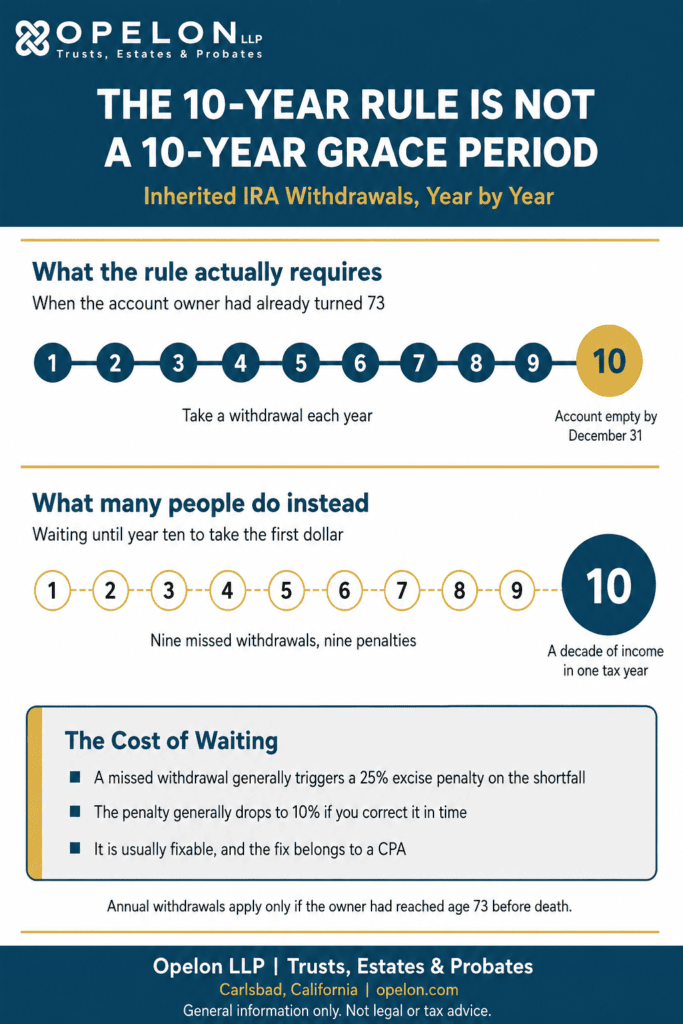
Most people who inherit a retirement account from an owner who died in 2020 or later face a hard deadline. The entire account must be emptied by December 31 of the tenth year after the year of death. One more rule applies if the original owner had already begun their own required withdrawals: The beneficiary generally must also take a withdrawal in each of years one through nine.
Here is what changed.
Before the SECURE Act, most beneficiaries could stretch withdrawals across their own life expectancy, sometimes for decades. That long runway is gone for most people who inherit today.
The IRS rules for IRA beneficiaries now cap the payout period at ten years for most heirs.
Two laws drive this, and you only need to learn them once.
- The SECURE Act of 2019 created the 10-year rule.
- SECURE 2.0 and the IRS final regulations issued in July 2024 confirmed the annual withdrawal requirement inside that ten-year window.
If the term is new to you, our explainer on required minimum distributions and RMD rules covers the underlying mechanics in plain English.
The most expensive misunderstandingDo not treat the 10-year rule as a 10-year grace period. For many beneficiaries it is not. Waiting until year ten to take the first dollar can trigger a penalty for every skipped year. It can also stack a decade of taxable income into a single tax year. That single mistake is the most expensive one we see in San Diego County. |
The Two Questions That Determine Everything
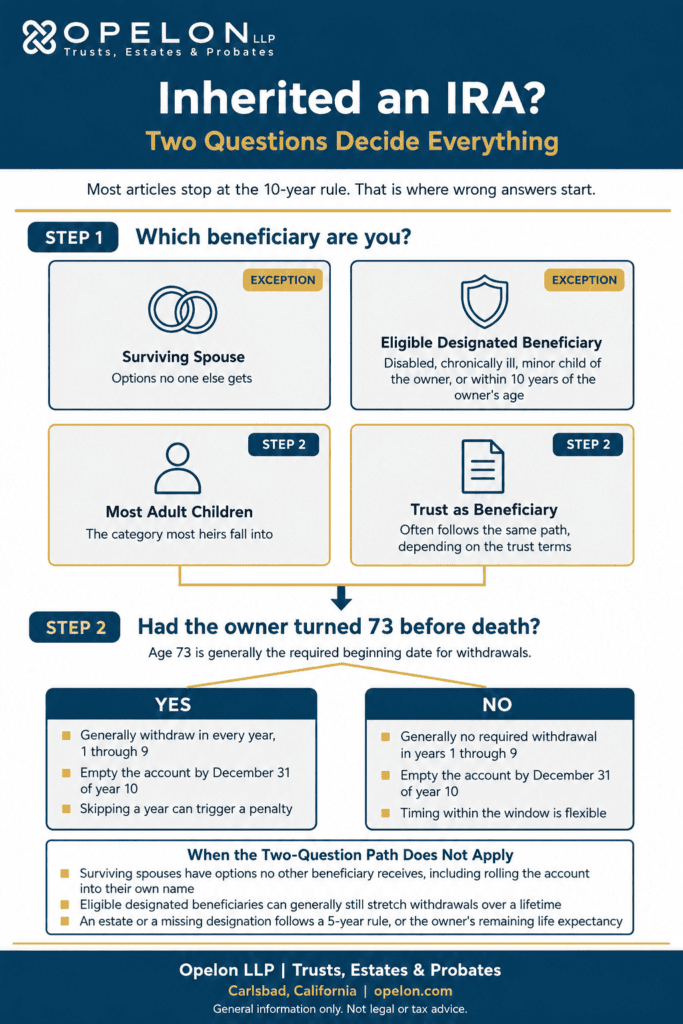
Almost every article you will find online collapses this topic into a single 10-year rule. That is where wrong answers come from. Every outcome turns on two facts, in this order.
Question 1: What kind of beneficiary are you? You are a surviving spouse, an eligible designated beneficiary, a non-eligible designated beneficiary, or a non-person such as a trust, an estate, or a charity. Each category follows different rules.
Question 2: Had the account owner reached their required beginning date before death? This is generally the year they turned 73. If yes, annual withdrawals apply inside the ten-year window. If no, the beneficiary generally has flexibility within the window. The account still must be empty by the deadline.
The table below shows how the two answers combine.
| Beneficiary type | Distribution timeline | Annual withdrawal in years 1 to 9? | Key planning note |
| Surviving spouse | Most flexible. May roll into own name or remain a beneficiary | Depends on the election chosen | Widest set of options. Some elections are irreversible |
| Eligible designated beneficiary (non-spouse) | Life expectancy stretch generally still available | Yes, based on the beneficiary’s life expectancy | A properly drafted special needs trust is powerful here |
| Non-eligible designated beneficiary (most adult children) | 10-year cleanout | Only if the owner died on or after age 73 | This is the row most heirs fall into |
| Trust as beneficiary | Generally 10 years unless it qualifies through an eligible beneficiary | Depends on trust type and the owner’s age at death | Pre-2020 trust language is the hidden trap |
| Estate or no named beneficiary | 5-year rule if the owner died before 73. Remaining life expectancy if after | No annual withdrawal under the 5-year path | Usually the worst outcome. Naming a beneficiary avoids it |
Every figure above reflects current federal rules as of the date on this article. Confirm your specific account with a CPA.
In our San Diego County practice, the most common thing we correct in a first meeting is simple. A beneficiary was told they have ten years and stopped listening there. The follow-up question is the one that changes the answer. Had the parent already started taking their own withdrawals?
Who Still Gets to Stretch Distributions?
Eligible designated beneficiaries can generally still spread withdrawals across their own life expectancy instead of over ten years. The category covers surviving spouses and beneficiaries who are disabled or chronically ill. It also covers minor children of the account owner until they reach 21. Finally, it covers any beneficiary who is not more than ten years younger than the owner.
Each category carries a practical catch worth knowing:
- Surviving spouse: the broadest set of options, covered in its own section below.
- Disabled or chronically ill beneficiary: qualifying requires documentation that meets the statutory definition. This is the category that makes a properly drafted special needs trust genuinely powerful. The account can support the beneficiary for life without upending their public benefits.
- Minor child of the account owner: stretch treatment ends at 21, and the 10-year clock starts then. Note the trap. This applies to the owner’s own child, not to a grandchild, a niece, or a nephew.
- Beneficiary not more than ten years younger than the owner: typically a sibling, a close-in-age partner, or a friend of the same generation.
If You Are the Surviving Spouse
A surviving spouse has options no other beneficiary receives, including treating the account as their own.
Rolling the account into your own name generally restarts the deferral. It also pushes required withdrawals out to your own required beginning date.
Remaining a beneficiary instead preserves different access rules. That can matter if you are under 59 and a half and may need the money.
Be honest with yourself about one thing. Some spousal elections cannot be undone. The right choice depends heavily on your age, your cash needs, and your overall tax picture. Make this decision with a CPA or a financial advisor before you act, not after.
In the first weeks, this decision is usually not urgent. It helps to hear that plainly. We often tell a surviving spouse in the first month that this is not the account to rush. The money is not going anywhere. Making the wrong election quickly costs far more than making the right one in month three. Our guide to estate planning for widows and widowers walks through the wider set of decisions in order.
When a Trust Is the Beneficiary
This is where a California estate plan either works or quietly backfires. It is also the part most brokerage explainers skip entirely. If your family named a trust as the beneficiary of a retirement account, the trust language controls. It sets how fast the money must come out and how it is taxed.
Conduit Trusts
A conduit trust must pass each withdrawal straight through to the beneficiary in the year it is received. Under current rules, that can force a large distribution out of the trust and onto the beneficiary’s personal tax return. It happens inside a compressed window. That is often the opposite of what the settlor wanted when they added the trust for protection.
Accumulation Trusts
An accumulation trust can hold withdrawals inside the trust, which preserves control and protection. The tradeoff is tax. Trust income tax brackets compress at very low income levels. Income kept inside a trust can reach the top federal rate after only a small amount of retained income.
The choice between the two structures is control versus tax efficiency. It is a real tradeoff rather than a trick question.
The Pre-2020 Drafting Problem
Here is the core message for anyone with an existing plan.
Trusts drafted before 2020 were often written assuming a lifetime stretch that no longer exists. That language can now speed distributions up rather than slow them down. It can push a decade of retirement income onto your children inside ten years.
There is a favorable exception. A trust built for a disabled or chronically ill beneficiary, properly drafted, may still qualify for extended treatment.
Spendthrift protection for that beneficiary’s interest continues to operate under California Probate Code sections 15300 through 15309, regardless of the distribution timeline.
We reviewed a Carlsbad family’s trust last year that named a conduit trust for two adult children. It was drafted in 2016, and it did exactly what it was designed to do under the old law. Under current rules, it would have pushed roughly a decade of retirement income onto both children inside ten years. A drafting update fixed it in one meeting. If you want the foundation first, review how a California revocable living trust fits into the rest of the plan.
How California Taxes an Inherited IRA
California has no estate tax, no inheritance tax, and no gift tax.
A California resident who withdraws from an inherited traditional IRA generally owes California income tax on that withdrawal. That is on top of federal income tax, because the distribution counts as ordinary income rather than as an inheritance.
Readers merge those two ideas constantly, so separate them cleanly. There is no California death tax. There is state income tax on the withdrawals, at your regular rate, reported in the year you take the money out. The California Franchise Tax Board treats these distributions like other retirement income for a California resident.
Inherited Retirement Accounts Do Not Get a Basis Step-Up
One more correction, because nearly everyone assumes the opposite. Retirement accounts do not receive a stepped-up basis at death.
The basis step-up under IRC section 1014 applies to capital assets such as real estate and brokerage holdings. The One Big Beautiful Bill Act left that rule unchanged. It does not apply to a traditional IRA. Every dollar of a traditional IRA distribution is generally taxable income to the beneficiary.
As for estate tax, most California families will never face it on a retirement account. Under current federal law the exemption is $15 million per person and $30 million per married couple. There is no scheduled sunset, and the figure is indexed for inflation beginning in 2027.
The couple figure is not automatic. It generally depends on a portability election or on credit shelter planning. For inherited IRAs, income tax is the live issue, not estate tax. Our guide to the federal estate tax exemption amount covers the estate side in full.
What Happens If You Missed a Required Withdrawal
Take the fear head on. A missed required withdrawal generally triggers an excise penalty of 25% of the amount you should have taken. The penalty drops to 10% if you correct it within the applicable window. It is a real penalty, but it is usually fixable.
The constructive move is simple. Take the missed amount, file what needs to be filed, and request relief. Do not ignore it, and do not guess at the number. This fix belongs to a CPA, who will run the calculation and handle the filing.
Related Guides
- California Estate Tax Planning Guide
- Your California Estate Planning Checklist
- California Step-Up in Basis and the Community Property Double Step-Up