


What Is a Spousal Property Petition in California?
A Spousal Property Petition is a California Superior Court proceeding under Probate Code Section 13650. It lets a surviving spouse or registered domestic partner obtain a court order confirming that property belongs to them, without a full probate administration. The petition can reach community property, quasi-community property, and separate property passing to the surviving spouse. |
The statute is short and practical. Under Probate Code Section 13650, a surviving spouse may petition the superior court in the county where the deceased spouse’s estate could be administered. The petition asks the court to rule that administration is not necessary. The reason is simple: that property already passes to the surviving spouse.
Think of the resulting order as a title document. It is the paper a bank or title company accepts when you ask to move an asset into your name alone.
Why This Matters
A court order under Probate Code Section 13650 gives you a clean, recordable title document. Without it, title companies, banks, and the San Diego County Recorder often decline to retitle property, even when the law is on your side. Paper follows people. Institutions want the order. |
New to the court process? Our California probate guide walks through how estates move through the Superior Court and where the shortcuts sit.
Do You Actually Need a Spousal Property Petition?
Not every surviving spouse needs to file. Probate Code Section 13500 provides that property passing to a surviving spouse passes without administration. The Section 13650 petition is a confirmation tool, not a legal prerequisite. Most people file because a bank, title company, or county recorder wants a court order. |
Here is the distinction that trips people up. The law already transfers the property. The institutions holding that property have their own paperwork rules.
Some assets move without any court involvement. Joint tenancy accounts and payable-on-death designations usually transfer on a death certificate and a form. The same is true for retirement accounts with a named beneficiary and assets already titled in a living trust.
Other assets stall. Real property held as community property without a right of survivorship is the classic example. So is a brokerage account titled in the deceased spouse’s name alone. In our experience working with San Diego County families, those two situations drive most filings.
Who Can File a Spousal Property Petition in California?
Surviving Spouses
Probate Code Section 13650 lets the surviving spouse file. It also allows the personal representative, guardian of the estate, or conservator of the estate of the surviving spouse to file on their behalf. That last point matters when a surviving spouse is no longer able to manage their own affairs.
Community property law gives each spouse a one-half interest in assets acquired during the marriage with community funds. The petition asks the court to confirm your existing half and to determine that the other half passes to you.
Registered Domestic Partners
Registered domestic partners have the same rights as spouses for this purpose. Family Code Section 297.5 grants them the same rights, protections, and benefits as spouses under California law.
The Judicial Council form reflects that parity directly. Form DE-221 is titled Spousal or Domestic Partner Property Petition, and it cites Family Code Section 297.5 on its face. One form, both relationships.
What Happens If Your Spouse Died Without a Will?
A Section 13650 petition is still available. When a decedent dies intestate, community property and quasi-community property pass to the surviving spouse under Probate Code Section 6401. Separate property is different. Under Probate Code Section 6401(c), a surviving spouse takes all, one-half, or one-third of the decedent’s separate property, depending on whether the decedent left issue, a parent, or a sibling.
The petition cites the intestate succession statute instead of a will provision. Nothing else about the procedure changes. Our guide to California intestate succession rules explains how to calculate shares when separate property is also in play.
From Our Practice
“We regularly guide surviving spouses in Carlsbad and across San Diego County through Section 13650 petitions after an intestate death. Often the couple had been meaning to update their estate plan and simply ran out of time.” T. Owen Rassman, Esq., LL.M., Managing Partner, Opelon LLP, Carlsbad, California. |
What Property Qualifies for a Section 13650 Petition?
A Spousal Property Petition can confirm community property and quasi-community property. It also reaches separate property passing to the surviving spouse by will or intestate succession. Probate Code Sections 100 and 101 govern the surviving spouse’s one-half interest in community and quasi-community property. Property passing to anyone else falls outside the petition. |
Community Property
Community property is the most common subject of these petitions. The family home, joint accounts funded with wages, and vehicles bought during the marriage all typically qualify.
You already own half under Probate Code Section 100. The petition confirms that half and determines that the deceased spouse’s half passes to you.
Quasi-Community Property
Probate Code Section 66 defines quasi-community property. It covers personal property anywhere, and real property in this state, that a decedent acquired while domiciled elsewhere, along with property acquired in exchange for it.
The test is a hypothetical. Would the asset have been community property if the decedent had been domiciled in California when they acquired it? If yes, it is quasi-community property at death. This comes up often for couples who retired to North County San Diego after careers in other states.
Separate Property Passing to the Surviving Spouse
Separate property can go through the same petition. Property owned before marriage, or received by gift or inheritance during marriage, qualifies to the extent it passes to you under the will or under intestate succession. Watch the intestate share. Probate Code Section 6401(c) does not always give the surviving spouse the entire separate estate, and only the portion actually passing to you belongs in the petition.
This is what makes the petition so useful. It is not limited to the community estate.
What the Petition Cannot Cover
Property passing to children, siblings, or any other beneficiary cannot be confirmed through a spousal petition. That property needs a probate administration or a trust process. Some estates need both a Section 13650 petition and a probate, running on parallel tracks. When a probate is already pending, Probate Code Section 13652 requires the petition to be filed in that proceeding, and Government Code Section 70655(c)(3) exempts that filing from an additional fee. A surviving spouse may also elect under Probate Code Section 13502 to have property administered in probate instead. Property covered by that election is outside the petition.
Is There a Dollar Limit?
No. Probate Code Section 13650 sets no cap on value. That is a real advantage over the small estate affidavit under Probate Code Section 13100. The affidavit route is limited to $208,850 for deaths on or after April 1, 2025. A surviving spouse can use the petition to confirm a multi-million-dollar home if it otherwise qualifies. The Judicial Council adjusts these thresholds every three years, and the next adjustment takes effect April 1, 2028. |
How to File a Spousal Property Petition in California: Five Steps
Filing a Spousal Property Petition takes five steps. Gather documents, prepare and file Judicial Council Form DE-221, serve notice under Probate Code Section 13655, attend the hearing, then record the order. Petitions are heard at the Central Courthouse, 1100 Union Street, San Diego. |
Step 1: Gather the Required Documents
Start with paper. You will generally need the following before drafting anything:
- A certified copy of the death certificate, available through the San Diego County Assessor/Recorder/County Clerk or the California Department of Public Health Vital Records.
- Your marriage certificate or Declaration of Domestic Partnership. Several courts now expect this as proof of the relationship.
- The original will, if one exists, plus any codicils.
- Deeds, account statements, and titles showing how each asset was held.
- A list of every heir, devisee, and named executor, because each of them receives notice.
Step 2: Prepare and File Form DE-221
You file Judicial Council Form DE-221 in the superior court of the county where the deceased spouse’s estate could be administered. For most Opelon LLP clients in North County San Diego, that means the San Diego County Superior Court Probate Division.
Probate Code Section 13651 sets out what the petition must contain. Expect to describe the property, including the legal description for real property. You also characterize each asset as community, quasi-community, or separate. You also attach any written agreement between the spouses that affects the property’s character.
San Diego Superior Court requires electronic filing through an approved electronic filing service provider for attorneys and represented parties in probate matters, with limited exceptions for certain documents. Self-represented filers may file electronically but are not required to.
Step 3: Serve Notice on the Required Parties
Probate Code Section 13655 identifies who must be served. Probate Code Section 1220 supplies the timing, requiring notice of the hearing at least 15 days beforehand. One exception matters in practice. If the petition is filed together with a petition for probate of the will or for administration of the estate, and no administration is already pending, separate notice under Section 13655 is not required.
Notice generally goes to the decedent’s heirs and devisees, and to any person named as executor in the will. If the petitioner is the trustee of a trust that is a devisee under the will, the persons interested in that trust receive notice too. If the will involves a charitable trust or a charitable devise with no identified beneficiary, notice also goes to the Attorney General. Courts use Form DE-120 for this notice.
Where Petitions Get Delayed
Missing a required notice party is one of the most common reasons a Section 13650 petition gets continued. Using the wrong notice form is another. Form DE-115/GC-015, Notice of Hearing on Petition to Determine Claim to Property, is for Probate Code Section 850 petitions, not spousal property petitions. An attorney who files regularly in the San Diego County Probate Division will catch these before the hearing. |
Step 4: Attend the Hearing
The court sets a hearing date. San Diego County probate matters are heard at the Central Courthouse 1100 Union St., San Diego, CA 92101 (Probate Business Office is on the 3rd Floor).
If the paperwork is in order and no one objects, the hearing is usually brief. Under Probate Code Section 13656, the court issues an order describing the property, on Judicial Council Form DE-226, Spousal or Domestic Partner Property Order. That order determines that the property passes to the surviving spouse and that no administration is necessary.
Probate Code Section 13657 adds an important protection. Once the order becomes final, it is conclusive on all persons, whether or not they are in being.
Step 5: Record the Order and Retitle the Assets
The order does no work sitting in a file. For real property, you record a certified copy with the recorder in the county where the property sits. Form DE-226 is built for that, with a recorder’s use block on its face.
For financial accounts, you present a certified copy to the bank or brokerage. Most institutions will then retitle the account without further court involvement.
How Long Does a Spousal Property Petition Take in California?
In the ordinary course, a Section 13650 petition runs about two to four months from filing to a recorded order. The variables are the hearing calendar, how quickly you finish notice, and whether the probate notes flag anything to fix.
Compare that to a full probate. A straightforward administration typically takes 12 to 18 months. One reason is the creditor claim period under Probate Code Section 9100. It runs until the later of four months after letters are first issued to a general personal representative or 60 days after notice of administration is given to a known creditor. The period is fixed by statute, although Probate Code Section 9103 allows a late claim in limited circumstances.
What Does a Spousal Property Petition Cost in San Diego County?
San Diego Superior Court charges $435 to file a spousal or domestic partner property petition under Probate Code Section 13650. That figure comes from the court’s fee schedule effective September 1, 2026. Attorney fees are separate and are not set by statute. Total cost is typically a fraction of full probate for the same assets. |
Costs generally break down into four buckets.
- Court filing fee. San Diego Superior Court lists $435 for a spousal or domestic partner property petition at item 143 of its fee schedule, under Government Code Section 70655(c)(3).
- Attorney fees. No statutory formula applies to a Section 13650 petition. Probate Code Section 13660 provides that these fees are set by private agreement between the attorney and the client and are not subject to court approval. Opelon handles straightforward petitions on a flat fee.
- Recording fees. The county recorder charges to record a certified order against real property.
- Service costs. Certified mail or a process server, plus certified copies of the order.
Full probate works differently, and the difference is stark. Probate Code Section 10800 sets the personal representative’s compensation. Probate Code Section 10810 sets the attorney’s compensation. Both use identical sliding scales on the value of the estate accounted for, which is the inventory value plus gains on sales and receipts, less losses on sales.
Each scale runs 4 percent on the first $100,000 and 3 percent on the next $100,000. From there it drops to 2 percent on the next $800,000 and 1 percent on the next $9 million. The scale continues at one-half of 1 percent on the next $15 million, with any amount above $25 million set by the court. The value is figured without reference to encumbrances, so the mortgage is not subtracted.
California statutory probate fees compared to the court filing fee for a Section 13650 petition
Gross estate value | Combined statutory probate fees (Sections 10800 and 10810) | Court filing fee, Section 13650 petition |
$500,000 | $26,000 | $435 |
$1,000,000 | $46,000 | $435 |
$2,000,000 | $66,000 | $435 |
The right-hand column reflects the court filing fee only. Attorney fees, recording fees, and service costs are additional.
Our California probate fees guide shows the full calculation with worked examples at several estate values.
Spousal Property Petition vs. Your Other California Options
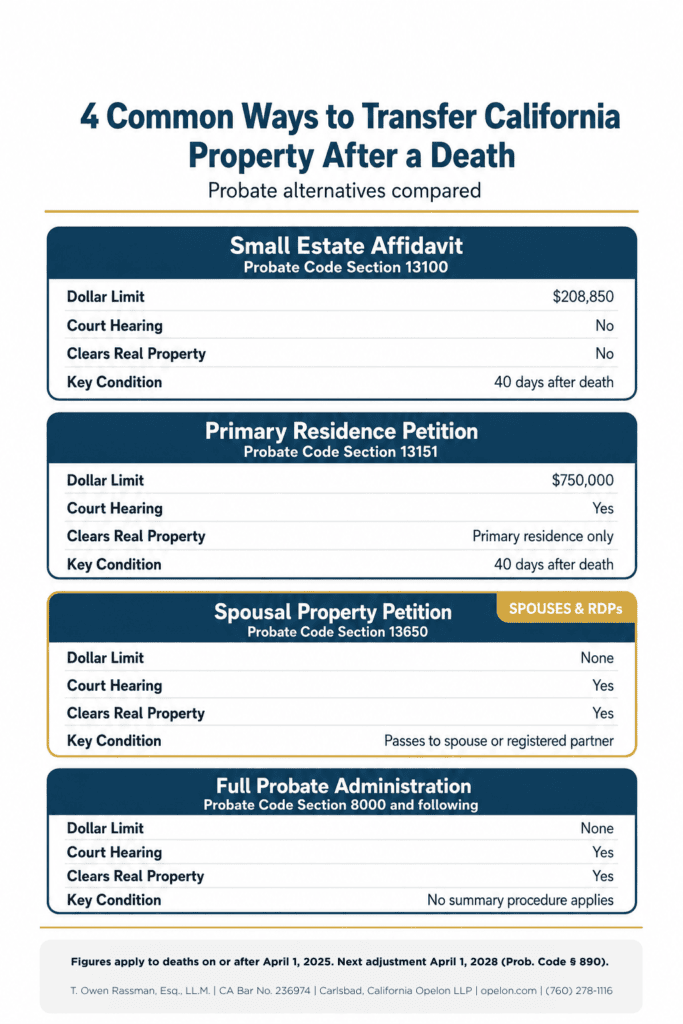
California offers several alternatives to full probate. The small estate affidavit under Probate Code Section 13100 caps at $208,850. The primary residence petition under Probate Code Section 13151 caps at $750,000 and can be filed on the 41st day after death. The Section 13650 spousal petition has no cap, but it only reaches property passing to a surviving spouse. |
California probate alternatives compared
Procedure | Court hearing | Dollar limit | Clears real property title |
Small estate affidavit (Section 13100) | No | $208,850 | No |
Primary residence petition (Section 13151) | Yes | $750,000 | Yes, primary residence only. 40 day wait. |
Spousal Property Petition (Section 13650) | Yes | None | Yes |
Full probate administration | Yes | None | Yes |
Spousal Property Petition vs. Small Estate Affidavit
The small estate affidavit under Probate Code Section 13100 needs no court case at all. A successor signs a declaration once 40 days have passed since the death.
It is faster and cheaper. It is also capped at $208,850 for deaths on or after April 1, 2025, and it cannot clear real property title. Our guide to the small estate affidavit in California covers the requirements in detail.
Spousal Property Petition vs. Full Probate
Full probate becomes necessary when property passes to someone other than the surviving spouse. It is also the right path when the Section 13650 petition would leave assets unresolved.
Blended families see this often. Assets going to the surviving spouse move through a Section 13650 petition, while assets going to children from a prior marriage move through probate administration.
Spousal Property Petition vs. Trust Administration
Property properly titled in a revocable living trust passes under the trust document. No court petition is needed for those assets.
The petition earns its keep when a couple created a trust and never moved an asset into it. Learning how to fund a trust properly during life is the cleanest way to avoid needing this petition at all.
A Debt Rule Every California Surviving Spouse Should Know
Under Probate Code Section 13550, a surviving spouse in California becomes personally liable for the deceased spouse’s debts chargeable against property that passes without administration. Probate Code Section 13551 caps that liability at date-of-death fair market value, less liens and encumbrances, and counts only property that is not exempt from enforcement of a money judgment. Read the cap carefully. It reaches not only what passed from the decedent but also the surviving spouse’s own half of the community and quasi-community property. This is one real trade-off of skipping formal probate. |
Full probate has a feature the petition route does not. It opens a short creditor claim window and cuts off late claims.
Property passing outside administration carries no such cutoff. Probate Code Section 13554 applies the one-year limitations period in Code of Civil Procedure Section 366.2 instead.
For most families, this is a non-issue. Where a deceased spouse left meaningful unsecured debt, it deserves a conversation before anyone files anything. Probate Code Section 13553 eliminates the liability if all of the property described in Section 13551 is administered in the estate. Probate Code Section 13552 does not eliminate it, but bars an action on the liability to the same extent as a creditor claim once administration is commenced and the claim period has run. That is one reason a full administration is sometimes the safer choice.
Six Mistakes Surviving Spouses Make With Property Transfers
- Assuming title transfers on its own. The law does pass community property to the surviving spouse. Banks, title companies, and the county recorder still want documentation.
- Waiting too long to file. There is no filing deadline in Section 13650 itself. Delay still creates real problems with insurance, refinancing, and any eventual sale.
- Missing a notice party. Probate Code Section 13655, with the 15-day period supplied by Section 1220, requires notice to heirs, devisees, a named executor, persons interested in a trust that is a devisee where the petitioner is the trustee, and in some cases the Attorney General.
- Confusing Section 13650 with Section 13100. The affidavit route has a $208,850 cap and no hearing. The petition has no cap and does require a hearing.
- Leaving assets out of the petition. Build a complete inventory before filing. Adding a forgotten asset afterward usually means going back to court.
- Filing in the wrong county. The petition goes where the deceased spouse’s estate could be administered, not necessarily where the property sits.