

How to Build a California Estate Plan in 4 Phases
A California estate plan comes together in four phases. First, take inventory of your assets, debts, family, and circumstances. Second, make key decisions about who manages money, makes medical decisions, and inherits. Third, execute the documents (trust, pour-over will, durable power of attorney, advance health care directive). Fourth, fund the trust, update beneficiary designations, and review every 3 to 5 years.
The Four Core Documents Every California Adult Needs
- Revocable Living Trust. The foundation of most California estate plans. Holds your assets and avoids probate.
- Pour-Over Will. Catches anything outside the trust at death and nominates guardians for minor children.
- Durable Power of Attorney for Finances. Lets your agent manage non-trust assets if you become incapacitated.
- Advance Health Care Directive (with HIPAA Authorization). Names a medical decision-maker and states your treatment preferences.
Why a California-Specific Estate Plan Matters
California rules drive every major estate planning decision. The state has its own probate process, its own community property regime, and its own property tax rules under Proposition 19. A generic online plan will miss these issues.
Consider the math in San Diego County. The median home sale price was approximately $918,000 in early 2026 according to Redfin. California’s small estate thresholds use gross fair market value, not equity. The primary residence petition threshold under Probate Code Section 13150 is $750,000. The personal property affidavit threshold under Section 13100 is $208,850. Most San Diego County family homes exceed those limits on gross value alone. Without a properly funded trust, the home goes through full California probate.
If you have minor children
Your estate plan must nominate a guardian and create a structure to manage money for your child until adulthood. A California court will weigh your nomination heavily, but the court is not bound by it. Backup nominations and a written explanation matter.
If you own real estate in California
Probate avoidance becomes the central goal. Statutory probate fees on a $1 million estate run roughly $46,000 in combined attorney and executor fees under Probate Code Sections 10800 and 10810. Proposition 19 also limits the parent-child property tax exclusion. The Prop 19 inherited property rules in California deserve careful planning.
If you have retirement accounts or life insurance
These assets pass by beneficiary designation. They override your will. Coordination between your trust and your beneficiary designations prevents accidental disinheritance. Digital access also matters under California’s RUFADAA rules. For high-net-worth families, holding a policy inside an ILIT can keep those proceeds outside the taxable estate entirely.
In our experience working with San Diego County families across more than 700 estate plans, the most expensive misconception is, “I have a will, I’m covered.” A will alone does not avoid probate. The will simply directs how the probate court should distribute your assets.
Phase 1: Take Inventory (Steps 1 to 3)
This phase costs you nothing and saves hours later. Build the picture of what you own and who depends on you. Then you can plan around real numbers.
Step 1. Inventory Your Assets and Your Debts
Build one master list. Include real property, bank accounts, investment accounts, retirement plans, life insurance, business interests, valuable personal property, and digital assets. Add money owed to you and outstanding debts.
Use a single spreadsheet. Add columns for asset type, account number or address, current value, how the asset is titled, and any beneficiary on record. Families who arrive with this spreadsheet save substantial meeting time. They almost always catch one or two assets they had forgotten.
Step 2. Confirm How Each Asset Is Titled
Note whether each item is held in your name alone, jointly, as community property, or in a trust. Pull deeds and recent statements so you verify rather than guess.
California adds a wrinkle. Community property versus separate property classification affects both inheritance and the step-up basis at death. Property owned before marriage may be your separate property. So may an inheritance received during marriage. Note any uncertainty so we can sort it out at the planning meeting. Your revocable living trust should reflect the correct classification.
Step 3. Identify Family, Dependents, and Special Circumstances
List your spouse or partner, children, grandchildren, pets, and anyone else who depends on you. Flag any beneficiary with special needs, a blended family situation, a non-U.S. citizen spouse, or a business that needs continuity planning.
Each flag triggers a specific planning approach. A special needs beneficiary calls for a special needs trust to preserve government benefits. A blended family calls for spousal trust funding formulas to balance the current spouse and prior-marriage children. A non-citizen spouse calls for QDOT planning. A business calls for buy-sell coordination with the trust.
Phase 2: Make Your Key Decisions (Steps 4 to 10)
This phase carries the most weight. The decisions you make here drive every document we draft. Talk with the people you intend to name before you name them.
Step 4. Choose Your Successor Trustee
Pick the person or institution who will manage your trust if you cannot serve. Name backups in order of preference.
The successor trustee role is operational, not honorific. Pick the family member who balances a checkbook, communicates clearly, and can stay impartial across all beneficiaries. Do not default to the eldest child.
Many families name co-trustees (two children acting jointly). In our practice, a single trustee with a strong backup performs better than co-trustee structures in most cases. For more on what trustees actually do, see our overview of what a trustee is.
Step 5. Choose Your Financial Agent
The financial agent under your California durable power of attorney acts when the trust does not. Bills paid from individual accounts, signing tax returns, and Social Security matters often happen outside the trust. Your agent needs the authority to handle them.
Step 6. Choose Your Health Care Agent
Your health care power of attorney names the person who makes medical decisions if you cannot speak. The agent should be local when possible. California hospitals call the agent in real time. Cross-country distance creates delays at the wrong moment.
Step 7. Nominate a Guardian for Minor Children
If you have children under 18, decide who would raise them. Name a backup. Talk with the people you choose before naming them.
California courts give significant weight to a parent’s nomination. The court is not bound by it. Two factors strengthen the nomination. First, a written explanation of why this person was chosen, filed with the will or trust. Second, a real relationship between the nominee and the children before any guardianship is needed. See our guide to naming a guardian for your children.
Step 8. Decide Your Distribution Plan
Decide who inherits, in what shares, and on what timeline. Outright distribution at death is one option. Many families prefer a structured release.
Strongest plans address staged distributions. A common structure releases one third at age 25, one third at age 30, and one third at age 35. Carve-outs allow earlier access for education, a first home purchase, or genuine emergencies.
Step 9. Plan for Vulnerable Beneficiaries
Plan for any beneficiary who needs more than money. A child with a disability needs a special needs trust. A beneficiary with addiction issues needs a discretionary trust with a thoughtful trustee. A pet needs a pet trust under Probate Code Section 15212.
Step 10. Plan for Business Succession
If you own a business, decide who runs it, who inherits it, and how the transfer happens. Coordinate the buy-sell agreement with your trust. Without coordination, the trust can hold an asset the business partners are contractually obligated to buy back. Mismatch creates legal exposure that can take years to resolve.
Phase 3: Put the Documents in Place (Steps 11 to 16)
This phase converts decisions into signed, witnessed, notarized California documents. Each one has statutory requirements. Skipping a formality can void the document.
Step 11. Create a Revocable Living Trust
The revocable living trust is the central document for most California estate plans. You serve as trustee during your life. Your successor trustee takes over at incapacity or death. The trust avoids probate for any asset titled in its name.
Step 12. Sign a Pour-Over Will
The pour-over will catches anything not transferred to your trust during your lifetime. It also nominates guardians for minor children.
California requires a will to be in writing, signed by you, and witnessed by two adults present at the same time under Probate Code Section 6110. The pour-over will does not avoid probate for assets that flow through it. The trust does that job. The will is a backstop. For more, see our California last will and testament guide.
Step 13. Sign a Durable Power of Attorney for Finances
This document lets your financial agent step in if you become incapacitated. California requires the DPOA to be either notarized or signed by two qualified witnesses (Probate Code Section 4121). Notarization is the practical default because any real property document the agent later records, such as a deed, requires the underlying authority to have been notarized.
California recognizes both immediately effective and springing durable powers of attorney. The right structure depends on the client. We typically recommend a springing DPOA with a two-physician determination for clients who prioritize privacy and have low near-term incapacity risk, and an immediately effective DPOA for clients facing imminent capacity concerns, simpler family structures, or who value the agent’s ability to act without a medical-determination step. We discuss both options at the planning meeting before drafting.
Step 14. Sign an Advance Health Care Directive and HIPAA Authorization
This document names your health care agent and states your treatment preferences. California requires the AHCD to be dated, signed by you, and either notarized or signed by two qualified witnesses under Probate Code Section 4673. The statutory short-form AHCD appears at Probate Code Section 4701. A separate HIPAA authorization lets your agent and trusted family members access your medical records before any incapacity decision is required.
Step 15. Create a Personal Property Memorandum
California allows a separate writing to dispose of tangible personal property. The authority sits at Probate Code Section 6132 for writings referenced in a will, with statutory limits of $25,000 total and $5,000 per item. Many California revocable living trusts include similar incorporation-by-reference language so the same memorandum can direct trust property as well. To be effective, the writing must be referenced by your will or trust, dated, and either handwritten or signed.
This is the lowest-friction way to direct sentimental items. Most families update the personal property memorandum more often than any other estate document, because it can be revised without amending the underlying will or trust.
Step 16. Document Your Funeral and Final Arrangement Wishes
Write down your wishes for cremation or burial, services, and disposition of remains. Keep this memo separate from the will. The will is often locked away and not located immediately upon death. Your family needs your wishes within hours, not weeks.
Phase 4: Make It Work and Keep It Current (Steps 17 to 21)
This is the phase where most plans fail. Drafting documents is half the work. Funding, updating, and storing them is the other half.
Step 17. Fund Your Trust
Sign and record a deed transferring real property to the trust. Retitle bank, brokerage, and business interests in the name of the trust. Update vehicle and other titles where appropriate. An unfunded trust does not avoid probate.
Across the trusts our firm administers, roughly one in four has at least one asset that was never retitled before the settlor died. The most common cause is a refinance that removed the property from the trust and was never put back. When that happens, the family can file a Heggstad petition under Probate Code Section 850 to confirm the asset as trust property based on the settlor’s clear intent. For step-by-step funding, see how to fund a trust.
Step 18. Update Your Beneficiary Designations
Beneficiary designations on retirement accounts, life insurance, and annuities pass outside your trust. They override your will. Confirm primary and contingent beneficiaries are current and consistent with your overall plan.
The most common failure is the ex-spouse listed on a 401(k) after a divorce. The plan administrator pays the named beneficiary. A divorce decree does not change that. Review every account annually and after every major life event.
Step 19. Plan for Digital Asset Access
California’s Revised Uniform Fiduciary Access to Digital Assets Act gives your fiduciary the legal pathway to digital assets. The relevant authority sits at Probate Code Section 870 et seq. SB 1458, effective January 1, 2025, expanded that authority to cover agents under powers of attorney and conservators during incapacity, not only personal representatives and trustees post-death. Statutes alone do not solve the practical problem. Two-factor authentication, biometric locks, and platform terms of service can still block access.
A password manager (1Password, Bitwarden, or similar) with emergency-access enabled for your successor trustee solves most of the digital asset access problem in advance. For a deeper look, see our overview of digital assets in California estate planning.
Step 20. Store Originals and Inform Your Fiduciaries
Original signed documents matter. Some California courts require the original will. A scanned copy may not be enough. Store originals in a fireproof safe at home or in your attorney’s vault. Bank safe deposit boxes are usable but add a step at death; California allows limited post-death access under Probate Code Section 331 to retrieve a will and certain other documents, but the broader contents may not be immediately available to your family.
Beyond the safe location, give your trustee, executor, and agents a one-page summary. Include the trustee’s name, the attorney who drafted the plan, the location of the originals, and a phone number for the firm.
Step 21. Review Your Plan Regularly
Plan a review every 3 to 5 years. Several life events should trigger an immediate review. Marriage or divorce. Birth or adoption. Death of a named fiduciary or beneficiary. A significant change in assets (sale of a home or business, large inheritance). A move to or from California. Or a material change in tax law.
The One Big Beautiful Bill Act of 2025 made the federal estate tax exemption permanent at $15 million per individual and $30 million per couple. The exemption indexes for inflation starting in 2027. This change supersedes the prior TCJA sunset framework.
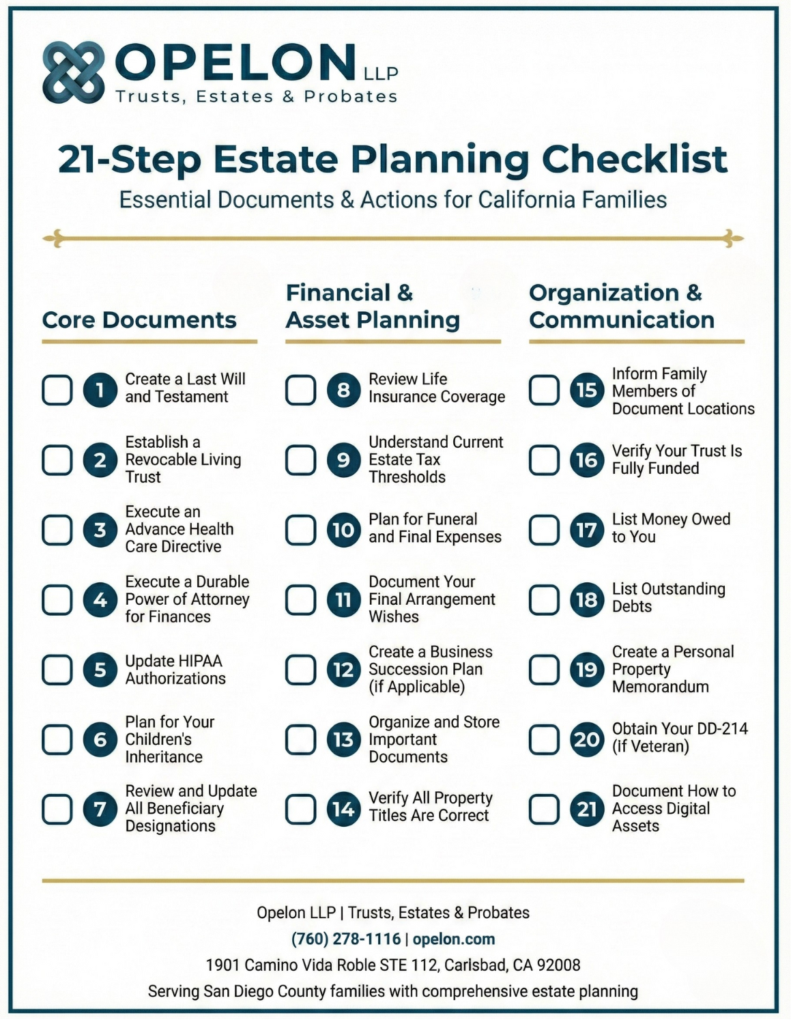
Common Mistakes That Make a Checklist Useless
A checklist is only as good as its execution. After drafting and administering hundreds of California estate plans, we see the same five mistakes again and again.
Mistake 1. Treating the Will as the Plan
A will alone does not avoid probate. The will only directs the probate court on how to distribute assets. When the gross probate estate exceeds the small-estate thresholds, full probate follows. In California, that means months of court supervision and statutory fees on the full value of the estate.
Mistake 2. Funding the Trust Once and Never Again
Most homeowners refinance at some point. The lender often pulls the property out of the trust at closing. The borrower forgets to retitle it back. We see this in roughly one out of four trust administrations. The fix is straightforward during life. After death, it requires a Heggstad petition.
Mistake 3. Letting Beneficiary Designations Contradict the Trust
A 401(k) with an ex-spouse listed pays the ex-spouse. The trust language does not override the plan administrator. Review designations every year and after every major life event.
Mistake 4. Skipping the Durable Power of Attorney
Without a durable power of attorney, a stroke or dementia diagnosis can require a court-supervised conservatorship just to pay bills. Conservatorship typically costs more than the entire estate plan and is a public proceeding.
Mistake 5. Updating Documents but Not the People
If your family does not know the documents exist, the plan fails on day one. Tell your trustee, your agent, and your guardian where the originals are stored. Give them the firm’s contact information.
When to Hire a California Estate Planning Attorney
Not every situation requires an attorney. Most California families benefit from professional help. The table below sorts cases by complexity.
| Profile | When This Applies | Recommended Approach |
| DIY-Acceptable | Total assets under $200,000. No minor children. No California real estate. Single beneficiary or equal split among adults. | Consider a low-cost online tool. Have a California attorney review the final documents. |
| Hybrid (Online + Attorney Review) | Basic plan with one moderate complexity factor. One piece of California real estate. One minor child. | Use an online tool to organize information. Hire an attorney for the trust and signing ceremony. |
| Attorney-Required | California real estate of any size. Blended family. Business interests. Special needs beneficiary. Non-citizen spouse. High net worth. Family conflict potential. Prior failed DIY attempt. | Work with a California estate planning attorney from start to finish. |
Opelon LLP Flat-Fee Estate Planning
We work on flat fees, not hourly billing. You know the cost before we begin. Most California families fall into the attorney-required bracket because of one factor: California real estate. We serve families throughout San Diego County from our Carlsbad office.
Schedule a planning consultation: (760) 278-1116. Or learn more about our San Diego estate planning attorney services.