


A HIPAA authorization is one of the most overlooked documents in a California estate plan. Without one, your spouse, adult children, or trusted family members may not be able to access your medical records or speak with your doctors when you need help the most.
For San Diego County families, understanding how HIPAA fits into a comprehensive estate plan can prevent frustrating delays during a medical emergency.
HIPAA stands for the Health Insurance Portability and Accountability Act. Congress passed HIPAA in 1996 to protect the privacy of personal health information. HIPAA safeguards are valuable. They can also block the people you trust most from getting the medical information they need to help you.
Key Takeaways
|
What Is a HIPAA Authorization?
A HIPAA authorization is a legal document where you give a medical provider written permission to share your protected health information (PHI) with a specific third party.
Under federal HIPAA regulations, physicians, dentists, medical professionals, and their business associates cannot disclose your health information without your consent.
The purpose of HIPAA is to give individuals control over their protected health information. That control is important. It can also create real problems for families during a health crisis. If you are hospitalized or unable to communicate, your family members cannot:
- Access your medical records
- Discuss your condition with your care team
- Coordinate treatment
A valid HIPAA authorization removes these barriers.
A well-drafted California estate plan should protect you in three stages:
- While you are healthy and making your own decisions
- If you become incapacitated and cannot make decisions
- After your death
A HIPAA authorization covers all three scenarios.
Why Your California Estate Plan Needs a HIPAA Authorization
Consider a common scenario. An 18-year-old starts college out of state. She needs a prescription refilled through her longtime family doctor in Carlsbad. Without a valid HIPAA authorization, that doctor cannot legally discuss her medical information with her father, even to fill a routine prescription.
This situation plays out regularly across San Diego County families:
- Aging parents who want their adult children to coordinate with specialists
- Spouses who need to manage insurance claims
- Caregivers who need access to medical histories
In each case, a HIPAA authorization removes the legal barrier to sharing information.
A HIPAA authorization is one of several essential documents in a California revocable living trust package. Other critical documents include a California durable power of attorney for financial decisions and a health care power of attorney for medical decision-making authority.
Nine Required Elements of a Valid HIPAA Authorization
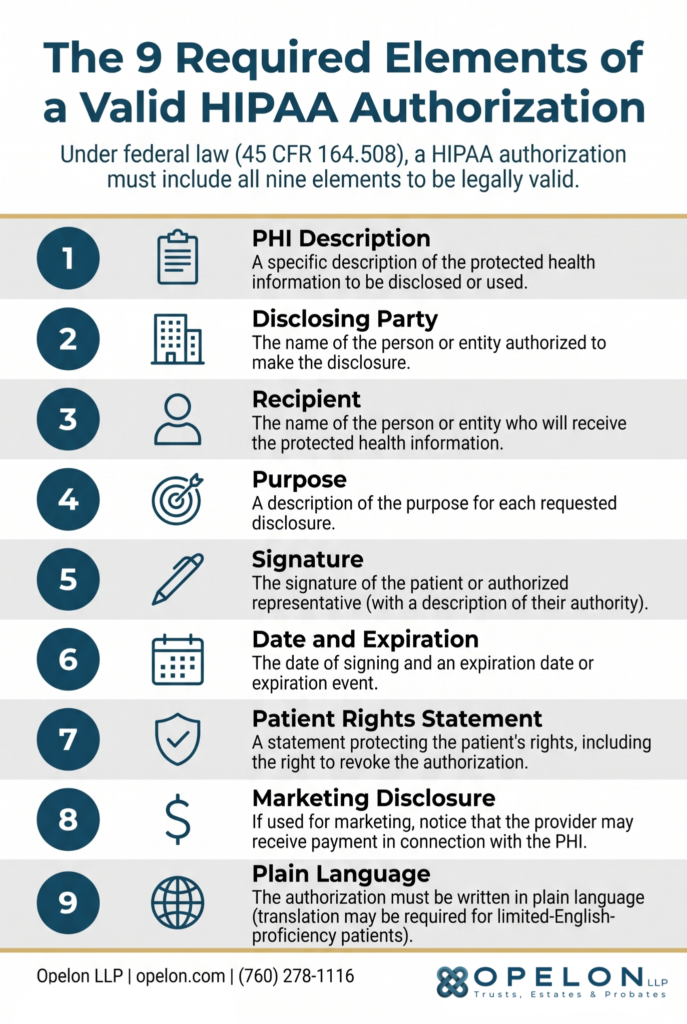
Under federal regulations (45 CFR 164.508), a valid HIPAA authorization must contain all nine of the following elements. A missing element can make the authorization invalid. That could prevent your family from accessing the information they need.
- A specific description of the protected health information (PHI) to be disclosed or used
- The name of the person or entity authorized to make the disclosure
- The name of the person or entity who will receive the PHI
- A description of the purpose for each requested disclosure
- The signature of the patient (or the patient’s authorized representative, with a description of their authority)
- The date of signing and an expiration date or expiration event
- A statement protecting the patient’s rights, including the right to revoke the authorization
- If used for marketing, notice that the provider may receive payment in connection with the disclosure
- Plain-language presentation (providers may need to translate for patients with limited English proficiency)
These requirements are precise. Have your HIPAA authorization drafted or reviewed by a licensed California estate planning attorney. The cost of doing it correctly is far less than the time, money, and stress of dealing with an invalid document during a medical emergency.
HIPAA Authorization vs. Health Care Power of Attorney
Many California families confuse a HIPAA authorization with an advance health care directive (also called a health care power of attorney). These are two separate documents that serve different purposes.
|
Feature |
HIPAA Authorization |
Health Care Power of Attorney |
|
Primary Function |
Grants access to medical information |
Grants authority to make medical decisions |
|
Decision-Making Power |
No. Information access only. |
Yes. Agent can consent to or refuse treatment. |
|
When It Takes Effect |
Immediately upon signing, unless specified otherwise |
Typically when the principal becomes incapacitated |
|
Governed By |
Federal HIPAA regulations (45 CFR 164.508) |
California Probate Code Sections 4600-4701 |
|
Revocable? |
Yes, at any time by the patient |
Yes, at any time while the patient has capacity |
|
Included in Estate Plan? |
Yes, as a standalone document |
Yes, usually part of an advance health care directive |
An important practical note: if a health care power of attorney is in effect, the designated health care agent generally does not need a separate HIPAA authorization. However, a standalone HIPAA authorization is still valuable. It can authorize information sharing before the power of attorney takes effect. It can also name additional recipients beyond the health care agent.
How a HIPAA Authorization Works With Other Estate Planning Documents
Your HIPAA authorization does not exist in a vacuum. It is one piece of a coordinated estate plan. Here is how it connects to other key documents.
Advance Health Care Directive
This document names a health care agent who can make medical decisions if you cannot. California’s statutory form (Probate Code Section 4701) includes a section authorizing the agent to direct disposition of remains.
The agent generally has access to your medical information through the directive itself. A separate HIPAA authorization provides broader coverage.
California Durable Power of Attorney
Your durable power of attorney for financial matters handles property and financial decisions. It does not grant medical information access. A HIPAA authorization fills that gap for financial agents who may need medical records to process insurance claims or disability benefits.
Revocable Living Trust
Your California revocable living trust manages your assets and helps your family avoid probate. A HIPAA authorization complements the trust by ensuring your successor trustee can access medical information needed to manage trust assets if you become incapacitated.
For a complete overview of the documents you need, review our estate planning checklist.