


What Is a California Special Needs Trust?
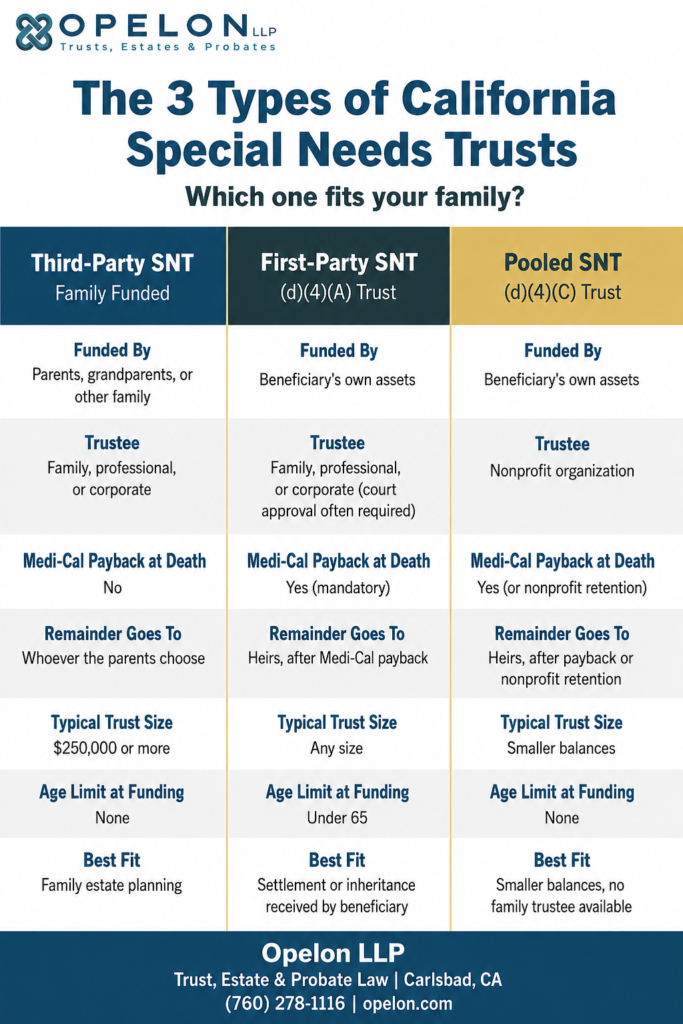
A California special needs trust is a trust designed to hold assets for a person with disabilities. It avoids disqualifying them from means-tested benefits like SSI and Medi-Cal. Three types exist: third-party SNTs funded by parents or relatives, first-party SNTs funded with the beneficiary’s own assets, and pooled SNTs run by a nonprofit.
Here is the core mechanic. SSI imposes a strict $2,000 resource limit for an individual ($3,000 for a couple where both spouses qualify). Anyone with more countable resources is generally ineligible for SSI. Assets held in a properly drafted SNT are not counted toward that limit, because the beneficiary cannot reach the principal directly.
The trustee, not the beneficiary, controls distributions. The trustee has sole discretion. Distributions are made for the benefit of the beneficiary rather than as cash handed to them. That structural feature is what preserves benefit eligibility.
You can read more about the Social Security Administration’s SSI resource rules on the SSA website. For broader context on how SNTs fit into a larger estate plan, see our California trusts complete guide.
The Three Types of California Special Needs Trusts
The right SNT for your family depends on whose money funds it, the beneficiary’s age, and whether a Medi-Cal payback at death is acceptable. Each type has trade-offs.
Third-Party Special Needs Trust (Family Funded)
A third-party SNT is funded with the assets of someone other than the beneficiary. Typically a parent or grandparent. This is the most common SNT we draft as part of family estate planning at Opelon.
The statutory basis is general California trust law under Probate Code 15200 and following, not the federal Medicaid statute. That distinction matters because a third-party SNT carries no federal mandate for Medi-Cal payback at the beneficiary’s death.
Funding usually happens at the death of the parent. Assets pour over from the parent’s revocable living trust, or pass directly through beneficiary designations on life insurance and retirement accounts. Because a disabled beneficiary is an eligible designated beneficiary, a special needs trust named as an IRA beneficiary can still stretch distributions over the beneficiary’s lifetime.
In working with San Diego County families, the third-party California special needs trust is the most common form we draft. It is usually built into the parents’ revocable living trust as a sub-trust. The sub-trust activates only if the disabled child outlives the parents. The parents’ assets pour into it at the surviving parent’s death.
Parents control where the remainder goes after the disabled beneficiary’s death. Siblings. Charities. Whoever the parents choose. That control is a major advantage over first-party SNTs.
When a third-party SNT is the right tool: Parents have meaningful assets that would otherwise pass to the disabled child. The child receives or is likely to receive SSI or Medi-Cal. The parents want to ensure remainder beneficiaries (siblings, charities, a family foundation) receive what is left at the disabled child’s death. |
First-Party Special Needs Trust (Self-Settled, (d)(4)(A) Trust)
A first-party SNT is funded with the beneficiary’s own assets. The most common funding source is a personal injury settlement. Other sources include an inheritance received outright before SNT planning was in place, or accumulated savings that pushed the beneficiary above the SSI resource limit.
The statutory basis is 42 USC 1396p(d)(4)(A), the federal Medicaid statute that explicitly allows this trust type if specific requirements are met.
Three requirements must all be satisfied. The beneficiary must be under age 65 at funding. The trust must be established by the beneficiary themselves (allowed under the Special Needs Trust Fairness Act of 2016, enacted as part of the 21st Century Cures Act), or by a parent, grandparent, legal guardian, or court. And the trust must contain a mandatory Medi-Cal payback provision at the beneficiary’s death.
In California, court-established (d)(4)(A) trusts often run through Probate Code 3600 through 3613. That happens when the funding source is a litigation recovery on behalf of a minor or incapacitated adult.
The Medi-Cal payback surprises families. After the beneficiary dies, the state is reimbursed first from remaining trust assets. The state can recover up to the total amount of Medi-Cal benefits paid during the beneficiary’s lifetime. Only what is left after the payback passes to heirs. For long-lived beneficiaries, the payback amount can exceed remaining trust assets entirely. |
In the personal injury context, we typically coordinate with the plaintiff’s trial counsel before settlement. That way the SNT is in place, and the settlement check can be deposited directly into the trust. Funding the SNT after the beneficiary has personally received the settlement creates compliance risk under SSI and Medi-Cal rules.
Pooled Special Needs Trust ((d)(4)(C) Trust)
A pooled SNT is administered by a nonprofit organization. The nonprofit pools the funds of many beneficiaries for investment management. Each beneficiary has a separate sub-account, but the funds are managed collectively.
The statutory basis is 42 USC 1396p(d)(4)(C). California has several pooled SNT providers, including PLAN of California (administered by Proxy Parent Foundation), Master Trust of California (administered by Inland Counties Regional Center), and Golden State Pooled Trust (administered by North Bay Housing Coalition). We do not endorse any specific provider. The right choice depends on the beneficiary’s circumstances and the nonprofit’s track record.
Pooled SNTs work well for several scenarios. Trust size is small (often under $500,000). Standalone SNT administration costs would erode the assets. Or no family member is available to serve as trustee. They also fit beneficiaries who want professional management without the cost of a corporate trustee.
Pooled SNTs include a payback provision similar to first-party trusts. Federal law (42 USC 1396p(d)(4)(C)(iv)) permits the nonprofit to retain remaining account assets in lieu of state Medicaid payback, but for California beneficiaries, the California Department of Health Care Services regulates pooled SNT retention narrowly and in practice operates as a near-total payback requirement for California Medi-Cal benefits paid on behalf of the beneficiary.
The Three SNT Types at a Glance
Feature | Third-Party SNT | First-Party (d)(4)(A) | Pooled (d)(4)(C) |
Funded by | Parents, grandparents, others | Beneficiary’s own assets | Beneficiary’s own assets |
Trustee | Family, professional, or corporate | Family, professional, or corporate (court approval often required) | Nonprofit organization |
Medi-Cal payback at death | No | Yes (mandatory) | Yes (or nonprofit retention) |
Remainder beneficiaries | Parents choose | After Medi-Cal payback | After payback or nonprofit retention |
Typical trust size | $250,000 or more | Any size | Smaller balances |
Age limit at funding | None | Under 65 | None |
Best fit | Family estate planning | Settlement or inheritance received by beneficiary | Smaller balances, no family trustee available |
How a California SNT Protects SSI and Medi-Cal Eligibility
The SNT protects two separate benefit programs with different rules. Understanding both is essential before you draft, fund, or distribute from one.
SSI Resource Limits and Trust-Held Assets
The SSI resource limit is $2,000 for an individual and $3,000 for a couple where both spouses qualify. SSI is the federal cash benefit for low-income individuals who are aged, blind, or disabled. The 2026 federal benefit rate is $994 per month for an eligible individual.
Trust-held assets are generally not counted toward the SSI resource limit. The protection applies if the beneficiary cannot reach the principal directly and the trustee has sole discretion over distributions.
Distribution rules matter just as much as funding rules. Distributions for shelter (rent, mortgage, property tax, utilities) trigger the In-Kind Support and Maintenance (ISM) rules. Shelter ISM can reduce SSI by approximately one-third of the federal benefit rate. Food was removed from ISM effective September 30, 2024, so trust payments for groceries no longer count against SSI. Cash given directly to the beneficiary is treated as unearned income and reduces SSI dollar-for-dollar.
Distributions for medical care, transportation, supplemental therapy not covered by Medi-Cal, education, recreation, and most other expenses do not trigger ISM. Those are the categories that make an SNT valuable to the beneficiary.
In our experience, the most common SNT distribution mistakes involve handing cash directly to the beneficiary or paying rent and mortgage directly from the trust. Those distributions are not prohibited, but they reduce SSI benefits. Some families make those payments intentionally, accepting the SSI reduction in exchange for better housing. The decision should be deliberate, not accidental.
Medi-Cal Eligibility and Trust-Held Assets
California’s Medi-Cal asset rules have changed twice in three years. Effective January 1, 2024, the state eliminated the asset limit for non-MAGI Medi-Cal under Welf. & Inst. Code 14005.62(a). Effective January 1, 2026, California reinstated the non-MAGI Medi-Cal asset limit under AB 116 and ACWDL 25-14. The reinstated limit is $130,000 for a single individual, with $65,000 added for each additional household member. The reinstated limit is higher than the pre-2024 figure of $2,000, but it is once again a real constraint on Medi-Cal eligibility for older adults and people with disabilities.
SSI-linked Medi-Cal recipients remain subject to the federal SSI resource limits of $2,000 for an individual and $3,000 for a couple. Those limits never changed. MAGI Medi-Cal has no asset test and never did. The 2024 elimination and the 2026 reinstatement apply only to non-MAGI Medi-Cal categories, which include Aged, Blind, and Disabled Medi-Cal and Medi-Cal for long-term care.
Income rules still matter. SNT distributions to or for the beneficiary can affect Medi-Cal share-of-cost calculations even where asset limits have been eliminated. The California Department of Health Care Services publishes current eligibility guidance.
2026 Medi-Cal asset limit reinstatement. California reinstated the non-MAGI Medi-Cal asset limit effective January 1, 2026 under AB 116 and ACWDL 25-14. The new limit is $130,000 for a single individual. Families who relied on the 2024 elimination should reassess their plans. SNT planning is more important under the reinstated rules, not less, because trust-held assets that satisfy SSI safe harbor requirements are also generally not counted toward Medi-Cal’s reinstated asset limit. An SNT also provides asset protection (trust assets are shielded from the beneficiary’s creditors and lawsuits) and remainder control (parents direct where assets go after the disabled beneficiary’s death). |
California-Specific SNT Considerations
California adds rules on top of the federal SNT framework. A California-licensed attorney is generally the right starting point. State-specific procedures, property tax rules, and community property treatment all affect how the trust is drafted and funded.
California Probate Code 3604 and Court-Established SNTs
Probate Code Sections 3600 through 3613 govern court-established trusts when the funding source is a compromise, covenant, or judgment on behalf of a minor or an adult with a disability as defined by Probate Code Section 3603. Probate Code Section 3604 sets out the findings the court must make to establish the SNT. The court reviews the proposed trust terms, the trustee selection, and the fee structure before approving the SNT and authorizing the funding.
Court-established (d)(4)(A) trusts under Probate Code 3604 require coordination between the personal injury attorney, the trust attorney, the proposed trustee, and the court. In our practice, we handle the trust drafting and the court approval steps for families who need a court-established SNT in connection with a settlement.
A separate issue often pairs with adult-beneficiary SNT planning: conservatorship. If the disabled beneficiary is an adult who cannot manage their own affairs, a conservator of the person or estate may also be needed. Opelon does not handle conservatorship as a discrete practice. For conservatorship setup, we generally recommend consulting an elder-law or disability-law specialist.
Community Property Considerations
For married couples planning an SNT for a child with disabilities, how the funding assets are characterized matters. California community property gets a full step-up in basis at the first spouse’s death under IRC 1014(b)(6). Assets used to fund the third-party SNT at the surviving parent’s death should be characterized correctly in the surviving spouse’s revocable living trust.
For SNTs funded from community property at the surviving spouse’s death, a second step-up applies on the surviving spouse’s death only. Coordinating the SNT with the couple’s overall trust plan captures both step-ups when possible.
Prop 19 and Inherited California Real Estate Held in an SNT
If the third-party SNT will hold California real estate after the parents die, Prop 19 reassessment rules apply. The parent-child exclusion is currently capped at the parent’s assessed value plus $1,044,586. That cap applies to transfers between February 16, 2025 and February 15, 2027. The cap adjusts for inflation every two years.
To qualify for the exclusion, the disabled child must use the property as their primary residence within one year of the parent’s death. The required filing is BOE-19-P, due within three years of the transfer. For SNTs holding real estate not used as the beneficiary’s primary residence, reassessment to current market value applies.
Updated 2025 California Probate Thresholds and SNT Funding
Effective April 1, 2025, California substantially raised the probate thresholds that determine when formal court-supervised probate is required. The change matters for SNT planning because many SNTs are designed to receive assets from a parent’s estate, and the new thresholds expand the set of estates that can transfer assets to an SNT without full probate.
The 2025 thresholds are as follows. Personal property collected by small estate affidavit under Probate Code 13100 increased to $208,850 (up from $184,500). The primary residence petition under Probate Code 13150 through 13158, as amended by AB 2016, increased to $750,000 (up from $184,500). Real property of small value under Probate Code 13200 increased to $69,625 (up from $61,500).
For SNT planning, the practical effect is that a parent’s primary residence worth up to $750,000 plus up to $208,850 in personal property can now reach the third-party SNT without formal probate administration. SNT funding mechanics should be drafted to coordinate with the small estate affidavit and primary residence petition procedures, not to assume full probate. For families relying on pour-over funding from a parent’s revocable living trust, the thresholds still matter for assets that were not retitled into the trust during the parent’s lifetime.
ABLE Accounts: When an SNT Is Not the Only Tool
Some families use both an SNT and an ABLE account. They serve different purposes.
ABLE accounts (Achieving a Better Life Experience) are tax-advantaged savings accounts under IRC 529A for individuals whose disability began before a qualifying age. Effective January 1, 2026, the age-of-onset threshold rose from age 26 to age 46 under the ABLE Age Adjustment Act, enacted as part of SECURE 2.0. That change opens ABLE eligibility to millions of additional people, including many veterans and adults with later-onset conditions.
The 2026 annual contribution limit is $20,000, set under IRC 529A and confirmed by Rev. Proc. 2025-32, Section 4.34. The OBBBA modified the base year used to calculate this limit effective January 1, 2026, so the ABLE annual contribution limit is no longer the same as the federal gift tax exclusion (which remains $19,000 for 2026).
Working ABLE beneficiaries can contribute additional amounts from their own earned income under the ABLE-to-Work provision. The 2026 cap is roughly $15,650 in the contiguous United States, based on the prior-year federal poverty level for a single-person household. ABLE-to-Work was made permanent in 2025.
ABLE assets up to $100,000 are not counted toward the SSI resource limit. Distributions for qualified disability expenses (housing, transportation, education, medical care, employment training, basic living expenses) are not taxed.
ABLE has real limits. The annual contribution cap is much lower than what an SNT can hold. California’s 2026 aggregate ABLE balance cap is $529,000, aligned with the state’s 529 plan limits. Medi-Cal payback applies to remaining ABLE assets at the beneficiary’s death (though states vary in how they enforce this).
ABLE versus SNT decision. ABLE works for amounts under $100,000 that the beneficiary will spend in their lifetime, especially funds the beneficiary wants direct control over. An SNT works for larger amounts, multi-generational planning, and situations where the family wants remainder control. Many families use both: a third-party SNT as the primary vehicle, and an ABLE account for short-term spending and beneficiary autonomy. |
Choosing the Trustee for a California SNT
The trustee has fiduciary duty to the beneficiary and broad discretion over distributions. The combination requires trust, time, and benefits-law literacy. In our experience, choice of trustee is one of the most common sources of SNT problems we see.
Family member trustees are the most common choice. The pros are real: the trustee knows the beneficiary, costs are low, and the relationship is direct. The cons are also real. Emotional difficulty making distribution decisions. Potential conflicts with other family members. A steep learning curve on SSI and Medi-Cal rules.
Professional trustees (CPAs, attorneys, fee-based fiduciaries) are experienced and neutral. They typically charge 1% to 2% of trust assets annually.
Corporate trustees (bank trust departments) are experienced, perpetual, and well-resourced. They generally require minimum balances of $500,000 or more, charge higher fees, and offer less personal attention.
A co-trustee structure often works best. Pair a family member with a professional. The family co-trustee handles the relationship work and knows what the beneficiary needs. The professional co-trustee handles compliance, investments, and benefits-law analysis.
In our experience, the co-trustee structure works particularly well in one common scenario. The disabled beneficiary is a child, the parents are still alive, and the family wants to begin transitioning trusteeship to a sibling. The professional handles the technical compliance. The family co-trustee handles the relationship. For more on selecting fiduciaries, see our guide on how to choose a trustee.
How Much Does a California SNT Cost?
Cost depends on whether the SNT is built into a larger estate plan or drafted as a standalone document.
A third-party SNT drafted as a sub-trust within a parent’s revocable living trust is typically charged at an additional $500 in most cases, on top of our standard estate planning flat fee. The SNT provisions add complexity but do not usually require a separate engagement. The exact fee will be quoted in writing at the engagement letter stage following a free consultation.
A standalone SNT (a separate document, often funded immediately) is typically a separate engagement on a flat-fee basis. The fee depends on complexity. Personal injury settlement SNTs often run $3,500 to $7,500 depending on court approval requirements and settlement complexity, and generally cost more than self-funded third-party SNTs that activate at death.
Ongoing trustee compensation is separate. Professional trustees typically charge 1% to 2% of trust assets annually. Corporate trustees may charge similar percentages plus investment management fees.
Common California SNT Mistakes to Avoid
Most SNT problems trace back to a small number of recurring mistakes. Each one is preventable with the right coordination upfront.
The Five Most Common SNT Drafting and Funding Mistakes
- Naming the disabled person directly as a beneficiary in a will or RLT. A direct inheritance puts the assets in the beneficiary’s name. That triggers SSI and Medi-Cal disqualification before the SNT can be activated. The fix: name the SNT (or the trustee of the SNT) as the beneficiary, not the disabled individual personally. For coordinated planning, see naming a beneficiary.
- Failing to update beneficiary designations. Life insurance, retirement accounts, and accounts with payable-on-death designations are not controlled by the trust. They pass to whoever is named directly. Update every beneficiary designation to name the SNT or the SNT trustee where appropriate.
- Distributing cash directly to the beneficiary. Cash distributions are treated as unearned income by SSI and reduce benefits dollar-for-dollar. The fix: pay third parties directly. The dentist. The wheelchair vendor. The therapy provider. The auto repair shop.
- Distributing for shelter without considering the SSI reduction. Shelter paid by the trust triggers ISM and reduces SSI by up to one-third. Some families intentionally trigger ISM to provide better housing, accepting the SSI reduction. That should be a conscious choice, not an accident. Food, by contrast, was removed from ISM effective September 30, 2024.
- Not coordinating with the personal injury attorney before settlement. If the disabled beneficiary’s name is on the settlement check before the SNT is established, funding the SNT becomes legally complex and may require court approval under Probate Code Sections 3600 through 3613.
When to Consult a California Special Needs Attorney
A consultation makes sense in several common scenarios.
- A personal injury settlement is pending or recent for a person on SSI or Medi-Cal.
- Parents of a child with disabilities are drafting or updating their estate plan.
- An inheritance is about to pass to a person on SSI or Medi-Cal. (Move quickly to disclaim and redirect into an SNT before the assets are received.)
- An existing SNT was drafted years ago and the family wants a refresh, given the OBBBA estate tax exemption changes, the ABLE Age Adjustment Act expansion, the 2024 Medi-Cal asset-limit elimination, and the 2026 Medi-Cal asset-limit reinstatement.
Opelon LLP handles third-party SNTs as part of family estate planning across San Diego County, from our office in Carlsbad. We do not handle Medi-Cal crisis planning, conservatorship, or active SSI or Medi-Cal application disputes. For those needs we refer to specialists.
California Advocates for Nursing Home Reform (canhr.org) maintains resources and referrals for Medi-Cal eligibility planning, and the Academy of Special Needs Planners (specialneedsanswers.com) is a national directory of attorneys focused on disability and benefits planning.
For families building a comprehensive plan that includes an SNT, a free estate planning consultation is the right starting point.
Related Guides
- Complete Guide to California Trusts (All Trust Types)
- California Revocable Living Trust: 7 Critical Steps