


The Core Difference Between a Joint Trust and a Separate Trust at a Glance
A joint trust is one revocable living trust signed by both spouses. It holds the couple’s community property and, often, each spouse’s separate property. Separate trusts are two trusts, one per spouse. For most first-marriage California couples with mostly community property, a joint trust is simpler and more tax-efficient. Separate trusts are often the better fit for blended families and asset-protection planning.
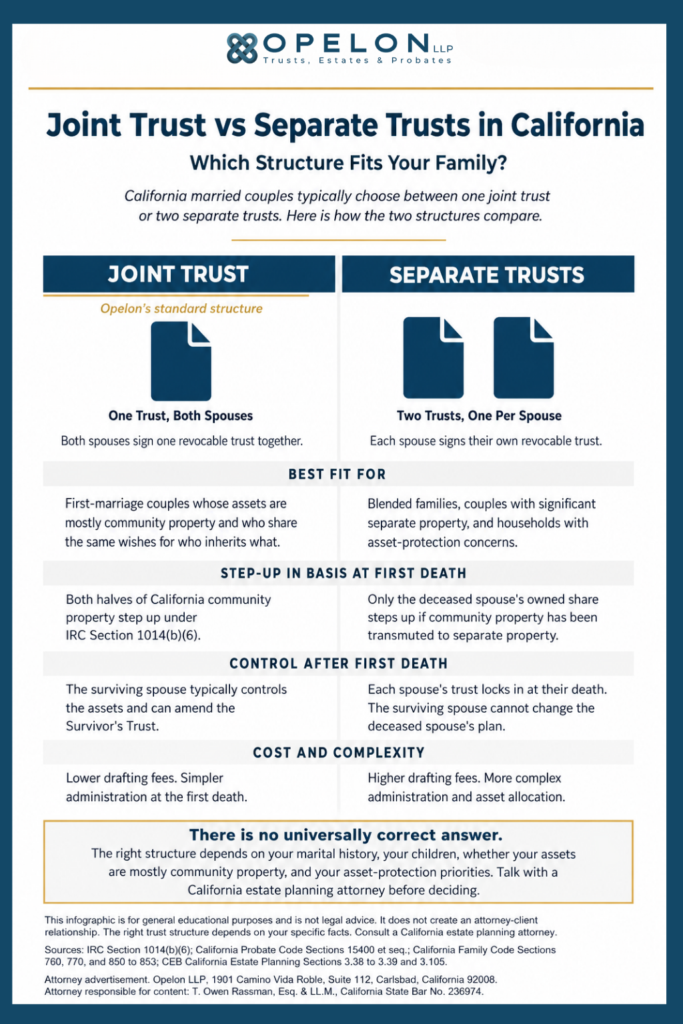
Joint Trust vs Separate Trusts: Quick Comparison
Feature | Joint Trust | Separate Trusts |
Number of documents | 1 trust | 2 trusts |
Drafting cost | Lower (one document) | Higher (two documents) |
Step-up at first death | Both halves of community property step up (IRC Section 1014(b)(6)) | Only the deceased spouse’s owned share steps up |
Remainder control after first death | Limited (surviving spouse can amend the Survivor’s Trust) | Strong (each spouse controls their trust’s remainder) |
Asset protection | Lower (assets held together) | Higher (each spouse’s assets isolated) |
Best fit | First-marriage couples, mostly community property, aligned remainder wishes | Blended families, high-liability professions, asset-protection focus |
Convert later? | Yes (revoke and redraft, or decant) | Yes (consolidate into a joint structure) |
First-death administration | Simpler | More complex, depending on funding |
Joint Trust: How It Works in California
A joint revocable living trust is one trust signed by both spouses as settlors and, usually, co-trustees. The trust holds the couple’s assets, including community property and any separate property the spouses choose to add. During the spouses’ joint lifetimes, either spouse acting alone can revoke the trust as to community property unless the trust instrument provides otherwise. This rule appears in California Probate Code Section 15401(b). Amending the trust generally requires both spouses to sign.
What happens at the first death depends on the trust’s structure. Two structures are common in California.
(a) Disclaimer trust.
The default is that all community property and the deceased spouse’s separate property pass to a Survivor’s Trust. The surviving spouse fully controls that trust and can amend it. Within nine months of the first death, the surviving spouse can elect to disclaim some or all of the deceased spouse’s share. The disclaimed share moves into an irrevocable Disclaimer Trust under IRC Section 2518. The Disclaimer Trust then locks in the disclaimed share for the deceased spouse’s chosen beneficiaries.
(b) A-B trust.
The split is automatic at the first death. The deceased spouse’s share funds a Bypass (or Decedent’s) Trust that is irrevocable. The surviving spouse cannot change that share’s remainder beneficiaries.
Our firm’s standard joint trust uses the disclaimer trust mechanism. That structure gives the surviving spouse maximum flexibility. It also preserves the option to lock in the deceased spouse’s plan if circumstances call for it. If your estate may approach the federal estate tax exemption, see our overview of the federal estate tax exemption amount.
The Community Property Double Step-Up Advantage
California is a community property state. Under Internal Revenue Code Section 1014(b)(6), community property held by a married couple receives a 100 percent step-up in basis at the first spouse’s death.
Both halves step up: the deceased spouse’s half and the surviving spouse’s half. The surviving spouse can sell soon after the first death with no federal capital gains tax on the pre-death unrealized appreciation. This is confirmed by Treasury Regulation TD 9785 and is discussed in CEB’s California Estate Planning treatise.
This is a leading tax advantage that joint trusts offer California couples whose assets are mostly community property. Couples in non-community-property states generally cannot get this benefit. A small number of states have community property trust statutes that allow an opt-in.
Experience Note The double step-up at first death is one of the more underappreciated tax benefits California gives married couples. Consider a couple with $2 million in appreciated California real estate. This rule can, on certain assumptions about basis, applicable capital gains rates, and sale timing, save the family significant federal capital gains tax compared to identical assets held as separate property. The exact savings depend on those facts. This is illustrative, not a guaranteed outcome. |
Joint Trust Drawback: Less Remainder Control
At the first death, the surviving spouse typically retains the power to amend the Survivor’s Trust portion. That portion holds the survivor’s half of community property plus their separate property.
For couples with the same children together, this is generally a non-issue. The survivor will likely keep the same plan.
For couples with different children (a blended family), the surviving spouse can later amend the Survivor’s Trust to disinherit the deceased spouse’s children. The deceased spouse’s irrevocable share, if any, stays protected. But if the joint trust does not include an A-B split or the survivor does not disclaim, no part of the estate is locked in.
This is the structural weakness for blended families. Separate trusts solve it directly. A joint trust with strong A-B provisions can solve part of it. So can a disclaimer trust where the surviving spouse actually disclaims. Either solution protects only the locked-in share. For background on a related title-holding tool, see our overview of joint tenants vs tenants in common in California.
Separate Trusts: How They Work in California
Quick Answer: Separate trusts (sometimes called “his and hers” trusts) are two revocable living trusts, one per spouse. Each trust holds that spouse’s share of community property, their separate property, and any assets titled in their name. Each spouse independently controls their own trust and directs how their share is distributed at death.
Each spouse acts as settlor and trustee of their own trust. Each spouse names their own successor trustee and beneficiaries.
Community Property in Separate Trusts
This is where separate trust drafting gets nuanced. California community property does not change character just because it sits in a separate trust.
A $1 million home purchased during marriage with community earnings is typically community property even if titled in one spouse’s separate trust. To actually change community property into separate property, the spouses must sign a transmutation. That transmutation must meet California Family Code Sections 850 through 853. The express written declaration requirement of Section 852 is the operative bite.
Without that written transmutation, the asset remains community property in character. Creditor rules, divorce rules, and estate tax rules will treat it accordingly regardless of how the trust is titled.
Experience Note Separate trust drafting in California is more complex than in non-community-property states. We sometimes see separate trusts drafted by out-of-state attorneys that ignore the community property characterization issue. The result can be surprise tax outcomes, surprise divorce-property outcomes, and unintended creditor exposure. If you are using separate trusts, work with a California attorney who handles the transmutation analysis. |
Step-Up Basis in Separate Trusts
Each spouse’s trust assets receive a step-up at that spouse’s death. The mechanics differ from a joint trust in one important way.
Community property that the spouses transmute into separate property loses the IRC Section 1014(b)(6) double step-up. Only the deceased spouse’s half steps up at the first death. The surviving spouse’s half stays at original basis until the surviving spouse later dies.
For couples whose assets are mostly community property, separate trusts can cost the family significant capital gains tax over the survivor’s lifetime. This is the primary tax argument in favor of joint trusts for those couples.
Illustrative Scenario For a California couple with appreciated community property, choosing separate trusts with transmutation over a joint trust may cost the family meaningful additional capital gains tax over the survivor’s lifetime. The actual figure depends on basis, sale timing, applicable capital gains rates, and whether the survivor actually sells. It is an illustrative scenario, not a guaranteed outcome. Weigh this against the non-tax benefits of separate trusts. |
Separate Trust Advantages: Remainder Control and Asset Protection
- Remainder control. Each spouse independently directs who gets their share at death. The surviving spouse cannot change those instructions. This is the foundational reason most blended families use separate trusts.
- Asset protection. Separate trusts can help preserve the distinction between each spouse’s separate property. They can also limit one spouse’s exposure to the other’s separate creditors. This matters most for physicians, contractors, and business owners with personal exposure. Revocable trusts do not provide asset protection against a settlor’s own creditors during the settlor’s lifetime. Spousal liability rules under California Family Code Sections 910 and 913 can still reach community property in many cases. The protection between spouses is not absolute.
- Cleaner unwind on divorce. Separate trusts unwind more easily if the marriage ends. Well-drafted joint trusts include divorce-revocation clauses, but separate trusts start clean.
When to Choose a Joint Trust over a Separate Trust
Quick Answer: A joint revocable trust is typically right for first-marriage California couples whose assets are mostly community property and who share aligned remainder wishes. The IRC Section 1014(b)(6) double step-up, lower drafting cost, and simpler first-death administration make it our default recommendation in those cases.
A Joint Trust Is Typically the Right Choice When:
- First marriage for both spouses with shared children, or no children but aligned wishes.
- Mostly community property assets acquired during the marriage. Real estate and brokerage accounts purchased during the marriage with community earnings are typically community property, although title and tracing issues can change the analysis. Retirement accounts (IRA, 401(k)) are generally not retitled into a joint trust during the participant’s lifetime; instead, the trust is typically named as beneficiary.
- Aligned remainder wishes. Same children, same charities, same plan for grandchildren.
- Cost minimization matters. Joint trust drafting is typically lower-fee than separate trust drafting.
- Simpler administration for the survivor. One trust to manage after the first death, with clear successor trustee instructions.
When to Choose Separate Trusts Over a Joint Trust
Quick Answer: Separate revocable trusts are typically right in several scenarios. They fit when one or both spouses have children from a prior relationship. They also fit when one spouse has significant separate property. The same is true when one spouse works in a high-liability profession. They make sense when remainder wishes meaningfully differ. The blended-family scenario is the dominant reason California couples we work with choose separate trusts. For more on this specific use case, see our guide to estate planning for blended families.
Separate Trusts Are Typically the Right Choice When:
- Blended family or second marriage with children from prior relationships. Separate trusts let each spouse protect their own children’s inheritance.
- Significant separate property held by one or both spouses. Pre-marriage assets, gifts received by only one spouse, and inherited assets all qualify as separate property under California Family Code Section 770.
- High-liability profession for one spouse. Physicians, contractors, real estate developers, and business owners with personal exposure often want the added separation.
- Asset protection focus as a planning priority, even outside high-liability professions.
- Meaningfully different remainder wishes that cannot be reconciled in a joint structure. Different charities, different beneficiary preferences, or different views on whether to leave assets to in-laws.
Can We Convert Joint to Separate (or Vice Versa)?
Yes. Conversions between joint and separate structures are common in California. The legal work involves revoking the existing trust and executing a new one (or restating it). The harder work is retitling the funded assets. We see mid-life conversions about as often as first-time drafting.
Joint to Separate Conversion
Revoke the joint trust. Execute two new separate trusts, one per spouse. Each spouse then re-funds their own trust with their share of assets. Any community asset moving to separate form needs a proper transmutation analysis under Family Code Sections 850 through 853.
The document changes are simple. Retitling deeds, account ownership, and beneficiary designations takes more time.
Separate to Joint Conversion
Revoke both separate trusts. Execute a new joint trust. Both spouses re-fund the new trust. Same retitling requirement.
Mid-life conversions usually happen because circumstances change: a second marriage, a significant inheritance, an asset-protection-driven business change, or a divorce. For what comes after one spouse’s death, see our guide to the California trust administration process.
California-Specific Considerations
California is one of nine community property states. Most national articles on “joint vs separate trusts” ignore this difference. Three California features change the analysis. The first is the IRC Section 1014(b)(6) double step-up. The second is the Family Code transmutation rules. The third is the absence of any California state estate tax.
Community Property State Status
California is a community property state under California Family Code Section 760. Most other states use common-law (equitable distribution) rules.
The IRC Section 1014(b)(6) double step-up applies only in community property states. National content on joint vs separate trusts often ignores this distinction. California couples should rely on California-specific guidance.
No California State Estate Tax
California has no state estate tax. California’s inheritance and gift taxes were repealed by Proposition 6 in 1982. California’s residual “pickup” estate tax effectively ended in 2005. That happened when the federal credit for state death taxes was phased out under EGTRRA (Pub. L. 107-16). Only the federal estate tax applies.
Under the One Big Beautiful Bill Act (OBBBA), signed July 4, 2025, the federal estate and gift tax exemption is $15 million per individual. Married couples have a combined $30 million exemption (with portability or appropriate trust planning). OBBBA made the exemption permanent and indexed it for inflation beginning in 2027.
For most California couples, federal estate tax is not the driving factor. Step-up basis, remainder control, and administration simplicity matter more.
Transmutation Rules Under Family Code Sections 850 to 853
Changing community property to separate property (or the reverse) requires a written transmutation. That transmutation must contain an express declaration signed by the spouse whose interest is adversely affected (Family Code Section 852). Trust drafting that purports to change character without a proper transmutation creates unenforceable provisions.
This is why separate trust drafting in California requires more care than in other states. The trust document alone cannot change the character of community property.