


1. How a California Revocable Living Trust Is Taxed During Your Lifetime
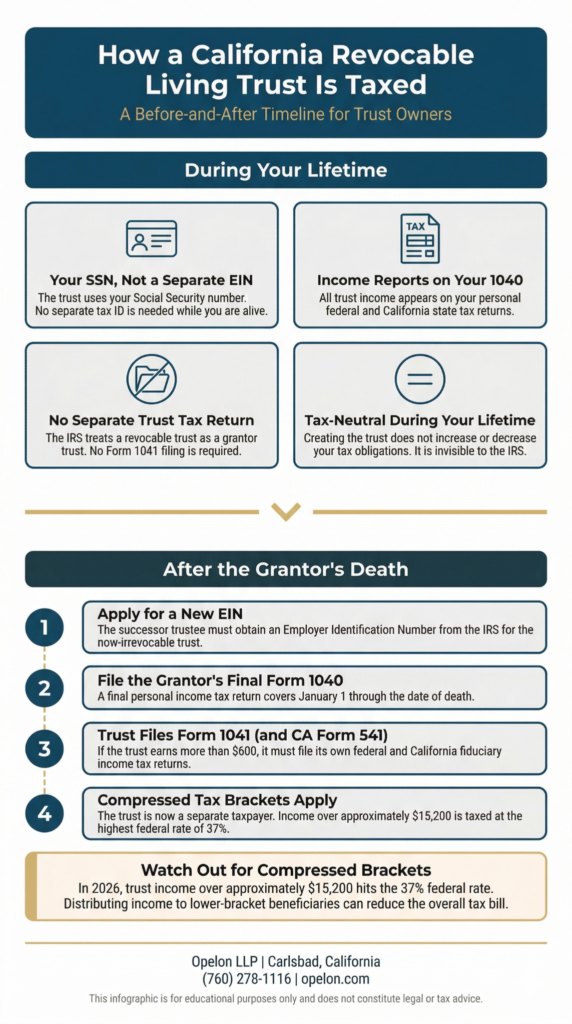
A California revocable living trust does not file its own income tax return while the grantor is alive. The grantor is the person who created the trust. The IRS classifies the trust as a grantor trust, which means the trust is invisible for income tax purposes.
All income earned by trust assets is reported on the grantor’s personal federal tax return (Form 1040). This includes interest, dividends, rental income, and capital gains. The trust uses the grantor’s Social Security number rather than a separate tax identification number.
California’s Franchise Tax Board follows the same approach. No separate state filing is required for the trust during the grantor’s lifetime.
What Does This Mean in Practice?
- You do not need a separate tax ID number (EIN) for your revocable trust while you are the trustee.
- You report all trust income on your individual California Form 540 and federal Form 1040.
- You claim all deductions and credits personally, just as you did before creating the trust.
- There is no extra tax filing burden during your lifetime.
California Note: Because California’s marginal income tax rate reaches 13.3% (including the 1% Mental Health Services Tax on income over $1 million), the grantor trust structure benefits trust creators. All trust income is taxed at individual rates, avoiding the highly compressed federal trust tax brackets that apply to irrevocable, non-grantor trusts. |
2. What Happens to Trust Taxes After the Grantor Dies?
When the grantor of a California revocable living trust dies, the trust’s tax treatment changes significantly. The trust typically becomes irrevocable. The successor trustee must take several steps to comply with both federal and California tax requirements.
Key Tax Steps After the Grantor’s Death
- Obtain an EIN. The successor trustee must apply for a new Employer Identification Number from the IRS. The trust can no longer use the deceased grantor’s Social Security number.
- File a final personal tax return. The decedent’s final Form 1040 covers income earned from January 1 through the date of death.
- File Form 1041. If the now-irrevocable trust has any taxable income, or gross income of $600 or more, the successor trustee must file a federal fiduciary income tax return for the trust (IRC §6012(a)(4)).
- File California Form 541. California requires a fiduciary income tax return for trusts with California-source income or California-resident trustees or beneficiaries.
Warning: After the grantor dies, the trust becomes a separate taxpaying entity subject to highly compressed federal income tax brackets. For 2026, trust taxable income exceeding $16,000 is taxed at the highest federal rate of 37% (Rev. Proc. 2025-32). Distributing income to beneficiaries, who often have lower individual tax rates, can reduce the overall tax burden. This is one reason working with a trust administration attorney matters during settlement. |
3. California Property Tax Rules for Revocable Trusts
One of the most common property tax concerns in California is whether transferring real estate into a revocable living trust triggers a reassessment. It generally does not.
Under California Revenue and Taxation Code §62(d), transferring property into a trust where the transferor is the present beneficiary does not cause a change in ownership. No reassessment is triggered, and your Proposition 13 property tax base stays the same.
How Proposition 19 Affects Trust Transfers to Children
Proposition 19, effective February 16, 2021, significantly changed the parent-child exclusion from property tax reassessment in California. Under Revenue and Taxation Code §63.2, when a parent transfers a primary residence to a child (including through a trust), the exclusion is now limited.
Prop 19 Factor | Current Rule |
Eligible property | Primary residence only (investment property excluded) |
Value limit | Assessed value plus $1,044,586 for transfers Feb. 16, 2025 through Feb. 15, 2027 (BOE LTA 2025/009) |
Child must | Make it their primary residence within 1 year of transfer |
Filing deadline (BOE-19-P) | File BOE-19-P within 3 years of transfer date, or before transfer to a third party (whichever is earlier) per BOE LTA 2022/012 and BOE Pub. 801 |
What was eliminated | Exclusion for rental and investment property; unlimited value exclusion for primary residence; most grandparent-grandchild transfers |
If the home’s current market value is at or below the assessed value plus $1,044,586, no reassessment occurs. The child keeps the parent’s property tax basis. If the current market value exceeds that amount, partial reassessment applies. The new assessed value equals current market value minus the cap.
Example: Parent’s assessed value is $200,000 and current market value is $1.5 million. The new assessed value is $1.5M minus the cap, not the full $1.5M.
For Prop 19 considerations from a high-net-worth planning perspective, including QPRT structures and family LLC strategies, see our California Estate Tax Planning Guide for High-Net-Worth Families.
4. Capital Gains Tax and the Stepped-Up Basis Advantage
One of the most significant tax benefits of holding assets in a California revocable living trust is the stepped-up basis at death. Under IRC §1014(a), inherited assets receive a new cost basis equal to their fair market value on the date of the owner’s death. This can eliminate decades of unrealized capital gains.
How the Stepped-Up Basis Works in California
California is a community property state. Under IRC §1014(b)(6), when one spouse dies, both halves of community property held in a revocable trust receive a stepped-up basis. This applies to the surviving spouse’s share as well as the deceased spouse’s share.
This is a major advantage over separate property or joint tenancy in non-community property states, where only the deceased owner’s share receives the step-up.
Example: Full Community Property Step-UpA married couple in Carlsbad, California holds their home in a revocable living trust as community property. They purchased it for $400,000. At the first spouse’s death, the home is worth $1,200,000. Because the home is community property in a trust, the entire cost basis resets to $1,200,000. If the surviving spouse later sells for $1,250,000, the taxable gain is only $50,000, not $800,000. If that same home were held as joint tenants (not community property), only half the basis would step up. The surviving spouse would have a basis of $800,000 and a taxable gain of $400,000 on the same sale. |
What About Capital Gains During the Grantor’s Lifetime?
While the grantor is alive, selling assets held in a revocable trust triggers capital gains tax on the grantor’s personal return. The trust itself does not shield you from capital gains.
The rates are the same as if you held the assets in your own name. The trust only provides capital gains advantages through the stepped-up basis at death.
Lifetime gifting versus holding for step-up basis is a strategic question for high-net-worth families. For a deeper analysis, see the Step-Up in Basis section of our California Estate Tax Planning Guide.
5. Estate and Gift Tax Rules for California Trust Owners
A revocable living trust does not reduce federal estate taxes. Because the grantor retains the right to amend or revoke the trust, the IRS includes all revocable trust assets in the grantor’s taxable estate.
Does California Have an Estate Tax?
No. California does not impose a state estate tax or a state inheritance tax. Only the federal estate tax applies to California residents.
Federal Estate Tax Exemption in 2026
The One Big Beautiful Bill Act (OBBBA), signed into law on July 4, 2025, permanently increased the federal estate, gift, and generation-skipping transfer tax exemptions. The 2026 federal estate tax exemption is $15 million per individual ($30 million for married couples). This amount is permanent and is indexed for inflation starting in 2027.
Tax Category | 2025 | 2026 | Source |
Federal estate tax exemption (individual) | $13.99M | $15M | |
Federal estate tax exemption (married) | $27.98M | $30M | IRC §2010(c) |
Annual gift tax exclusion (per recipient) | $19,000 | $19,000 | |
Top federal estate tax rate | 40% | 40% | |
California estate tax | None | None | Repealed 1982 |
Gift Tax When Funding a Trust
Transferring assets into your own revocable living trust is not a taxable gift. Because you retain the power to revoke the trust and reclaim the assets, no completed gift occurs for tax purposes. You do not need to file a gift tax return (Form 709) for transfers to your revocable trust.
Funding an irrevocable trust is different. A transfer over the $19,000 annual gift tax exclusion (per recipient, for 2026) may use a portion of your $15 million lifetime exemption. You may also need to file Form 709.
Need More Depth on Estate Tax Planning? For coverage of federal estate tax planning strategies, including SLATs, GRATs, ILITs, charitable trusts, and other approaches for high-net-worth families, see our California Estate Tax Planning Guide for High-Net-Worth Families. For the current-year federal exemption number and quick-reference figures, see our Federal Estate Tax Exemption page. |
6. Common California Trust Tax Mistakes to Avoid
In our experience helping families across San Diego County, Carlsbad, and throughout North County with trust administration, we see several recurring tax mistakes. Most can be prevented with proper planning.
Mistake 1: Believing a Revocable Trust Eliminates All Taxes
A revocable living trust helps avoid probate and provides privacy. It does not reduce income taxes, capital gains taxes, or estate taxes during the grantor’s lifetime. The trust is tax-neutral while you are alive.
Mistake 2: Forgetting to Obtain an EIN After Death
After the grantor dies, the successor trustee must apply for a new EIN promptly. Using the deceased grantor’s Social Security number for trust transactions after death can create reporting problems with the IRS and the California FTB.
Mistake 3: Not Distributing Income to Beneficiaries Strategically
Irrevocable trusts (including trusts that became irrevocable at the grantor’s death) face compressed federal tax brackets. Income retained in the trust hits the 37% federal bracket at $16,000 in 2026. Distributing income to beneficiaries in lower tax brackets can reduce the combined tax bill significantly.
Mistake 4: Overlooking the Full Community Property Step-Up
Failing to properly characterize trust assets as community property can cost a surviving spouse hundreds of thousands of dollars. The avoidable cost is in capital gains taxes. California community property in a trust receives a full stepped-up basis on both halves at the first spouse’s death.
Mistake 5: Missing Prop 19 Deadlines for Parent-Child Transfers
Under Proposition 19, a child who inherits a parent’s primary residence through a trust faces a strict filing deadline. The child must file the reassessment exclusion claim (Form BOE-19-P) within 3 years of the transfer date, or before the property is transferred to a third party, whichever comes first. This deadline is set by BOE LTA 2022/012 and BOE Publication 801. The child must also make the property their primary residence within one year of the transfer. Missing either deadline can result in reassessment to current market value.
Mistake 6: Failing to Fund the Trust
A revocable living trust only governs assets that have been transferred into it. Unfunded trusts, where accounts, real estate, or other assets remain titled in the individual’s name, may require California probate for those assets.
Personal property held outside the trust at death may need formal probate when it exceeds the small estate affidavit threshold of $208,850 (Cal. Prob. Code §13100, effective April 1, 2025; adjusted every three years under Prob. Code §890, with the next adjustment scheduled for April 1, 2028). California provides separate streamlined procedures for real property: an affidavit for real property of small value under §13200 (currently $69,625) and, under AB 2016 (effective January 1, 2025), a petition to determine succession to a primary residence valued up to $750,000 under §13151. Assets passing through trust funding, joint tenancy, beneficiary designations, or other non-probate transfer mechanisms do not count toward these thresholds.
Revocable Trust vs. Irrevocable Trust: Tax Comparison
Tax Feature | Revocable Trust | Irrevocable Trust |
Income tax during grantor’s life | Reported on grantor’s personal return | Trust files its own return (Form 1041) |
Separate EIN needed during life? | No (uses grantor’s SSN) | Yes |
Reduces estate taxes? | No | May remove assets from taxable estate |
Gift tax on funding? | No (not a completed gift) | May apply if over annual exclusion |
Stepped-up basis at death? | Yes | Depends on trust type |
Avoids probate? | Yes (if properly funded) | Yes |
Can be amended or revoked? | Yes, anytime during grantor’s life | Generally no |
Examples of irrevocable trusts used in high-net-worth planning include SLATs, GRATs, ILITs, and Generation-Skipping Trusts. For full coverage of these trust types and when each applies, see our California Estate Tax Planning Guide.