


Why the SECURE Act Changed Retirement Trust Planning
Before 2020, a non-spouse beneficiary could “stretch” required minimum distributions over their own life expectancy, deferring income tax for decades. The SECURE Act replaced that for most beneficiaries with a 10-year rule for deaths after December 31, 2019. The entire inherited account must generally be emptied by the end of the tenth year following the year of the owner’s death.
A narrow group of heirs, called eligible designated beneficiaries (EDBs), escape the flat 10-year rule under IRC 401(a)(9)(E)(ii). There are five categories: (1) the surviving spouse, (2) a minor child of the account owner (not a grandchild), (3) a disabled beneficiary, (4) a chronically ill beneficiary, and (5) a beneficiary who is not more than ten years younger than the owner. For the minor-child category, the age of majority for this purpose is 21 under the final regulations. When the owner’s minor child reaches 21, the 10-year clock then begins. Everyone else, including most adult children and all grandchildren, is subject to the 10-year rule.
The 2024 final Treasury regulations (T.D. 10001), effective for distribution calendar years beginning on or after January 1, 2025, added an important wrinkle. If the account owner died on or after their required beginning date (RBD), a beneficiary subject to the 10-year rule must also take annual required minimum distributions in years one through nine and then empty the account by the end of year ten. If the owner died before the RBD, there are generally no annual RMDs in years one through nine, and the beneficiary need only empty the account by the end of year ten.
The RBD itself moved under SECURE 2.0. The required beginning date is now driven by an “applicable age” of 73 for those born between 1951 and 1959, rising to 75 for those born in 1960 or later (IRC 401(a)(9)(C)(v)). In shorthand, the RMD age is 73, rising to 75 in 2033.
Why does any of this matter for a trust? The compressed 10-year window concentrates taxable income into a short period. A poorly drafted trust can force a large taxable distribution to a beneficiary at the worst possible time, or trap that income inside the trust at compressed trust tax rates. A standalone retirement trust is how you plan around this deliberately.
The SECURE Act did not eliminate the value of naming a trust. It changed the goal. The old goal was maximum tax deferral through the stretch. The new goal is control, protection, and tax-aware timing within a 10-year window. A well-drafted standalone retirement trust still delivers all three.
Standalone Retirement Trust vs. Naming a Person vs. Your Living Trust
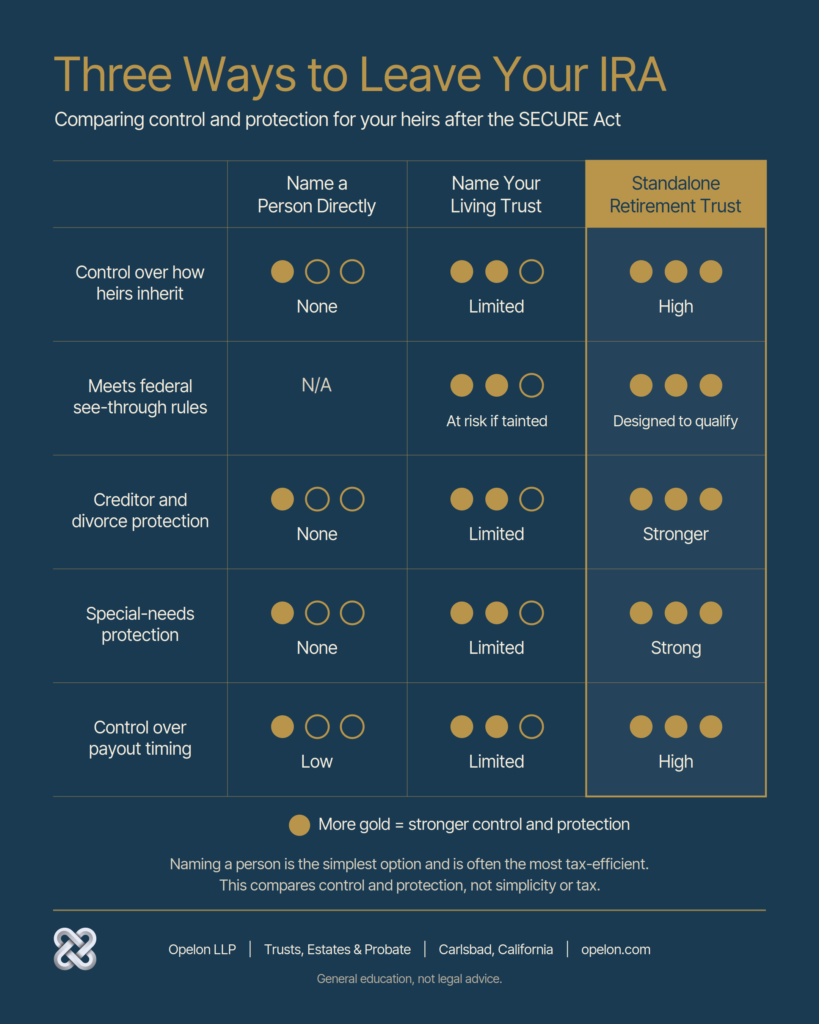
Most people weighing this decision are choosing among three options: name a person directly, name their existing revocable living trust, or build a purpose-made standalone retirement trust. Here is how they compare.
Factor | Name a person directly | Name your revocable living trust | Standalone retirement trust |
Control over how heirs receive the money | None (lump-sum access) | Depends on RLT drafting; often not optimized for IRAs | High (purpose-built) |
Meets federal see-through rules cleanly | N/A (a person is already the designated beneficiary) | Sometimes; risk if the RLT has non-individual or charitable beneficiaries who count | Designed to qualify |
Creditor and divorce protection for the heir | None | Limited | Stronger (accumulation design) |
Special needs beneficiary protection | None | Limited | Strong (special-needs sub-trust) |
Spendthrift or young-heir guardrails | None | Limited | Strong |
Risk of accelerating the full distribution | Low (a person can stretch if an EDB, otherwise the 10-year rule) | Higher if a non-individual beneficiary taints the trust | Controlled by drafting |
Best fit | Simple plans, mature responsible heirs | Smaller IRAs already integrated into an RLT plan | Large IRAs, vulnerable or protected heirs, blended families |
In the plans we draft for San Diego County families, we sometimes find an older revocable living trust named as the IRA beneficiary with charitable gifts or a much-older contingent beneficiary buried in the terms, which can jeopardize see-through status. A standalone retirement trust isolates the retirement money from that risk.
Conduit Trust vs. Accumulation Trust: The Core Design Choice
Every see-through trust is built in one of two ways, and the choice drives everything else: how your heirs are taxed, how well the money is protected, and whether the trustee or the calendar controls the payout. Understanding the difference is the single most useful thing you can do before meeting with an attorney.
Conduit Trust
A conduit trust requires the trustee to pass each distribution from the retirement account out to the beneficiary in the year it is received. The money flows through the trust to the human beneficiary rather than staying behind.
Because the distribution is carried out to the beneficiary, it is taxed at the beneficiary’s individual rate, which is usually lower than trust rates. That is the main appeal: tax efficiency. For identifying the relevant beneficiary, the conduit beneficiary is generally treated as the measuring beneficiary for the payout rules. So if that beneficiary is an EDB, such as a disabled child, life-expectancy treatment can still apply; if not, the 10-year rule applies.
The trade-off is protection. Because the money must leave the trust, a conduit trust provides weaker ongoing protection. Once distributed, the funds are exposed to the beneficiary’s creditors, a divorce, or simple bad judgment. Under the 10-year rule, a conduit trust can also be forced to push the entire account out to the beneficiary by year ten, exactly the lump-sum result many families want to avoid.
A conduit design fits best with responsible adult beneficiaries where tax efficiency matters more than long-term protection.
Accumulation Trust
An accumulation trust allows the trustee to retain retirement-account distributions inside the trust rather than passing them out. The trustee decides what stays and what goes to the beneficiary.
The cost of that flexibility is tax. Income retained in the trust is taxed at the compressed trust income-tax rates, which reach the top 37% federal bracket at a very low threshold (approximately $16,250 of retained taxable income for the 2026 tax year; it was $15,650 for 2025, and the figure is adjusted for inflation annually under the applicable Revenue Procedure). The 3.8% net investment income tax can apply at that same low threshold. This is the main downside of accumulation.
Counting the beneficiaries is also more complex. With an accumulation trust, the payout period generally depends on all beneficiaries who could receive the retirement assets, which can include certain remainder beneficiaries. A non-individual remainder beneficiary, such as an estate or in some cases a charity, can disqualify see-through status or shorten the payout. Careful drafting has to control exactly who counts.
There is one powerful exception. An accumulation trust drafted as an “applicable multi-beneficiary trust” (AMBT) under IRC 401(a)(9)(H) can let a disabled or chronically ill beneficiary be treated as an EDB and use life-expectancy payout, even though the trust accumulates. This is the mechanism that lets a special-needs accumulation sub-trust both protect the beneficiary and stretch distributions, rather than being locked into the 10-year rule. The AMBT requirements are technical and should be handled by counsel.
The payoff for accepting the higher tax rate is stronger protection. Money kept in the trust is generally shielded from the beneficiary’s creditors, a divorcing spouse, lawsuits, and the beneficiary’s own poor decisions, and the trust can carry remainder control for blended families. An accumulation design fits best with special needs beneficiaries, spendthrift heirs, minor beneficiaries, second-marriage remainder protection, and creditor-exposed professionals.
Conduit vs. Accumulation at a Glance
Feature | Conduit Trust | Accumulation Trust |
Distributions must pass to the beneficiary | Yes, in the year received | No, trustee may retain |
Income tax rate on distributions | Beneficiary’s individual rate (usually lower) | Compressed trust rates on retained income (usually higher) |
Creditor and divorce protection | Weak once distributed | Strong while retained |
Control over a vulnerable heir | Limited | Strong |
10-year rule exposure | May force full payout to heir by year 10 | Trustee controls timing within the trust |
Disabled or chronically ill beneficiary | Can stretch if the conduit beneficiary is an EDB | Can stretch via an AMBT (life-expectancy payout) |
Typical best fit | Responsible adult heir, tax-first | Special needs, spendthrift, minors, blended family |
There is no universally “better” choice. The right standalone retirement trust often uses different designs for different beneficiaries: a conduit design for a financially mature adult child, and an accumulation special-needs sub-trust for a disabled child. We draft the sub-trusts to fit each heir.
The See-Through Trust Requirements
For the IRS to look through the trust to the human beneficiaries, rather than treating the trust as a non-individual beneficiary (which can force a faster payout under the 5-year rule or the owner’s remaining life expectancy), the trust must generally meet four requirements under Treas. Reg. 1.401(a)(9)-4:
- The trust must be valid under state law, which for our clients means California.
- The trust must be irrevocable, or must become irrevocable by its terms upon the account owner’s death.
- The beneficiaries who could receive the retirement assets must be identifiable from the trust document and, with limited exceptions, must all be individuals.
- Required trust documentation must be provided to the plan administrator or IRA custodian by the applicable deadline, generally October 31 of the year following the year of the owner’s death (Treas. Reg. 1.401(a)(9)-4(h)).
A single drafting error, such as naming an estate or a non-individual beneficiary that counts, or leaving a charitable gift inside the trust that taints the beneficiary pool, can cause the trust to fail the see-through rules and accelerate the taxable distribution. This is the strongest argument for a purpose-built standalone retirement trust over a general-purpose living trust pulling double duty.
You can read the governing regulation at Treas. Reg. 1.401(a)(9)-4 on the Cornell Legal Information Institute.
When a Standalone Retirement Trust Makes Sense
An SRT adds complexity, and it is not the right answer for every family. It earns its keep in a recognizable set of situations.
Situations Where an SRT Earns Its Keep
- Large retirement balances. When the IRA or 401(k) is the family’s biggest asset, handing it to an heir outright creates real risk.
- Minor children or grandchildren. A minor cannot manage an inherited account; an SRT provides a trustee and staged access. Note that only the owner’s own minor child is an EDB. A minor grandchild is not, and is subject to the 10-year rule.
- A special needs beneficiary. An outright inherited IRA can disqualify a beneficiary from SSI or Medi-Cal. A properly drafted accumulation special-needs sub-trust, often an AMBT, can preserve needs-based eligibility and, for a disabled or chronically ill beneficiary, can also keep life-expectancy payout. See our California Special Needs Trust
- Spendthrift or financially immature heirs. The trustee controls the pace of distributions instead of a 10-year cliff payout.
- Second marriages and blended families. An SRT lets you provide for a current spouse while directing the remainder to children from a prior marriage. See our discussion of joint trusts versus separate trusts for married couples.
- Creditor or divorce exposure. Beneficiaries in high-liability professions or unstable marriages benefit from accumulation-trust protection.
In our experience drafting estate plans across San Diego County, the blended-family case and the special-needs case are the two situations where a standalone retirement trust is most often worth the added complexity.
Creditor Protection: Clark v. Rameker and California
One of the most under-appreciated reasons to use a standalone retirement trust is protecting your heirs from their own future creditors. The leading authority is Clark v. Rameker, 573 U.S. 212 (2014), in which the U.S. Supreme Court held that an inherited IRA is not “retirement funds” protected under the federal bankruptcy exemption (11 U.S.C. 522(b)(3)(C)). Your own IRA may receive protection during your life, but once it passes to a non-spouse heir, that federal bankruptcy protection is generally lost.
The practical effect is that a child who inherits your IRA outright can be exposed to a bankruptcy, a lawsuit, or a divorce. An accumulation-style standalone retirement trust keeps the funds inside a protected trust structure rather than in the heir’s own hands.
The state-law angle is more nuanced than many online guides suggest. California is an “opt-out” state, so debtors here generally use the state exemptions rather than the federal list. Under Cal. Code Civ. Proc. 704.115, employer-sponsored “private retirement plans” can be fully exempt, but IRAs and self-employed plans are exempt only to the extent necessary to provide for the support of the owner and dependents at retirement. State courts have enforced this limit even for the owner’s own IRA. Protection for an inherited account in the heir’s hands is even more limited, and the law on that point is genuinely unsettled here, so no one should treat trust-based protection as a guarantee.
Important framing: this protection is for your beneficiaries, your heirs, against their future creditors and divorces. A standalone retirement trust is not a tool for shielding your own assets from your own creditors, and Opelon does not provide self-settled asset-protection services.
The Tax Picture: Income Tax, Trust Brackets, and the Estate
Income tax is the dominant issue in retirement-trust planning. Traditional IRA and 401(k) distributions are ordinary income to whoever receives them, whether a person or a trust. Roth accounts are generally income-tax-free on qualified distributions, but they are still subject to the 10-year emptying rule for most beneficiaries.
There is a useful Roth nuance. Because a Roth IRA owner has no required beginning date, the owner is treated as dying before the RBD. So an inherited Roth IRA subject to the 10-year rule does not require annual RMDs in years one through nine; the beneficiary need only empty the account by the end of year ten. That makes Roth accounts especially attractive for trust-based planning when the goal is tax-free growth across the full ten years.
The compressed trust bracket is the central tension. A non-grantor trust reaches the top 37% federal income-tax bracket at approximately $16,250 of retained taxable income for the 2026 tax year (it was $15,650 for 2025), and the 3.8% net investment income tax can apply at that same threshold. Accumulating large IRA distributions inside the trust can therefore be expensive, which is exactly the friction between the conduit and accumulation designs.
This is where coordination with your CPA matters most. Your CPA models whether to accept the higher trust rate in exchange for protection, use a conduit design for tax efficiency, or distribute income to beneficiaries within the trust’s 65-day window. Opelon drafts the trust; your CPA and financial advisor model the numbers.
On the estate-tax side, two points deserve mention. A retirement account is included in your taxable estate and is also income in respect of a decedent (IRD) that is subject to income tax to the heir, the so-called double tax. When estate tax is actually paid on the IRD, the heir gets a partial offset through the IRC 691(c) income-tax deduction. Under current federal law, the estate-tax exemption is $15 million per individual and $30 million per couple (with a 40% top rate), and the exemption is indexed for inflation beginning in 2027, so estate tax affects only larger estates. California imposes no state estate or inheritance tax. For the full picture, see our California Estate Tax Planning Guide.
California-Specific Considerations
A standalone retirement trust is formed under California Probate Code 15200 and following, and see-through qualification requires that the trust be valid under California law, which is the first of the four federal requirements.
For married couples, retirement accounts earned during the marriage may have community-property characteristics that affect beneficiary planning, and the rules differ by account type. ERISA-governed qualified plans, such as most 401(k)s, require the spouse’s written, witnessed or notarized consent to name a non-spouse beneficiary (IRC 417). IRAs are not subject to that federal spousal-consent requirement, but California community-property principles can still give a spouse a community interest in IRA assets. Both spousal consent and community-property characterization need to be coordinated when you set up the plan.
California also has no state estate or inheritance tax, so the analysis here is about control, protection, and probate avoidance, not a state death tax. On probate: any retirement account with a valid beneficiary designation, whether it names a person or a trust, passes outside probate as a nonprobate transfer under Probate Code 5000. That is not unique to the SRT. Where probate is a concern for your other assets, the California statutory fee schedule sets the personal representative’s compensation (Probate Code 10800) and the attorney’s compensation (Probate Code 10810) on identical sliding scales based on the gross value of the probate estate. You can estimate the impact with our California probate fee calculator.
How Much Does a Standalone Retirement Trust Cost in California?
When the retirement account is a primary asset, a standalone retirement trust is often integrated into a comprehensive flat-fee estate planning engagement. A truly standalone document, or a complex multi-beneficiary design (a special-needs sub-trust, a blended-family remainder structure), is typically a separate flat-fee engagement that depends on the complexity involved. Because pricing depends on the specific plan, the best way to get a firm number is a consultation rather than a published figure.
One ongoing cost to plan for separately: if you name a professional or corporate trustee, they typically charge an annual percentage of trust assets. Whether that makes sense is a beneficiary-by-beneficiary decision.
Common Standalone Retirement Trust Mistakes to Avoid
- Letting the general living trust serve as IRA beneficiary by default. Hidden charitable gifts or non-individual contingent beneficiaries that count can break see-through status.
- Choosing accumulation when conduit would do, or the reverse. The wrong design either over-taxes the heir or leaves a vulnerable heir unprotected.
- Missing the documentation deadline. Failing to provide trust documentation to the custodian by the deadline (generally October 31 of the year following the year of death) can cost see-through treatment (Treas. Reg. 1.401(a)(9)-4(h)).
- Forgetting to actually update the beneficiary designation. The trust does nothing if the IRA custodian’s beneficiary form still names a person. The designation form on file at death controls.
- Ignoring the spouse’s options. A surviving spouse generally has better choices, including the spousal rollover that restarts deferral under the spouse’s own life expectancy, than a trust does. Naming a trust for a spouse can forfeit valuable deferral.
- Drafting once and never revisiting. The SECURE Act, SECURE 2.0, and the 2024 final regulations changed the rules. Older retirement trusts, especially pre-2020 conduit trusts, frequently need a redraft.
The single most common problem we see is also the simplest one: a carefully drafted trust paired with an IRA beneficiary form that was never updated. The custodian’s form controls. We confirm every designation as part of funding the plan.