


What Is the Difference Between a Revocable and Irrevocable Trust?
|
A revocable trust can be changed or revoked by its creator at any time during life. The creator keeps full control, and the assets stay in their taxable estate. An irrevocable trust generally cannot be changed once created. The creator gives up control, but the assets can move outside their estate and beyond most creditors. |
Here is the trade in plain English. A revocable trust buys you flexibility and a step-up in basis for your heirs. An irrevocable trust buys estate-tax and asset-protection benefits, but you pay for them with control. Neither one is better on its own. The right choice depends entirely on your goals.
The Revocable Living Trust: California’s Default Tool
A revocable living trust is the workhorse of California estate planning. You create it, move your assets into it, and serve as your own trustee. You keep the right to amend or revoke it whenever you want. At your death, it becomes irrevocable and distributes your assets to your beneficiaries, all without probate.
This trust does three things well for most families. It avoids California probate and the statutory fees that come with it. It plans for incapacity by naming a successor trustee who can step in. And it preserves the step-up in basis, because your assets stay in your estate.
Those probate fees are not small. On a $1 million California estate, combined statutory fees total roughly $46,000 under Probate Code Sections 10800 and 10810. You can see the full breakdown in our guide to California probate fees. A revocable living trust sidesteps that process when it is funded correctly.
Now for the part people get wrong. A revocable living trust gives you no creditor protection during life. Because you can revoke it, the law treats the assets as yours. Under California Probate Code Section 18200, your creditors can reach trust property to the extent you can revoke the trust. This is the most common misconception about living trusts.
In our experience working with San Diego County families, most people need exactly one thing. They want to keep their home and accounts out of probate while staying in control. That is precisely what a California revocable living trust delivers.
The Irrevocable Trust: A Specialized Tool
An irrevocable trust works differently. You transfer assets into it and give up control. An independent trustee then manages those assets under terms you cannot freely change. Because you no longer own or control the assets, the law can treat them as outside your taxable estate and beyond your personal creditors.
Irrevocable trusts work well for specific goals:
- Estate-tax reduction for large estates that approach the federal exemption.
- Asset protection for the people you leave assets to, such as children or a spouse.
- Holding life insurance outside your taxable estate through an ILIT.
- Special-needs planning that protects a beneficiary’s public benefits.
- Charitable giving paired with tax planning.
The benefits come at a real cost. You lose control and flexibility once the trust is set. Gifting appreciated assets into the trust can also forfeit the step-up in basis. For many families, that lost step-up matters more than any tax saved.
Here is the honest framing. An irrevocable trust is the right answer for specific goals, not a general upgrade over a revocable trust. We tell families this plainly. If your goal is simply avoiding probate, you usually do not need to give up control to get there.
Revocable vs Irrevocable: Side-by-Side
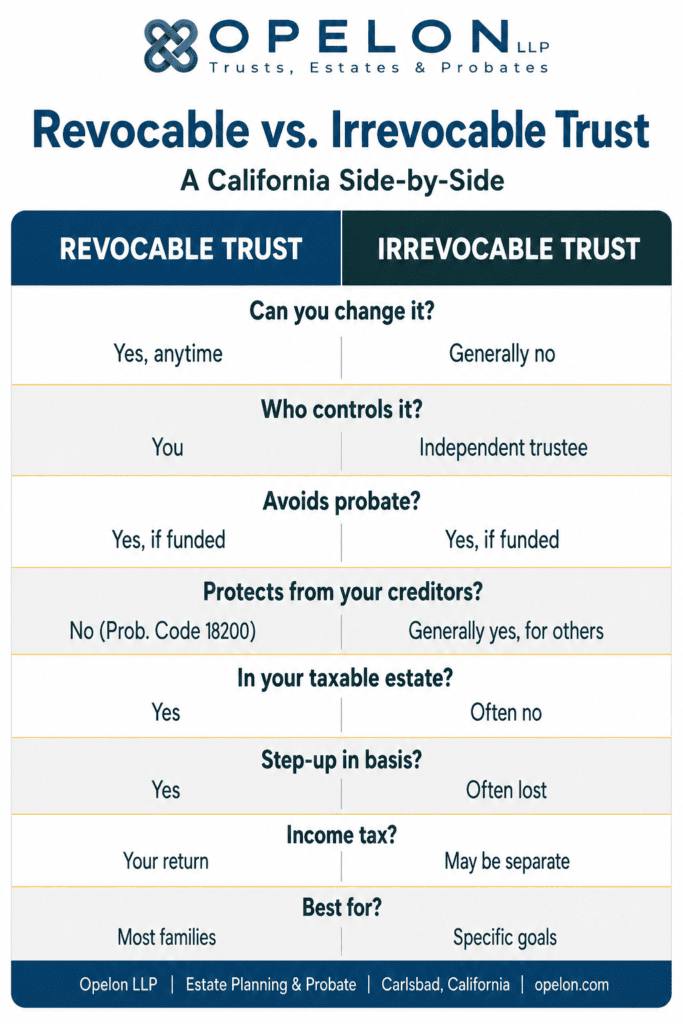
Here is how the two trusts compare on the points that matter most to families.
|
Feature |
Revocable Trust |
Irrevocable Trust |
|
Can you change or revoke it? |
Yes, anytime during life |
Generally no |
|
Who controls the assets? |
You do, as trustee |
An independent trustee |
|
Avoids California probate? |
Yes, if properly funded |
Yes, if properly funded |
|
Protects assets from your creditors? |
No (Probate Code 18200) |
Generally yes, if properly structured |
|
In your taxable estate? |
Yes |
Often no, if a completed gift |
|
Step-up in basis at death? |
Yes |
Often no for gifted assets |
|
Income tax reporting? |
On your return (grantor) |
May be a separate taxpayer |
|
Best for? |
Probate avoidance, flexibility |
Estate tax, asset protection, special needs |
One caveat on creditor protection. An irrevocable trust protects assets you set aside for others. It does not shield assets you keep for yourself in California, a point we cover below.
The Step-Up in Basis Trade-Off (The Part Most People Miss)
The step-up in basis is the most overlooked factor in this decision. When you die, assets in your taxable estate get their cost basis reset to fair market value under Internal Revenue Code Section 1014. That reset often erases the capital gain your heirs would otherwise owe.
Consider this scenario. You bought a home decades ago for $200,000, and it is worth $1 million today. If that home sits in your revocable trust at death, your heirs take it at the $1 million basis. They could sell it the next day and owe no capital gains tax on the growth.
If you are married and hold that home as community property in your revocable trust, both halves receive the step-up at the first spouse’s death under Internal Revenue Code Section 1014(b)(6), not just the deceased spouse’s half. That makes the revocable trust especially powerful for California couples with appreciated assets.
Now compare an irrevocable trust. If you gift that same home into an irrevocable trust during life, you may remove it from your estate. But you often lose the step-up too. Your heirs could inherit your original $200,000 basis and face tax on $800,000 of gain.
This trade only pays off for genuinely large estates. The One Big Beautiful Bill Act (OBBBA), signed on July 4, 2025, set the federal estate tax exemption at $15 million per person for 2026. Married couples can shelter up to a combined $30 million, but that combined amount is not automatic. It requires a portability election or a credit shelter trust. The law set these figures with no scheduled expiration and indexes them for inflation starting in 2027, though a future Congress could still change the exemption. California has no separate state estate tax, which you can confirm against the current federal estate tax exemption amount.
So here is the math for most families. If your estate sits below $15 million, you owe no federal estate tax anyway. Giving up the step-up to use an irrevocable trust can cost your heirs more in capital gains than it saves. That is why a revocable trust, which preserves the step-up, is usually the smarter path.
Asset Protection: What Each Trust Really Does
|
Asset protection is where myths run deepest. A revocable living trust gives you zero protection from your own creditors in California. An irrevocable trust can protect assets, but mostly for the people who inherit them, not for you. |
Start with the revocable trust. Because you keep the power to revoke it, your creditors can reach the assets under Probate Code Section 18200. The protection simply is not there for you during life.
An irrevocable trust works differently, with limits. It can protect assets you leave to beneficiaries through a spendthrift provision. It can also remove assets from your estate. But a self-settled irrevocable trust still fails to protect the California settlor’s own assets under Probate Code Section 15304. California does not provide a domestic asset protection trust option for its residents.
If protecting your own assets from creditors is the goal, California law limits your choices. That planning is fact-specific, and some approaches fall outside what a California trust can do. It is worth reviewing with a qualified attorney before you commit to any structure.
Common Types of Irrevocable Trusts in California
California families use several kinds of irrevocable trusts, each built for a specific goal.
- Irrevocable Life Insurance Trust (ILIT): An ILIT holds a life insurance policy outside your taxable estate. This keeps the death benefit from inflating your estate for tax purposes.
- Special Needs Trust: This trust provides for a loved one with disabilities. It does so without disqualifying them from public benefits like Medi-Cal or SSI.
- QTIP Trust: A California QTIP trust supports a surviving spouse during life. It then directs the remaining assets to beneficiaries you choose, often children from a prior marriage.
- Charitable Trusts: Charitable remainder and charitable lead trusts combine giving with tax planning. They can generate income or deductions while supporting a cause you care about.
- Spousal Lifetime Access Trust (SLAT): A SLAT lets one spouse gift assets out of the estate while the other keeps indirect access. High-net-worth couples use it for estate-tax planning.
- Generation-Skipping or Dynasty Trust: These trusts pass wealth to grandchildren and beyond. They aim to reduce transfer taxes across multiple generations.
- Medi-Cal Asset Protection Trust: This trust supports long-term-care planning. It is an elder-law specialty, and Opelon LLP refers these matters to qualified elder-law counsel.
Can You Change a Revocable Trust to Irrevocable (or Modify an Irrevocable One)?
|
Yes, in specific ways. A revocable trust becomes irrevocable automatically when its creator dies. During life, you can convert a revocable trust to irrevocable on purpose, but that step is deliberate and usually permanent. |
The word irrevocable does not always mean frozen forever. California allows changes to an irrevocable trust in limited circumstances. The settlor and all beneficiaries can agree to modify or end it. A court can also modify or terminate a trust by petition under California Probate Code Sections 15400 through 15414. Decanting, which pours assets into a new trust, offers another path in some cases.
Here is what to expect. Changing an irrevocable trust is possible, but it is never casual. Each route has legal requirements and limits. For a fuller view of how these trusts fit together, see our California trusts complete guide.
How to Decide Which Trust You Need
Choosing between these trusts gets easier when you work through it in order. Here is the approach we use with San Diego County families.
- Name your main goal. Decide what you most want to accomplish. For most people, the goal is avoiding probate and planning for incapacity.
- Start with a revocable living trust. If probate avoidance, flexibility, and control top your list, the revocable trust usually fits. This covers the large majority of families.
- Check for a special situation. Look for triggers like a taxable estate near $15 million, a beneficiary with special needs, significant life insurance, or charitable goals.
- Add a targeted irrevocable trust only if a trigger applies. Match the specific irrevocable trust to the specific goal, rather than treating it as an upgrade.
- Consider using both. Many strong plans pair a revocable living trust as the foundation with one irrevocable trust for a single purpose.
Not sure which one you need? That is completely normal, and it is the exact conversation we have with Carlsbad and San Diego County families every week. For most, the answer is a well-drafted revocable living trust. For the situations that truly call for an irrevocable trust, we will tell you plainly and explain the trade-offs first. When you are ready, you can schedule a free estate planning consultation in Carlsbad to talk through your goals.
Related Guides
- Complete Guide to California Trusts (All Trust Types)
- California Revocable Living Trust: 7 Critical Steps