

Why California Residents Consider Out-of-State LLCs
California residents explore out-of-state LLC formation because Wyoming, Nevada, and Delaware market lower fees, zero state income tax, and stronger asset protection. These benefits are real in those states, but they do not transfer to California residents who live, work, or own property in California.
The appeal is understandable. Wyoming charges $100 to form an LLC and $60 per year to maintain it. Wyoming also offers single-member LLC charging order protection, meaning a creditor of the LLC owner cannot force the LLC to distribute assets. Nevada advertises zero state income tax and strong privacy protections. Delaware offers a specialized Chancery Court and a well-developed body of business entity case law.
For a California resident, though, the question is not what those states offer. The question is what survives contact with California law. The answer, as explained in detail below, is very little.
Three Realities That Eliminate the Supposed Benefits
Reality 1: California Taxes Income Where It Is Earned
California taxes its residents on all income from all sources worldwide. Forming an LLC in a zero-income-tax state like Wyoming or Nevada does not reduce or eliminate California state income tax for California residents.
California’s Franchise Tax Board (FTB) follows a residency-based taxation model. If you are a California resident, you owe California income tax on every dollar you earn, regardless of where the money comes from or where your LLC is organized. This rule applies to wages, business income, rental income, and investment income.
Wyoming and Nevada do not impose state income tax on their residents. That is a real benefit for people who live in Wyoming or Nevada. For a California resident, it is irrelevant. You still file a California return, report all of your LLC income, and pay California tax at rates up to 13.3%.
California Note: California Revenue and Taxation Code Section 17041 imposes income tax on the entire taxable income of California residents. This includes income from LLCs formed in other states. Forming a Wyoming or Nevada LLC does not change your California residency or your California tax obligations.
Reality 2: Foreign LLC Registration Means Paying Twice
Any LLC doing business in California or owning California property must register as a foreign LLC with the California Secretary of State and pay the $800 annual franchise tax, on top of the formation state’s own annual fees. Foreign LLCs must also file a biennial Statement of Information, just like domestic California LLCs.
Under California Corporations Code Section 17708.02, a foreign LLC transacting intrastate business in California must register with the Secretary of State by filing Form LLC-5 and paying a $70 filing fee. After registration, the foreign LLC owes the same $800 annual franchise tax under Revenue and Taxation Code Section 17941 that a domestic California LLC pays.
Both domestic and foreign LLCs registered in California must also file a Statement of Information (Form LLC-12) with the Secretary of State. The initial filing is due within 90 days of formation or registration, and subsequent filings are due every two years (biennially) thereafter. The filing fee is $20 for LLCs. Failure to file results in a $250 penalty.
This means a Wyoming LLC doing business in California pays Wyoming’s $60 annual report fee plus California’s $800 franchise tax plus the $20 biennial Statement of Information fee, for a total baseline of $880 per year (averaging the biennial filing). A California LLC pays $800 per year plus $10 per year averaged for the biennial filing. The out-of-state LLC costs more and requires maintaining compliance in two states instead of one.
The same math applies to Nevada and Delaware. The table below compares the annual costs.
Formation State | Formation State Annual Fee | CA Franchise Tax | CA Statement of Info (Biennial) | Total Annual Cost* | States to Maintain |
California | $0 | $800 | $20 / 2 years | ~$810/year | 1 |
Wyoming | $60 | $800 | $20 / 2 years | ~$870/year | 2 |
Nevada | $150 | $800 | $20 / 2 years | ~$960/year | 2 |
Delaware | $300 | $800 | $20 / 2 years | ~$1,110/year | 2 |
*Total annual cost averages the $20 biennial Statement of Information fee as $10/year. Actual costs vary by filing year. Does not include the additional LLC fee for California-source income above $250,000.
Cost Info: LLCs with California-source income above $250,000 also owe an additional LLC fee under Revenue and Taxation Code Section 17942, starting at $900 and going up to $11,790. This fee applies regardless of where the LLC is formed.
Reality 3: California Courts Apply California Creditor Remedies
Wyoming and Nevada limit creditors to a charging order as the exclusive remedy against LLC membership interests. California does not. California courts can order foreclosure on a membership interest, appoint a receiver, and direct the sale of the interest to satisfy a judgment.
The charging order is the centerpiece of the Wyoming and Nevada LLC marketing pitch. In those states, a creditor of an LLC member can only obtain a charging order, which redirects distributions from the LLC to the creditor. The creditor cannot force the LLC to make distributions, cannot seize LLC assets, and cannot take control of the LLC. This is especially significant for single-member LLCs, where Wyoming and Nevada provide the same protection as they do for multi-member LLCs.
California does not follow this approach. Under California Corporations Code Section 17705.03, a court may charge the transferable interest of a judgment debtor, appoint a receiver of the distributions, make all other orders necessary to give effect to the charging order, and, upon a showing that distributions will not pay the judgment within a reasonable time, foreclose the lien and order the sale of the transferable interest. For single-member LLCs, California provides even less protection because there are no other members whose interests need shielding.
The critical question is which state’s law applies when a California resident forms a Wyoming LLC. While the internal affairs doctrine generally applies the formation state’s law to governance questions, California courts addressing creditor remedies against a California resident’s assets have applied California law. A California creditor suing a California resident in California court will seek to apply California’s broader creditor remedies, not Wyoming’s more restrictive charging order statute.
Warning: The asset protection benefits of a Wyoming or Nevada LLC are designed for residents of those states. For California residents, California courts retain the authority to apply California creditor remedies, which include foreclosure and receivership, not just charging orders.
Pros and Cons: Out-of-State LLC vs. California LLC
Forming an out-of-state LLC as a California resident adds cost and complexity without delivering meaningful tax, privacy, or asset protection benefits. A California LLC is simpler, less expensive, and provides the same practical outcome.
Out-of-State LLC (Wyoming, Nevada, or Delaware)
Pros | Cons |
Wyoming offers single-member LLC charging order exclusivity under Wyoming law | California courts can apply California creditor remedies to California residents, limiting the practical value of Wyoming’s charging order protection |
Nevada and Wyoming have no state income tax for their residents | California taxes residents on worldwide income regardless of LLC formation state, so there is no tax savings |
Delaware has a well-developed body of LLC case law and a specialized Chancery Court | Delaware’s legal advantages matter primarily for large-scale corporate disputes, not for individual LLC owners holding real estate or small businesses |
Wyoming offers privacy through nominee manager services | California’s foreign LLC registration and FTB filings require disclosure of member information, reducing the privacy benefit |
Low formation fees in Wyoming ($100) and Nevada ($75) | Foreign LLC registration in California adds the $800 franchise tax, $20 biennial Statement of Information, and dual-state compliance, increasing total costs above a single California LLC |
California LLC
Pros | Cons |
Single-state compliance: one $800 annual franchise tax plus a $20 biennial Statement of Information | California’s $800 annual franchise tax applies even if the LLC has no income |
No foreign LLC registration required | California does not offer charging order exclusivity for single-member LLCs |
California Revised Uniform Limited Liability Company Act (RULLCA) provides a modern statutory framework under Corporations Code Sections 17701.01 through 17713.13 | California’s additional LLC fee for income over $250,000 can reach $11,790 |
Easier to coordinate with a California revocable living trust for probate avoidance | California’s 13.3% top marginal income tax rate applies regardless of LLC formation state |
Lower total annual cost compared to any out-of-state LLC registered in California |
What About Wyoming LLCs Holding California Real Estate?
A Wyoming LLC that owns real property in California must register as a foreign LLC in California, pay the $800 franchise tax, file the biennial Statement of Information, and comply with California tax and reporting obligations. The property’s location in California subjects the LLC to California jurisdiction.
Owning California real estate through a Wyoming LLC does not move the property out of California’s reach. The property is still physically located in California, still subject to California property tax, and still governed by California real property law. The Wyoming LLC must register as a foreign LLC with the California Secretary of State and pay the annual $800 franchise tax. For more on using a California LLC to hold real estate, see our detailed guide.
Rental income from the California property is California-source income, taxable by California regardless of where the LLC is formed. If the California resident sells the property, the capital gain is California-source income subject to California tax.
From a practical standpoint, the Wyoming LLC adds a layer of complexity and cost without changing the tax result or the creditor exposure for California real estate.
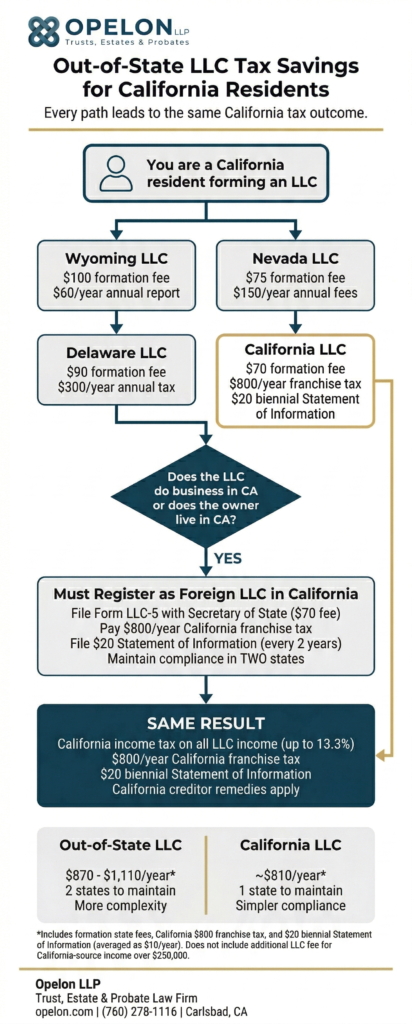
Every out-of-state LLC path leads to the same California tax result for California residents. A California LLC costs less and requires compliance in only one state. Source: Opelon LLP, Carlsbad, California.
The Practical Approach: California LLC Plus a Revocable Living Trust
Opelon LLP in Carlsbad, California recommends forming a California LLC and transferring the membership interest into a revocable living trust. This approach avoids probate, simplifies compliance, and costs less than maintaining an out-of-state LLC.
For most California residents, the right answer is straightforward. Form a California LLC. Transfer the membership interest into your revocable living trust. This combination accomplishes two goals that out-of-state LLC formation does not. If you do not yet have a trust, our estate planning checklist covers the steps involved in building a complete plan.
First, the LLC provides liability protection for the assets it holds. Whether the LLC owns rental property, business assets, or investment accounts, the LLC structure separates those assets from your personal liabilities.
Second, the revocable living trust ensures that the LLC membership interest avoids probate. Without a trust, an LLC membership interest is a probate asset. When the LLC owner dies, the membership interest must go through the California probate process, which takes 12 to 18 months and costs a percentage of the estate’s value under Probate Code Section 10800. For a $1 million estate, combined statutory attorney and personal representative fees total approximately $46,000.
Key Takeaway: Entity formation is only half the equation. Without proper estate planning integration, an LLC membership interest ends up in probate court regardless of where the LLC was formed. A California estate planning attorney can coordinate the LLC and trust to work together.
Does Delaware’s Chancery Court Matter for Individual LLC Owners?
Delaware’s Court of Chancery handles complex corporate disputes involving large businesses, venture-backed companies, and publicly traded entities. For individual California residents forming an LLC to hold real estate or a small business, Delaware’s court system offers no practical advantage.
Delaware’s Court of Chancery is a real asset for certain types of businesses. Venture capital firms prefer Delaware because the Chancery Court has extensive experience with corporate governance disputes, preferred stock rights, and merger litigation. These issues do not apply to a California resident forming an LLC to hold a rental property, a small business, or investment assets.
If a dispute arises involving your California LLC, it will almost certainly be litigated in California courts, not in Delaware. Forming in Delaware adds annual fees ($300 per year) and dual-state compliance without any corresponding benefit for the types of matters individual LLC owners typically encounter.