



A trustee holds a position of extraordinary responsibility. When you create a California living trust, this person becomes legally and ethically responsible for managing the assets you spent a lifetime building, from your Carlsbad home to your retirement and investment accounts, and ultimately distributing them according to your wishes.
Choosing the wrong trustee can undermine even the most carefully crafted estate plan. Choosing the right trustee, on the other hand, provides your family with stability, protection, and peace of mind, not just today, but for generations to come.
Whether you are creating a trust or have been named as someone’s trustee, understanding the scope of this role is critical. Here’s what every California family should know.
Key Takeaways for Understanding the Role of Trustee
- A trustee is the person responsible for managing trust assets and carrying out the trust’s instructions after the grantor passes away or becomes incapacitated.
- Most California families name themselves as initial trustee of their own revocable living trust, maintaining full control during their lifetime.
- Trustees have significant legal duties called fiduciary obligations, including acting in beneficiaries’ best interests and avoiding self-dealing.
- Choosing the right successor trustee requires balancing trustworthiness, financial competence, availability, and family dynamics.
- California trustees can be held personally liable for mismanagement, self-dealing, or breach of fiduciary duty under the California Probate Code.
If you have a living trust or you’re considering creating one, understanding the trustee’s role is essential. The trustee is the person who makes your trust actually work. Without a competent, trustworthy trustee, even the most carefully drafted trust document cannot protect your family or carry out your wishes.
For San Diego County families creating estate plans, choosing the right trustee is one of the most important decisions you’ll make. This guide explains what a trustee does, the legal responsibilities involved, and how to select someone who will serve your family well.
What Is a Trustee in Estate Planning?
A trustee is the person or institution legally responsible for managing trust assets and carrying out the instructions set forth in a trust.
When you create a California revocable living trust, you transfer ownership of your assets into the trust. The trustee holds legal title to those assets and is responsible for managing them strictly according to the terms you establish in the trust document.
Think of a trust as a legal framework that holds your assets and spells out exactly how they should be managed during your lifetime and distributed after your death. The trustee’s role is to faithfully implement those instructions.
What makes this arrangement unique is that, in most cases, you initially serve as your own trustee. This allows you to maintain full control over your property—you can buy, sell, invest, or use trust assets just as you always have. The trustee role becomes especially important when you can no longer manage your affairs yourself due to incapacity, or after your death, when a successor trustee steps in to carry out your plan.
In short, a trust:
- Holds legal ownership of your assets
- Contains your written instructions for management and distribution
- Allows you to remain in control while you are alive and capable
- Provides a seamless transition of management if you become incapacitated or pass away
The Three Parties Involved in a Living Trust
Understanding how trusts work requires knowing the three key roles involved. In many California living trusts, particularly during your lifetime, one person often fills all three roles.
Role | Definition | Key Responsibilities |
Grantor (Settlor/Trustor) | The person who creates the trust and transfers assets into it | Establishes trust terms, funds the trust, can amend or revoke during lifetime |
Trustee | The person or institution managing trust assets | Manages investments, pays bills, distributes assets, files tax returns, keeps records |
The person or persons who receive benefits from the trust | Receives distributions according to trust terms, can request accountings |
In a typical California revocable living trust, a married couple often serves as co-grantors, co-trustees, and initial beneficiaries all at once. This structure allows them to maintain complete control while setting up a framework for what happens when they can no longer manage things themselves.
What Powers Does a Trustee Have?
California trustees are granted broad authority to manage trust assets, but that authority is paired with significant legal responsibilities. While the exact scope of a trustee’s powers depends on the language of the trust document, most well-drafted California living trusts grant trustees the following core powers and duties:
1. Manage and Protect Trust Assets
A trustee’s primary responsibility is to safeguard and manage all assets held in the trust, including real estate, bank accounts, investment accounts, business interests, and personal property. For example, if a Carlsbad family home is held in trust, the trustee is responsible for paying property taxes, maintaining insurance, arranging repairs, and deciding whether and when to sell the property.
2. Follow the Trust’s Terms
The trust document serves as the trustee’s instruction manual. Trustees must read, understand, and strictly follow its terms. If the trust states that a beneficiary is to receive distributions at age 25, the trustee has no authority to distribute earlier, even if the beneficiary requests it. Courts enforce these obligations seriously.
3. Uphold Fiduciary Duties
Under California Probate Code Section 16000, trustees owe beneficiaries a fiduciary duty—one of the highest legal standards recognized by law. Trustees must act solely in the beneficiaries’ best interests, avoid conflicts of interest, treat beneficiaries impartially, and never use trust property for personal gain.
4. Make Prudent Investment Decisions
California’s Uniform Prudent Investor Act (Probate Code Sections 16045–16054) requires trustees to invest with reasonable care, skill, and caution. This includes diversifying investments, evaluating risk, and balancing growth with preservation of principal. Concentrating trust assets in a single speculative investment can expose a trustee to personal liability.
5. Keep Accurate Records and Accountings
Trustees must maintain detailed records of all income, expenses, distributions, and investment activity. Clear documentation protects the trustee if questions arise and ensures continuity if a successor trustee later assumes responsibility.
6. Communicate with Beneficiaries
Trustees must keep beneficiaries reasonably informed about the trust and its administration. Under Probate Code Section 16061.7, trustees must provide formal notice when a trust becomes irrevocable (usually at the grantor’s death) and, upon request, provide accountings showing how trust assets have been managed.
7. Distribute Trust Assets
When required by the trust’s terms, the trustee distributes income or principal to beneficiaries. Distributions may occur immediately, in stages, or over many years. For trusts benefiting minors, the trustee may manage assets for decades before final distribution.
8. Hire and Rely on Professionals
Trustees are not expected to handle everything alone. California law anticipates that trustees will seek help from attorneys, CPAs, and financial advisors when appropriate. Reasonable professional fees are typically paid from trust assets.
Key Takeaways
- California trustees have broad authority to manage trust assets, but must always follow the instructions in the trust document.
- Trustees owe beneficiaries a fiduciary duty, requiring them to act solely in beneficiaries’ best interests and avoid conflicts of interest.
- Trustees must make prudent, diversified investment decisions and keep detailed financial records and accountings.
- Trustees are responsible for communicating with beneficiaries and distributing assets exactly as the trust directs.
- Trustees may, and often should, hire qualified professionals and pay those fees from trust assets.
How to Choose the Right Trustee
Selecting a successor trustee is one of the most consequential decisions in your estate plan. The person you choose will manage potentially significant assets and make decisions affecting your family for years after you’re gone. Here’s what to consider:
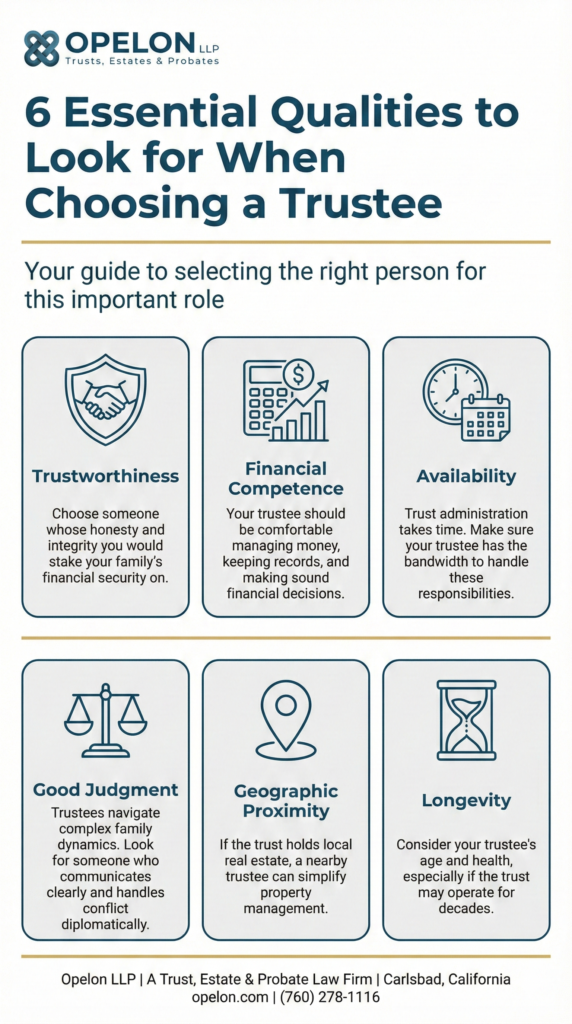
6 Essential Qualities to Look For when Choosing a Trustee
- Trustworthiness and integrity. This seems obvious, but it’s worth stating plainly. Your trustee will have access to your family’s assets with minimal oversight. Choose someone whose honesty you would stake your family’s financial security on.
- Financial competence. Your trustee doesn’t need to be a financial expert, but they should be comfortable managing money, keeping records, and making sound financial decisions. Someone who struggles with their own finances may not be the best choice for managing yours.
- Availability and willingness. Trust administration takes time, especially in the months following a death. Your trustee needs the bandwidth to handle these responsibilities. Make sure they’re willing to serve before naming them.
- Good judgment and communication skills. Trustees often navigate complex family dynamics. The ability to communicate clearly, make difficult decisions, and handle conflict diplomatically matters enormously.
- Geographic proximity (sometimes). If the trust holds local real estate, having a trustee in San Diego County can simplify property management. However, with modern technology, distance matters less than it once did.
- Longevity considerations. If your trust might operate for decades (common with trusts for minor children), consider your trustee’s age and health. Naming someone your own age means they may not outlive the trust’s active administration period.
Common Trustee Options
Option | Advantages | Considerations |
Adult Child | Knows family dynamics, no fees, personal investment in outcomes | May create sibling tension, limited financial experience, emotional involvement |
Trusted Friend | Objective perspective, knows your values, personal relationship | May decline, friendship could strain under responsibility, may not outlive trust |
Professional Trustee | Expertise, impartiality, institutional continuity, liability coverage | Annual fees (often 1-2% of assets), less personal touch, minimum asset requirements |
Co-Trustees | Checks and balances, shared workload, combines family knowledge with expertise | Requires cooperation, can create deadlock, more complex decision-making |
In our experience working with Carlsbad and San Diego County families, most people name an adult child or close family member as successor trustee, with a professional trustee or another family member as backup. This approach balances personal connection with practical safeguards.
What Is a Successor Trustee?
A successor trustee is the person who takes over trust management when the original trustee can no longer serve. In most California revocable living trusts, you name yourself as initial trustee. Your successor trustee steps in when you become incapacitated or pass away.
The transition to a successor trustee typically happens in one of two situations:
- Incapacity: If you become unable to manage your own affairs due to illness, injury, or cognitive decline, your successor trustee takes over. Your trust should specify how incapacity is determined, typically requiring one or two physicians’ certifications.
- Death: When you pass away, your successor trustee assumes responsibility for administering the trust, paying final expenses and debts, and distributing assets to beneficiaries according to your instructions.
Good estate planning includes naming multiple successor trustees in sequence. If your first choice cannot serve, your second choice takes over, and so on. This prevents your trust from lacking leadership if circumstances change unexpectedly.
Can a Trustee Be Personally Liable?
Yes. California trustees can face personal liability for mismanaging trust assets or breaching their fiduciary duties. This potential liability is one reason the trustee role requires serious consideration.
Under California Probate Code, trustees may be held personally responsible for:
- Self-dealing. Using trust assets for personal benefit, such as borrowing trust funds or purchasing trust property at below-market prices. Note that some trusts include provisions allowing certain types of self-dealing, but these must be explicitly stated.
- Negligent mismanagement. Failing to exercise reasonable care in managing trust assets. Examples include ignoring necessary property maintenance, making reckless investments, or failing to pay required taxes.
- Breach of fiduciary duty. Acting against beneficiaries’ interests, showing favoritism among beneficiaries, or failing to follow trust terms.
- Failure to account or communicate. Refusing to provide beneficiaries with required information about trust assets and administration.
Trustees can reduce liability risk by keeping meticulous records, seeking professional advice when needed, and documenting the reasoning behind significant decisions. Some families also purchase trustee liability insurance for additional protection.
Key Takeaways
- Selecting the right trustee is one of the most consequential choices in your California estate plan, as this person may manage significant assets for many years.
- The best trustees demonstrate trustworthiness, basic financial competence, availability, good judgment, and strong communication skills.
- Common trustee options include adult children, trusted friends, professional trustees, or co-trustees, each with distinct advantages and tradeoffs.
- A successor trustee steps in if you become incapacitated or pass away, ensuring uninterrupted trust administration.
- Naming multiple successor trustees in sequence provides critical backup protection.
- Trustees can face personal liability for self-dealing, negligent management, breaches of fiduciary duty, or failure to account and communicate.
- Careful recordkeeping, professional guidance, and (in some cases) trustee liability insurance can significantly reduce risk.