


What Is an Irrevocable Life Insurance Trust (ILIT)?
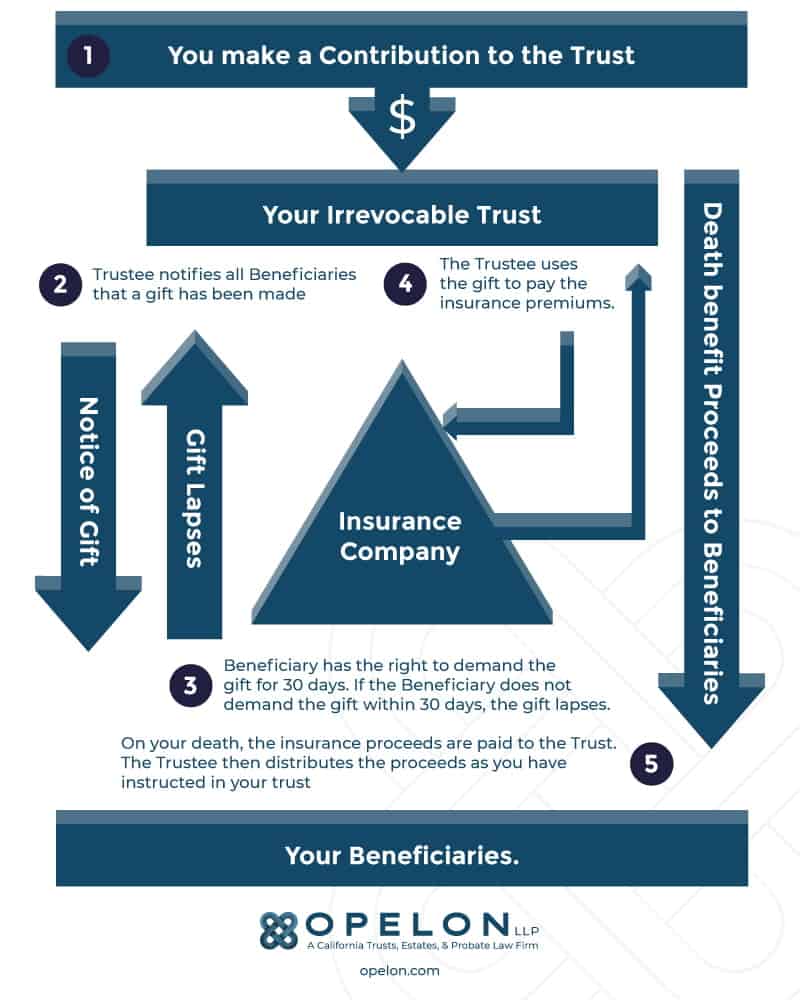
An irrevocable life insurance trust (ILIT) is an irrevocable trust created to own a life insurance policy on the grantor’s life, so the death benefit is generally excluded from the grantor’s taxable estate. The grantor funds premiums through gifts to the trust. At death, the trustee collects the income-tax-free proceeds and distributes them to the beneficiaries under the trust terms. |
Why does ownership matter so much? Under IRC section 2042, if the insured holds any “incidents of ownership” in the policy, the full death benefit is pulled back into the taxable estate. Those incidents include the right to change beneficiaries, borrow against the policy, surrender it, or assign it. The ILIT exists to remove those incidents of ownership from the insured.
The contrast is simple. A policy you own personally is counted in your estate at the full death benefit. The same policy owned by a properly structured ILIT is generally excluded. That difference can be worth millions for a larger California estate.
The Three Parties to an ILIT
The grantor (also the insured).
This is the person whose life is insured and who funds the premiums through gifts. The grantor cannot retain incidents of ownership. The grantor generally cannot serve as trustee either, because serving in that role typically restores those incidents of ownership and defeats the estate exclusion under IRC section 2042. A narrow fiduciary-capacity exception exists under Rev. Rul. 84-179, but it rarely applies to a normal ILIT.
The trustee.
The trustee owns and administers the policy, sends Crummey notices, pays premiums from trust funds, and distributes the proceeds. An independent trustee is the standard choice, since that keeps the estate exclusion intact. The insured may keep a limited power to remove and replace the trustee, as long as the replacement is not the insured, a settlor, or a related or subordinate party (Rev. Rul. 95-58).
The beneficiaries.
These are typically the grantor’s spouse and children. They receive the proceeds, and they hold the temporary withdrawal (Crummey) rights that let premium gifts qualify for the annual gift tax exclusion.
Why Use an ILIT Now That the Exemption Is $15 Million?
Here is the current law, stated plainly. Under the One Big Beautiful Bill Act (OBBBA), signed July 4, 2025, the federal estate, gift, and generation-skipping exemption is $15 million per individual. OBBBA made that amount permanent and indexed it for inflation for years after 2026. A married couple can shelter up to $30 million, but that combined figure is not automatic. It depends on planning, through both spouses using their own exemptions or a portability (DSUE) election on a timely Form 706 at the first death. Most California families will not owe federal estate tax at all.
So the honest question is no longer whether the exemption will shrink. The question is whether this estate still needs an ILIT. It usually does in four situations.
- Estates above or growing toward the exemption. An estate above $15 million, or a couple whose combined estate plus a large policy exceeds $30 million, faces a 40% estate tax on the excess. Removing a multimillion-dollar death benefit from the taxable estate is still meaningful.
- Liquidity for illiquid estates. This is the most common modern reason. A family business, a real estate portfolio, or a concentrated stock position is hard to sell quickly at a fair price. The estate tax bill is generally due nine months after death. ILIT proceeds provide that cash without a forced sale.
- Generation-skipping and dynasty planning. Because the GST exemption is not portable between spouses, allocating it to an ILIT at the first death preserves multigenerational leverage that would otherwise be wasted.
- Creditor protection and control. Proceeds held in trust are generally protected from a beneficiary’s creditors, divorce, or mismanagement. They can be distributed on the grantor’s schedule rather than as a single lump sum.
In our experience advising San Diego County families with high-net-worth estates, the ILIT conversation has shifted since OBBBA. We see it most often now not as a tax-shelter play. It is a liquidity tool for clients whose wealth is tied up in a business or California real estate they do not want their heirs forced to sell.
Is an ILIT Right for Me?Likely yes: your estate is near or above $15 million individual or $30 million per couple; you hold a large policy on top of an already-large estate; you own a closely held business or concentrated real estate; or you have multigenerational (GST) goals. Probably not: your total estate sits comfortably under the exemption, your assets are liquid, and your policy is modest. A California revocable living trust may be all you need. |
How an ILIT Works: Premiums, Gifts, and the Crummey Power
Funding the Premiums
Each year, the grantor gifts cash to the ILIT. The trustee then uses that cash to pay the policy premium. The grantor never pays the insurer directly, since doing so risks an incident-of-ownership argument. These gifts are completed gifts to the trust beneficiaries. They are potentially taxable gifts unless they qualify for the annual gift tax exclusion.
Are the Premium Gifts Taxable? The Annual Exclusion
A gift qualifies for the annual exclusion only if it is a gift of a present interest. A gift into a trust is normally a future interest, so it would not qualify on its own. That is the exact problem the Crummey power solves. In 2026, the annual exclusion is $19,000 per beneficiary, or $38,000 for a married couple electing gift-splitting. Premium gifts up to those limits per beneficiary generally avoid using any lifetime exemption, provided Crummey withdrawal rights are properly granted and noticed.
Gifts above the annual exclusion are reported on Form 709. They then draw against the $15 million lifetime exemption.
The Crummey Withdrawal Power and Notice
The power is named for Crummey v. Commissioner, 397 F.2d 82 (9th Cir. 1968). Here is the fix it provides. Each time the grantor contributes premium money, the beneficiaries get a temporary right, commonly 30 days, to withdraw their share. That right converts the gift into a present interest, so it qualifies for the annual exclusion.
The beneficiaries are expected not to exercise the right, so the money stays available for the premium. The right must be real, though, and the trustee must give written notice of it each year. The IRS scrutinizes ILITs where Crummey notices are skipped or backdated.
The single most common ILIT defect we see in older trusts is missing or undocumented Crummey notices. The trust language can be perfect. Without a documented annual notice, the IRS can still disallow the annual-exclusion treatment of the premium gifts.
What a Crummey Notice Must Contain A complete notice describes four things: the contribution amount, the beneficiary’s withdrawable share, the deadline to withdraw, and how to exercise the right. These are the required elements, not a fill-in-the-blank form. A defective do-it-yourself notice can blow the annual-exclusion treatment, so we prepare and document these for clients each year. |
What if a beneficiary actually exercises the withdrawal right? The trustee must honor it, and that year’s premium may go unpaid for that share. In practice this is rare. It is managed through family communication and careful trust drafting.
The Three-Year Rule: Transferring an Existing Policy
There are two ways to get a policy into an ILIT. With a new policy, you have the ILIT apply for and own the policy from inception. That is the cleanest path, and there is no lookback. With an existing policy, you transfer a policy you already own into the ILIT. Under IRC section 2035, if the insured dies within three years of transferring an existing policy, the death benefit is pulled back into the taxable estate as if the transfer never happened.
The same three-year rule applies to releasing an incident of ownership, not just to transferring the policy outright. So for an older or higher-risk insured, a new policy owned by the ILIT from day one is generally safer than transferring an existing policy and hoping to survive the three-year window.
Factor | New policy in the ILIT | Existing policy transferred in |
Three-year risk | None; clean from inception | Death within three years pulls the benefit back |
Cost | New underwriting and premiums | Keeps an existing, possibly cheaper policy |
Insurability | Requires current health and underwriting | Useful if new coverage is hard to obtain |
ILITs and the Generation-Skipping Transfer (GST) Tax
When an ILIT is designed to benefit grandchildren or later generations, it becomes a dynasty ILIT. At that point the generation-skipping transfer (GST) tax comes into play. The GST tax is a flat 40%, and it is separate from the estate tax.
The grantor allocates GST exemption to the ILIT, which is also $15 million in 2026 under OBBBA. This allocation is typically reported on Form 709, so the trust and its eventual distributions are sheltered from GST tax. Automatic allocation rules can apply to certain GST trusts under IRC section 2632(c). For that reason, the allocation should be confirmed with counsel or a CPA rather than assumed.
Critical Distinction: GST Exemption Is Not PortableUnlike the estate-tax exemption, the GST exemption is not portable between spouses. A married couple who fails to allocate the first spouse’s GST exemption can permanently waste up to $15 million of GST shelter. This is a core reason advisors fund and allocate at the first death rather than waiting. |
Can a California ILIT Ever Be Changed?
The honest answer is that “irrevocable” means the grantor cannot simply amend it. California still provides limited routes when circumstances change. The first is court modification under California Probate Code section 15409, available when circumstances the grantor did not anticipate would defeat or substantially impair the trust’s purposes.
The second is nonjudicial modification under California Probate Code section 15404, by the written consent of the settlor and all beneficiaries, without court approval. Modification by all beneficiaries without the settlor is a different statute, section 15403, and that route requires a court petition. The court may decline if a material trust purpose still remains.
The third is decanting under the California Uniform Trust Decanting Act, codified at Probate Code sections 19501 through 19530. Decanting lets a trustee who has discretion to distribute trust property pour the assets into a new trust with updated terms, generally without beneficiary consent or court approval, subject to statutory limits.
Each of these routes is fact-specific and counsel-dependent. For an ILIT in particular, drawing the settlor back into a modification can itself raise estate-inclusion and incidents-of-ownership questions. None of this means an ILIT is easy to unwind.
Tax Filing and Administration for ILIT’s
An ILIT generally obtains its own EIN. Here is an important nuance. An ILIT that holds insurance on the grantor’s life is usually a grantor trust under IRC section 677(a)(3). That means trust income is typically taxed to the grantor rather than the trust, and the trust may use grantor-trust reporting instead of paying tax on a Form 1041.
A funded ILIT that earns income, such as one holding income-producing assets to pay premiums, may still need to file Form 1041. Reporting depends on the trust’s terms and assets. A CPA or tax advisor should confirm the correct filing method for your trust.
The trustee’s annual job is steady and modest. Receive the premium gift, send Crummey notices, pay the premium, and keep records. The work is light, but it must be done every year and on time.
On the California angle, California imposes no state estate, gift, or GST tax. The state inheritance and gift taxes were repealed by Proposition 6 in 1982, codified in the Revenue and Taxation Code, and the older pick-up estate tax became inoperative for deaths on or after January 1, 2005. So the transfer-tax analysis here is purely federal. The trust still must comply with California trust administration law.