

What the 2026 Probate Threshold Is and How It Changed
Quick Answer The California probate threshold for 2026 is $208,850. This figure has been in effect since April 1, 2025, when Assembly Bill 2016 increased it from the prior $184,500 level. The threshold adjusts periodically for inflation under California Probate Code Section 890. |
For years, California families watched the probate threshold creep upward, but home values in San Diego County have risen far faster. The Legislature responded by linking the threshold to the Consumer Price Index and adjusting it every three years starting April 1, 2022.
The most recent adjustment took effect on April 1, 2025. Decedents who died before that date remain subject to the old $184,500 figure. Decedents who died on or after April 1, 2025, including those who die in 2026, fall under the current $208,850 threshold.
The governing statute is California Probate Code Section 13100. The inflation-adjustment mechanism sits in Probate Code Section 890, which directs the Judicial Council to publish updated figures using Judicial Council Form DE-300.
One practical point worth noting: even though many sources still reference the old $184,500 figure, that amount is no longer current. Any California probate analysis for 2026 should use $208,850.
Effective Period | Threshold | Authority |
Before April 1, 2022 | $166,250 | Prob. Code §13100 / §890 |
April 1, 2022 through March 31, 2025 | $184,500 | Prob. Code §13100 / §890 |
April 1, 2025 and after (current) | $208,850 | Prob. Code §13100 / §890 (AB 2016) |
Which Assets Count Toward the California Probate Threshold
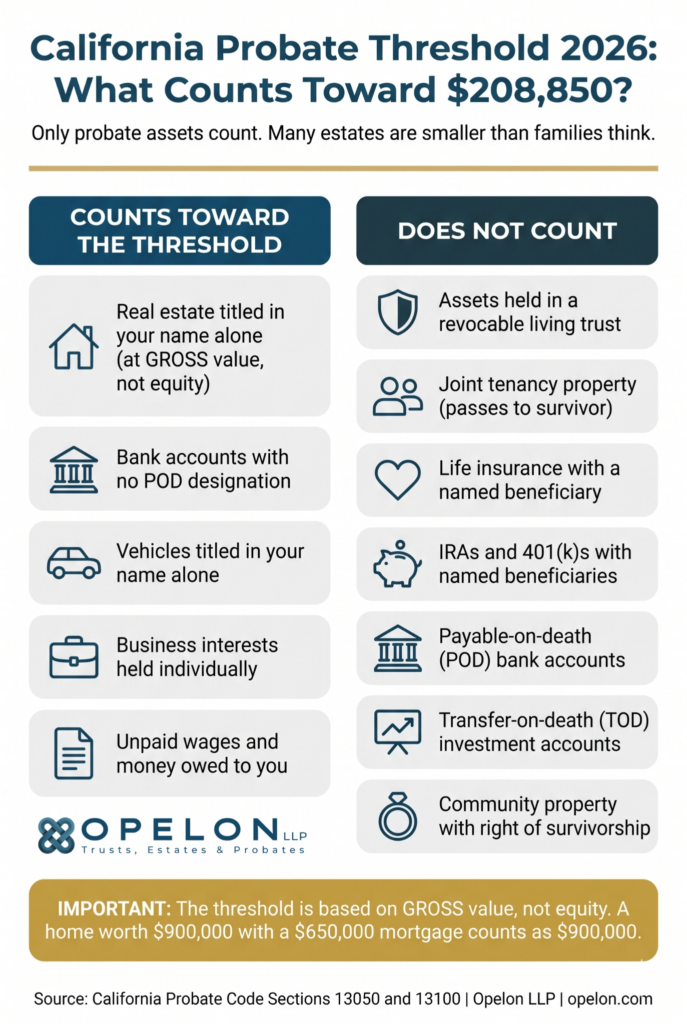
Quick Answer Only California assets that must pass through the probate court count toward the $208,850 threshold. This typically means property owned in the decedent’s name alone, without a beneficiary designation or survivorship right. The threshold is based on gross value, not net equity. |
Families sometimes look at a loved one’s estate and assume it falls below the threshold because the mortgage balance seems large. California law does not see it that way. The threshold calculation uses gross fair market value, not the owner’s equity.
If a Carlsbad homeowner dies with a house worth $900,000 and a $650,000 mortgage, the house counts as $900,000 toward the threshold, not $250,000. That single asset pushes the estate well above $208,850.
Assets that count toward the threshold include:
- Real estate owned solely in the decedent’s name (at gross fair market value)
- Bank and brokerage accounts without a payable-on-death (POD) or transfer-on-death (TOD) designation
- Vehicles and personal property titled in the decedent’s name alone
- Business interests held individually, such as a sole proprietorship or a membership interest without a survivorship provision
- Money owed to the decedent, such as outstanding promissory notes or unpaid wages
Which Assets Do NOT Count Toward the Probate Threshold
Quick Answer California Probate Code Section 13050 lists assets excluded from the probate threshold calculation. These include assets held in a revocable living trust, property passing by joint tenancy, retirement accounts and life insurance with named beneficiaries, and payable-on-death accounts. |
This is the most misunderstood part of California probate law. Many San Diego County families own homes and financial accounts worth far more than $208,850 but still avoid probate entirely because their assets are titled or designated correctly. Our San Diego probate attorneys regularly see estates worth several million dollars close outside of court because the planning was done right.
Assets excluded from the probate threshold under Probate Code Section 13050 include:
- Assets held in a revocable living trust
- Real property held in joint tenancy with right of survivorship
- Real property held as community property with right of survivorship
- Life insurance proceeds with a named beneficiary other than the estate
- Retirement accounts (IRA, 401(k), 403(b)) with a named beneficiary
- Bank accounts with a payable-on-death (POD) designation
- Investment accounts with a transfer-on-death (TOD) designation
- Property that passed to a surviving spouse under Probate Code Section 13500
- Vehicles transferred under the DMV’s simple transfer process for surviving spouses
The practical implication: a California couple with a $1.2 million home held in joint tenancy, two retirement accounts with named beneficiaries, and a bank account with a POD designation could have zero probate assets. Their estate would fall entirely below the threshold. This is why proper California estate planning focuses heavily on titling and beneficiary designations, not just drafting documents.
What Happens If the California Probate Estate Is Under $208,850
Quick Answer Estates with California probate assets valued at $208,850 or less may use one of two simplified procedures: a Small Estate Affidavit under Probate Code Section 13100 for personal property, or a Petition to Determine Succession to Real Property under Probate Code Section 13200. Neither requires full probate court proceedings. |
Small Estate Affidavit (Personal Property)
When the gross value of all California probate assets is $208,850 or less, an heir can collect the decedent’s personal property without opening a probate case. The heir simply prepares a written declaration that meets the requirements of Probate Code Section 13101 and presents it to the institution or individual holding the property.
The affidavit must state the following:
- The decedent’s date of death
- At least 40 days have elapsed since the date of death
- No probate proceeding is pending or has been conducted in California
- The gross value of the decedent’s California real and personal property does not exceed $208,850
- A description of the property being claimed and the basis for the affiant’s entitlement
The property holder must transfer the asset upon receiving the affidavit and a certified copy of the death certificate. If the holder refuses without reasonable cause, the claimant may seek a court order and attorney fees under Probate Code Section 13105(b).
One important distinction: as of January 1, 2025, the value of a decedent’s primary residence transferred by a separate court petition is excluded from the personal property affidavit calculation. This means a family could potentially transfer close to $1 million in a decedent’s primary residence (using a court petition) and up to $208,850 in personal property (using an affidavit) without a full probate. See our complete guide to the California Small Estate Affidavit for details.
Petition to Determine Succession to Real Property
For real property with a gross value at or below $208,850 (excluding any primary residence transferred separately), an heir can file a simplified court petition under Probate Code Section 13200 rather than opening a full probate case. This process requires court filing and notice to heirs, but it is significantly faster and less expensive than formal probate. The waiting period is six months from the date of death. Judicial Council Form DE-310 is used for this petition.
What Happens If the California Probate Estate Exceeds $208,850
Quick Answer If a California decedent’s probate estate exceeds $208,850, the estate generally requires formal probate in the California Superior Court. The process typically takes 12 to 18 months and involves court petitions, creditor notification, asset inventory, and final accounting. Statutory fees on a $1 million estate total approximately $46,000. |
Formal probate in California is governed by the California Probate Code and supervised by the Superior Court in the county where the decedent lived. For San Diego County residents, that means the San Diego Superior Court Probate Division in downtown San Diego.
The process follows this general sequence:
- File a Petition for Probate with the Superior Court and give notice to heirs and beneficiaries.
- Attend a court hearing. The judge appoints a personal representative (executor or administrator) and issues Letters Testamentary or Letters of Administration.
- Publish a Notice to Creditors in a newspaper of general circulation. Known creditors also receive direct notice within 30 days of the appointment.
- Complete an Inventory and Appraisal of all probate assets, typically with a court-appointed probate referee. This must be filed within four months of the Letters being issued.
- Allow the creditor claim period to run. Creditors have four months from the issuance of Letters, or 60 days from receiving actual notice, whichever is later (Probate Code Section 9100).
- File a Petition for Final Distribution with a formal accounting. The court reviews, holds a hearing, and approves distribution to heirs and beneficiaries.
The statutory fee formula under Probate Code Sections 10800 and 10810 applies to both the personal representative and the attorney. Each receives: 4% of the first $100,000, 3% of the next $100,000, and 2% of the next $800,000. Because both the executor and the attorney receive these fees, they are effectively doubled. See our detailed California probate fees guide for a full breakdown.
Gross Estate Value | Attorney Fee | Executor Fee | Combined Statutory Fees |
$300,000 | $9,000 | $9,000 | $18,000 |
$500,000 | $13,000 | $13,000 | $26,000 |
$750,000 | $18,000 | $18,000 | $36,000 |
$1,000,000 | $23,000 | $23,000 | $46,000 |
$1,500,000 | $28,000 | $28,000 | $56,000 |
These fees are calculated on gross value, not net equity. A Carlsbad home worth $1.2 million with a $700,000 mortgage generates fees based on the full $1.2 million. Additional costs include court filing fees, probate referee fees, publication costs, and potential extraordinary fees for complex matters.
California also permits independent administration under the Independent Administration of Estates Act (IAEA), which allows many routine actions without a court hearing. This can shorten the overall timeline in qualifying cases, though it does not change the statutory fee structure.
2026 California Probate Thresholds at a Glance
California law provides several different thresholds and simplified procedures depending on asset type and the relationship of the claimant to the decedent. The table below summarizes the figures currently in effect for 2026.
Procedure | Threshold / Limit | Waiting Period | Court Filing Required? | Authority |
Full probate required | Estate exceeds $208,850 in probate assets | None (file promptly) | Yes | |
Small Estate Affidavit (personal property) | $208,850 gross value or less | 40 days from death | No | Prob. Code §§13100-13101 |
Petition to Determine Succession (real property) | $208,850 gross value or less (excluding primary residence transferred separately) | 6 months from death | Yes (simplified) | |
Primary residence succession petition | $750,000 or less (for decedents dying on/after April 1, 2025) | 6 months from death | Yes (simplified) | Prob. Code §§13151, 13152 |
Spousal/Domestic Partner Property Petition | No dollar limit | No minimum wait | Yes (streamlined) |
Note on the primary residence rule: Effective January 1, 2025, a decedent’s primary residence transferred by a Section 13151 court petition is excluded from the personal property affidavit calculation. This means a surviving heir can potentially transfer the primary residence using a simplified petition and also use an affidavit for personal property, without either amount counting against the other.
These thresholds adjust for inflation. Always verify the current figures on California Probate Code Section 890 or Judicial Council Form DE-300 before relying on any specific dollar amount.
How a Revocable Living Trust Avoids the Probate Threshold Entirely
The probate threshold is only relevant for assets that pass through your estate without a trust, beneficiary designation, or survivorship right. A revocable living trust sidesteps the threshold calculation completely, because trust assets are not part of your probate estate at all.
When a California resident transfers their home, bank accounts, and investment accounts into a California revocable living trust, those assets pass directly to beneficiaries according to the trust terms when the grantor dies. There is no court petition, no probate filing, and no waiting period. A successor trustee simply administers the trust.
In our experience working with San Diego County families, the single most common planning mistake we see is an unfunded trust. The trust document is signed, but the home was never retitled and the bank account was never transferred in.
At death, those assets fall outside the trust and become subject to probate, regardless of what the trust says. In some cases, families can recover unfunded assets through a Heggstad petition under Probate Code § 850, but this requires court action and clear evidence of the decedent’s intent.
Proper trust funding is not optional. It is what makes the trust work. Opelon LLP’s Carlsbad estate planning team designs trusts and walks clients through the funding process to make sure every asset is properly titled before the trust documents are filed away.