



If you are a real estate agent in San Diego County or anywhere in California, probate listings will come your way. When they do, you need to know the rules before you plant the sign. The California probate sale process for realtors is different from a standard residential transaction in several important ways, from who can sign the listing agreement to whether a judge must approve the final price.
This guide walks you through every stage, explains how the Independent Administration of Estates Act (IAEA) changes your workflow, and highlights the mistakes agents most commonly make on probate listings. Whether you are handling your first estate property or looking to build a probate niche, this is the reference you can bookmark and revisit.
Key Takeaways
|
Understanding the Two Probate Sale Tracks in California
Every California probate real estate sale follows one of two tracks, and the track is determined by the level of authority the court grants to the personal representative. As the listing agent, the first question you should ask is: does the personal representative have full IAEA authority, limited IAEA authority, or no IAEA authority at all?
The answer is in the Letters Testamentary/Letters of Administration or order for Probate issued by the court. Ask the estate’s attorney for a copy of both. Item 3 on the Letters and 4 on the Order will tell you exactly what authority the court granted.
Track 1: Full IAEA Authority (No Court Confirmation Needed)
When the personal representative has full authority under the IAEA (Probate Code Sections 10400 through 10592), the sale of real property works much like a standard residential transaction. The representative can list the property, negotiate offers, accept terms, and close escrow without a court confirmation hearing.
There is one extra step. Before the sale can close, the personal representative must serve a Notice of Proposed Action (NOPA) on all beneficiaries, heirs, and anyone who filed a request for special notice (Probate Code Section 10580). Recipients have 15 days to object. If no one objects in writing, the sale proceeds.
What this means for you as the listing agent: You can price the property based on market value (no 90% floor). You can accept offers with financing contingencies, inspection contingencies, and other standard terms. The sale is not subject to overbidding. As long as none of the recipients who receive the NOPA object, no Court confirmation is required. Buyers will find this much more attractive, and you should highlight it in your marketing.
Track 2: Limited Authority or No IAEA (Court Confirmation Required)
When the personal representative has only limited IAEA authority (or none at all), every sale of real property must be confirmed by the court under Probate Code Section 10308. This is where the process differs significantly from anything you handle in a typical listing.
Court-confirmed sales require the offer price to be at least 90% of the probate referee’s appraised value (Probate Code Section 10309). The appraisal must be less than one year old at the time of the confirmation hearing. If the property was appraised at the date of death and more than a year has passed, a reappraisal for sale is needed.
IAEA Full Authority vs. Court-Confirmed Sales: Quick Comparison
Factor | Full IAEA Authority | Court Confirmation |
Minimum sale price | No statutory minimum (fiduciary duty still applies) | 90% of probate referee appraisal |
Buyer contingencies | Permitted (financing, inspection, etc.) | Generally not accepted by courts |
Overbid risk | None | Yes, at public hearing |
Court hearing required | No (if no objections to NOPA) | Yes |
Typical timeline to close | 45-75 days from accepted offer | 90-150+ days from accepted offer |
Notice of Sale publication | Not required (Prob. Code 10503) | Required before sale |
Listing period | 90-day increments, up to 270 days | 90-day increments, court approval for extensions |
Step-by-Step: Listing and Selling a Probate Property
The California probate sale process for realtors follows a predictable sequence, but the details vary depending on the IAEA authority level. Here is the workflow from initial contact through closing.
Step 1: Verify the Personal Representative’s Authority
Before you do anything, confirm that your client actually has legal authority to sell. The personal representative cannot sign a listing agreement until the court issues Letters. Ask the estate attorney for certified copies of the Letters and the Order for Probate. Check Item 3 on the Letters and item 4 on the Orderfor the IAEA authority level.
If Letters have not been issued yet, the probate case may still be in the petition stage. In our experience, in San Diego County,. it can take on average six to eight weeks from filing the petition until the court issues Letters. You can begin preparing a comparative market analysis during this period, but do not sign the listing agreement or market the property until Letters are in hand.
Step 2: Sign the Probate Listing Agreement
Use the California Association of Realtors (C.A.R.) Probate Listing Agreement form. This is not the same form you use for a standard listing. The probate form addresses fiduciary capacity, court limitations, and commission approval requirements.
Critical detail: The listing agreement can last no more than 90 days (Probate Code Section 10150(c)). Extensions are also limited to 90-day increments. If the total duration exceeds 270 days, the personal representative must send a Notice of Proposed Action regarding the extension. Never use a standard six-month or one-year listing agreement for a probate property.
The personal representative must sign in their fiduciary capacity. The signature line should read something like: “Jane Smith, as Personal Representative of the Estate of John Smith, Deceased.” If the representative signs in their individual capacity, the agreement may be unenforceable against the estate.
Step 3: Price the Property Strategically
Pricing strategy depends on which track the sale will follow.
Full IAEA authority: You price based on market comparable sales, just as you would for any listing. The probate referee’s appraisal will still be filed with the court as part of the inventory and appraisal process, but it does not set a minimum sale price.
Court confirmation: The probate referee’s appraisal sets the floor. The court will not confirm a sale below 90% of that appraised value (Probate Code Section 10309). If you believe the property’s market value is lower than the appraisal, talk to the estate’s attorney about requesting a reappraisal or adjusting expectations.
In either case, remember that probate fees in California are calculated on gross value, not net equity. A home worth $1,000,000 with a $600,000 mortgage still generates $46,000 in combined statutory probate fees for the attorney and personal representative. Understanding this helps you explain to sellers why maximizing the sale price matters even more in probate.
Step 4: Market the Property and Receive Offers
Market the property the same way you would any listing: MLS, professional photography, open houses, and targeted outreach. For court-confirmed sales, you are also required to publish a Notice of Sale in a local newspaper of general circulation before the sale (Probate Code Section 10300). The estate attorney typically handles this, but confirm it is done.
For court-confirmed sales, educate potential buyers about the process. Let them know that their offer, even if accepted by the personal representative, will be subject to overbidding at a public hearing. Buyers who understand this upfront are less likely to walk away later.
Step 5: Accept an Offer and Navigate the Closing Process
Full IAEA authority: Once the personal representative accepts an offer, the estate attorney prepares and serves the NOPA. After the 15-day notice period expires with no objections, the sale proceeds to close. From the agent’s perspective, the escrow process from this point forward is similar to a standard transaction.
Court confirmation: After the personal representative accepts an offer, the estate attorney must file a Report of Sale and Petition for Order Confirming Sale (Judicial Council form DE-260) within 30 days (Probate Code Section 10308). The court then schedules a confirmation hearing, the timing of which is dependent on the court’s calendar.
The Overbid Process: What Listing Agents Need to Know
In court-confirmed sales, any interested party may appear at the confirmation hearing and submit a higher bid, potentially outbidding your buyer. This is the overbid process under Probate Code Section 10311, and it is one of the most misunderstood parts of probate real estate.
How the Overbid Formula Works
The first overbid must exceed the original accepted offer by at least 10% of the first $10,000 plus 5% of the remaining balance. Here is how the math works for a $500,000 accepted offer:
Calculation Component | Amount |
10% of the first $10,000 | $1,000 |
5% of the remaining $490,000 | $24,500 |
Original offer | $500,000 |
Minimum first overbid | $525,500 |
After the first overbid, the court sets the minimum increment for additional bids. The process functions like an open auction in the courtroom. The court will confirm the sale to the highest bidder, and overbidders must typically present a cashier’s check or certified funds for 10% of their bid at the hearing.
Practical Tips for Agents in Overbid Situations
- Prepare your buyer. Explain the overbid risk before they submit their offer. Buyers who are surprised at the hearing often feel frustrated and may lose confidence.
- Advise on deposits. Courts typically require a 10% deposit from all bidders in the form of a cashier’s check. Make sure your buyer comes to the hearing with funds ready, even as the original bidder.
- Be present at the hearing. If you want to protect your commission, attend the confirmation hearing. Under Probate Code Section 10313(b), if a broker is present and fails to request a commission, the court may not award one later.
- Understand the commission structure. In overbid situations, the listing broker typically receives 5% of the sale price. If a buyer’s agent brings the successful overbidder, commission splits are governed by local court rules.
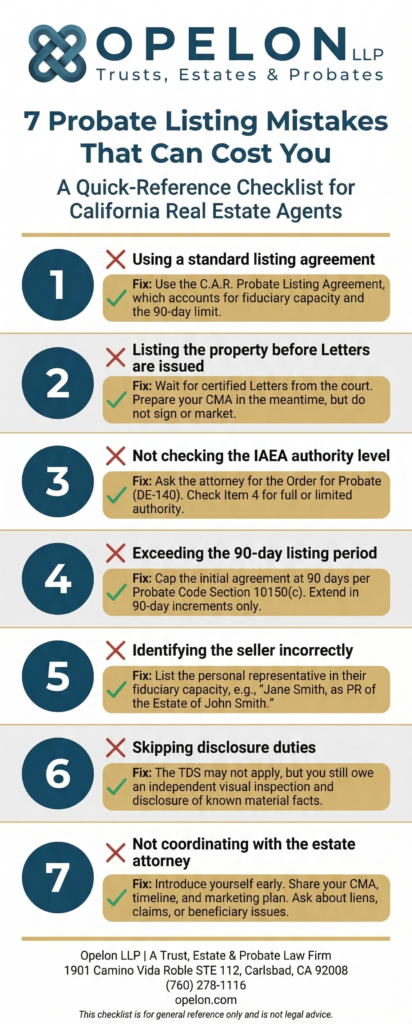
Common Mistakes Realtors Make on Probate Listings
Probate real estate has unique requirements, and agents who apply standard residential assumptions can create serious problems for the estate. Here are the mistakes we see most often in our Carlsbad probate practice.
- Using a standard listing agreement instead of the C.A.R. Probate Listing Agreement. A standard form does not account for the 90-day limitation, fiduciary capacity, or court commission approval. This can expose both the agent and the personal representative to liability.
- Listing the property before Letters are issued. The personal representative has no legal authority to act until the court issues Letters. Marketing or signing agreements before that point is premature and potentially unenforceable.
- Failing to check IAEA authority level. If you price and market a property assuming full authority but the representative only has limited authority, you may set expectations that cannot be met. Buyers expecting a clean close will be unpleasantly surprised by a court hearing and overbid process.
- Ignoring the 90-day listing period cap. Signing a six-month listing agreement violates Probate Code Section 10150(c). If a dispute arises, the agreement may not hold up.
- Identifying the seller incorrectly. The seller is the estate, acting through the personal representative in their fiduciary capacity. Listing “Jane Smith” as the individual seller is wrong and could create title and liability issues.
- Skipping disclosure requirements. The personal representative generally is not required to complete a standard Transfer Disclosure Statement (TDS) because they typically have not lived in the property. However, the agent still has an independent duty to conduct a visual inspection and disclose known material facts. Do not assume that “as-is” means “no disclosures.”
- Not coordinating with the estate attorney. The attorney handles the NOPA (if applicable), the petition for confirmation (if applicable), title clearance, and distribution. Working in isolation from the attorney creates gaps that can delay or derail the sale.
Working with the Estate Attorney: A Realtor’s Best Practice
A strong working relationship with the estate’s probate attorney is one of the biggest advantages you can have on a probate listing. The attorney is managing the legal administration of the estate, and the real property sale is often the most significant transaction in the process.
Here is what the estate attorney typically handles that directly affects your sale:
- Letters and authority verification: The attorney petitions the court and obtains the Letters and IAEA authority.
- NOPA preparation and service: For full-authority sales, the attorney drafts and serves the Notice of Proposed Action.
- Court petition and confirmation hearing: For court-confirmed sales, the attorney files the Report of Sale and represents the estate at the hearing.
- Title clearance: Probate properties often have title issues, including outdated deeds, missing affidavits of death, or unrecorded trust transfers. The attorney coordinates these.
- Commission approval: In court-confirmed sales, the commission must be approved by the judge at the confirmation hearing.
Introduce yourself to the estate attorney early. Share your CMA, your marketing plan, and your timeline. Ask about any issues that might affect the sale, such as outstanding liens, pending creditor claims, or beneficiary disputes. In our experience at Opelon LLP, agents who collaborate with the probate attorney close faster and with fewer complications.
Probate-Specific Disclosures and Forms
Probate sales involve specialized paperwork that goes beyond standard residential forms. Knowing which disclosures apply (and which do not) prevents delays and protects everyone involved.
The personal representative is generally exempt from the standard Transfer Disclosure Statement (TDS) because they usually have no personal knowledge of the property’s condition. However, California Civil Code Section 1102.2 still requires the agent to conduct a reasonably competent visual inspection and disclose findings.
Other forms to be aware of include the Representative Capacity Signature Addendum (C.A.R. form RCSA), which ensures that every signature by the personal representative is made in their fiduciary capacity. You should also use escrow instructions that reference the probate case number and include language about the Notice of Proposed Action or court confirmation process, depending on the track.
Frequently Asked Questions About California Probate Sales for Realtors