



If you are considering adding a child to your bank account for estate planning reasons, you are not alone. It usually starts with good intentions. You walk into the bank with your adult child, fill out some paperwork, and add their name to your checking or savings account. Maybe you want them to help pay bills if you get sick. Maybe someone told you it is a simple way to avoid probate. Or maybe it just feels like the responsible thing to do.
We get it. It can sound quick and easy, and banks often make it simple. But what is easy at the counter can have unintended consequences. Joint ownership may increase exposure to a child’s creditor issues, create distribution outcomes that differ from your broader estate plan, and raise tax or reporting questions depending on how the account is used.
As estate planning attorneys who work with families across San Diego County, we often see confusion and disputes arising from joint account ownership. This article summarizes seven commonly overlooked considerations, a few situations where a joint bank account with an adult child may be appropriate, and California-focused alternatives that may better align account access with broader planning goals.
Key Takeaways
- Adding a child as a joint owner may expose your account to their creditors, lawsuits, or divorce proceedings, even if you deposited all the funds.
- Joint account survivorship features can override your will or trust, potentially leading to unintended or unequal results among your beneficiaries.
- Alternatives such as POD designations, durable powers of attorney, and revocable living trusts may offer better trade-offs than joint ownership.
- A joint bank account is an account-level ownership choice, not an estate plan, and it can produce results that differ from your broader wishes.
- Consider consulting a California estate planning attorney before changing account ownership, especially with significant funds or multiple beneficiaries.
Why Do Parents Add a Child as a Joint Owner on Their Bank Account?
Parents often add an adult child as a joint owner on a bank account to try to avoid California probate for that account, to allow help with bill-paying during illness or aging, or to make access easier after death. These can be reasonable goals. However, joint ownership is a broad tool that can create side effects that may not be obvious at the time the account is opened or retitled.
In many cases, the idea comes from a well-meaning friend, a family member, or even the bank itself. We sometimes call this “coffee shop estate planning” because it is advice passed along casually without any understanding of how it fits into a person’s overall financial picture. And to be fair, it sounds logical. If your child is on the account, they can write checks and pay your bills. When you pass away, the money goes straight to them without probate.
What can get lost in that conversation is the set of legal and practical consequences that can come with joint ownership. Many families do not learn about these issues until a creditor event, family dispute, incapacity, or death brings them to the surface.
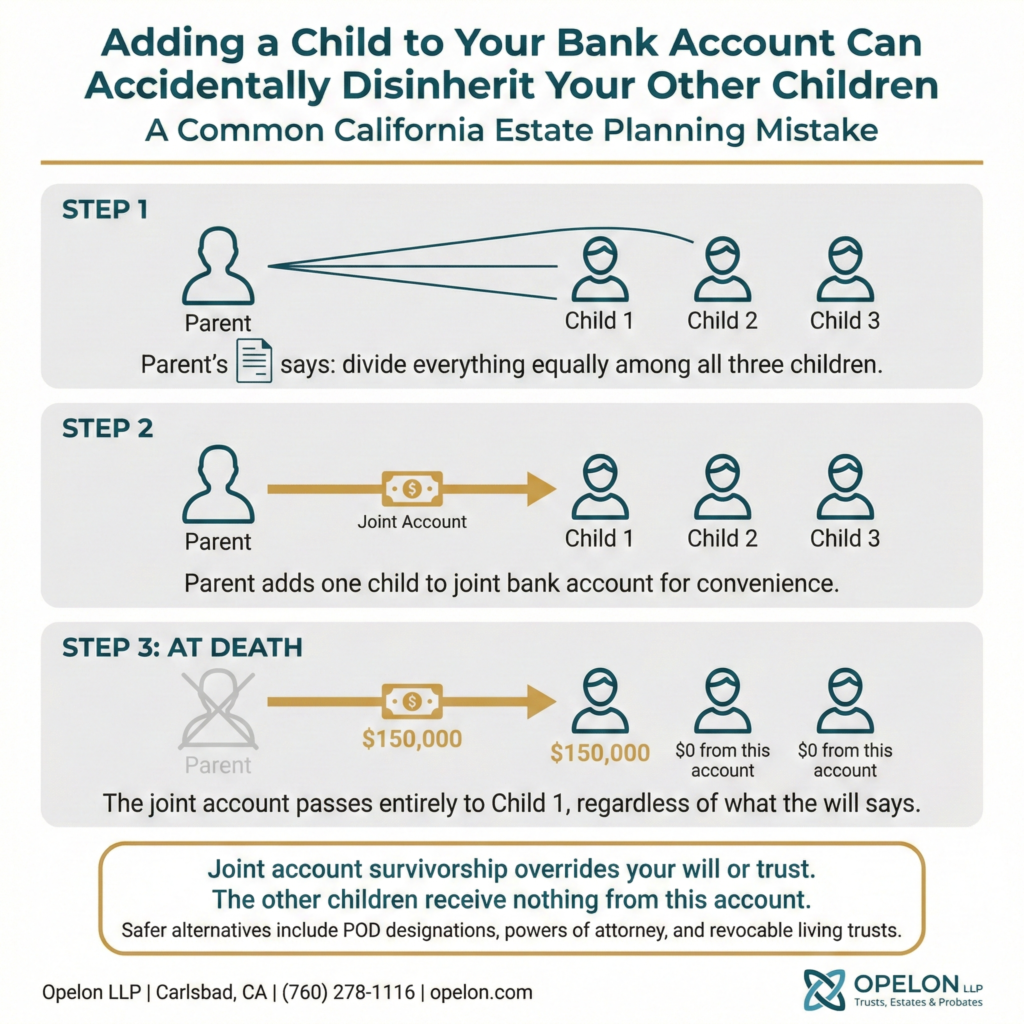
7 Hidden Risks of Making Your Adult Child a Joint Owner on Your Bank Account
Risk 1: Your Account Is Exposed to Your Child’s Creditors
When you add your child as a joint owner, they generally gain rights associated with ownership under the account agreement and applicable law. As a result, a child’s creditors may attempt to reach funds in the account to satisfy debts, judgments, or bankruptcy-related claims, and you may need to rely on contribution and tracing arguments to contest how much is actually reachable.
Think about it this way. You have $150,000 in a savings account. You deposited every dollar. Your child gets into a car accident, and the injured party obtains a judgment. Because your child has an ownership interest in the account, that creditor may try to reach those funds to satisfy the debt.
Under California Probate Code Section 5301, ownership of a joint account is generally based on each party’s net contribution. That concept may support an argument that some or all of the funds are yours, but asserting it can require documentation and, in some disputes, court involvement. This is one reason some families prefer structures that separate “access” from “ownership.”
Risk 2: Your Child’s Divorce Could Put Your Savings at Stake
California is a community property state. If your child is going through a divorce, attorneys and the court process may scrutinize assets your child owns or has access to, including joint accounts. Even if the funds are ultimately shown to be yours, the account may become part of the information-gathering and dispute process.
Even if a court ultimately determines the funds belong to you, joint accounts can be temporarily restricted, disputed, or delayed during proceedings depending on the facts and court orders. If you rely on the account for living expenses, any disruption can be stressful and may create practical hardship.
Risk 3: Joint Ownership Overrides Your Will or Trust
This is a common surprise. In many cases, a joint bank account with right of survivorship passes to the surviving owner at death outside of probate. As a result, the account’s survivorship feature may control disposition of that account even if your will or trust provides for a different overall distribution plan.
Under California Probate Code Section 5302(a), the funds remaining in a joint account at death belong to the surviving party unless there is clear and convincing evidence of a different intent.
Here is a scenario that can occur. A parent has three children and adds one child to a bank account for convenience (for example, because that child lives nearby and helps with bills). The parent’s will says “divide everything equally among my three children.” At death, the survivorship feature on the joint account may result in the named joint owner receiving the account outside probate, while the will governs only the assets that actually pass through the estate.
In that situation, the other children may receive nothing from that particular account. Whether the child who received the account has any obligation to share can depend on the facts and any separate agreements, and voluntary sharing may raise gift-tax reporting questions. This is a common example of how account titling can produce outcomes a family did not intend.
Risk 4: Your Child Can Withdraw Funds Without Your Consent
As a practical matter, many banks will honor withdrawals or transfers by any named joint owner under the account agreement. Banks typically do not adjudicate disputes between co-owners about who is entitled to the funds, so disagreements are often handled between the parties (and sometimes in court) after the fact.
Now, most children would never drain their parent’s account. But life happens. Financial hardship, a job loss, an addiction, or bad judgment can change the picture. We have worked with families where a child made an “excess withdrawal” (as the Probate Code calls it under Section 5301(b)) and the parent was left scrambling to recover the funds.
California law may provide remedies for certain “excess withdrawals” between parties to a joint account, but enforcing those rights can be difficult in practice and may require a formal dispute process. For many families, the possibility of having to pursue a claim against a child is reason enough to consider alternatives.
Risk 5: Potential Gift Tax Complications
Here is one area where California families can take some comfort. Adding your child’s name to a bank account is generally not a completed gift for federal tax purposes, as long as you deposited all the funds and your child does not withdraw anything. The IRS recognizes that the parent can still take back the entire balance. (See Treasury Regulation Section 25.2511-1(h)(4).)
Tax and reporting issues can arise if your child withdraws money for personal use. Depending on the amount and the year, a withdrawal could exceed the annual federal gift tax exclusion (currently $19,000 per recipient for 2025, subject to periodic adjustment) and may require filing a gift tax return (IRS Form 709). Filing does not necessarily mean tax is owed, but it can reduce the available lifetime federal gift and estate tax exemption (currently $13.99 million for 2025, also subject to adjustment).
And while California does not have its own state gift tax, the federal reporting requirements still apply to California residents. It is one more complication that proper estate planning can help avoid.
Risk 6: Possible Medi-Cal Eligibility Problems
For families thinking about long-term care, account ownership and transfers can affect Medi-Cal eligibility depending on the specific program and circumstances. Adding a child to your bank account may raise questions about ownership, access, and whether any transfer occurred, which in some cases could affect eligibility or timing for benefits.
Medi-Cal eligibility rules are complex and can change. If long-term care planning is a concern, it may be worth getting guidance before changing account ownership so you understand how the change could be treated under current rules. This is particularly relevant in high-cost areas such as San Diego County and throughout California.
Risk 7: Undoing It Is Harder Than You Think
One of the most common things we hear is, “Well, if it does not work out, I’ll just take them off the account.” It sounds simple, but removing a joint owner can create its own complications.
If you later try to remove your child from an account that held significant funds, there can be questions about whether any taxable gift or reporting issue occurred depending on the facts. And if you lose capacity before making changes, you may be limited in what you can do without additional legal authority, which in some cases can involve court proceedings (such as a conservatorship).
A revocable living trust, by contrast, can be changed at any time while you have capacity. You stay in control. A joint account gives up a piece of that control from the moment your child’s name goes on the signature card.
When a Joint Bank Account with Your Child Might Make Sense
We do not want to suggest that a joint bank account with a child is always a mistake. There are limited situations where it can be appropriate, and it is important to weigh the pros and cons of adding an adult child to your bank account honestly.
If you have only one child and you want them to have immediate access to funds after your death, a joint account accomplishes that. If the total balance is modest and the account is just one piece of a larger estate plan, the risks may be manageable. And for some families, the convenience of allowing a trusted child to pay bills during a health crisis is worth the trade-offs, especially if a power of attorney is not yet in place.
The key is making sure a joint account (if used) fits into your overall plan rather than serving as the entire plan. When joint ownership is used as a stand-alone solution, it can increase the likelihood of unintended outcomes.
Joint Account vs. Safer Alternatives: A Side-by-Side Comparison
Feature | Joint Account | POD Account | Power of Attorney | Revocable Living Trust |
Avoids probate | Yes | Yes | No | Yes |
Child can access funds during your life | Yes | No | Yes (as agent) | Yes (if named trustee) |
Exposed to child’s creditors | Yes | No | No | No |
Overrides your will or trust | Yes | No | N/A | N/A (trust controls) |
You keep full control | No | Yes | Yes | Yes |
Protects equal distribution | No | Yes (multiple payees) | N/A | Yes |
Protects against incapacity | Partial | No | Yes | Yes |
4 Safer Alternatives to Adding Your Child to Your Bank Account in California
1. Pay-on-Death (POD) Designation
A pay-on-death (POD) account can allow you to name one or more beneficiaries who receive the account balance after your death (subject to the bank’s forms and applicable California law). During your lifetime, you generally keep control of the account, and beneficiaries typically have no access or ownership rights while you are alive.
You can often name multiple POD beneficiaries so the account can be distributed among more than one person. If circumstances change, beneficiary designations can typically be updated by completing your bank’s required forms. For many families, POD designations are a relatively simple way to avoid probate for a specific account.
2. California Durable Power of Attorney
If your main concern is allowing someone to help manage finances if you cannot, one commonly used tool is a durable power of attorney. It can authorize your child (or another trusted person) to act as your agent for tasks such as paying bills and managing accounts, subject to the document’s terms and any bank requirements.
A key difference is that a power of attorney generally provides authority to act, not ownership of your money. Because the agent is not an owner, this structure may reduce (though not eliminate) the risk that the account is treated as the child’s asset for creditor or divorce purposes. If you change your mind, you can generally revoke a power of attorney while you have capacity. (See California Probate Code Section 4123.)
Learn more about the California Durable Power of Attorney on our website.
3. Revocable Living Trust
For many California families, a revocable living trust is a commonly used way to help avoid probate for trust assets, plan for incapacity, and document how assets are to be distributed after death. Typically, you create the trust, retitle certain assets (including some bank accounts) into the trust, and name a successor trustee (often an adult child) who can manage trust assets if you become incapacitated or after you pass away.
A trust document can spell out who receives what, when, and how, which may reduce ambiguity compared to informal arrangements. Using a trust can also avoid joint ownership of the account itself and may reduce the risk of unintended disinheritance caused by survivorship titling. Because the trust is revocable, you can generally change it while you are alive and have capacity.
For families in Carlsbad, Oceanside, Encinitas, and throughout San Diego County, trust-based planning is a common approach to reducing probate exposure and clarifying management and distribution of assets, though the right structure depends on each family’s goals and circumstances.
Related: California Revocable Living Trust and Estate Planning Checklist: 21 Steps
4. Authorized Signer (Not Joint Owner)
Many banks allow you to add an authorized signer to your account. This can allow your child to make transactions on your behalf without becoming an owner, subject to the bank’s rules. The signer’s authority typically ends at death, and the account then passes according to its title and any beneficiary designation (or, if neither applies, through estate administration).
This option is more limited than a power of attorney and is not available at every bank. But if you want a quick way to give your child access for day-to-day bill paying without the ownership risks of a joint account, it is worth asking your bank about.
How to Protect Your Bank Accounts as Part of Your California Estate Plan
If you are thinking about adding a child to your bank account, or if you have already done so, here are general planning steps many families use to review whether account access and ownership align with their goals.
- Review all your bank account titles and beneficiary designations. Check every checking, savings, and money market account. Note who is listed as an owner, beneficiary, or authorized signer.
- Identify your goals for each account. Do you want someone to help pay bills? Avoid probate? Ensure equal distribution among your children? Each goal has a specific tool.
- Match the tool to the goal. For example, some people use POD designations to help avoid probate for a specific account, powers of attorney to authorize financial management during incapacity, and trusts to coordinate control and distribution. The best fit depends on your circumstances.
- Make sure account ownership matches your estate plan. If you have a revocable living trust, your bank accounts should be titled in the name of the trust. Mismatched titles are one of the most common estate planning mistakes.
- Consider consulting a qualified California estate planning attorney. An attorney can help review your overall financial picture and identify whether account titles and beneficiary designations are consistent with your broader planning documents and goals.
- Document your decisions and tell your family. Keep a record of every account, its title, and its beneficiary designation. Make sure the people you trust know where to find this information.
Related: Estate Planning Checklist: 21 Steps