



The way you hold title to real property in California can quietly shape your entire estate plan. If you own a home or investment property with someone else, the form of property co-ownership you choose determines what happens to that property when you pass away, whether your family will face probate, and how much they may owe in capital gains taxes. This article explores joint tenants vs. tenants in common in California estate planning so you can choose the right approach for your family.
For many San Diego County families, this decision comes down to two options: joint tenancy and tenancy in common. Joint tenancy includes a right of survivorship that lets property pass directly to the surviving owner without probate. Tenancy in common gives each owner the freedom to leave their share to anyone they choose through a will or trust. California also offers a third path for married couples, community property with right of survivorship, which combines probate avoidance with a significant tax advantage that neither joint tenancy nor tenancy in common can match. Below, we compare joint tenancy vs. tenants in common in California under current law.
This guide breaks down how each form of title works under California law, when each option makes the most sense, and the mistakes our San Diego estate planning clients most often make.
Key Takeaways
|
What Does It Mean to Hold Title in California?
How you hold title defines your legal ownership rights, your obligations during your lifetime, and what happens to the property after your death. In California, the form of title is not just a line on a deed. It controls whether your co-owner, your spouse, your children, or the probate court decides who receives the property when you are gone. Your real estate title choice is, therefore, a core estate planning decision.
California law recognizes several ways to hold title to real property. The most common forms include:
- Joint tenancy with right of survivorship (Civil Code §683)
- Tenancy in common (Civil Code §685)
- Community property (Family Code §760)
- Community property with right of survivorship (Civil Code §682.1)
- Sole ownership in one person’s name alone
Each option affects estate planning, probate exposure, and taxes differently. Choosing the right form of title is one of the most important decisions you can make when building your estate planning checklist.
Joint Tenancy in California: How It Works
Joint tenancy is a form of co-ownership in which two or more people own property in equal, undivided shares. The defining feature is the right of survivorship. When one joint tenant dies, their interest automatically passes to the surviving joint tenant or tenants at the moment of death, without going through probate (Civil Code §683.2(c)). For joint tenants, California law provides a clear process and timeline for confirming the transfer.
To create a valid joint tenancy in California, the deed must expressly state that the owners hold title as joint tenants with right of survivorship. Without that language, California law presumes a tenancy in common (Civil Code §686). All joint tenants must also hold equal shares. If you want unequal ownership, joint tenancy is not an option.
Clearing title after a joint tenant’s death is straightforward. The surviving owner records an affidavit of death of joint tenant, along with a certified death certificate, with the county recorder’s office (Probate Code §§210–212). There is no need to open a California probate case.
Benefits of Joint Tenancy
These joint tenancy benefits matter for many families:
- Avoids probate. Property passes directly to the surviving owner by operation of law, without court involvement.
- Simple transfer process. Recording an affidavit of death and a death certificate clears title quickly.
- Creditor protection. A deceased joint tenant’s interest generally passes free of the decedent’s separate debts, because the property vests in the survivor at the moment of death.
Risks and Drawbacks of Joint Tenancy
- No control over who inherits. The surviving joint tenant receives the property automatically. You cannot direct your share to children, grandchildren, or anyone else through a will or trust.
- Only a half stepped-up basis for spouses. When married couples hold property as joint tenants rather than community property, only the deceased spouse’s half receives a stepped-up basis at death (IRC §1014(a)). The surviving spouse’s half keeps its original basis, which can mean a larger capital gains tax bill if the property is later sold.
- Unilateral severance risk. Any joint tenant can sever the joint tenancy without the other owner’s consent by recording a written instrument showing the intent to sever (Civil Code §683.2(a)). This converts the ownership to a tenancy in common and eliminates the right of survivorship.
- Exposure to a co-owner’s creditors during life. A creditor of one joint tenant can force a sale of the property to satisfy a judgment or lien, which would sever the joint tenancy.
- Only delays probate. Joint tenancy avoids probate at the first death, but the property is fully exposed to probate when the last surviving joint tenant dies, unless other planning is in place.
Tenancy in Common in California: How It Works
A tenancy in common is a form of co-ownership in which each owner holds a separate, undivided interest in the property. There is no right of survivorship. When a tenant in common dies, their share does not pass automatically to the other co-owners. Instead, it becomes part of the deceased owner’s estate and passes according to their will, trust, or California’s intestacy laws (Civil Code §685; Probate Code §§6400–6414).
Unlike joint tenancy, tenants in common can hold unequal shares. One owner might hold a 70% interest while the other holds 30%. Each owner can sell, gift, or transfer their share independently without the other owner’s consent.
Benefits of Tenancy in Common
- Full control over your share. You can leave your interest to anyone you choose, whether that is a spouse, a child, a friend, or a charity.
- Flexible ownership percentages. Co-owners can hold unequal shares that reflect their actual financial contributions.
- Works well with trusts. Each owner can transfer their share into a revocable living trust, which avoids probate for that interest while preserving full control over who inherits. Many investors also choose to transfer title to a trust as part of funding a comprehensive estate plan.
Risks and Drawbacks of Tenancy in Common
- Probate exposure. Without a trust or other planning, a deceased tenant in common’s share passes through probate if it exceeds California’s small estate threshold of $208,850 (effective April 1, 2025) (Probate Code §13100).
- Potential for co-owner disputes. Disagreements about property use, maintenance costs, or whether to sell can lead to conflict, because any co-owner can file a partition action to force a sale.
- No automatic transfer at death. The surviving co-owner has no special right to the deceased owner’s share unless the deceased owner’s estate plan provides for it.
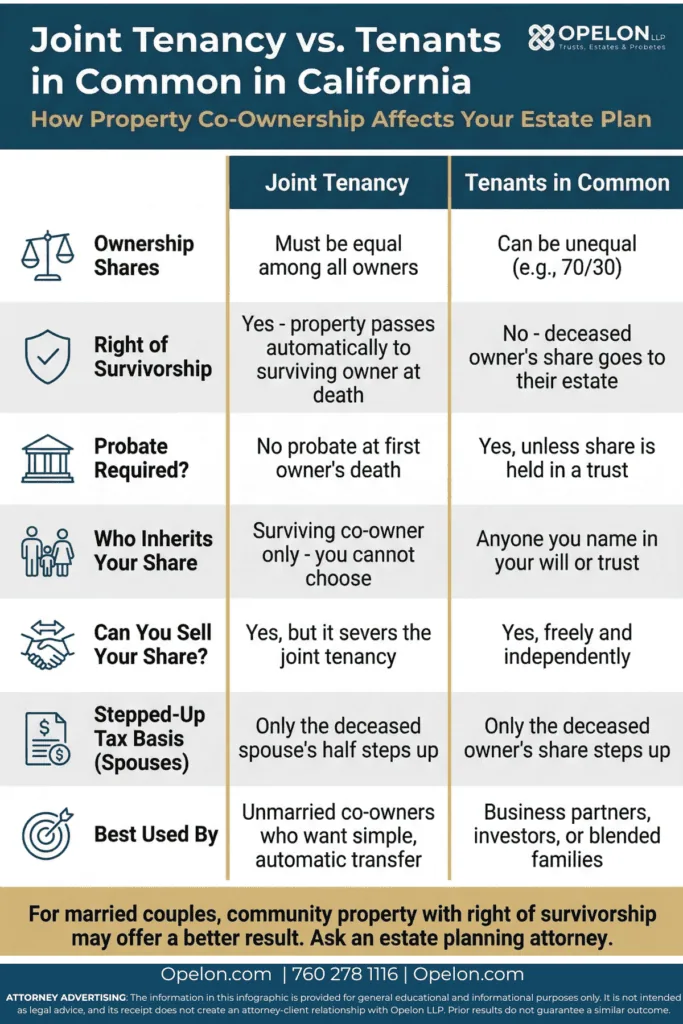
Joint Tenancy vs. Tenants in Common: Side-by-Side Comparison
The table below highlights the key differences between joint tenancy and tenancy in common under California law. Understanding these distinctions is essential for making an informed decision about how to hold title to your property.
Feature | Joint Tenancy | Tenancy in Common |
Legal authority | Civil Code §683 | Civil Code §685 |
Ownership shares | Must be equal | Can be unequal |
Right of survivorship | Yes | No |
Probate required at first death | No | Yes, unless share is in a trust |
Can choose who inherits your share | No (goes to surviving co-owner) | Yes (via will or trust) |
Can sell or transfer share independently | Yes (severs the joint tenancy) | Yes |
Stepped-up basis at death (spouses) | Only decedent’s half | Only decedent’s half |
Common use case | Unmarried co-owners who want simplicity | Business partners, investors, blended families |
Community Property with Right of Survivorship: The Option Many California Couples Overlook
For married couples in California, community property with right of survivorship often provides a better result than either joint tenancy or tenancy in common. This form of title, established under Civil Code §682.1, combines two powerful advantages: the property passes to the surviving spouse without probate (just like joint tenancy), and both halves of the property receive a full stepped-up basis at the first spouse’s death for federal income tax purposes (IRC §1014(b)(6)).
The stepped-up basis advantage is the key reason many estate planning attorneys recommend this form of title for married couples. Here is a simplified example of how it works:
Joint Tenancy | Community Property w/ ROS | |
Original purchase price | $400,000 | $400,000 |
Fair market value at first spouse’s death | $1,200,000 | $1,200,000 |
Surviving spouse’s new tax basis | $800,000 (only decedent’s half steps up) | $1,200,000 (both halves step up) |
Taxable gain if sold immediately | $400,000 | $0 |
In the example above, the surviving spouse holding title as community property with right of survivorship could sell the home immediately after the first spouse’s death and owe zero capital gains tax. With joint tenancy, that same sale could trigger a tax bill on $400,000 of gains. At current federal capital gains rates, that difference could amount to tens of thousands of dollars.
Changing title from joint tenancy to community property with right of survivorship does not trigger a property tax reassessment because the property still passes to the spouse at the first death. The process requires preparing and recording a new deed and filing a Preliminary Change of Ownership Report with the county assessor. An estate planning attorney can prepare these documents and confirm that the change does not create any unintended consequences for your overall estate plan.
How Your Choice of Title Affects Probate in California
The form of title you choose directly determines whether your property will pass through probate. In California, the probate process can take 12 to 18 months or longer and involves statutory fees calculated as a percentage of the gross estate value under Probate Code §10810.
- Joint tenancy property avoids probate at the first owner’s death, but the surviving owner’s interest will be subject to probate when that owner later dies, unless additional planning is in place.
- Tenancy in common property goes through probate when any co-owner dies, unless the deceased owner’s share is held in a trust or qualifies for California’s small estate procedures (estates under $208,850 as of April 1, 2025).
- Community property with right of survivorship avoids probate at the first spouse’s death, just like joint tenancy.
For this reason, many families find that the most reliable way to avoid probate for real property is to transfer the property into a revocable living trust.
Tax Implications of Property Title Choices in California
Capital Gains and the Stepped-Up Basis
The way you hold title determines how much of the property’s tax basis steps up when one owner dies. Assets inherited at death generally receive a new tax basis equal to the fair market value on the date of death (IRC §1014(a)). This stepped-up basis eliminates capital gains tax on any appreciation that occurred during the deceased owner’s lifetime.
- Joint tenancy (spouses): Only the deceased spouse’s half receives a stepped-up basis. The surviving spouse’s half keeps its original cost basis.
- Tenancy in common: Only the deceased owner’s share receives a stepped-up basis. Same result as joint tenancy for tax purposes.
- Community property: Both halves receive a full stepped-up basis at the first spouse’s death (IRC §1014(b)(6)). This is a major tax advantage unique to community property states like California.
Proposition 19 and Property Tax Reassessment
Under Proposition 19 (effective February 16, 2021), most transfers of California real property trigger a property tax reassessment. The parent-child exclusion now applies only to a parent’s primary residence, and only if the child files a claim within one year and makes the home their own primary residence (Revenue and Taxation Code §63.2). Transfers of investment property and vacation homes between parents and children no longer qualify for an exclusion.
Changing title between spouses, including converting joint tenancy to community property, does not trigger reassessment. However, transferring property to a non-spouse co-tenant or adding a new owner to a deed may result in a partial or full reassessment.
How to Change the Way You Hold Title to California Property
Changing the form of title requires preparing and recording a new deed with the county recorder’s office. The process involves several steps, and getting the details right matters. An error on the deed can create title problems that are expensive to fix.
- Determine your goal. Clarify why you want to change title and what form of ownership best fits your estate planning strategy.
- Prepare the new deed. A grant deed or interspousal transfer deed (for married couples) must include the correct legal description, the names of all parties, and the new form of title.
- File a Preliminary Change of Ownership Report (PCOR). This form is submitted to the county assessor along with the recorded deed. The PCOR tells the assessor whether the transfer triggers a property tax reassessment.
- Record the deed. File the deed with the San Diego County Recorder’s Office (or the recorder’s office in the county where the property is located). Recording fees vary by county.
- Update your estate plan. If you hold property in a revocable living trust, make sure the new deed is consistent with your trust’s terms. A title change without updating your trust can create conflicts.
For married couples converting from joint tenancy to community property with right of survivorship, the transmutation must be in a signed writing that expressly states the change, as required by Family Code §852. Some counties also require a Transfer Tax Affidavit.
When Each Form of Title Makes the Most Sense
Joint Tenancy May Be a Good Fit When:
- Unmarried co-owners want a simple way to pass property to the surviving owner without probate.
- The co-owners do not need flexibility in choosing who inherits.
- The property has not appreciated significantly (minimizing the stepped-up basis disadvantage).
Tenancy in Common May Be a Good Fit When:
- Co-owners want to hold unequal shares that reflect different financial contributions.
- Each owner wants to leave their share to someone other than the co-owner, such as children from a prior marriage.
- The property is an investment or business asset with multiple owners.
- Each owner plans to hold their share in a revocable living trust to avoid probate.
Community Property with Right of Survivorship May Be the Best Choice When:
- A married couple wants to avoid probate at the first death and receive the full double stepped-up basis.
- The couple does not need the property held in a bypass or marital trust at the first death.
- The property has appreciated significantly since purchase.
See Also For a deeper look at how a revocable living trust can complement any form of title, read our guide to the California revocable living trust. If you are not sure whether your current estate plan addresses how your property is titled, our estate planning checklist can help you identify gaps. |
Frequently Asked Questions About Property Title and Estate Planning in California
Yes. Under Civil Code §683.2(c), a joint tenant’s interest passes to the surviving joint tenant or tenants at the moment of death, by operation of law. The surviving owner does not need to go through probate. They clear title by recording an affidavit of death of joint tenant and a certified death certificate with the county recorder. For joint tenants, California law provides this streamlined process to avoid court.
Yes. Each tenant in common owns a separate, undivided interest that they can sell, gift, or transfer at any time without the consent of the other co-owners (Civil Code §685). However, finding a buyer for a partial interest in a property can be difficult in practice.
No. Joint tenancy and community property are different forms of title with different legal and tax consequences. The most significant difference for married couples is the tax basis treatment at death. Community property gives both halves a full stepped-up basis (IRC §1014(b)(6)), while joint tenancy only steps up the deceased spouse’s half. Many California estate planning attorneys recommend converting spousal joint tenancy to community property for this reason.
Under Probate Code §223(b), if there is no clear and convincing evidence that one joint tenant survived the other, the property is split in half. One half is treated as if the first joint tenant survived, and the other half as if the second survived. Each half is then distributed according to each owner’s estate plan or intestacy laws.
Yes. Under Civil Code §683.2(a), any joint tenant can sever the joint tenancy unilaterally by recording a written instrument that shows the intent to sever. Once severed, the former joint tenants hold the property as tenants in common, and the right of survivorship no longer applies. The severance must be recorded before the severing owner’s death to be effective.
In most cases, community property with right of survivorship provides a better result for married couples. It avoids probate at the first death (like joint tenancy) and also provides a full stepped-up basis on both halves of the property. An experienced estate planning attorney can advise based on your specific goals and assets.
Yes. When you transfer property into a revocable living trust, title is held in the name of the trustee. This is one of the key steps in fully funding your trust.
A revocable transfer-on-death (TOD) deed allows a property owner to name a beneficiary who will receive the property at the owner’s death, without probate. However, TOD deeds are limited to residential property of 1 to 4 units and carry restrictions that make them unsuitable for many families. A TOD deed also cannot override a joint tenancy or community property with right of survivorship designation. For more details, see our guide to the California TOD deed.
Protect Your Family with the Right Title Strategy
How you hold title to property is one of the most important, and most often overlooked, pieces of a California estate plan. The right choice can help your family avoid probate, reduce taxes, and carry out your wishes exactly as you intended. The wrong choice can lead to court proceedings, unexpected tax bills, and family conflict.
At Opelon LLP, we help San Diego County families review how their property is titled and build estate plans that work together as a whole. Whether you need to change a deed, set up a revocable living trust, or create a comprehensive estate plan from scratch, our Carlsbad attorneys can guide you through the process.
Schedule a free estate planning consultation to find out which form of title is right for your property and your family.
About the Author Matt Odgers, Esq. is a Founding Partner at Opelon LLP in Carlsbad, California, where he oversees marketing and operations. A San Diego County native who grew up in Ramona, Matt earned his J.D. from Thomas Jefferson School of Law and holds a B.A. in Political Science from Purdue University. He has been recognized by Best Lawyers: Ones to Watch in America (2026) and Super Lawyers Rising Stars. California State Bar #290722. |
Disclaimer: This article provides general information about California estate planning law and is for educational purposes only. It does not constitute legal advice and does not create an attorney-client relationship. Estate planning laws are complex and change frequently. The information in this article was accurate as of March 2026. For advice about your specific situation, please consult with a qualified California estate planning attorney.