



What Is the Federal Estate Tax Exemption for High-Net-Worth Estates in 2026?
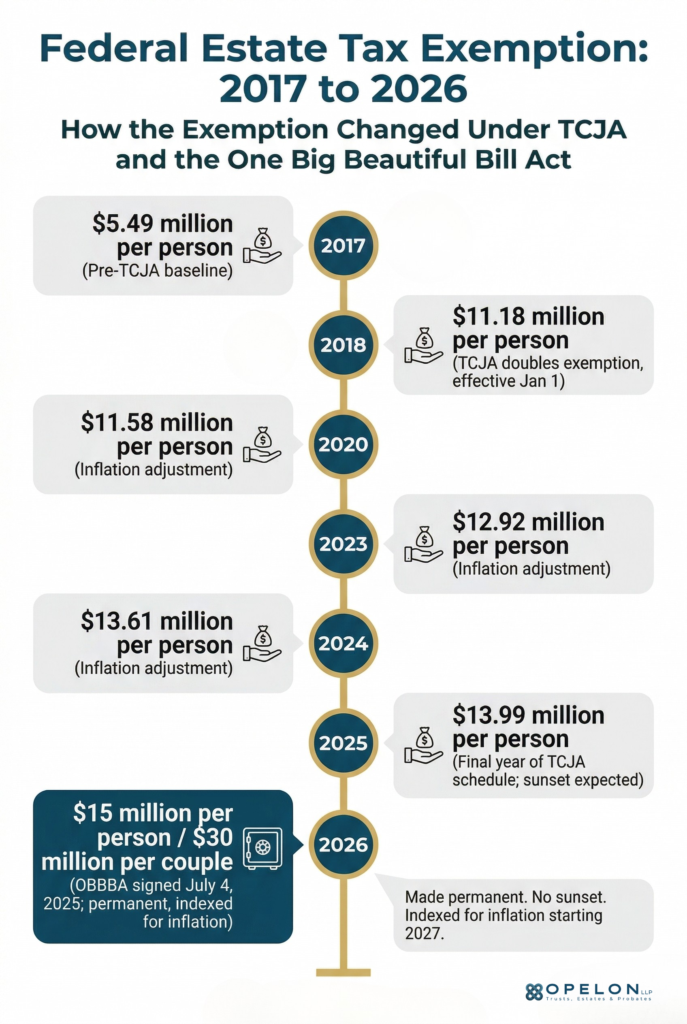
The federal estate tax exemption is $15 million per individual and $30 million per married couple, effective January 1, 2026, under the One Big Beautiful Bill Act (OBBBA) signed into law on July 4, 2025. This exemption applies to the combined value of lifetime gifts and assets transferred at death. The OBBBA made the increased exemption permanent and indexed it for inflation beginning in 2027. Any estate value above the exemption is taxed at a top rate of 40% under IRC Section 2001.
California does not impose a separate state estate tax or inheritance tax. The state repealed both taxes in 1982. However, many California residents, particularly those in high-cost areas like San Diego County, Carlsbad, and La Jolla, hold real estate portfolios and business interests that push their estate values well above the $15 million federal threshold.
For married couples, portability allows a surviving spouse to use the deceased spouse’s unused exemption by filing an estate tax return (IRS Form 706) after the first death. This preserves the full $30 million combined exemption. However, the generation-skipping transfer (GST) tax exemption is not portable between spouses, which means separate planning is required for transfers to grandchildren and later generations. The federal estate tax exemption amount page on our site explains the history and current rules in more detail.
Why a Standard Estate Plan Is Not Enough for High-Net-Worth Estates
A revocable living trust is the foundation of most California estate plans. It avoids probate, maintains privacy, and provides management during incapacity. But for estates above the $15 million threshold, a revocable trust alone does nothing to reduce estate taxes. Every asset inside a revocable trust is included in the grantor’s taxable estate because the grantor retains the power to revoke or amend the trust during their lifetime.
High-net-worth estate planning in California requires a layered approach. The revocable living trust remains the organizational core, but irrevocable structures must be added on top to shift appreciating assets out of the taxable estate. The difference between planning and not planning is significant. For a $20 million estate, for example, the federal estate tax on the amount exceeding a $15 million exemption is $2 million. For a $30 million estate owned by a single individual, the exposure is $6 million. A comprehensive estate planning checklist helps identify which tools apply to your situation.
How Do Irrevocable Trusts Reduce Estate Taxes in California?
Irrevocable trusts are the primary tool for removing assets from a high-net-worth individual’s taxable estate in California. Once assets are transferred to an irrevocable trust, the grantor gives up the right to revoke, amend, or directly control those assets. In exchange, those assets (and all future appreciation) are no longer included in the grantor’s estate for federal estate tax purposes.
Grantor Retained Annuity Trusts (GRATs)
A GRAT is an irrevocable trust in which the grantor retains the right to receive annuity payments for a specified term. The grantor transfers assets to the GRAT, receives fixed annuity payments back over the trust term, and the remaining assets pass to beneficiaries at the end of the term. Under IRC Section 2702, the taxable gift is calculated as the value of the transferred assets minus the present value of the retained annuity interest.
The power of a GRAT lies in its ability to transfer appreciation without gift tax. If the GRAT assets outperform the IRS Section 7520 interest rate used to value the annuity, the excess growth passes to the beneficiaries tax-free. A “zeroed-out” GRAT sets the annuity payments high enough that the calculated gift is nearly zero, making it a low-risk, high-reward strategy for transferring wealth.
The primary risk is that the grantor must survive the GRAT term. If the grantor dies before the term expires, some or all of the trust assets are pulled back into the taxable estate.
Irrevocable Life Insurance Trusts (ILITs)
An irrevocable life insurance trust owns a life insurance policy on the grantor’s life. Because the trust (not the grantor) owns the policy, the death benefit is excluded from the grantor’s taxable estate. For high-net-worth individuals, an ILIT provides a source of liquidity to pay estate taxes, equalize inheritances, or replace wealth donated to charity.
The grantor makes annual gifts to the ILIT, which the trustee uses to pay premiums. These gifts typically qualify for the annual gift tax exclusion ($19,000 per beneficiary in 2025 and 2026) through Crummey withdrawal rights. The ILIT must be drafted carefully to avoid estate inclusion under IRC Sections 2035 and 2042.
Intentionally Defective Grantor Trusts (IDGTs)
An IDGT is an irrevocable trust that is treated as a separate entity for estate tax purposes but as the grantor’s own trust for income tax purposes. The grantor sells appreciated assets to the IDGT in exchange for an installment note. Because the trust is a grantor trust, the sale does not trigger capital gains tax. The assets grow inside the trust, and all appreciation above the note’s interest rate passes to the beneficiaries free of gift and estate tax.
IDGTs are frequently used in combination with GRATs and family limited partnerships as part of a comprehensive high-net-worth estate plan in California.
What Charitable Giving Strategies Reduce Estate Taxes for High-Net-Worth Families?
Charitable giving is a cornerstone of estate tax planning for high-net-worth individuals in California. Properly structured charitable gifts reduce the taxable estate, generate income tax deductions, and allow families to support causes that reflect their values.
Charitable Remainder Trusts (CRTs)
A charitable remainder trust provides an income stream to the grantor (or other non-charitable beneficiary) for a term of years or for life, with the remaining assets passing to a qualified charity at the end of the term. CRTs are particularly effective for highly appreciated assets because transferring assets to the CRT avoids capital gains tax on the sale. The grantor receives a current income tax deduction for the present value of the charitable remainder interest.
CRTs come in two forms. A charitable remainder annuity trust (CRAT) pays a fixed annuity amount each year. A charitable remainder unitrust (CRUT) pays a fixed percentage of the trust’s value, recalculated annually.
Charitable Lead Trusts (CLTs)
A charitable lead trust works in the opposite direction from a CRT. The charity receives income payments for a specified term, and the remaining assets pass to the grantor’s beneficiaries (typically children or grandchildren) at the end of the term. The gift tax value of the transfer to the beneficiaries is reduced by the present value of the charitable lead interest. When interest rates are low relative to the trust’s investment returns, a CLT can transfer significant wealth to the next generation at minimal gift tax cost.
Combining ILITs with Charitable Giving
A common California estate planning strategy for high-net-worth families combines a CRT with an ILIT. The grantor creates a CRT with appreciated assets, receives income from the CRT, and uses a portion of that income to fund premiums on a life insurance policy held in an ILIT. The ILIT death benefit replaces the wealth that was donated to charity, effectively allowing the family to benefit from the charitable deduction while still transferring the full asset value to heirs.
How Does Lifetime Gifting Reduce Estate Taxes for High-Net-Worth Individuals?
Lifetime gifting is one of the most direct ways to reduce the size of a taxable estate. Every dollar gifted during life is a dollar removed from the estate at death, along with all future appreciation on that gifted asset.
Annual Exclusion Gifts
Under IRC Section 2503, each individual can give up to $19,000 per recipient per year (2025 and 2026) without using any of their lifetime exemption. Married couples can combine their exclusions to give $38,000 per recipient. For a family with three children and six grandchildren, annual exclusion gifts alone can transfer $342,000 per year ($684,000 for a married couple) outside the taxable estate.
Direct Payments for Education and Medical Expenses
Payments made directly to educational institutions for tuition or to medical providers for medical expenses are excluded from gift tax entirely under IRC Section 2503(e). These payments do not count against the annual exclusion or the lifetime exemption. This is a powerful tool for high-net-worth grandparents funding private school or college tuition for grandchildren.
Gifts to Irrevocable Trusts
Rather than making outright gifts, high-net-worth individuals often transfer assets to irrevocable trusts for the benefit of their children and grandchildren. When structured with Crummey withdrawal rights, these transfers qualify for the annual gift tax exclusion. The trust provides professional management, creditor protection, and control over distributions that an outright gift does not. For more on funding trust assets, see our detailed guide.
What Is Generation-Skipping Transfer Tax Planning?
The generation-skipping transfer (GST) tax is a separate federal tax imposed on transfers to beneficiaries who are two or more generations below the transferor (typically grandchildren or great-grandchildren). The GST tax rate equals the top estate tax rate of 40%. Each individual has a GST exemption equal to the basic exclusion amount ($15 million in 2026), but unlike the estate tax exemption, the GST exemption is not portable between spouses.
Dynasty Trusts
A dynasty trust is designed to hold assets for multiple generations while avoiding estate tax at each generational level. California’s rule against perpetuities limits trust duration to the longer of a measuring life plus 21 years or 90 years. Within those limits, a dynasty trust allows assets to grow and compound for the benefit of grandchildren and great-grandchildren without triggering estate or GST tax at any intervening generation.
Allocating the grantor’s GST exemption to a dynasty trust at the time of funding ensures that the trust (and all future growth) remains exempt from GST tax. Proper allocation requires filing a federal gift tax return (IRS Form 709) in the year of the transfer.
What California-Specific Issues Affect High-Net-Worth Estate Planning?
California law creates several unique considerations for high-net-worth estate planning that do not exist in every state.
Community Property and Separate Property
California is a community property state. Assets acquired during marriage are generally owned equally by both spouses. This affects estate tax planning because each spouse owns only their half of community property. Proper characterization of assets as community or separate property is critical for determining each spouse’s taxable estate and for maximizing the stepped-up basis at death.
Proposition 19 and Property Tax Reassessment
Proposition 19, effective February 16, 2021, significantly changed California’s property tax reassessment rules for inherited property. Under current law, children who inherit a parent’s primary residence receive a limited property tax exclusion, but only if they use the property as their own primary residence and only for the first $1 million of assessed value increase. Investment properties and second homes transferred to children are reassessed at current market value. High-net-worth families with significant California real estate holdings must account for Proposition 19’s impact when deciding how to structure transfers.
California Probate Costs for Unplanned Estates
If assets are not properly titled in trusts or structured to avoid probate, California’s statutory probate fee schedule under Probate Code Section 10800 applies. For a $2 million estate, combined attorney and personal representative fees total approximately $66,000, calculated on the gross value of the estate (mortgage balances are not subtracted). For high-net-worth families, ensuring that assets are properly titled and beneficiary designations are current is essential to avoiding unnecessary probate costs. The full California probate fee schedule is available on our site.
How Should High-Net-Worth Individuals Plan for Incapacity in California?
Estate planning for high-net-worth individuals must address incapacity, not just death. Complex portfolios, business interests, and multi-state assets require detailed planning for who will manage these assets if the owner cannot.
Durable Power of Attorney for Financial Matters
A California durable power of attorney authorizes a trusted agent to manage financial affairs, including investment accounts, business operations, real estate transactions, and tax filings. Under California Probate Code Section 4000 et seq., the power of attorney must be signed, dated, notarized, and witnessed. For high-net-worth individuals, the power of attorney should include specific authority to manage LLCs, limited partnerships, and trust-related transactions.
Advance Health Care Directive
California’s advance health care directive (Probate Code Section 4700) combines the appointment of a health care agent with instructions for end-of-life care. A separate HIPAA authorization ensures that the agent can access medical records needed to make informed decisions.
Comparison: Estate Planning Tools for High-Net-Worth Estates
|
Tool |
Estate Tax Benefit |
Income Tax Benefit |
Best For |
|
Revocable Living Trust |
None (included in estate) |
Stepped-up basis at death |
Probate avoidance and management |
|
GRAT |
Removes appreciation above Section 7520 rate |
Grantor trust (no income tax to trust) |
Transferring appreciating assets |
|
ILIT |
Excludes life insurance proceeds from estate |
Death benefit received income-tax-free |
Estate liquidity and tax payment |
|
IDGT |
Removes assets and future appreciation from estate |
No capital gains on sale to trust |
Transferring business interests |
|
CRT |
Removes donated assets from estate |
Avoids capital gains; income tax deduction |
Highly appreciated assets and income needs |
|
CLT |
Reduces gift value of remainder to beneficiaries |
Grantor CLT provides income tax deduction |
Transferring wealth to next generation |
|
Dynasty Trust |
Avoids estate tax at each generation |
Varies based on trust design |
Multi-generational wealth preservation |
How to Build a High-Net-Worth Estate Plan in California: Step-by-Step
- Inventory all assets and liabilities. List every asset, its current value, how it is titled, and whether it is community or separate property. Include real estate, business interests, investment accounts, retirement accounts, life insurance, and digital assets.
- Calculate your estate tax exposure. Subtract the applicable exemption ($15 million per person in 2026) from the total estate value. Multiply the excess by 40% to estimate the federal estate tax. Account for any prior taxable gifts that have used a portion of the lifetime exemption.
- Establish or update the revocable living trust. The revocable trust serves as the foundation for probate avoidance, incapacity management, and distribution planning. Ensure it reflects current California law and family circumstances.
- Add irrevocable trust structures for tax reduction. Work with your estate planning attorney to determine which irrevocable trusts (GRATs, ILITs, IDGTs, dynasty trusts) are appropriate for your estate’s size, composition, and goals.
- Implement a gifting strategy. Maximize annual exclusion gifts, direct education and medical payments, and planned gifts to irrevocable trusts. Coordinate gifting with your CPA to manage income tax implications.
- Integrate charitable giving. If philanthropy aligns with your values, charitable remainder trusts, charitable lead trusts, and donor-advised funds can reduce estate and income taxes simultaneously.
- Coordinate incapacity documents. Execute a durable power of attorney, advance health care directive, and HIPAA authorization. Ensure these documents address the specific assets and entities in your estate.
- Review and update regularly. Estate plans for high-net-worth individuals should be reviewed at least every two to three years, and after any major life event, tax law change, or significant change in asset values.