


What Is a POLST Form in California?
A California POLST is a medical order that turns a seriously ill person’s treatment wishes into instructions providers can follow right away. The patient, or a legally recognized decision maker, signs it along with a physician, nurse practitioner, or physician assistant. The law treats it as a request regarding resuscitative measures under Cal. Prob. Code § 4780. |
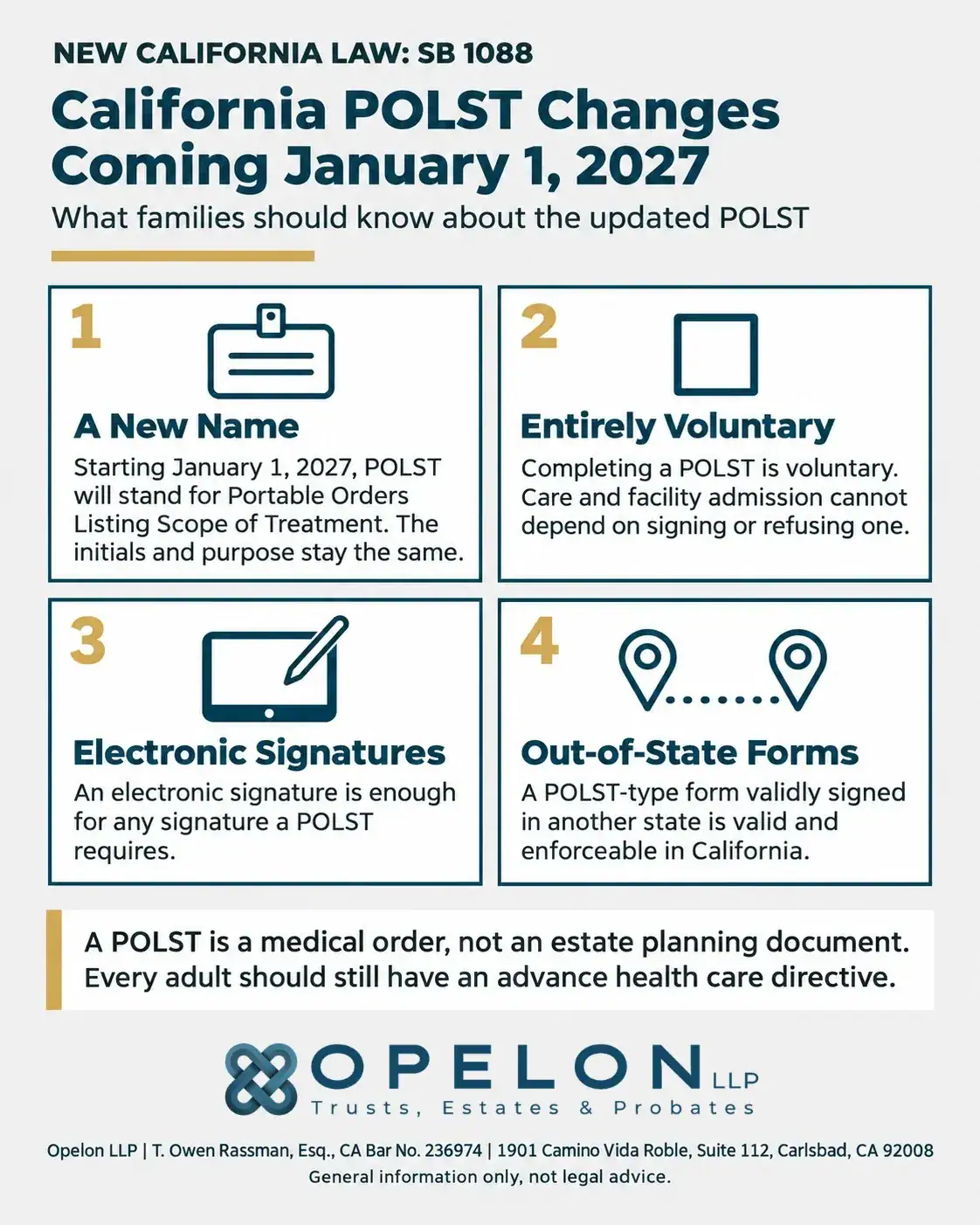
POLST now stands for Physician Orders for Life-Sustaining Treatment. On January 1, 2027, SB 1088 will change the name to Portable Orders Listing Scope of Treatment. The initials and the purpose stay the same.
Most estate planning documents speak to the future, and they speak to a decision maker. A POLST speaks to right now, and it speaks to a clinician. That is why it is a medical order rather than a document you sign on your own. Its rules sit in Cal. Prob. Code § 4780 and following, inside the Health Care Decisions Law. For the directive itself, see our guide to California living wills and advance directives.
The pink paper helps responders find the form fast. Pink is recommended, not required, and copies are generally honored. The California POLST program offers translated versions for reference, but the English version is generally the one signed.
Opelon does not complete POLST forms, and that is by design. A POLST belongs to the relationship between a patient and a treating clinician.
Who a POLST Is Actually For
A POLST is generally meant for people who are seriously ill, medically frail, or in the later stage of a progressive illness, at any age. It is not meant for healthy adults. Healthy adults in California generally need an advance health care directive instead, which is a different document with a different job. |
Whether a POLST fits right now is a judgment for the treating clinician, not a law firm. Families most often first see a POLST at one of these moments:
- A hospital discharge after a serious admission
- A hospice enrollment conversation
- A skilled nursing or residential care admission
- A new diagnosis of an advanced, progressive illness
- A primary care visit revisiting goals of care
Seeing the form is not the same as being required to complete it. Completing a POLST is voluntary. Starting in 2027, SB 1088 says so expressly and bars conditioning care or facility admission on it.
We often tell adult children they are allowed to slow down. A POLST conversation is a conversation, not an intake form. “We would like to talk with our doctor first” is a complete answer.
If you are healthy You almost certainly do not need a POLST. You do need an advance health care directive. Those are two different sentences, and they are both true. |
Who Signs a California POLST
A California POLST generally needs two signatures. One comes from the patient or their legally recognized decision maker. The other comes from a licensed physician, nurse practitioner, or physician assistant. Notarization and witnesses are generally not required, which is a key difference from an advance health care directive. |
When a patient can still decide, the patient signs. Adults are presumed to have capacity (Cal. Prob. Code § 4657). Once a patient loses capacity, the signer is usually the health care agent named in their directive. That agent’s authority generally begins when the primary physician finds capacity is gone (Cal. Prob. Code § 4682).
If no agent was ever named, the law has a fallback, but it may not be the person your parent would have chosen. A provider or facility may pick a surrogate from an unranked list of relatives and close friends (Cal. Prob. Code § 4712). Families usually learn this at the worst possible moment.
Nurse practitioners and physician assistants have been able to sign since January 1, 2016, under AB 637 (2015).
| Requirement | POLST | Advance Health Care Directive |
| Who signs besides you | A physician, nurse practitioner, or physician assistant | No clinician signature required |
| Witnesses or notary | Generally neither | Generally a notary or two qualified adult witnesses (Cal. Prob. Code § 4673) |
| Who it speaks to | Clinicians and emergency responders, right away | Your agent and physicians, usually once you lack capacity |
| Who it is for | People already seriously ill or frail | Every adult |
In our experience, the real gap is rarely the POLST. It is that nobody was ever named as health care agent. Fixing that takes one appointment, and it has to happen while there is still capacity. That step is the core of incapacity planning for San Diego County families.
What the POLST Sections Cover
This overview is here so you can follow a conversation with a clinician, not fill out the form yourself. The provider completing a POLST is expected to explain it, including how it differs from a directive (Cal. Prob. Code § 4780). The current form addresses three areas:
- Resuscitation. Whether to attempt CPR if the person has no pulse and is not breathing.
- Level of medical intervention. Full treatment, selective treatment, or comfort-focused treatment. Full treatment includes a trial-period option, so the choice need not be all or nothing.
- Artificially administered nutrition. Whether to use methods such as a feeding tube. The form treats this as a medical treatment, with benefits and burdens that depend on the person’s condition.
Which options fit a given person is a medical conversation with the treating clinician. That conversation works best when it draws on values already written into an advance health care directive. This is where the legal document becomes the input to the medical one.
POLST vs Advance Health Care Directive vs DNR
These three get used interchangeably in hospital hallways. They are not interchangeable.
POLST and Your Advance Health Care Directive
The directive is the durable legal document. It names your health care agent and records your instructions (Cal. Prob. Code §§ 4605 and 4623). The POLST turns those values into immediate orders once someone is seriously ill. A new POLST conversation is a good reason to reread the directive, not to assume it is handled.
POLST and a Prehospital DNR
A prehospital DNR form addresses resuscitation only. A POLST covers resuscitation plus a broader range of treatment. The law treats both as requests regarding resuscitative measures (Cal. Prob. Code § 4780). A directive alone generally will not direct paramedics at the front door.
What If They Disagree?
The Probate Code answers this directly. If a POLST’s orders directly conflict with a person’s written health care instructions, the more recent of the two generally controls. That rule reaches only the conflict itself (Cal. Prob. Code § 4781.4).
The rest of the directive keeps working, including the agent appointment. A conflict is a signal to talk with the treating clinician. If the directive no longer reflects the person’s wishes, update the advance directive so the two documents agree.
Changing, Revoking, and Keeping the Form Findable
A person with capacity may revoke a POLST at any time, in any way that shows intent to revoke (Cal. Prob. Code § 4780). A decision maker for someone without capacity should generally consult the treating physician before seeking a change (Cal. Prob. Code § 4781.2). A new signed form generally replaces the old one, so void old copies. Responders act on the form immediately, often without ever meeting the patient.
Where the form should live:
- Where responders look. Usually the refrigerator door or a bedside table, not a drawer or safe deposit box.
- In the doctor’s chart. Send a copy to the treating physician.
- With the patient on every move. Between home, hospital, and facility.
- Known to the agent. The agent should know where it is kept.
- Beside the directive. Keep both documents together.
The state is building a POLST eRegistry through the Emergency Medical Services Authority so providers can find a form when paper cannot be found. As of this writing it is still in development, so the paper copy matters.
Rules vary by state. From 2027, SB 1088 treats a POLST-type form validly signed in another state as valid and enforceable in California. Whether another state honors a California POLST depends on its law, so raise it with a clinician before a move.
The POLST that does the least good is the one in a fireproof box. This is the one document in the plan that belongs on the refrigerator.
What This Means for Your Estate Plan
If your family is in a POLST conversation right now, the most important document in the room is the one your clinician is preparing. It is not anything a law firm offers.
Still, a POLST is only as good as the thinking behind it. That thinking should already exist in a directive. Three gaps cause most of the trouble:
- No agent was ever named. Who signs may fall to a surrogate picked under a statutory process.
- The agent is no longer the right person. Older directives often name someone who has died, moved, or become estranged.
- The instructions are too generic. Checkbox language gives an agent little to reason from.
Opelon prepares advance health care directives as part of California estate plans from our Carlsbad office, for families across San Diego County. Estate planning is flat-fee. We do not prepare POLST forms or take part in medical decisions.
Some families without a directive still need a court-appointed conservator (Cal. Prob. Code § 1800 and following). Opelon does not file or litigate conservatorship petitions. Families who need one should work with counsel who handles that court practice.
If you are reading this in a hospital corridor, the paperwork can wait until you have talked with the doctor. If you are at your kitchen table because nobody in your family has signed anything, that is the better moment. Start with a Free Phone Consultation with our team.