


Does California Have a Living Will?
Not by that name. Since July 1, 2000, California’s Health Care Decisions Law (Cal. Prob. Code 4600 et seq.) has governed advance health care directives. What people call a living will is an “individual health care instruction.” It is usually paired with a power of attorney for health care, which names your agent. |
“Living will” was the popular name for a declaration under the state’s former Natural Death Act. The Legislature repealed that Act through AB 891 (Stats. 1999, ch. 658), effective July 1, 2000. The new law folded it and the old durable power of attorney for health care into one scheme. See Cal. Prob. Code 4665(a).
Today the law has two building blocks. The individual health care instruction, Cal. Prob. Code 4623, is your own direction about your care. The power of attorney for health care, Cal. Prob. Code 4629, names an agent to decide for you. An “advance health care directive” means either one, or both together, Cal. Prob. Code 4605.
Any adult with capacity may generally give an instruction or sign a power of attorney for health care, Cal. Prob. Code 4670 and 4671. Capacity is presumed, Cal. Prob. Code 4657. An instruction may be oral, but a written, properly signed directive is far easier for providers and family to rely on.
Signed one before July 1, 2000? As a rule, a document valid under the law at the time remains valid, Cal. Prob. Code 4665(a) and (d). It is often worth replacing anyway. Our guide to the California health care power of attorney explains how the agent role works.
What Your California Living Will Instructions Actually Cover
The instruction half of a directive records what you want. The agent half names who decides everything you did not anticipate. Most people arrive focused on the first and leave knowing the second matters just as much.
A health care instruction typically addresses:
- Life-sustaining treatment, and the circumstances in which you would want it started, continued, or stopped.
- Artificial nutrition and hydration.
- Pain relief and comfort-focused care.
- Organ and tissue donation.
- Post-death decisions you authorize your agent to make, such as autopsy and disposition of remains, Cal. Prob. Code 4683.
- Anything personal a form would never ask, such as religious observance, who you want in the room, or where you would prefer to be.
These are your choices, made with your doctors and the people close to you. The directive simply records them.
What It Does Not Do
A health care directive does not let anyone manage your money, pay bills, or sell your house. That takes a separate financial power of attorney under Cal. Prob. Code 4000 et seq., covered in our power of attorney guide. A directive also does not distribute property after death. That is the job of a will or a trust.
The law does not authorize mercy killing, assisted suicide, or euthanasia. The End of Life Option Act is a separate process under Cal. Health & Safety Code 443 et seq. That request must come from the patient, not an agent, directive, or conservator. Opelon does not administer that process.
Finally, a directive is not a medical order. On its own, it generally does not direct paramedics in an emergency.
How to Sign a California Living Will So It Holds Up
In California, a written advance health care directive generally must be dated and signed by you. It must then be either acknowledged before a notary public or signed by two qualified adult witnesses, Cal. Prob. Code 4673. Either method alone is sufficient. An electronic directive must be notarized and must also satisfy California’s digital-signature requirements, Cal. Prob. Code 4673(b). |
| What the Law Generally Requires | Where People Go Wrong |
| Dated and signed by you, or by another adult in your name, in your presence, and at your direction, Cal. Prob. Code 4673(a). | A family member signs “for” you outside your presence, or the document is left undated. |
| Either a notary or two qualified adult witnesses, Cal. Prob. Code 4673(a)(3). An electronic directive must be notarized, Cal. Prob. Code 4673(b). | Assuming a paper directive must be notarized, or signing electronically without a notary. |
| Witness limits. Your health care provider or the provider’s employee, the operator or an employee of a community care facility or residential care facility for the elderly, and your named agent may not witness. At least one witness must be unrelated to you by blood, marriage, or adoption and not entitled to any part of your estate, Cal. Prob. Code 4674. These rules do not apply to a notary, Cal. Prob. Code 4674(g). | Using two adult children as the only witnesses, or letting the facility staff who handed you the form sign. |
| Skilled nursing facility patients. A patient advocate or ombudsman must sign as a witness, either as one of two witnesses or in addition to a notary, Cal. Prob. Code 4675. | Signing at a skilled nursing facility without the ombudsman signature, which generally leaves the directive ineffective. |
Can I Write My Own?
Yes, generally. The statutory form appears at Cal. Prob. Code 4701. Using it is optional, and you may modify it or use a different form, Cal. Prob. Code 4700. The form is free, and for a simple situation it is far better than nothing.
What drafting adds is concrete: agent choices coordinated with your full plan and instructions written for your real circumstances. HIPAA authority can be handled at the same appointment, so your agent can get information.
Signing Tip A notary or two qualified witnesses. Either one is enough. If you use witnesses, read the witness restrictions in Cal. Prob. Code 4674 carefully. That is where self-prepared directives often go wrong. More on drafting and execution: California advance health care directive attorney. |
Living Will vs Advance Directive vs POLST vs DNR vs Last Will
In a hospital hallway, several different documents get called “my living will.” Only one of them names your decision-maker. This table sorts them out.
| Document | What It Does | Who Signs It | Governing Law | Do You Also Need It? |
| Advance Health Care Directive | Records your medical instructions and, if you choose, names your health care agent. This is the document that does the job of a “living will.” | You, plus a notary or two qualified witnesses. An ombudsman is also required in a skilled nursing facility, and a notary for an electronic directive. | Cal. Prob. Code 4600 et seq., 4673 to 4675 | Yes. This is the core document. |
| “Living Will” | Not a term California law uses. The closest match is an individual health care instruction. The phrase was the popular name under the repealed Natural Death Act. | Not applicable | Cal. Prob. Code 4623, 4665(a) | Covered by your directive. |
| POLST | A medical order set for people with serious illness, completed with a provider based on your preferences and medical condition. It is not an advance health care directive. | You (or your legally recognized decisionmaker) and a physician, or a nurse practitioner or physician assistant acting under a physician’s supervision. | Cal. Prob. Code 4780 et seq. | Generally only with a serious illness, and only with your clinician. |
| DNR (Prehospital) | A medical order directing emergency responders about resuscitation. | You (or your legally recognized decisionmaker) and your physician, on the EMSA form or a substantially similar form. | Cal. Prob. Code 4780 et seq. | Situational. A directive alone generally will not direct paramedics. |
| Last Will and Testament | Distributes property after death. No medical authority at all. | You, plus two witnesses present at the same time. A holographic will in your own handwriting needs no witnesses. | Cal. Prob. Code 6110, 6111 | Yes. It is a completely separate document. |
| Durable Power of Attorney (Financial) | Covers money, property, bills, and taxes. No medical authority. | You, dated, with a notary or two qualified witnesses. In practice, a notary is generally needed for real property. | Cal. Prob. Code 4000 et seq., 4121 | Yes. It is a separate document. |
POLST and DNR
A POLST and a prehospital DNR are medical orders, not estate planning documents. You complete them with a clinician. The statute says a POLST is not an advance health care directive, Cal. Prob. Code 4780. The Emergency Medical Services Authority developed the prehospital DNR form and approves the POLST form.
Your directive tells your agent and doctors what you want. A POLST or DNR is designed to guide emergency responders. The two work together, and only the directive names your agent. If a POLST and your instruction directly conflict, the more recent one controls to that extent, Cal. Prob. Code 4781.4.
Living Will vs Last Will and Testament
A living will governs your medical care while you are alive. A last will and testament governs your property after you die. Neither substitutes for the other. Most plans include both, often alongside a revocable living trust.
When It Takes Effect, and Who Decides You Cannot Speak for Yourself
In California, a health care agent’s authority generally begins only when you are determined to lack capacity, Cal. Prob. Code 4682. Unless your directive says otherwise, your primary physician makes that determination, Cal. Prob. Code 4658. A directive can instead make the agent’s authority effective immediately. |
Neither choice is right for everyone. The choice matters most for a spouse or adult child who wants to speak with doctors without waiting on a capacity determination.
Capacity is not a one-way door. Under the default rule, the agent’s authority generally ends when your physician determines you have recovered, Cal. Prob. Code 4658 and 4682. Even while an agent has authority, the law does not authorize a decision you object to, Cal. Prob. Code 4689.
In our incapacity planning work, we align this trigger with the triggers in the financial power of attorney and the trust. It is unglamorous drafting. It can spare a family delay when they need to step in.
What Happens If You Do Not Have One
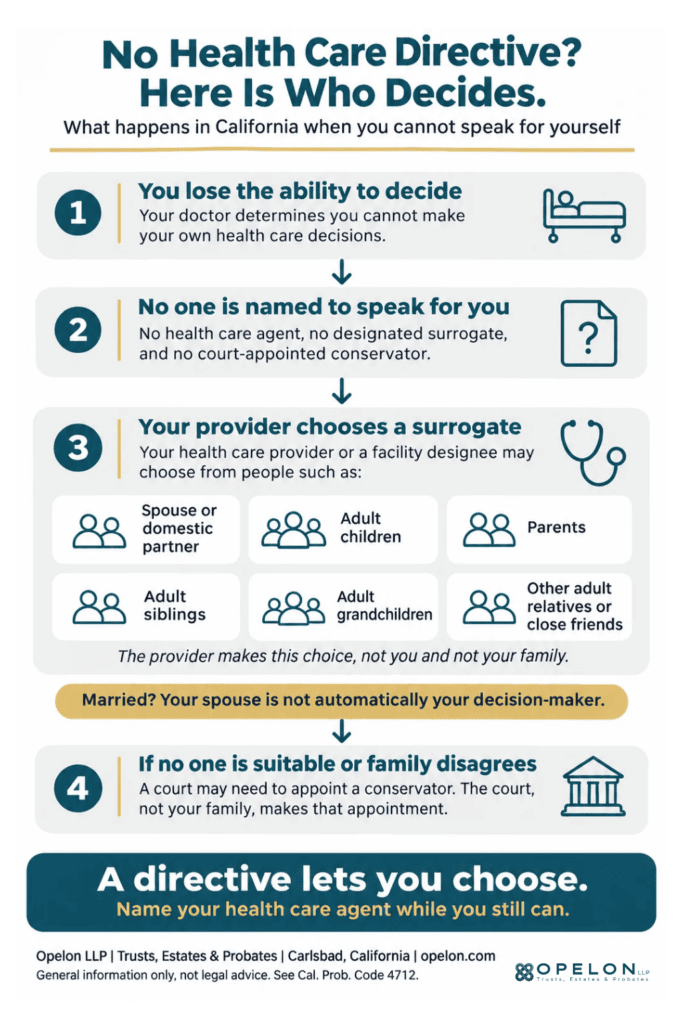
Being married does not, by itself, give your spouse legal authority over your medical decisions in California. Since January 1, 2023, if you have no agent, designated surrogate, or conservator, a provider or facility designee may choose a surrogate, Cal. Prob. Code 4712.
The candidates include a spouse or domestic partner, adult children, parents, adult siblings, adult grandchildren, and other adult relatives or close friends. The provider makes that choice, not you and not your family. A directive lets you decide.
You may also designate a surrogate by personally telling your supervising provider or a facility designee, Cal. Prob. Code 4711. That designation generally lasts only for the current treatment, illness, or stay, or 60 days, whichever is shorter. It is a stopgap, not a plan.
In some situations, a court-appointed conservator may become necessary, Cal. Prob. Code 1800 et seq. Examples include no suitable surrogate, family disagreement, or a need for broader authority over finances or living arrangements. The court, not the family, makes that appointment.
Opelon does not file or litigate conservatorship petitions. Families who already need one should work with counsel who handles that court practice.
Changing Your Mind, and Keeping the Document Findable
While you have capacity, you may revoke an agent designation only in a signed writing or by personally telling your supervising provider. Other parts may be revoked in any manner that shows your intent, Cal. Prob. Code 4695.
Two rules surprise most readers. Divorce or annulment automatically revokes a former spouse’s designation as agent, Cal. Prob. Code 4697. A later directive revokes an earlier one only to the extent they conflict, Cal. Prob. Code 4698.
The practical rule: sign a new directive that expressly revokes prior ones, then replace the copies in circulation. Old copies are what a hospital will find. Five steps keep it findable:
- Give a copy to your agent and to every alternate agent.
- Give a copy to your primary physician for your chart.
- Tell your family who your agent is, before anyone needs to know.
- Keep the original somewhere reachable in an evening, not in a safe deposit box.
- Note where it lives in your estate planning binder.
Review your directive after a marriage or divorce, a serious diagnosis, or a child turning 18. Review it, too, if an agent dies or moves, or if you move.
A directive signed in another state is generally valid here if it complied with that state’s law or with California law, Cal. Prob. Code 4676. Other states’ rules vary. If you split time between states, have the document reviewed.
The update we see most often is not to the medical instructions. It is to the agent, usually because a marriage, a death, or a move changed who will realistically show up.
When It Is Worth Having an Attorney Draft It
For a healthy adult with a simple family and clear wishes, the statutory form, correctly signed, does a real job. Drafting tends to earn its keep when:
- You have a blended family or a second marriage.
- Your agent lives far away, or your family is likely to disagree.
- A serious diagnosis is already in the picture.
- Your wishes do not fit the form’s checkboxes.
- A trust or financial power of attorney has capacity triggers that need to line up.
- You want the signing supervised, so the witness rules are not what fails.
Opelon LLP prepares advance health care directives as part of estate plans from our Carlsbad office, for families across San Diego County and throughout California. Our estate planning is offered on a flat-fee basis.
Most people put this off because it feels heavy. In practice, it is usually one conversation, a few decisions, and a signing appointment. Then it is done, and your family does not have to guess.
Ready to talk it through? Schedule a Free Phone Consultation with our team.