


Estate planning for new parents is one of the most important steps you can take to protect your child after a birth or adoption. Without a plan in place, California courts, not you, decide who raises your children and how your assets are managed on their behalf. A
Estate planning for new parents is one of the most important steps you can take after welcoming a child into your family. Without a plan, California courts decide who raises your children and how your assets are managed on their behalf. The good news is that creating a solid estate plan does not have to be complicated or expensive.
This guide covers the essential documents every new parent in California needs, from naming a guardian in your will to setting up a trust that protects your child’s inheritance. Whether you live in Carlsbad, elsewhere in San Diego County, or anywhere in California, these steps apply to your family. Opelon LLP helps new parents build
This guide covers the essential documents every new parent in California needs, from naming a guardian in your will to setting up a revocable living trust that protects your child’s inheritance. Whether you live in Carlsbad, elsewhere in San Diego County, or anywhere in California, these steps apply to your family.
Key Takeaways • California parents should name a guardian in a will because courts appoint one if you do not. • A revocable living trust lets you control when and how your child receives their inheritance. • Beneficiary designations on life insurance and retirement accounts override your will or trust. • Opelon LLP in Carlsbad, California offers flat-fee estate planning for families across San Diego County. • Review your estate plan after every major life event, including the birth of each child. |
Why Do New Parents Need an Estate Plan in California?
Estate planning for new parents in California ensures that a trusted person, not a judge, raises your children and manages their inheritance if something happens to you. Without a will or trust, California’s intestacy laws under Probate Code Sections 6400 through 6402 determine who receives your assets.
Most new parents focus on cribs, car seats, and pediatrician visits. Estate planning often gets pushed to the back of the list. But the legal consequences of having no plan are significant.
If both parents pass away without naming a guardian, the San Diego County Superior Court appoints one. The judge considers the child’s best interests, but the decision may not reflect your preferences. Family members may disagree, leading to costly and stressful guardianship proceedings.
On the financial side, any inheritance your child receives without a trust goes through probate. California probate for a $500,000 estate costs approximately $26,000 in combined statutory attorney and personal representative fees under Probate Code Section 10800. The process typically takes 12 to 24 months.
A comprehensive estate plan avoids these outcomes. It gives you control over guardianship, asset management, and medical decisions for your family.
How to Name a Guardian for Your Child in California
California Probate Code Section 1500 allows parents to nominate a guardian for their minor children in a valid will. This nomination carries significant weight with the court, though the judge retains discretion to act in the child’s best interests.
Naming a guardian is the single most important estate planning decision for new parents. The guardian is the person who will raise your child if both parents are unable to do so.
What to Consider When Choosing a Guardian
- Shared values: Does the person share your views on education, discipline, and daily routines?
- Relationship with your child: Does your child already know and trust this person?
- Location: Would your child need to change schools or leave their community?
- Financial stability: Can the guardian manage the financial resources you leave for your child?
- Willingness and ability: Has the person agreed to serve, and are they physically and emotionally able to do so?
How to Make the Nomination Legal
In California, you nominate a guardian by including the designation in your will. Probate Code Section 1500 governs this process. The nomination is not automatically binding, but courts give strong preference to a parent’s written choice.
Both parents should name the same person to avoid conflicting nominations. You should also name at least one backup guardian in case your first choice is unable or unwilling to serve when the time comes.
California Note A guardian nomination in a will only takes effect if the court approves it during a guardianship proceeding. However, the parent’s written preference is given priority under California Probate Code Section 1500. If you want the nomination to take effect immediately in an emergency, consider also executing a separate Nomination of Guardian form. |
Why Should New Parents Set Up a Revocable Living Trust?
A revocable living trust allows California parents to hold assets for their children, avoid probate, and set specific conditions for how and when those assets are distributed. Opelon LLP in Carlsbad, California helps families create trusts tailored to their goals.
A will alone does not protect your child’s inheritance from probate. When assets pass through a will, they go through the California probate process, which is public, time-consuming, and expensive.
A revocable living trust solves this problem. You transfer your assets into the trust during your lifetime. When you pass away, those assets transfer directly to your beneficiaries, or to a trustee who manages them on behalf of your minor child, without court involvement.
Key Benefits of a Trust for New Parents
- Avoid probate: Assets in a properly funded trust bypass the California probate process entirely.
- Age-based distributions: You decide when your child receives their inheritance. Many parents set milestones at ages 25, 30, and 35 rather than handing over everything at 18.
- Protection from mismanagement: A trustee manages the funds until your child reaches the age you specify.
- Privacy: Unlike probate, trust administration is a private process. The details of your estate stay out of public records.
Choosing a Trustee
The trustee is the person or institution responsible for managing your child’s inheritance. This is a separate role from the guardian. In many families, the guardian and trustee are different people.
Separating these roles creates a system of checks and balances. The guardian focuses on raising your child. The trustee focuses on financial management. Neither person has unchecked authority over both your child and your child’s money.
Essential Estate Planning Documents for New Parents in California
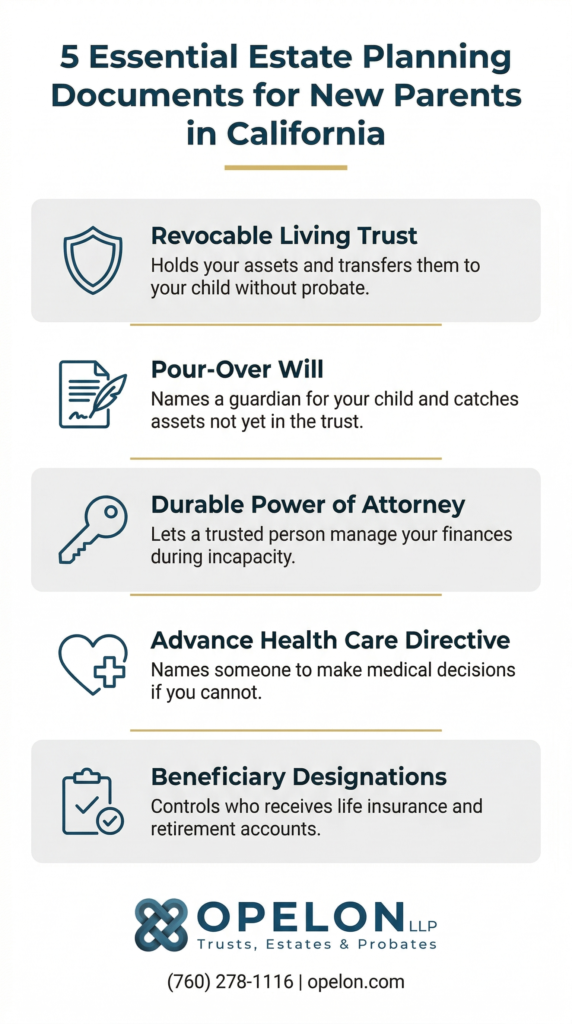
A complete estate plan for new parents in California typically includes five core documents: a revocable living trust, a pour-over will, a durable power of attorney, an advance health care directive, and updated beneficiary designations.
Document | What It Does | Why New Parents Need It |
Revocable Living Trust | Holds and manages your assets during your lifetime and transfers them to beneficiaries without probate | Protects minor children from a court-supervised inheritance process that can take 12 to 24 months in California |
Pour-Over Will | Catches any assets not yet transferred into your trust and names a guardian for minor children | The only legal document that allows you to nominate a guardian under California Probate Code Section 1500 |
Durable Power of Attorney | Gives a trusted person authority to manage your finances if you become incapacitated | Ensures bills, mortgage, and child-related expenses are paid without court intervention |
Advance Health Care Directive | Names someone to make medical decisions for you and records your treatment preferences | Prevents family disagreements about your medical care during emergencies |
Beneficiary Designations | Controls who receives life insurance, retirement accounts, and other payable-on-death assets | Overrides your will or trust if not updated, potentially sending assets to an ex-spouse instead of your child |
Why Are Beneficiary Designations Critical for New Parents?
Beneficiary designations on life insurance policies, 401(k) plans, and IRAs override the terms of your will or trust under California law. New parents must update these designations after the birth or adoption of each child to ensure assets pass to the intended recipients.
This is one of the most common estate planning mistakes. Many new parents create a will and trust but forget to update the beneficiary forms on their financial accounts.
If your life insurance policy still names an ex-spouse, for example, that person receives the payout regardless of what your will says. The same is true for retirement accounts and payable-on-death bank accounts.
After the birth of each child, review and update beneficiary designations on every account. For minor children, name your trust as the beneficiary rather than the child directly. Naming a minor child as a direct beneficiary can trigger a court-supervised guardianship of the estate, which defeats the purpose of your trust.
How Does Life Insurance Fit Into a New Parent’s Estate Plan?
Life insurance provides the financial foundation for your child’s care if you pass away prematurely. For most new parents in California, a term life insurance policy with a death benefit of 10 to 15 times annual income provides adequate coverage during the child-rearing years.
Life insurance is not technically an estate planning document, but it works hand-in-hand with your trust. The trust provides the legal structure for managing assets. The life insurance policy provides the money that funds the trust.
When you name your revocable living trust as the life insurance beneficiary, the death benefit flows directly into the trust. The trustee then manages those funds for your child according to the distribution schedule you set up.
Term Life vs. Whole Life for New Parents
Term life insurance covers a specific period, typically 20 or 30 years. It costs significantly less than whole life insurance and is usually the better fit for new parents who need maximum coverage during the years their children are dependent.
Whole life insurance includes a cash value component and lasts your entire lifetime. It costs more but can serve estate planning purposes for families with larger estates. A financial advisor can help determine which type of policy fits your situation.
What Powers of Attorney Do New Parents Need in California?
California new parents need two types of powers of attorney: a durable power of attorney for financial matters under Probate Code Sections 4000 through 4545, and an advance health care directive under Probate Code Sections 4700 through 4701. These documents ensure someone you trust can act on your behalf during incapacity.
Durable Power of Attorney for Finances
A durable power of attorney for financial matters allows your designated agent to pay bills, manage investments, file tax returns, and handle real estate transactions if you become incapacitated. The word “durable” means the authority survives your incapacity, unlike a standard power of attorney.
Without this document, your spouse or family member may need to petition the court for a conservatorship to manage your finances. That process is expensive, time-consuming, and requires ongoing court oversight.
Advance Health Care Directive
An advance health care directive combines two functions. It names a health care agent to make medical decisions for you, and it records your preferences for treatment, including end-of-life care.
California Probate Code Sections 4700 through 4701 govern advance health care directives. Your agent can consent to or refuse treatment, choose doctors, and access your medical records. This authority is critical for parents of young children because an incapacitated parent who cannot make medical decisions creates uncertainty for the entire family.
Common Estate Planning Mistakes New Parents Make in California
The most common estate planning mistakes among new parents include failing to name a guardian, not funding their trust, leaving outdated beneficiary designations in place, and assuming a will alone avoids probate in California.
- Not naming a guardian: Without a guardian nomination in your will, the court decides who raises your child.
- Creating a trust but never funding it: A trust only works if you transfer assets into it. An unfunded trust does not avoid probate.
- Forgetting beneficiary designations: Life insurance and retirement accounts pass by beneficiary designation, not by your will or trust.
- Naming a minor child as a direct beneficiary: Minors cannot legally manage inherited assets in California. This triggers a court-supervised guardianship of the estate.
- Using online templates without California-specific review: Generic templates may not comply with California Probate Code requirements, especially for trust creation under Probate Code Section 15200.
- Waiting too long to start: Estate planning is not a project you complete “someday.” The need exists the moment you become a parent.
When Should New Parents Review Their Estate Plan?
California estate planning attorneys recommend reviewing your estate plan after every major life event, including the birth or adoption of a child, a change in marital status, a significant change in assets, or a move to a new state.
Your estate plan is not a one-time project. It should evolve as your family and finances change. At a minimum, review your plan every three to five years even if nothing major has changed.
Specific events that should trigger a review include:
- Birth or adoption of an additional child
- Divorce or remarriage
- Purchase or sale of a home or business
- Significant increase or decrease in assets
- Death or incapacity of a named guardian, trustee, or agent
- A move from California to another state, or from another state to California