
Ultimate Guide to Surviving California Probate (2026 Update)

California Probate is a Court process required to manage a Decedentโ€™s estate and distribute his or her assets. Probate is statutorily driven, meaning that much of the process is governed by the statutes/laws passed by the California legislature and set forth in the California Probate Code.
California Probate Lawyer

California probate law governs the court-supervised process used to administer a deceased personโ€™s estate, including identifying assets, paying valid debts and taxes, and distributing remaining property to heirs or beneficiaries. The probate process is largely statutory, meaning the required steps, timelines, and procedures are dictated by laws enacted by the California Legislature and codified in the California Probate Code.

What is California Probate?

Probate is the court-supervised legal process used to administer a decedentโ€™s estate, including identifying assets, paying valid debts and taxes, and distributing remaining property to heirs or beneficiaries. Because probate is statutorily driven, nearly every step of the process is governed by laws enacted by the California Legislature and codified in the California Probate Code.

What happens during a California Probate?

During a probate in California:

  1. The Decedentโ€™s assets are identified and marshaled by the Executor/Administrator;
  2. The Decedentโ€™s heirs/beneficiaries are determined;
  3. The Decedentโ€™s creditors are identified and his/her debts paid;
  4. The Decedentโ€™s taxes (and the estateโ€™s taxes) are paid;
  5. The estateโ€™s assets may be liquidated.
  6. The Decedentโ€™s Executor/Administrator is paid;
  7. The Executor/Administratorโ€™s attorney is paid, and
  8. The Decedentโ€™s assets (or net liquidation proceeds) are distributed to his/her heirs/beneficiaries.

During a California probate, the court appoints an executor or administrator to identify and gather the decedentโ€™s assets, determine heirs and beneficiaries, notify creditors, and pay valid debts and taxes. If necessary, estate property may be sold to cover expenses. Once all obligations are satisfied, approved fees are paid, and the remaining assets or proceeds are distributed to the appropriate heirs or beneficiaries under California probate law.

When is Probate Required in California?

โ€‹With certain limited exceptions, a California Probate is required when:

  1. The Decedent was a California Resident.
  2. The Decedent owned property in California; and
  3. No โ€œexemptionโ€ exists to avoid probate.

Key Takeaways

  • California probate is a court-supervised legal process for administering a decedentโ€™s estate, paying valid debts and taxes, and distributing remaining assets to heirs or beneficiaries.
  • Probate is generally required when a person dies owning assets in their individual name without beneficiary designations or other probate-avoidance planning.
  • During probate, a court appoints an executor or administrator to gather assets, notify creditors, resolve claims, and oversee distributions.
  • Not every estate must go through probate, many assets transfer automatically, and later sections explain how probate can be avoided or minimized under California law.

How to avoid the California Probate Court? (California Probate Exemptions)

Certain assets are exempted from probate and are, therefore, โ€œnon-probate propertyโ€. Examples of โ€œnon-probate propertyโ€ include:

  • Assets titled to the Decedentโ€™s revocable living trust;
  • Assets held by the Decedent and another individual jointly, provided the Decedent is the first to pass away;
  • Assets held by a husband and wife as โ€œcommunity property with right of survivorshipโ€;
  • Real property (i.e., real estate) transferred by way of a โ€œrevocable transfer on death deedโ€;
  • Assets that name a โ€œpayable on deathโ€ or โ€œtransfer on deathโ€ beneficiary;
  • Manufactured homes and mobile homes, provided they are on rental land;
  • Automobiles and boats registered in California; and
  • Assets remaining that, in the aggregate, have a value of less than $208,850 (effective April 1, 2025).

For comparison, examples of โ€œprobate propertyโ€ include:

  • Real property (i.e., real estate) titled in the Decedentโ€™s name without a โ€œrevocable transfer on death deedโ€ on record;
  • Real property (i.e., real estate) titled in the Decedentโ€™s name as a โ€œtenant in commonโ€ without a โ€œrevocable transfer on death deedโ€ on record;
  • Assets in the Decedentโ€™s name alone without a โ€œpayable on deathโ€ or โ€œtransfer on deathโ€ beneficiary; and
  • Retirement accounts and life insurance policies that do not name a โ€œpayable on deathโ€ or โ€œtransfer on deathโ€ beneficiary.
  • Business assets or professional practice assets

Key Takeaways

  • Many assets pass outside of probate under California law, including trust-owned property, jointly held property with right of survivorship, and accounts with named beneficiaries.
  • Proper estate planning, especially the use of a revocable living trust, is one of the most effective ways to avoid probate altogether.
  • Beneficiary designations (POD/TOD) and transfer-on-death deeds can allow certain assets to transfer directly to loved ones without court involvement.
  • Even when some assets avoid probate, any property held solely in the decedentโ€™s name without planning may still require a probate proceeding.

What are the different types of Probate in California?

Under California probate law, there are several types of probate proceedings, commonly referred to as formal probate, summary (simplified) probate, and ancillary probate. The type of probate required, if any, is primarily determined by the nature, location, and total value of the decedentโ€™s probate property.

Formal Probate

A formal probate is the most comprehensive, time-consuming, and expensive form of probate in California. Even in relatively straightforward cases, a formal probate typically lasts 9 to 12 months or longer. The cost of a formal probate is largely based on a statutory percentage of the fair market value of the decedentโ€™s probate estate, plus court costs and other administrative expenses. Much of the information in this guide applies to formal probates. (See our guide on the cost of probate in California.)

Ancillary Probate

Ancillary probate is required when:

  1. The decedent was not a California resident at the time of death;
  2. The primary estate administration is occurring in another state or country; and
  3. The decedent owned real or tangible property located in California.
  4. Because courts outside California do not have jurisdiction over California property, an ancillary probate must be opened in California to transfer that property to the personal representative of the primary estate.

Summary (Simplified) Probate

A summary probate is a streamlined and expedited probate procedure that generally involves lower costs and fewer court formalities than a formal probate. A summary probate may be available when:

  • The total value of the decedentโ€™s probate property is less than $208,850 (effective April 1, 2025);
  • The decedentโ€™s property passes to a surviving spouse; or
  • The decedent intended to transfer assets into a revocable living trust but did not complete the transfer.

Whether court supervision is required in a summary probate depends on the specific facts of the case and the procedures used.

Key Takeaways

  • California recognizes several probate pathways, including formal probate, summary (simplified) probate, and ancillary probate, depending on the estateโ€™s size, complexity, and location of assets.
  • Formal probate is the most time-consuming and expensive option, while summary procedures may be available for smaller or qualifying estates.
  • Ancillary probate is required when a non-California resident owned property located in California.
  • Determining the correct type of probate early can significantly affect timelines, costs, and court involvement.

Simplified Procedures for Transferring Real Property Without Probate in California

California law provides two simplified procedures for transferring real property without a formal probate, depending on the type and value of the property. Effective April 1, 2025, these thresholds increased significantly, making it possible for many California families to avoid probate entirely when the estate consists primarily of a home and personal property.

Petition to Determine Succession to Real Property (Primary Residence)

A Petition to Determine Succession to Real Property under California Probate Code Sections 13150 through 13158 allows heirs or beneficiaries to transfer a decedent’s primary residence through a simplified court process. This procedure avoids the cost and complexity of a full probate proceeding.

Effective January 1, 2025, this petition is now limited exclusively to the decedent’s primary residence. However, the value threshold increased dramatically to $750,000 for decedents dying on or after April 1, 2025. For deaths occurring before April 1, 2025, the threshold was $184,500.

Requirements for the Petition to Determine Succession:

  • The real property must be the decedent’s primary residence
  • The property’s appraised gross value cannot exceed $750,000 (effective April 1, 2025)
  • An inventory and appraisal of both the real property and any personal property must be filed
  • Notice must be delivered to all persons named in the petition at least 15 days before the court hearing
  • The court must issue a final order determining succession

This procedure requires filing a petition with the Superior Court and paying a filing fee, but it is significantly faster and less expensive than a formal probate. The court’s order is conclusive once issued, meaning it provides clear title to the property.

Important Note: Beginning in 2025, you can combine this petition with a small estate affidavit for personal property. This means an estate with a primary residence worth up to $750,000 plus personal property worth up to $208,850 may avoid formal probate entirely, potentially allowing nearly $1 million in assets to transfer outside of probate.

Affidavit for Transfer of Real Property of Small Value (Non-Primary Residence)

For real property other than the decedent’s primary residence, California Probate Code Sections 13200 through 13211 provide an affidavit procedure for transferring real property of small value. This is a simpler process than the petition procedure because it does not require a court hearing.

The threshold for this procedure is $69,625 for decedents dying on or after April 1, 2025. This amount reflects the gross value of all real property in the decedent’s estate located in California (excluding the primary residence if transferred under a separate petition).

Requirements for the Real Property Affidavit:

  • The gross value of all the decedent’s real property in California cannot exceed $69,625
  • At least six months must have elapsed since the decedent’s death
  • An inventory and appraisal must be attached to the affidavit
  • The affidavit is filed with the Superior Court (filing fee is $45)
  • The court clerk issues a certified copy, which is then recorded in the county where the property is located

This procedure works well for situations involving vacant land, partial interests in property, or other real estate holdings of modest value. However, because the value limit is relatively low, it is most useful when combined with other small estate procedures.

Comparison of Real Property Transfer Procedures

ProcedureProperty TypeValue Limit (April 2025)Waiting PeriodCourt Hearing Required
Petition to Determine Succession (Prob. Code 13151)Primary residence only$750,000None specifiedYes
Real Property Affidavit (Prob. Code 13200)Any real property (excluding primary residence)$69,6256 months after deathNo
Personal Property Affidavit (Prob. Code 13100)Personal property only$208,85040 days after deathNo

COMPARE: With a properly funded revocable living trust, real property transfers directly to beneficiaries without any court involvement, waiting periods, or value limitations. This is one reason why estate planning attorneys in California often recommend living trusts for clients who own real property.

Key Takeaways

  • California law provides special simplified procedures that can allow certain real property to transfer without a formal probate.
  • A decedentโ€™s primary residence valued up to $750,000 (for deaths on or after April 1, 2025) may be transferred through a Petition to Determine Succession to Real Property.
  • Non-primary real property with a total California value of $69,625 or less may be transferred using a Real Property Affidavit without a court hearing.
  • Beginning in 2025, families may combine real property transfer procedures with a personal property affidavit (up to $208,850), potentially allowing nearly $1 million in assets to pass outside probate.
  • A properly funded revocable living trust remains the most reliable method for transferring real property without court involvement or value limitations.

How Long Does the probate process in California usually take?

In most California counties, the shortest possible timeline for completing a formal probate is approximately eight months. This estimate generally includes about two months to obtain a court hearing and appoint an executor or administrator, four months for creditors to file claims, and an additional two months to obtain court approval of the final distribution.

In practice, however, even a relatively simple probateโ€”one involving few assets, minimal debt, no disputes, and limited tax issues, usually takes 10 to 12 months, and in many counties may take longer due to heavy court calendars and limited judicial resources.

More complex probates, such as those involving numerous assets or creditors, contested issues, unknown heirs, pending litigation, or significant tax matters, can last several years.

COMPARE: With a properly funded revocable living trust, probate can often be avoided altogetherโ€”and so can many of these delays. Trust administrations are generally not subject to ongoing court supervision, and in straightforward cases, a trust administration may be completed in a matter of weeks or a few months.

Key Takeaways

A properly funded revocable living trust remains the most reliable way to transfer real property without court involvement, value limits, or waiting periods.

California law offers two simplified methods for transferring real property without a formal probate: a court petition for a primary residence and an affidavit for low-value non-primary real estate.

A primary residence valued up to $750,000 (for deaths on or after April 1, 2025) may be transferred through a Petition to Determine Succession, avoiding full probate.

Non-primary real property with a total California value of $69,625 or less may be transferred using a Real Property Affidavit without a court hearing.

Beginning in 2025, families may combine the primary residence petition with a personal property affidavit (up to $208,850), allowing nearly $1 million in assets to transfer outside probate in some cases.

How Much Does Probate Cost in California?

In addition to out-of-pocket expenses, such as court filing fees, publication costs, probate referee fees, bond premiums, and the ongoing cost of maintaining and safeguarding estate assets, a formal probate typically involves compensation to two primary parties:

Types of Probate Fees

Under California probate law, these parties may receive:

  • Statutory fees (set by law), and
  • Extraordinary fees (awarded by the court for work beyond ordinary services)

Statutory Probate Fees

Statutory fees are calculated as a percentage of the gross fair market value of the probate estate, and the same schedule applies to both the personal representative and the attorney:

  • 4% of the first $100,000
  • 3% of the next $100,000
  • 2% of the next $800,000
  • 1% of the next $9,000,000
  • 0.5% of the next $15,000,000

For estates exceeding $25,000,000, the personal representativeโ€™s fee is determined by the court.

Extraordinary Fees

For services that go beyond routine administration, such as handling litigation, complex tax matters, operating or selling a business, or managing unusual assets, the court may award extraordinary fees, which are often based on an hourly rate and must be approved by the court.

COMPARE: With a properly funded revocable living trust, probate can often be avoided altogetherโ€”and so can many of the costs described above. Trustees are commonly compensated on an hourly basis or as a modest percentage of trust assets (often around 1%), and total trustee compensation is typically lower than statutory probate fees.

Key Takeaways

  • Even the fastest formal probates in California generally take eight months or longer, and most cases last 10โ€“18 months or more.
  • Probate timelines increase significantly when estates involve disputes, complex assets, unknown heirs, or tax issues.
  • California probate law sets statutory fee schedules for both the executor/administrator and the probate attorney, based on the gross value of the probate estate.
  • In addition to statutory fees, estates may incur court costs, appraisal fees, bond premiums, and approved extraordinary fees.

Proper estate planning, particularly through a revocable living trust, can help families avoid both the lengthy timelines and substantial costs of probate.

Will my estate need to go through the California Probate Process if I have a will?

There are generally 3 types of Wills that may be admitted to probate: Witnessed Wills, holographic Wills, and statutory Wills:

Witnessed Wills: Unless the Will is a holographic Will, California law requires that a Will be (see Cal. Prob. Code ยง 6110);

  1. Signed by the Decedent (or in the Decedentโ€™s name by someone else at the Decedentโ€™s instruction, or by a conservator under Court order); and;
  2. Witnessed by at least 2 persons, each of whom a) was present at the same time, witnessed either the Decedent signing the Will or the Decedentโ€™s acknowledgment of the signature or of the Will, and b) understood that the instrument they signed was the Decedentโ€™s Will.

NOTE: Even if certain of the above requirements are not met, a proponent of a Will can establish by โ€œclear and convincing evidenceโ€ that, when the Decedent signed the Will, the Decedent intended the Will to constitute his/her Will. California Probate Code ยง 6110(c)(2).

Holographic Wills: If a Will is in the Decedentโ€™s own handwriting, only the Decedentโ€™s signature and the material provisions of distribution must be present for the Will to be valid. It need not be signed by witnesses. If these conditions are met, the Will is called a โ€œholographic Willโ€.

Statutory Wills: The California legislature has approved a form of a Will, called a โ€œstatutory Willโ€. If a Decedent signed this statutory form and had it witnessed as required in the form, the Will satisfies the California Probate Code requirements for a valid Will.

What Happens If the Will Is Lost or Destroyed?

If a photocopy of a Will is located, but the originally signed Will cannot be found, California law provides a rebuttable presumption that the Decedent destroyed his/her Will with the intent to revoke it.

Cal. Prob. Code ยง 6124 provides: โ€œIf the testatorโ€™s will was last in the testatorโ€™s possession, the testator was competent until death, and neither the will nor a duplicate original of the will can be found after the testatorโ€™s death, it is presumed that the testator destroyed the will with intent to revoke it. This presumption is a presumption affecting the burden of producing evidence.โ€

The presumption of Cal. Prob. Code ยง 6124 is rebuttable, meaning that if there is a Will contest, the proponent of the Will (i.e., the person advocating admission of the Will to probate) must introduce evidence that the Will should be validated.

Is the California Probate process private or public?

As a Court process, a probate is largely a public record. With certain exceptions, all filings during the probate are available to the public, including the Decedentโ€™s Last Will and Testament (if Decedent died testate), the Decedentโ€™s assets and financial information, names of the Executor/Administrator and his/her attorney, names of the heirs/beneficiaries, etc.

COMPARE:  With a revocable living trust, a probate can be avoided, and therefore so can the public information inherent in a probate.

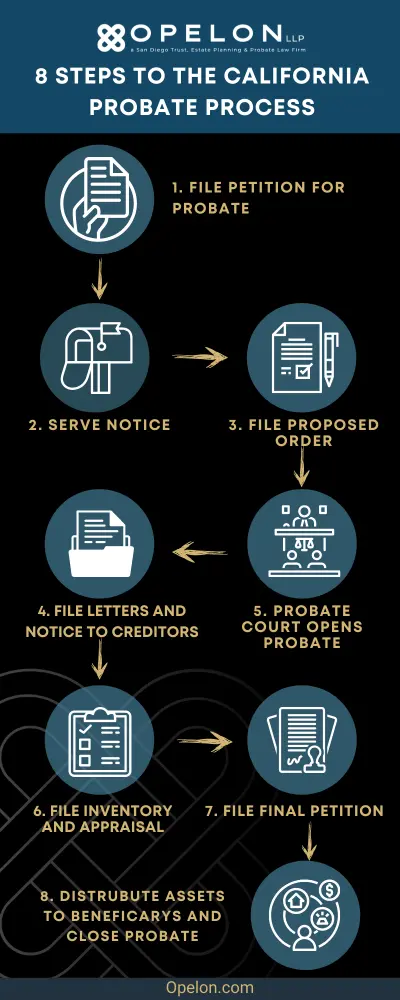
California Probate Process Chart.

California Probate Process
Ultimate Guide to Surviving California Probate (2026 Update) 3

What is the difference between Testate and Intestate?

Testate vs. Intestate

A โ€œtestateโ€ Decedent passed away having executed a valid Last Will and Testament. The Decedentโ€™s โ€œprobate propertyโ€ will be distributed to the beneficiaries named in the Last Will and Testament.

An โ€œintestateโ€ Decedent passed away without having a valid Last Will and Testament in place.  The Decedentโ€™s โ€œprobate propertyโ€ will be distributed to the Decedentโ€™s โ€œheirs at lawโ€. The California Probate Code defines the term โ€œheir at lawโ€. See Cal. Prob. Code ยง 6401 and 6402. Generally, โ€œheirs at lawโ€ are a combination of the Decedentโ€™s spouse (if any) and the Decedentโ€™s:

  • Children, if any;
  • Parents, if he/she did not have children;
  • Siblings, if he/she did not have children or parents;
  • Nieces and nephews, if he/she did not have children, parents or siblings; and
  • Etc.

What is the difference between an Executor and an Administrator?

Executor vs. Administrator

The terms โ€œexecutorโ€ and โ€œadministratorโ€ are the names given to the personal representative appointed by the Court to administer the probate.

An โ€œexecutorโ€ is appointed by the Court, nominated by the Decedent in his/her Will.

If, however, the Decedent died intestate (i.e., without a Will), or if the Decedent died testate (i.e., with a Will) but failed to nominate a person to be in charge of the probate, the person appointed by the Court is called an โ€œadministratorโ€.

Regardless of the name applied to the personal representative of the estate, the responsibilities of an executor and an administrator are largely the same.

COMPARE:  A person nominated in a revocable living trust to be in charge of trust assets upon the Decedentโ€™s death is called a โ€œtrusteeโ€.

What is the difference between Heir and Beneficiary?

Heir vs. Beneficiary

If a Decedent died testate (i.e., with a valid Will), the person(s) entitled to receive the Decedentโ€™s assets in the probate are called the Decedentโ€™s โ€œbeneficiariesโ€.

If, however, the Decedent died intestate (i.e., without a Will), the persons entitled to receive the Decedentโ€™s assets are determined by California law and called the Decedentโ€™s โ€œheirs at lawโ€See Cal. Prob. Code ยง 6401 and 6402.

Generally, โ€œheirs at lawโ€ are a combination of the Decedentโ€™s spouse (if any) and the Decedentโ€™s:

  • Children, if any;
  • Parents, if he/she did not have children;
  • Siblings, if he/she did not have children or parents;
  • Nieces and nephews, if he/she did not have children, parents, or siblings; and
  • Etc.

What are Letters Testamentary and what are Letters of Administration in the probate process?

Letters Testamentary vs. Letters of Administration

If/when a petition for probate is approved by the Court and an Executor/Administrator is appointed, the Executor/Administrator must file for and receive from the Court โ€œLettersโ€ (i.e., the document granting powers to the Executor/Administrator).

Without โ€œLettersโ€, the Executor/Administrator has no authority to act (e.g., marshal assets, pay the Decedentโ€™s debts, pay the Decedentโ€™s taxes, sell assets, buy assets, distribute assets to beneficiaries, etc.); and even with โ€œLettersโ€, many actions still require Court approval.

The exact name applied to the โ€œLettersโ€ depends on whether the Decedent died testate or intestate, and if testate, whether the person appointed by the Court was named by the Decedent in his/her Will.

  • Letters Testamentary: If the Decedent died testate and the person appointed as the personal representative by the Court was a person named as executor in the Decedentโ€™s Will, the personal representative is called the โ€œexecutorโ€ and must obtain โ€œLetters Testamentaryโ€ from the Court.
  • Letters of Administration with Will Annexed: If the Decedent died testate, but the person appointed as the personal representative by the Court was not the person named as executor in the Decedentโ€™s Will (or the Decedent failed to name his/her executor), the personal representative is called the โ€œadministratorโ€ and must obtain โ€œLetters of Administration with Will Annexedโ€.
  • Letters of Administration: If the Decedent died intestate, the personal representative appointed by the Court is called the โ€œadministratorโ€ and must obtain โ€œLetters of Administrationโ€.

What is a Probate Bond and when in the probate process is it needed?

With certain exceptions, an Executor/Administrator must be โ€œbondedโ€ before the Court will grant him/her authority to administer the probate, and the petition for probate must reference the bond. See Cal. Prob. Code ยง 8480.

A bond is like an insurance policy; it protects heirs/beneficiaries from an executor or administrator who steals from the estate, fails to safeguard assets, or negligently manages them. In these events, the heirs/beneficiaries have a fund (like an insurance policy) from which to recover.

Like an insurance policy, however, a bond requires an annual premium to be paid (from estate assets).

Exceptions to the requirement of a bond include (see Cal. Prob. Code ยง 8481):

  1. If the Decedent died testate and the Will waives bond; and/or
  2. If all heirs/beneficiaries waive the requirement for a bond.

What is the Independent Administration of Estates Act (the โ€œIAEAโ€)?

The petition for probate must address the Independent Administration of Estates Act (the โ€œIAEAโ€), and specifically whether the petitioner is requesting full authority under IAEA, limited authority under IAEA, or no authority under IAEA. See Cal. Prob. Code ยง 10400 โ€“ 10592.

  • Full Authority: Full authority under the IAEA under the California Probate Code allows the Executor/Administrator the broadest authority and allows him/her to take many actions without prior Court approval (e.g., sell or purchase real property, sell or purchase personal property, abandon property, borrow against the estate, settle or compromise a claim, etc.).

NOTE: Even though Court approval may not be required for certain actions, the Executor/Administrator may still be required to give a โ€œnotice of proposed actionโ€.

  • Limited Authority: Limited authority under IAEA strikes a middle ground between full authority and no authority (i.e., it grants to the Executor/Administrator some of the powers under full authority). For example, an Executor/Administrator cannot sell real property, borrow money by securing the loan against estate real property, etc.).
  • No Authority: No authority under the IAEA requires the Executor/Administrator to obtain prior Court approval for most actions.

A bond is like an insurance policy; it protects heirs/beneficiaries from an executor or administrator who steals from the estate, fails to safeguard assets, or negligently manages them. In these events, the heirs/beneficiaries have a fund (like an insurance policy) from which to recover.

Like an insurance policy, however, a bond requires an annual premium to be paid (from estate assets).

Exceptions to the requirement of a bond include (see Cal. Prob. Code ยง 8481):

  1. If the Decedent died testate and the Will waives bond; and/or
  2. If all heirs/beneficiaries waive the requirement for a bond.

What is a Notice of Proposed Action in a Probate (NOPA)?

If the Executor/Administrator wishes to take an action under IAEA, but the California Probate Code requires him/her to give a โ€œnotice of proposed actionโ€ (a โ€œNOPAโ€) before taking such action, the Executor/Administrator must follow the statutory process found in Cal. Prob. Code ยง 10580 โ€“ 10592.

Specifically, among other requirements, the Executor/Administrator must describe the action he/she intends to take (e.g., sell real property) with a reasonably specific description and the date on or after which the action is proposed to be taken, and deliver such notice/description to each heir/beneficiary of the estate.

The NOPA must be delivered to each heir/beneficiary no less than 15 days before the date specified in the notice.
Each heir/beneficiary may then object (in writing) to the proposed action. If, however, no heir/beneficiary objects either within such 15-day window or objects before the action is taken, the Executor/Administrator has authority to proceed with the action.

NOTE: Cal. Prob. Code ยง 10501 sets forth certain actions that may never be taken under notice of proposed action.

COMPARE: The powers of a trustee of a trust may be specified in the trust or under other provisions of the California Probate Code. In most instances, a trustee has more authority to take various actions than an executor or administrator in a probate.

What is a Probate Referee?

During the probate, the Decedentโ€™s assets must be inventoried and appraised, the results of which must be filed by the Executor/Administrator on a form called an โ€œInventory and Appraisalโ€. The values for assets such as bank accounts, retirement accounts, and life insurance policies payable on death in lump sums can be provided by the Executor/Administrator on the Inventory and Appraisal. Other assets, however, such as the Decedentโ€™s home, other real property, stocks, automobiles, timeshares, etc., must be appraised by an individual called a โ€œProbate Refereeโ€ โ€“ a person appointed by the Court to provide date-of-death fair market values.

NOTE: Here is a list of the current probate referees in San Diego.

What is Abatement in Probate?

If there are insufficient assets in the estate to pay the Decedentโ€™s expenses/creditors/taxes/etc. and to satisfy all beneficiaries identified in the Decedentโ€™s Will, the California Probate Code sets forth specific rules as to which beneficiaries see their distributions reduced first.  Under Cal. Prob. Code ยง 21402, โ€œshares of beneficiaries abate in the following order:

  1. Property not disposed of by the instrument;
  2. Residuary gifts;
  3. General gifts to persons other than the transferorโ€™s relatives;
  4. General gifts to the transferorโ€™s relatives;
  5. Specific gifts to persons other than the transferorโ€™s relatives; and
  6. Specific gifts to the transferorโ€™s relatives.โ€

NOTE: If the Decedent died testate with a Will that directs a different order of โ€œabatementโ€, the order of abatement in such Will supersedes the above-referenced default California Probate Code order of abatement.

How to file a Petition for Probate in California?

If a formal probate is required, a petition to open the probate must be filed in the appropriate California Court, which, with certain exceptions, is the Probate Court in the California county where the Decedent resided.

This petition must be filed on Form DE-111.

The person filing the petition is referred to as the โ€œPetitioner.โ€ This person is often the person seeking power to administer the estate (i.e., the proposed Executor/Administrator), but this is not always the case.

On the petition, the Petitioner must allege and address:

  1. The name, residence, and citizenship of the Decedent;
  2. The Decedentโ€™s date and place of death;
  3. The name and residence of the Petitioner;
  4. Whether the Petitioner is seeking Letters Testamentary, Letters of Administration with Will Annexed, Letters of Administration, etc.
  5. Bond;
  6. Value of Decedentโ€™s probate property/assets, including annual income therefrom;
  7. Whether the Decedent died testate or intestate;
  8. If testate, whether the Will waives the bond;
  9. Names of the Decedentโ€™s heirs and spouse, if any; and
  10. Etc.

Filing Notice of Petition for Probate in San Diego:

Notice of the filed petition, including notice of the hearing date given by the Court, must be served on various parties at least 15 days before the hearing. See Cal. Prob. Code ยง 8110. Notice must be filed on Form DE-121.

Among other parties who must receive notice are:

  • The proposed Executor/Administrator (where the petitioner is not the proposed personal representative);
  • If the Decedent died testate, all beneficiaries named in the Decedentโ€™s Will;
  • The Decedentsโ€™ heirs at law;
  • With certain exceptions, if the Decedentโ€™s spouse predeceased him/her, the predeceased spouseโ€™s heirs at law;
  • If the Decedent died testate and his/her Will involves a charitable purpose, notice may have to be served on the California Attorney General; and
  • etc.

COMPARE: There are generally fewer notice requirements in a trust administration, with California Probate Code 16061.7 being the most common required notice.

Publication of Probate Petition

Cal. Prob. Code ยง 8121 requires notice of a pending probate petition to be published โ€œin a newspaper of general circulation in the city where the Decedent resided at the time of death, or where the Decedentโ€™s property is located if the courtโ€ there has jurisdiction.

The first publication date must be at least 15 days before the hearings.

The probate code states that โ€œthree publications in a newspaper published once a week or more often, with at least five days intervening between the first and last publication dates, not counting the publication dates, are sufficient.โ€ Cal. Prob. Code ยง 8121.

If the Decedent did not reside in a city, or if there is no such newspaper in the city, or if the Decedentโ€™s property is not in a city, Section 8121 provides alternative publication requirements. The information required for the publication is in Cal. Prob. Code ยง 8100.

Hearing on Petition for Probate in California

Upon filing the petition for probate, the Court will set a hearing date for the petitioner (or his/her attorney) to appear before the Court. The timing of when the Court sets the hearing date varies from county to county.

Theoretically, the Court could set a hearing date 15 days after the petition is filed (15 days being the time required for notice under Cal. Prob. Code ยง 8110). However, most Probate Courts set hearings between 30 and 45 days from filing.

Provided the petition for probate is properly completed and formalities under the California Probate Code are satisfied (e.g., notice, publication, etc.), and provided further that no interested parties object to the petition, the Court often grants the petition and appoints an Executor/Administrator.

If the Petition is not completed properly, the Courtโ€™s โ€œProbate Examinerโ€ will flag โ€œdefectsโ€ (i.e., procedural issues) that the petitioner must resolve before the hearing. Generally, these โ€œdefectsโ€ are published on the Courtโ€™s website 2-3 weeks before the hearing date. To resolve these โ€œdefectsโ€, the petitioner can/should submit a supplement to the petition before the hearing. Some Courts have a prescribed form that can be used for this purpose.

What Are Some of the Common Objections to a Petition for Probate?

Common objections to a petition for probate include:

  • A party may claim a superior right to act as Executor/Administrator. This right could stem from priority given to such an individual in the Decedentโ€™s Will (if the Decedent died testate) or from priority under Cal. Prob. Code ยง 8461).
  • The proposed Executor/Administrator is disqualified because he/she is a minor, subject to a conservatorship, not a resident of the United States, etc. Prob. Code ยง 8402.
  • The Decedentโ€™s Will is invalid because the Decedent lacked capacity to sign the Will, the Decedent was unduly influenced to sign the Will, the signature on the Will is not the Decedentโ€™s, etc. Prob. Code ยง 8004 and 8252.
  • The Decedentโ€™s Will is invalid because it was not signed and/or witnessed by 2 individuals. Prob. Code ยง 6110.

Regarding a claim that the Will is invalid, lacking due execution or witness signatures, a proponent of the Will can overcome the presumption of invalidity upon โ€œclear and convincing evidenceโ€ that, when the Decedent signed the Will, the Decedent intended the Will to constitute his/her Will. Cal. Prob. Code ยง 6110(c)(2).

Request Probate Letters and Order During the Probate Process

Upon the petition being approved by the Court, the Executor/Administrator must then request Letters and an Order appointing the Executor/Administrator.

The Letters will be โ€œLetters Testamentaryโ€, โ€œLetters of Administration with Will Annexedโ€, or โ€œLetters of Administrationโ€, all depending on whether the Decedent died testate or intestate, and if testate whether the person appointed was named as Executor in the Decedentโ€™s Will.  Without โ€œLettersโ€ and an Order, the Executor/Administrator has no legal authority to administer the estate.

What is Marshaling Probate Assets?

Upon being appointed by the Court and obtaining Letters, one of the first tasks of the Executor/Administrator is to marshal (i.e., obtain possession of) the Decedentโ€™s assets. Cal. Prob. Code ยง 9650. To do so, the Executor/Administrator usually starts by monitoring the Decedentโ€™s mail, forwarding such mail to the Executor/Administratorโ€™s address, reviewing the Decedentโ€™s tax returns, ordering and reviewing the Decedentโ€™s credit reports, interviewing the Decedentโ€™s professional (e.g. legal and financial) advisors, etc.

Once the Decedentโ€™s assets are identified, the Executor/Administrator must then marshal such assets. Regarding tangible, personal property (e.g., artwork, jewelry, clothing, furniture, photographs, etc.), the Executor/Administrator must take personal possession of such property, and if necessary, safeguard such assets from theft, damage, and waste. With certain exceptions, regarding bank accounts, brokerage accounts, stocks, etc., the Executor/Administrator must re-title such assets in the name of the estate (one exception being retirement accounts). Real property often remains titled in the Decedentโ€™s name until the property is sold or distributed to the estateโ€™s heirs/beneficiaries.

Open an Estate bank account and apply for a Taxpayer Identification Number

Another โ€œfirst stepโ€ in the probate involves opening an estate bank account (usually a checking account to hold sufficient funds for estate expenses and a savings account for liquid funds over and above what is needed for the day-to-day management of the estate).

To open accounts for the estate, the Executor/Administrator must have a taxpayer identification number (โ€œTINโ€) assigned by the IRS to the estate. Such a TIN can be obtained online (often in a matter of minutes) by the Executor/Administrator, their attorney, or their tax return preparer (e.g., a CPA or Enrolled Agent).

Conduct an Inventory and Appraisal During a California  Probate 

During the probate, the Decedentโ€™s assets must be inventoried and appraised (unless waived by the Court), the results of which must be filed by the Executor/Administrator on a form called an โ€œInventory and Appraisalโ€. Depending on the asset, the appraisals are performed either by the Executor/Administrator or by the Probate Referee.  Specifically:

  • Assets appraised by the Executor/Administrator: Cash and cash equivalents (e.g., bank accounts, retirement accounts, and life insurance policies payable on death in lump sums) are generally appraised by the Executor/Administrator, the reason being that the values of these assets are usually easy to determine.
  • Assets appraised by the Probate Referee: Assets such as the Decedentโ€™s home, other real property, stocks, automobiles, timeshares, etc., must be appraised by the Probate Referee โ€“ a person appointed by the Court to provide date-of-death fair market values.

Whether or not the estateโ€™s assets are appraised by the Executor/Administrator or by the Probate Referee, the appraisal(s) must be filed on Form DE-160 (Inventory and Appraisal). The California Probate Code and Form DE-160 allow the Executor/Administrator to file โ€œpartialโ€ inventories, provided that a โ€œfinalโ€ inventory is filed within 4 months after letters are first issued to the Executor/Administrator.

NOTE: Depending on the appraisals made by the Executor/Administrator/Probate Referee, the bond may either need to be increased or decreased.

Creditor Claims in Probate

The California Probate Code requires the Executor/Administrator to โ€œgive notice of administration of the estate to the known or reasonably ascertainable creditors of the Decedent.โ€ Cal. Probate Code ยง 9050.  This โ€œnoticeโ€ must be given within the later of:

  1. 4 months after the date letters are first issued; and
  2. 30 days after the Executor/Administrator first knows of the creditor.

Such notice must be given because all debts of the Decedent must have been paid or adequately provided for before assets can be distributed to the heirs/beneficiaries and the estate closed. Cal. Prob. Code ยง 11640(a). If the estateโ€™s debts exceed its assets (i.e., the estate is insolvent), the California Probate Code dictates priority of payment for such debts. See Cal. Prob. Code ยง 11420.

The exact form and substance of such notice is as required in Cal. Prob. Code 9052. Providing such notice on Form DE-157 satisfies these California requirements. Prob. Code 9052 requirements.

Once served proper notice (i.e., notice that satisfies Cal. Prob. Code 9052), creditors have a limited period of time to file a โ€œcreditorโ€™s claimโ€ against the estate. Specifically, creditors must file their claim with the Court before the last to occur of:

  1. 4 months after the date Letters were issued to the Executor/Administrator, or
  2. 60 days after such notice was mailed or personally delivered to the creditor.

If the creditor fails to file a claim within this time, the creditor will, with limited exceptions, be statutorily barred from bringing a claim against the estate (i.e., the creditor no longer will be able to collect their debt against the Decedent).

How to Respond to Creditor Claims in Probate

For each creditorโ€™s claim filed with the Court, California Rules of Court ยง 7.401 requires the Executor/Administrator (whether or not acting under the Independent Administration of Estates Act (IAEA)) to:

  1. Allow or reject in whole or in part the claim in writing;
  2. Serve a copy of the allowance or rejection on the creditor and the creditorโ€™s attorney; and
  3. File a copy of the allowance or rejection with proof of service with the court.

Executors/Administrators acting with full IAEA authority may allow or reject a claim without first getting Court approval (unless the claim is a claim by the Executor/Administrator). Cal. Prob. Code ยง 10552 and 10501.

Executors/Administrators without IAEA authority must file the allowance or rejection with the Court and give notice of the allowance/rejection to the creditor. The allowance/rejection must state (see Cal. Prob. Code ยง 9250):

  1.  The name of the creditor;
  2. The total claim.
  3. The date of issuance of letters.
  4. The date of the decedentโ€™s death;
  5. The estimated value of the decedentโ€™s estate.
  6. The amount allowed or rejected by the Executor/Administrator;
  7. Whether the Executor/Administrator may act under the Independent Administration of Estates Act (Part 6 (commencing with Section 10400)); and
  8. A statement that the creditor has 90 days in which to act on a rejected claim.

NOTE: Judicial Counsel Form DE-174 satisfies the requirements of Cal. Prob. Code ยง 9250.

For allowed claims filed with the Court, the judge will then review the claim and either allow it or reject it. For rejected claims, the Court takes no further action; it is then up to the creditor to litigate the validity of the claim. A creditor of a rejected claim has 90 days to file such a lawsuit (from the date the claim was rejected) or 90 days after the claim becomes due. Cal. Prob. Code ยง 9353.

6 Possible Exceptions to the Creditor Claim Procedures for Probate in California

The strict timelines set forth above regarding giving notice to creditors and creditors filing a claim may not apply in certain situations, including:

  1. Known or Reasonably Ascertainable Creditors: A โ€œknown or reasonably ascertainableโ€ creditor who does not receive notice of the Decedentโ€™s death under Cal. Probate Code ยง 9050 is not subject to the strict timelines of other creditors, provided notice is given. The known or reasonably ascertainable creditor generally has 1 year from the Decedentโ€™s death to file a claim. Civ. Proc. Code ยง 366.2.
  2. California Department of Health Care Services (DHCS): If the Decedent received or may have received Medi-Cal, or the Decedentโ€™s surviving spouse received or may have received Medi-Cal, notice of the Decedentโ€™s death must be provided to the California Department of Health Care Services. Prob. Code ยง 215. The DHCS then has 4 months after receiving such notice to file a claim. Cal. Prob. Code ยง 9202.
  3. California Victim Compensation Board (VCB): If the Decedent has an heir or beneficiary who is or has been confined โ€œin a prison or facility under the jurisdiction of the Department of Corrections and Rehabilitation, or its Division of Juvenile Facilities, or confined in any county or city jail, road camp, industrial farm, or other local correctional facilityโ€, notice of the Decedentโ€™s death must be provided to California Victim Compensation Board. Prob. Code ยง 216. The VCB then has 4 months after receiving such notice to file a claim. Cal. Prob. Code ยง 9202.
  4. California Franchise Tax Board (FTB): Notice of the Decedentโ€™s death must be provided to the California Franchise Tax Board within 90 days of the Decedentโ€™s death. Prob. Code ยง 9202.
  5. Mortgages / Liens on Estate Property: โ€œThe holder of a mortgage or other lien on property in the Decedentโ€™s estate, including, but not limited to, a judgment lien, may commence an action to enforce the lien against the property that is subject to the lien, without first filing [a creditorโ€™s claim as provided above] if in the complaint the holder of the lien expressly waives all recourse against other property in the estate.โ€ Prob. Code ยง 9391.
  6. Federal Government: Federal law, not the California Probate Code, governs creditor claims of federal agencies (e.g., the Internal Revenue Service).

Key Takeaways

  • A formal probate begins with filing a Petition for Probate and providing proper notice to heirs, beneficiaries, and interested parties.
  • The court appoints an executor or administrator and issues Letters before the personal representative has legal authority to act.
  • One of the personal representativeโ€™s first duties is to identify, gather, and safeguard all estate assets.
  • California law requires timely notice to creditors and imposes strict deadlines for filing and responding to creditor claims.

Mistakes in notice, asset marshaling, or creditor claim handling can cause significant delays, added expense, or personal liability for the personal representative.

During a California Probate, What are the Powers of the Executor/Administrator?

The Executor/Administrator will be granted either full authority under IAEA, limited authority under IAEA, or no authority under IAEA. See Cal. Prob. Code ยง 10400 โ€“ 10592.

The power granted to the Executor/Administrator will determine whether he/she has the power to take certain actions only with Court approval, without Court approval, or without Court approval provided he/she follows the โ€œnotice of proposed actionโ€ procedure.

NOTE: Whether or not an Executor/Administrator is granted full or limited IAEA authority, a Decedentโ€™s Will may preclude various actions without Court approval.

California Estate Taxes 

All of the Decedentโ€™s debts must have been paid or adequately provided for before assets can be distributed to the heirs/beneficiaries and the estate closed. Cal. Prob. Code ยง 11640(a). Included in these debts are the Decedentโ€™s and the estateโ€™s taxes.

Among other tax returns that may have to be filed (with potentially taxes owed) by the Executor/Administrator before the estate can be terminated are:

  • The Decedentโ€™s personal income tax returns, on both a state (e.g. Form 540) and federal level (e.g. Form 1040);
  • The estateโ€™s โ€œfiduciaryโ€ income tax returns, on both a state (e.g. Form 541) and federal level (e.g. Form 1041); and
  • A federal Estate Tax Return (e.g., Form 706) is required if the Decedentโ€™s taxable estate exceeds the estate tax federal exemption for the year of the Decedentโ€™s death.

Final Stage to the Probate Process: How to Close a California Probate? 

The Final Report and Petition for Final Distribution:

Once the Decedentโ€™s debts and taxes (if any) have been paid by the Executor/Administrator, the estate may be in a condition to be closed. The Executor/Administrator will file a Final Report and Petition for Final Distribution. In this Report and Petition, the Executor/Administrator is required to:

  • Account to the Court and the heirs/beneficiaries, in which the Executor/Administrator sets forth all assets that existed at the start of the probate, all receipts and property received during the probate, all gains on sales of assets, all disbursements made and expenses incurred during the probate, all losses on sales of assets, all distributions to heirs/beneficiaries, and all assets that exist as of filing the Report and Petition.

NOTE:  If all heirs/beneficiaries waive an accounting, the Executor/Administrator may not be required to present the above-referenced accounting in the Report and Petition.

  • Confirm that proper notice was provided to known and reasonably ascertainable creditors and to the California Department of Health Care Services, California Victim Compensation Board, California Franchise Tax Board, etc.
  • Confirm that the Probate Referee was paid his/her fee and the date it was paid.
  • Indicate whether the estate is solvent or insolvent.
  • Confirm that all estate assets have been filed and appraised on the Inventory & Appraisal.
  • Report on what creditor claims have been filed and are being resolved.
  • Report what actions were taken by the Executor/Administrator under his/her IAEA.
  • Report whether income taxes, estate taxes, or property taxes are due or payable or have been paid.
  • Indicate what statutory and extraordinary fees (if any) are being requested by the Executor/Administrator and his/her attorney, and the calculation of such fees.
  • Request approval to distribute assets remaining to the heirs/beneficiaries.

When to Distribute Assets to Heirs/Beneficiaries

If/when the Court approves the Final Report and Petition for Distribution, the Executor/Administrator will have authority to distribute assets remaining in the estate to the heirs/beneficiaries.

If the Decedent died testate, the distributions made would be to the beneficiaries set forth in the Decedentโ€™s Will, under the specific amounts and/or in the proportions set forth. If the Decedent died intestate, the distributions made would be to the Decedentโ€™s heirs at law, as set forth in Cal. Probate Code ยง 6401 and 6402. Generally, โ€œheirs at lawโ€ are a combination of the Decedentโ€™s spouse (if any) and the Decedentโ€™s:

  • Children, if any;
  • Parents, if he/she did not have children;
  • Siblings, if he/she did not have children or parents;
  • Nieces and nephews, if he/she did not have children, parents, or siblings; and
  • Etc.

Upon making such distributions, the Executor/Administrator will then need to file receipts with the Court signed by the heirs/beneficiaries acknowledging their receipt of the distribution(s). Finally, the Executor/Administrator will need to file an Ex Parte Petition for Final Discharge and Order. This Petition for Discharge and Order is important because it discharges the Executor/Administrator and releases him/her from liability for subsequent acts.

Key Takeaways

  • A California probate cannot be closed until all debts, taxes, and expenses have been paid or properly provided for.
  • The executor or administrator must file a Final Report and Petition for Final Distribution and obtain court approval before distributing assets.
  • Heirs and beneficiaries typically must sign receipts acknowledging distributions before the personal representative is discharged.
  • The probate is not officially complete until the court issues an order discharging the executor or administrator from further liability.

Because errors at this stage can delay closure or create personal liability, many personal representatives choose to work with an experienced California probate attorney.

Should you use a probate attorney for the probate process?

The Probate Process is a very technical and time-consuming process. This ultimate guide to probate is intended to give you a better understanding of the process; however, it is not intended, and should not be used, as legal advice. We strongly recommend working with an experienced San Diego probate attorney to protect yourself from personal liability and ensure the process is as efficient as possible.

Keep in mind that prior estate planning with a valid revocable living trust, power of attorney, and advance health care directive will help you to avoid probate altogether.

California Probate FAQ’s

What is California probate, and when is it required?

Probate in California is a court-supervised legal process by which a decedentโ€™s assets are inventoried, debts and taxes are paid, and remaining property is distributed to heirs or beneficiaries. It is required when a person dies with or without aย will, if the decedentโ€™s estate includes assets that cannot transfer automatically (e.g., real property, bank accounts without a payable-on-death beneficiary, etc.). If the estate is small or all assets are in non-probate form, probate may be avoidable.

How long does the probate process take in California?

The length of probate in California depends on the complexity of the estate, whether there are disputes, the countyโ€™s court backlog, whether independent administration (IAEA) is used, etc. For formal probate, the process often takes 9 to 18 months or more. Summary or simplified probate can be faster.

How much does California probate cost?

Probate costs in California include statutory executor and attorney fees, court filing fees, appraisal (probate referee) fees, publication notices, and possibly extraordinary fees for additional legal work. The statutory fee schedule is tiered, for example:

4% on the first $100,000
3% on the next $100,000
2% on the next $800,000
1% on the next $9 million
0.5% on the next $15 million

Other costs, such as filing fees (โ‰ˆ $435 for the petition to open probate), newspaper notices, and appraisal fees, can add up.

How can probate be avoided in California?

Probate may be avoided or minimized via several estate planning tools:

Living trusts (revocable trusts) hold title to assets, so they pass directly to beneficiaries without court intervention.

Payable-on-death (POD) or Transfer-on-Death (TOD) designations for bank accounts, securities.

Joint tenancy or community property with right of survivorship.

Small estate affidavit procedures are available when the decedent’s estate is below $208,850 (effective April 1, 2025). Additionally, a petition to determine succession to real property can transfer a primary residence valued up to $750,000 without formal probate.

What are the different types of probate in California (formal, summary, and ancillary)?

There are a few different probate types under California law:

Formal Probate: the standard procedure used when estates are large, complex, or there is no will or disputes.

Summary Probate: for smaller estates, a less formal procedure, often faster.

Ancillary Probate: used when the decedent had real property in one county/state/country different from where they resided; ancillary probate is needed in the location where the property is located.
Each type has different procedural requirements and timelines.

What is the difference between testate and intestate probate in California?

Testate probate occurs when the decedent died with a valid will. The will names an executor, indicates how assets are to be distributed, and often who the beneficiaries are.

Intestate probate happens when someone dies without a valid will. Then Californiaโ€™s intestacy laws apply, determining which relatives inherit (spouse, children, others), and the court appoints an administrator rather than accepting the executor named (since there may be none valid).

What is the Independent Administration of Estates Act (IAEA) and how does it affect probate in California?

The Independent Administration of Estates Act (IAEA) (Calif. Probate Code ยงยง 10400โ€“10592) allows a personal representative (executor or administrator) to manage and distribute many aspects of the estate with reduced court involvement.

Under the IAEA, a Personal Representative may do tasks such as collecting assets, paying debts/taxes, distributing property, and even selling or leasing property, often without needing separate court orders for each actionโ€”provided certain statutory notice or procedural requirements are met. This can make probate faster and less costly.

What are the duties and powers of an executor or administrator in California probate?

-Filing the will (if one exists), opening probate, and obtaining Letters Testamentary or Administration.
– Locating, securing, and inventorying all the decedentโ€™s assets, having them appraised by the probate referee for non-cash assets.
– Notifying known heirs, beneficiaries, and creditors.
– Paying valid debts, final bills, taxes, and handling any pending claims.
– Under IAEA, possibly selling real or personal property, leasing, or distributing to beneficiaries.
– Keeping accurate records, accounting to beneficiaries and the court when required.
– Closing the estate: filing the final accounting, distributing assets, obtaining court approval, issuing receipts, and obtaining discharge of the personal representative.

Is California probate public or private?

California probate is public. Court filings (like the petition for probate, inventory/appraisal, notices, and final accounting) become part of the public record. Anyone can access basic probate case information (depending on local rules).

If privacy is desired, alternatives such as trusts (especially revocable living trusts), beneficiary designations, and joint ownership can help keep the disposition of certain assets out of public probate.

What happens if there is no Will in California probate?

If someone dies without a valid will (intestate), the California Probate Codeโ€™s intestacy rules apply. The court appoints an administrator according to a priority list (usually spouse/domestic partner, children, etc.). The estate is distributed to heirs as defined by statute.

Because there is no will, there is no named executor; the administrator must follow intestate succession laws, which may be less flexible than someoneโ€™s personal wishes. Additionally, intestate estates may take longer to settle, especially if potential heirs are unknown or disputes arise.

What is the process of probate in California?

California Probate Process

1. File a Petition for Probate โ€” Submit the petition (DE-111) at the Superior Court in the county where the decedent lived, along with the original will (if there is one).

2. Notify Heirs, Beneficiaries & Creditors โ€” Send formal notice to all named beneficiaries and known heirs, and publish notice in a local newspaper so unknown creditors can come forward.

3. Court Hearing & Appointment of Personal Representative โ€” The court holds a hearing to appoint an executor (if thereโ€™s a will) or administrator (if no will) to act for the estate.

4. Inventory & Appraisal of Assets โ€” The personal representative identifies all the decedentโ€™s assets, values them (often via a probate referee for real property or complex assets), and files an Inventory and Appraisal with the court.

5. Pay Debts, Taxes & Expenses โ€” Valid creditor claims are paid, funeral expenses, taxes (estate, income, etc.), court and administrative costs are settled.

6. Manage & Distribute Assets โ€” Once obligations are satisfied, the remaining assets are distributed to heirs or beneficiaries per the will, or per California intestacy law if there is no will.

7. Final Report & Closing the Estate โ€” A final accounting is prepared and submitted to the court, and once approved, the estate is closed.

Contact Us to Work with an Experienced San Diego Probate Attorney

Probate in California can be a complex, time-consuming, and emotional journey, especially during an already difficult time. From understanding when probate is required, to navigating the rules under the Independent Administration of Estates Act, to minimizing costs and delays. The decisions you make now can greatly impact how smoothly the process unfolds for your loved ones.

At Opelon LLP, we understand how overwhelming probate matters can feel. With years of experience in California trusts, estates, and probate law, our attorneys are committed to guiding you through every step. Helping you protect what matters, reduce uncertainty, and honor the wishes of those who have passed.

If youโ€™re facing probate or just want to proactively prepare, donโ€™t go it alone. Let Opelon LLP put our knowledge, clarity, and compassion to work for you. Contact us today for a complimentary consultation, where we can address your questions, outline your options, and develop a customized strategy tailored to your specific situation. Call 760-278-1116 or fill out our consultation form at Opelon.com. Letโ€™s help you move forward with confidence.

Author Bio (Short, for Blog Byline):

Written by T. Owen Rassman, Esq., Managing Partner at Opelon LLP in Carlsbad, California. Owen earned his J.D. and M.B.A. from Pepperdine University, holds an LL.M. in Taxation from the University of San Diego, and received his B.A. in English from UCLA. He has been named to the San Diego Super Lawyers list (2023, 2024, 2025) and recognized among the San Diego Business Journal’s Top 100 Leaders in Law (2023). Owen is admitted to the State Bar of California (Bar #236974).

Disclaimer (Variation):

This article is intended as a general overview of California Probate law and should not be relied upon as legal advice for any specific situation. Estate planning and Probate decisions involve complex legal and tax considerations that vary based on individual circumstances. No attorney-client relationship is formed by reading this content. Opelon LLP encourages readers to seek personalized guidance from a licensed California estate planning attorney before making changes to asset titles or beneficiary designations. To speak with our team about your estate plan, call (760) 278-1116 or request a free consultation.

Picture of T. Owen Rassman

T. Owen Rassman

Table of Contents

Related Posts

Lets Chat!